10 Workflow Automation Examples for Growth Teams
A funding announcement lands in your feed while your sales team is still working through yesterday's spreadsheet. The event itself is useful, but an alert alone doesn't create pipeline, identify a hiring opportunity, update a market view, or help an analyst make a decision. The value appears when verified funding data moves immediately through enrichment, qualification, routing, and review.
That connected path is the recurring blueprint in these workflow automation examples. Each workflow has six parts: a trigger, the data it carries, decision rules, business actions, safeguards, and a human checkpoint. NowFunded can deliver newly verified funding events through a webhook, REST API, MCP endpoint, CSV export, or dashboard, with contact enrichment available when a workflow needs verified founder or leadership details.
The best implementations aren't built around blind automation. They use software for speed, filtering, enrichment, and repetitive handoffs, then reserve judgment, compliance, and sensitive communication for people. The following examples show how that works across prospecting, recruiting, partnerships, customer expansion, and research.
Table of Contents
- 1. Real-Time Lead Qualification and Enrichment Pipeline
- 2. Automated Outbound Prospecting Campaign Generation
- 3. Competitive Intelligence and Market Monitoring Dashboard
- 4. Talent Acquisition and Executive Search Automation
- 5. Partnership and Integration Opportunity Discovery
- 6. Customer Expansion and Upsell Opportunity Routing
- 7. Media Coverage and PR Outreach Automation
- 8. Investor Intelligence and Deal Flow Monitoring
- 9. AI Agent-Powered Research and Due Diligence Automation
- 10. Startup Ecosystem Mapping and Network Effect Analysis
- Top 10 Workflow Automation Examples Comparison
- Build the Smallest Reliable Workflow First
1. Real-Time Lead Qualification and Enrichment Pipeline
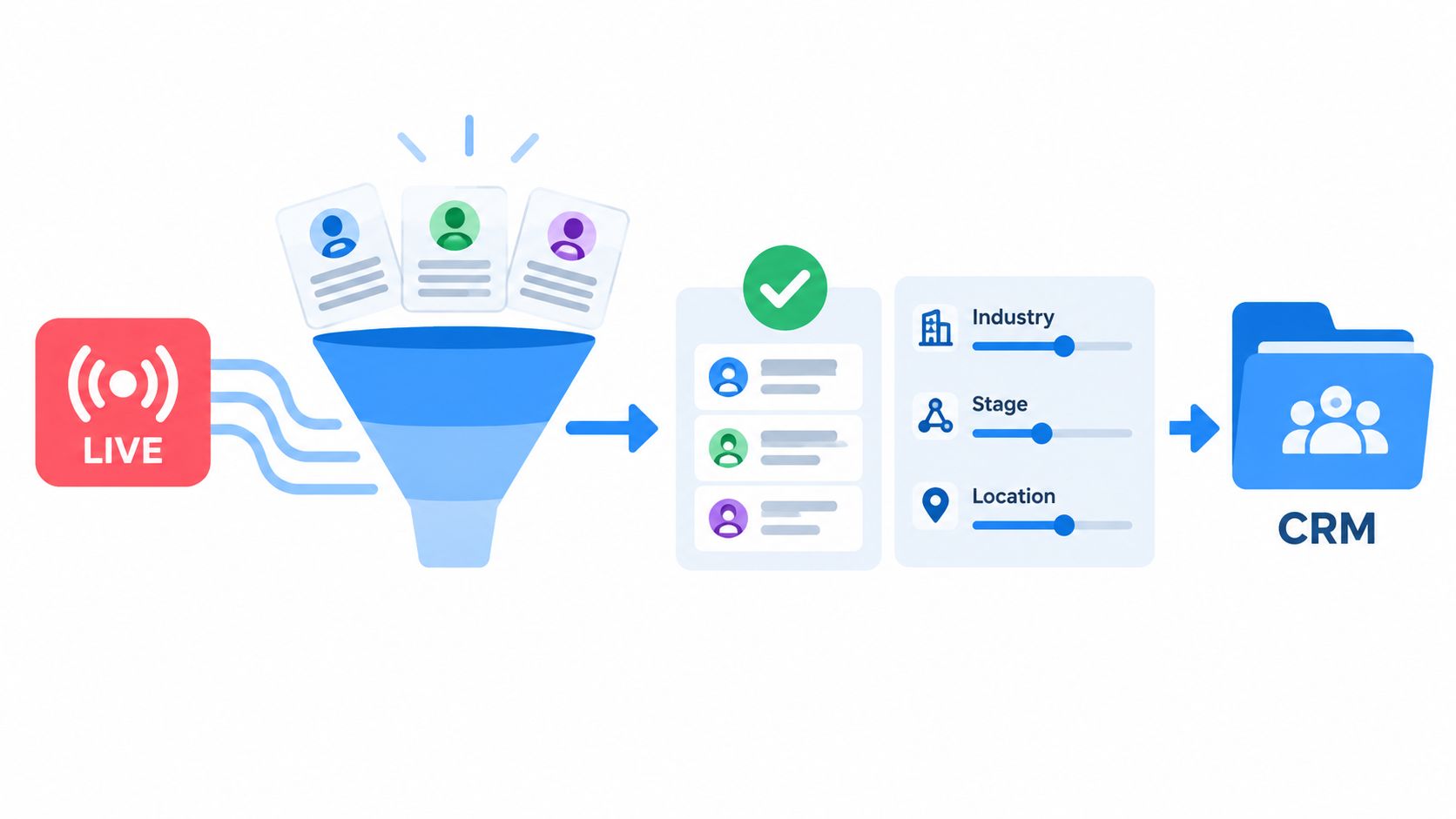
A newly verified funding event can become a sales-ready record without waiting for a researcher to copy company details into a spreadsheet. The trigger is a NowFunded webhook, sent when a funding round is confirmed. The payload carries the company, round, stage, industry, geography, website, and other structured fields. A Zapier or Make scenario then checks the record against the sales team's initial criteria.
Start broad. A sales team might accept all Series A and Series B companies, then narrow the audience by industry, location, or business model after reviewing conversion quality. The workflow should query the CRM before creating anything, using the company domain as the primary matching key and the company name as a secondary check. That prevents duplicate accounts when naming conventions differ between systems.
Decision logic and routing
The qualification branch can work like this:
- Match the ICP: Keep companies that fit the selected industry, funding stage, and geography.
- Enrich only qualified records: Pull verified founder, CEO, or relevant leadership contacts after the company passes the first filter.
- Assign ownership: Route records by territory, segment, or account executive availability.
- Create context: Map the round, lead investors, website, and contact role into CRM fields for personalized research.
- Pause exceptions: Send incomplete or ambiguous matches to RevOps instead of creating unreliable records.
A Salesforce lead can then be created within minutes of the announcement, with a task for the assigned account executive. Use webhook delivery rather than repeated polling when latency and infrastructure load matter. For longer-term targeting, the historic database of 10,000+ records from the last 12 months can support monthly trend analysis, but that analysis belongs in a separate reporting workflow.
2. Automated Outbound Prospecting Campaign Generation
Outbound automation becomes dangerous when it turns every funding event into an immediate blast. It becomes useful when verified funding data supplies timely context, enrichment confirms the recipient, and a person approves the message before launch.
The trigger is a new company that matches a campaign segment, such as a Series A startup whose description indicates a data analytics product. The workflow retrieves the round, company description, lead investor, website, and verified founder or leadership contact. It can then pass those fields to a message-generation step that drafts an email for Lemlist, Apollo, or Outreach.
The decision layer should separate research from sending. First, check whether the company already exists in the CRM, whether the recipient has an active conversation, and whether the contact is appropriate for the offer. Next, combine the funding signal with other context, such as the website technology stack or current job postings. A funding event can indicate momentum, but it doesn't prove that the company needs your product.
Personalization without overreach
A practical campaign branch includes:
- Segment by stage: Series A messaging should address early scaling needs, while Series B messaging may focus on broader operational complexity.
- Use factual context: Reference the verified round or lead investor only when that information is present in the source record.
- Require approval: Hold the first draft for a seller or recruiter to review before launch.
- Protect deliverability: Monitor bounce rates and pause the sequence if deliverability falls below the team's approved threshold.
- Stop on intent: Remove contacts from automation when they reply, book a meeting, opt out, or enter an existing sales process.
Don't let an agent invent a business problem from a funding announcement. The system should draft from known fields, label assumptions clearly, and leave the final decision to the operator.
3. Competitive Intelligence and Market Monitoring Dashboard
A funding feed becomes market intelligence when teams preserve history, normalize categories, and connect events to the questions they already ask. The trigger can be a live funding event delivered through a webhook or API, while a scheduled import brings historic records into a warehouse. From there, a transformation layer standardizes industries, locations, round stages, investor names, and company identifiers.
A product team might create cohorts such as startups that raised a Series A during a defined period, then compare funding activity across selected verticals. A business development leader can examine which investors repeatedly appear in adjacent categories. A market analyst can combine the funding dataset with CRM records to understand whether newly funded companies progress through the commercial funnel.
The dashboard should not pretend that every event is comparable. Industry tags can be broad, investor names can have spelling variations, and a company can change positioning after a round. Store the original values alongside normalized fields so an analyst can inspect how each category was assigned.
From event to executive signal
Useful dashboard actions include:
- Build cohort views: Group companies by stage, industry, geography, and event date.
- Track velocity: Define a consistent cohort window and compare event volume over time without changing the underlying rule.
- Map investor activity: Use lead investor fields to identify concentration and recurring syndicates.
- Create alerts: Notify the right owner when activity rises in a priority category.
- Keep provenance: Link every dashboard record back to the source event and ingestion timestamp.
A Looker, Tableau, or Metabase dashboard can support weekly operating reviews, but it shouldn't replace analyst judgment. The team still needs to investigate unusual spikes, category changes, and missing records before turning a visual pattern into a strategic claim. For a direct data source, teams can connect the NowFunded funding intelligence platform to their warehouse or dashboard layer.
4. Talent Acquisition and Executive Search Automation
New funding often changes a startup's recruiting context, but it doesn't identify the right candidate by itself. The workflow starts with a recruiting need, such as an engineering leadership search or a product hiring campaign. A scheduled query or webhook filter finds newly funded companies that fit the target industry, geography, and stage, then checks for open roles or other hiring signals.
The data path runs from company record to role profile to verified contact. A recruiting team can retrieve a CTO, VP of Engineering, founder, or talent leader, depending on the purpose of the outreach. If the role requires deeper mapping, the workflow can use a founder's public professional profile to identify adjacent team members, then route those names to a researcher for verification.
Matching stage to hiring context
Stage-based assumptions should guide prioritization, not dictate it. A Series A company may be building its technical foundation, while a Series B company may be expanding sales or operations. Those are useful hypotheses, but the workflow should validate them against current job postings, headcount signals, and the company's stated priorities.
The implementation can:
- Filter by hiring profile: Start with companies in the desired sector and location.
- Check role evidence: Confirm that the company has a relevant open position or a credible hiring signal.
- Enrich selectively: Pull leadership contacts only for companies that pass the role and fit checks.
- Create talent pools: Group prospects by industry or function so one search can support multiple assignments.
- Require respectful outreach: Let a recruiter approve the message and check for existing relationships before sending.
Lever or Greenhouse can receive qualified company and contact records, but candidate suitability still needs human assessment. Automation should reduce sourcing and data-entry work, not turn a funding event into an unsupported claim about someone's hiring plans.
5. Partnership and Integration Opportunity Discovery
Partnership discovery works best as a fit-scoring workflow, not a list of every startup that raised money. The trigger is a newly verified funding event or a scheduled refresh of companies in a target cohort. The workflow filters by industry, stage, geography, company size, and any available technology indicators, then compares the result with a partnership profile.
For a payment processor, the profile might include commerce companies with a product that needs transaction infrastructure. For an analytics platform, it might include fintech startups whose descriptions indicate a reporting or data challenge. A cloud provider could prioritize companies entering a growth phase where infrastructure planning is likely to become more important.
The decision path should contain both positive and negative rules. A company may fit the industry but lack the relevant technology stack. It may have a compatible product but already use a competing integration. Website crawling or another enrichment source can verify technical fit before the record reaches a partnership manager.
Build the action around evidence
The downstream record should explain why the opportunity passed. Include the funding stage, lead investor, company description, matching criteria, and the specific integration hypothesis. That gives a partner manager enough context to review the record without repeating the research.
Use historic records to refine the ideal partner cohort, then measure progression from identified company to conversation, technical evaluation, and signed partnership. Don't automate a generic “congratulations on your round” message. A partnership proposal should describe a plausible joint outcome, and a human should approve that claim before it leaves the business.
6. Customer Expansion and Upsell Opportunity Routing
A funding event becomes commercially meaningful when it belongs to an existing customer and aligns with product usage. The trigger is a new verified round. A matching service compares the company domain and normalized name with CRM accounts, then checks whether the account is active, at risk, already in expansion, or subject to a renewal process.
Once the system confirms the match, it updates the Salesforce account and creates an internal task for the account manager. The task can include the new round, lead investor, current plan, recent product usage, seat consumption, open support issues, and the reason the event may justify a conversation. Funding should be treated as a timely context signal, not proof that the customer wants to buy more.
Safeguards for account teams
The workflow can branch according to account conditions:
- Strong product fit: Route to the account manager with a prepared expansion hypothesis.
- Usage constraint: Prioritize customers approaching plan or seat limits.
- Open risk: Suppress automated outreach and send the account to Customer Success leadership.
- Duplicate event: Update the existing account record instead of opening another opportunity.
- Low confidence match: Hold the record for manual verification.
An HR technology provider might use a new customer round as a prompt to discuss scaling support. An analytics vendor might route the event to an account executive only when product usage confirms broader demand. The human checkpoint matters because a funding announcement can coincide with budget freezes, leadership changes, or an unresolved service issue. A reliable workflow surfaces the opportunity while preserving the account team's judgment.
7. Media Coverage and PR Outreach Automation
PR teams often see funding news before they have assembled the surrounding story. Automation can shorten that research cycle, but it shouldn't manufacture a narrative. The trigger is a funding event that matches a defined relationship, such as a portfolio company, customer, partner, or strategic account. The workflow retrieves the verified round details and supplements them with approved company information from the website, newsroom, and public professional profiles.
A language model can draft a briefing note with possible angles, relevant facts, and unanswered questions. It can also organize a journalist list by beat, publication, and relationship status when connected to a media database such as Cision. The draft then moves to a communications professional, who checks every factual statement and decides whether the event is newsworthy.
Keep the announcement grounded
A useful PR workflow separates confirmed facts from proposed framing:
- Confirmed data: Company, round stage, date, lead investors, location, and other verified fields.
- Context to verify: Product focus, customer relevance, hiring plans, and strategic implications.
- Proposed angle: A short explanation of why the announcement may matter to a specific audience.
- Human approval: Final review of language, claims, embargoes, and journalist fit.
- Campaign tracking: Record pitches, replies, coverage, and follow-up ownership.
A venture firm may generate a draft portfolio announcement, while a corporate communications team may prepare a partner celebration post. Neither should publish investor or performance claims that aren't supported by the source record. The workflow earns trust by making fact checking easier, not by making the copy sound more certain than the evidence allows.
8. Investor Intelligence and Deal Flow Monitoring
An investor intelligence workflow starts with a question, not a dashboard. A seed fund may want to monitor companies approaching a later round. A corporate venture team may want to understand which investors are active in a target vertical. An LP relations team may need a repeatable view of portfolio progress and peer activity.
The trigger can be a weekly data refresh, with live events added as they arrive. The ingestion layer stores company, round, investor, geography, industry, and portfolio relationships in consistent fields. Analysts can then build views around a defined cohort, such as companies in a fund's portfolio that raised during a selected reporting period.
Design for comparison and auditability
The most useful investor workflows distinguish observation from interpretation. The system can count matching events, surface recurring lead investors, and identify co-investment patterns. An analyst still needs to explain whether a pattern reflects investment thesis, geographic exposure, data coverage, or a change in reporting quality.
Practical controls include:
- Preserve snapshots: Keep the source version used for each weekly or monthly report.
- Normalize investor names: Resolve spelling and entity variations before aggregation.
- Join internal records: Compare external funding events with CRM notes and portfolio status.
- Flag missing relationships: Send uncertain portfolio matches to an analyst.
- Publish with definitions: Document exactly how each cohort and KPI was constructed.
A fund can use the NowFunded investor intelligence data as an input to recurring reports, provided the report retains source context and review ownership. The system should support investment judgment, not turn activity counts into automatic recommendations.
9. AI Agent-Powered Research and Due Diligence Automation
AI agents are most useful in research when they have a reliable starting point and a constrained job. The trigger is a newly funded startup matching a research mandate. Through NowFunded's MCP endpoint, an agent can retrieve structured funding information, then call approved tools for the company website, professional profiles, and other external context.
A practical chain uses separate responsibilities. One agent gathers company facts, another examines competitors, and a third summarizes investor patterns. An orchestration layer combines the results into a fixed report template containing funding details, investor context, company description, open questions, and source references. The report then goes to an analyst rather than directly to an investment committee or executive decision.
Make the agent prove its work
The workflow should enforce several rules:
- Ground the funding facts: Treat the structured funding record as the primary source for round details.
- Separate sourced facts from inference: Label analysis, assumptions, and unresolved questions.
- Validate key fields: Check important claims against an independent public record.
- Log every call: Preserve source responses, prompts, agent outputs, and revisions.
- Route exceptions: Send contradictory or incomplete information to a human reviewer.
An analyst might ask Claude to prepare a summary of enterprise software companies that recently raised a particular round. A corporate development team could use a GPT-based agent to rank companies against acquisition criteria. In both cases, the agent saves reading and formatting time, but it shouldn't invent a founding date, customer, market position, or growth trajectory. MCP makes the data path more direct, while governance keeps the result usable.
10. Startup Ecosystem Mapping and Network Effect Analysis
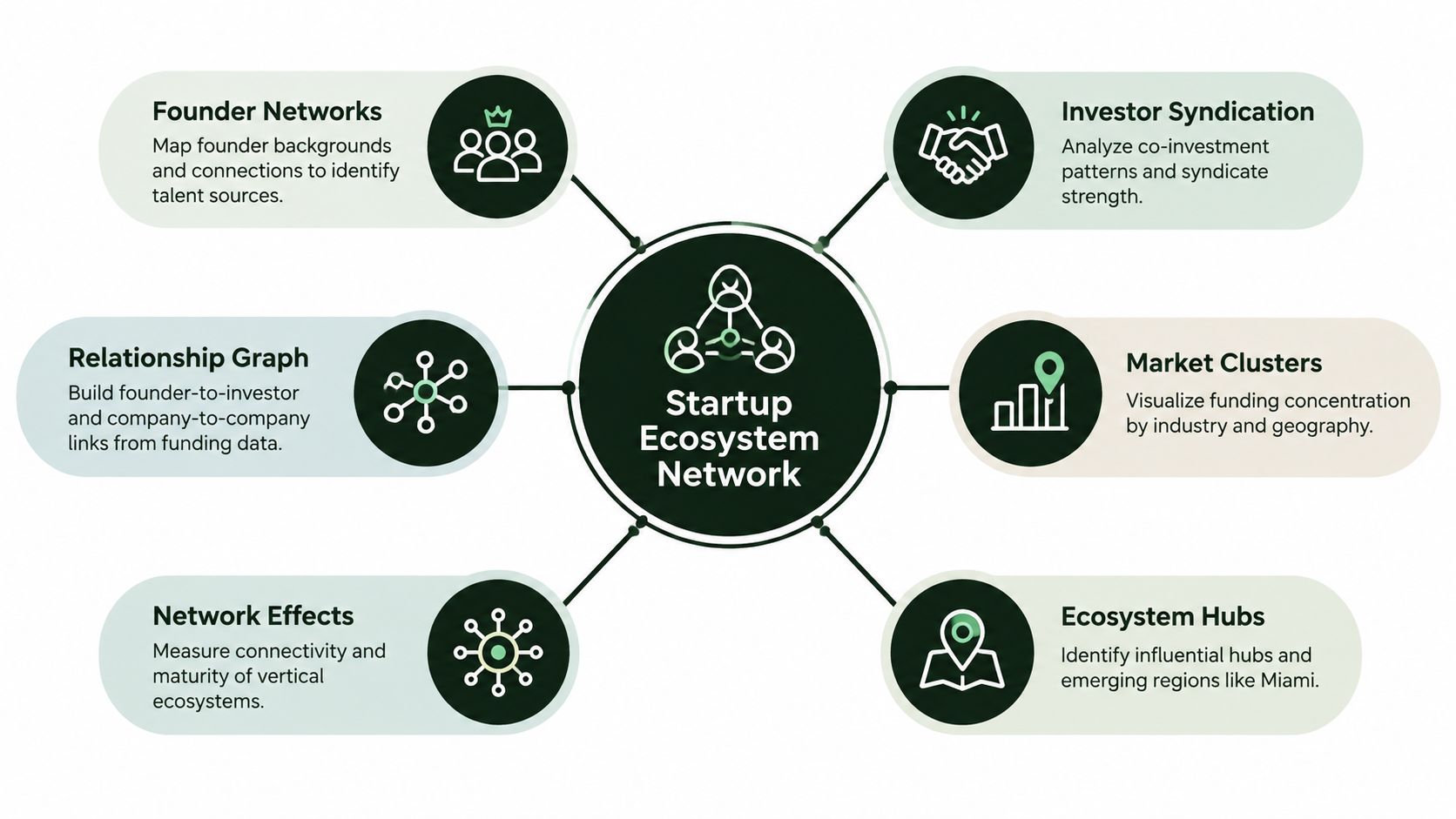
Funding records can reveal relationships that are hard to see in individual company profiles. The trigger is a new funding event or a scheduled refresh of the funding database. The workflow converts companies, founders, investors, rounds, and locations into nodes and relationships, then writes them into a graph database such as Neo4j or AWS Neptune.
From there, an analyst can examine co-investment patterns, recurring founder relationships, geographic clusters, and bridges between market segments. A venture ecosystem team might map AI infrastructure companies and identify which investors connect otherwise separate groups. A startup founder could use the graph to find potential introduction paths to investors, then ask a trusted contact for a warm connection.
The network model needs careful definitions. A shared investor doesn't necessarily mean a strong operating relationship. A founder's previous company may be relevant, but the connection should be verified before it influences outreach. LinkedIn relationship graphs can add context, but they also introduce privacy, permission, and data-quality considerations.
Turn the graph into a decision
The output should answer a specific business question:
- Market entry: Which locations and investor groups connect the target ecosystem?
- Sourcing: Which founders or investors bridge the desired subgroups?
- Partnerships: Which companies share a relevant syndicate or operating network?
- Research: Where are clusters forming, and which relationships need verification?
- Outreach: What is the most credible introduction path?
Keep the graph explainable. Store the source event behind each edge, expose confidence levels, and route suggested introductions to a person. The NowFunded ecosystem research resources can support the broader research process, but the final network interpretation belongs to an analyst who understands the market context.
Top 10 Workflow Automation Examples Comparison
Workflow Implementation complexity Resource requirements Expected outcomes Ideal use cases Key advantages Real-Time Lead Qualification and Enrichment Pipeline Medium, webhook + CRM API + filtering logic CRM integration, contact enrichment budget, qualification rule setup Verified, qualified leads pushed to CRM within minutes of funding SDR/RevOps teams at B2B SaaS, recruiters prioritizing outreach Fast time-to-lead, verified contacts, automated qualification, reduced manual research Automated Outbound Prospecting Campaign Generation Medium–High, campaign orchestration and personalization at scale Outreach platform (Lemlist/Apollo), contact costs, copy templates, deliverability monitoring Personalized multi-channel campaigns launched automatically; higher response rates High-volume outbound sales, growth teams, recruiters Personalization at scale, rapid time-to-first-touch, reduced list building effort Competitive Intelligence and Market Monitoring Dashboard High, ETL, warehousing, BI dashboards Data engineering, historic data ingestion, dashboard maintenance, analysts Ongoing market trend and competitor visibility; sector and geographic insights Product strategy, market research, corporate development teams Trend detection, benchmarking, earlier competitor identification Talent Acquisition and Executive Search Automation Medium, ATS integration and role-matching logic ATS/CRM integration, verified contact spend, recruiter workflow setup Candidate pipelines from newly funded startups; passive candidate outreach Technical recruiting firms, venture studios, enterprise TA teams Early access to talent, lower sourcing cost vs. premium tools, verified contacts Partnership and Integration Opportunity Discovery Medium, filtering, fit-matching, BD workflow triggers Real-time filters, product-fit criteria, BD tooling Pipeline of partnership-fit startups; prioritized outreach opportunities BD/partnership teams at API-first SaaS, fintech, platform vendors Data-driven fit discovery, scaled partner pipeline, timing advantage Customer Expansion and Upsell Opportunity Routing Medium, customer matching, routing rules, CRM automation Clean CRM mapping, webhook integration, playbooks for AMs Timely upsell/opportunity creation with estimated value routed to owners Customer success, account expansion teams in SaaS Proactive expansion triggers, quantified opportunity estimates, faster outreach Media Coverage and PR Outreach Automation Low–Medium, detection + PR template automation Media contact DB (Cision/etc.), PR templates, human review Automated PR briefs and outreach lists; faster pitching of funding stories VC comms, PR agencies, corporate communications Faster pitch timing, data-driven story angles, scalable briefing generation Investor Intelligence and Deal Flow Monitoring High, continuous analytics and benchmarking models Data science, historic database, dashboards, model maintenance Investor activity tracking, co-investment patterns, benchmarking reports VC funds, corporate venture, LP relations teams Deal flow visibility, benchmarking, identification of syndicates AI Agent-Powered Research and Due Diligence Automation High, MCP/agent integration, prompt engineering, validation LLM/agent infra, external data APIs, developer and prompt engineering expertise, human review Rapid, structured due diligence reports with source attributions Investment analysts, corp dev teams, research-heavy orgs Speed of research, grounded outputs reduce hallucination, scalable consistent reports Startup Ecosystem Mapping and Network Effect Analysis High, graph building, network analysis, visualization Graph DBs (Neo4j/etc.), data science, historic records, visualization tooling Ecosystem maps, influencer/hub identification, network-effect insights VC analysts, ecosystem builders, regional economic teams Identify hubs and connectors, measure network effects, inform strategic introductionsBuild the Smallest Reliable Workflow First
The strongest workflow automation examples don't begin with a large orchestration project. They begin with one valuable trigger, one narrow audience, one destination, and one review point. For a growth team, that might be a newly verified funding event that matches a specific sales segment. For a research team, it might be a funding record that enters a controlled agent workflow and produces a reviewable brief.
Choose the delivery method according to the job. Use a webhook when the team needs a push-based event as soon as a round is verified. Use the REST API when an application needs controlled, on-demand queries. Use MCP when an AI agent needs structured access within a research or orchestration environment. Use CSV for a deliberate batch handoff, backfill, or analyst-led review. A dashboard is useful when operators need to inspect and filter records without building an integration first.
Keep enrichment conditional. Pull verified contacts only after a company passes the initial fit rules, and don't send a contact into outreach until the workflow has checked for duplicates, suppression status, existing conversations, and role relevance. Contact data should carry an explicit verification state, while company matching should use domain and normalized name logic rather than name alone.
Measure the process before expanding it. Track cycle time, lead time, manual step count, SLA response time, throughput, process cost, error rate, rework rate, and data quality, as recommended in workflow automation measurement guidance. Capture a baseline, allow the workflow to stabilize for 60 to 90 days, and compare the same indicators on the same volume basis. That avoids mistaking a change in workload or data quality for an automation result.
Use a short operating checklist:
- Matching: Define the company identifier and the duplicate-handling rule before creating records.
- Verification: Keep source fields, verification status, timestamps, and unresolved exceptions visible.
- Deliverability: Suppress bounced, opted-out, or already-engaged contacts before any campaign action.
- Auditability: Log triggers, transformations, decisions, API responses, approvals, and failures.
- Cost control: Enrich only qualified records, select push delivery where polling adds no value, and monitor agent or API usage.
- Human review: Require approval for consequential outreach, public claims, investment recommendations, hiring decisions, and sensitive account actions.
- Measurement: Compare the baseline with the stabilized workflow, then refine rules instead of adding complexity by default.
The market evidence supports a selective approach. More than 66% of organizations have automated at least one process, while only about 4% report fully automated workflows, according to workflow automation adoption data. That gap reflects the practical reality: teams automate valuable slices first, then connect them carefully. Enterprise automation analysis has also reported a 248% three-year ROI for organizations deploying workflow automation platforms, while employees using automation save an average of 3.6 hours per week on manual tasks, as summarized in workflow automation statistics. Those figures are useful context, not a reason to automate every decision.
A good first workflow is observable, reversible, and modest in scope. Let software capture the event, move structured data, apply transparent rules, and prepare the next action. Let a human confirm the parts where context, risk, or judgment matter. That combination is more durable than an impressive demo that can't explain why it made a decision.
NowFunded provides a live, verified feed of newly funded startups, with structured delivery through webhooks, REST API, MCP, CSV, and a dashboard, plus verified founder and leadership contact enrichment. Use NowFunded to turn fresh funding events into reviewable prospecting, recruiting, partnership, expansion, and research workflows.