What Is Unicorn Startup

A unicorn startup is a privately held, venture-backed company with a post-money valuation of at least US$1 billion. The term was coined in 2013 by venture capitalist Aileen Lee to highlight how statistically rare that outcome was.
The label once described an almost mythical result. Lee's original analysis identified just 39 U.S.-based software unicorns, later summarized as roughly 0.07% of venture-backed startups reaching that threshold in the history of the unicorn concept). By 2026, however, unicorns had become a substantial private-market cohort rather than an occasional anomaly.
That shift creates a more useful question than “what is unicorn startup?” The threshold is simple. The interpretation isn't. A unicorn valuation can give founders fundraising power and investors a valuable market signal, but it doesn't prove profitability, durable revenue, product maturity, or a clear path to exit.
The practical task is to understand how the label is created, what it measures, where new unicorns are emerging, and what the designation should change in a founder's or investor's decision-making.
Table of Contents
- Why the Unicorn Label Still Matters in 2026
- The Technical Definition Behind Unicorn Status
- How Startups Reach Billion-Dollar Valuation
- Where Unicorns Are Emerging in 2026
- What Unicorn Status Means for Founders
- What Unicorn Status Means for Investors
- Looking Beyond the Label
Why the Unicorn Label Still Matters in 2026
By the end of Q1 2026, a market summary counted 1,680 companies with a combined post-money valuation of $8.6 trillion. That scale changes how founders and investors should read the word “unicorn.” It now describes a concentrated private-market segment, not a handful of isolated anomalies.
Hurun's Global Unicorn Index 2025 counted 1,523 unicorns worldwide across 52 countries and 307 cities, compared with 1,453 unicorns across 53 countries and 291 cities in its 2024 index, according to Hurun's index data. The same index reported earlier provides the context: the category has expanded across markets, sectors, and company types.
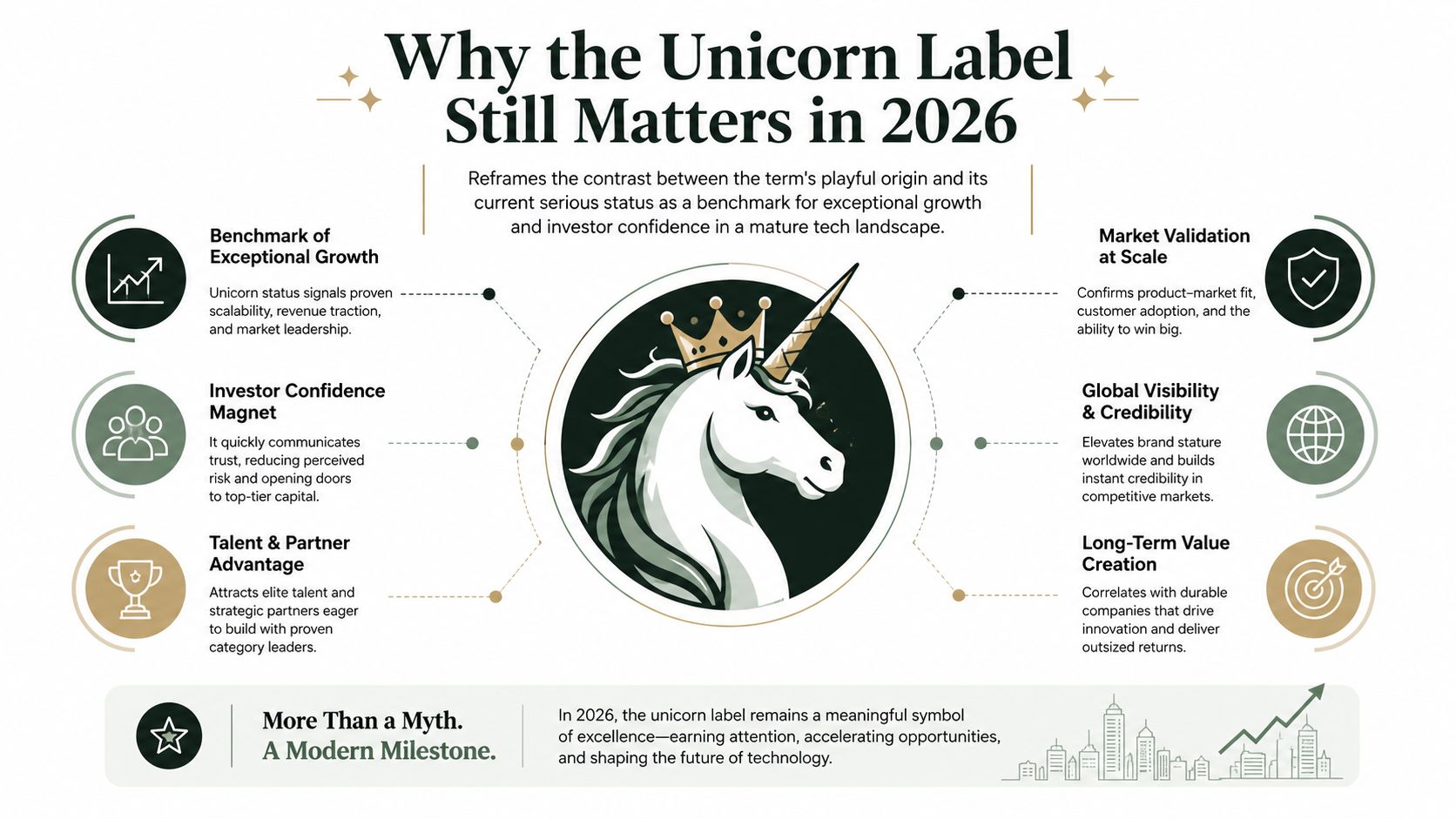
The label still has practical uses. Investors can track where capital is concentrating. Founders can compare fundraising outcomes with companies competing for similar talent and funding. Operators can recognize a shorthand for businesses receiving unusual access to capital, senior hires, partnerships, and strategic attention.
The larger cohort also makes the label less self-explanatory. A billion-dollar valuation can reflect strong operating performance, a scarce technical asset, fierce investor competition, or enthusiasm for a fast-moving category. It records the price and terms implied by a financing event. It does not establish profitability, durable revenue, product maturity, or a credible exit path.
That distinction matters even more as frontier-AI companies account for a growing share of attention and capital. Their valuations may reflect technical capability, scarce talent, and expected future demand alongside current business results. The label therefore offers a signal about market conviction, while revealing little about how much execution risk remains.
Practical rule: Treat unicorn status as the start of diligence, not the conclusion.
Founders should identify the financing conditions that produced the valuation and the obligations the next round may impose. Investors should verify the valuation event, then test revenue quality, margins, retention, capital needs, and exit prospects. A milestone can open doors, but only the underlying business determines whether the valuation holds.
The Technical Definition Behind Unicorn Status
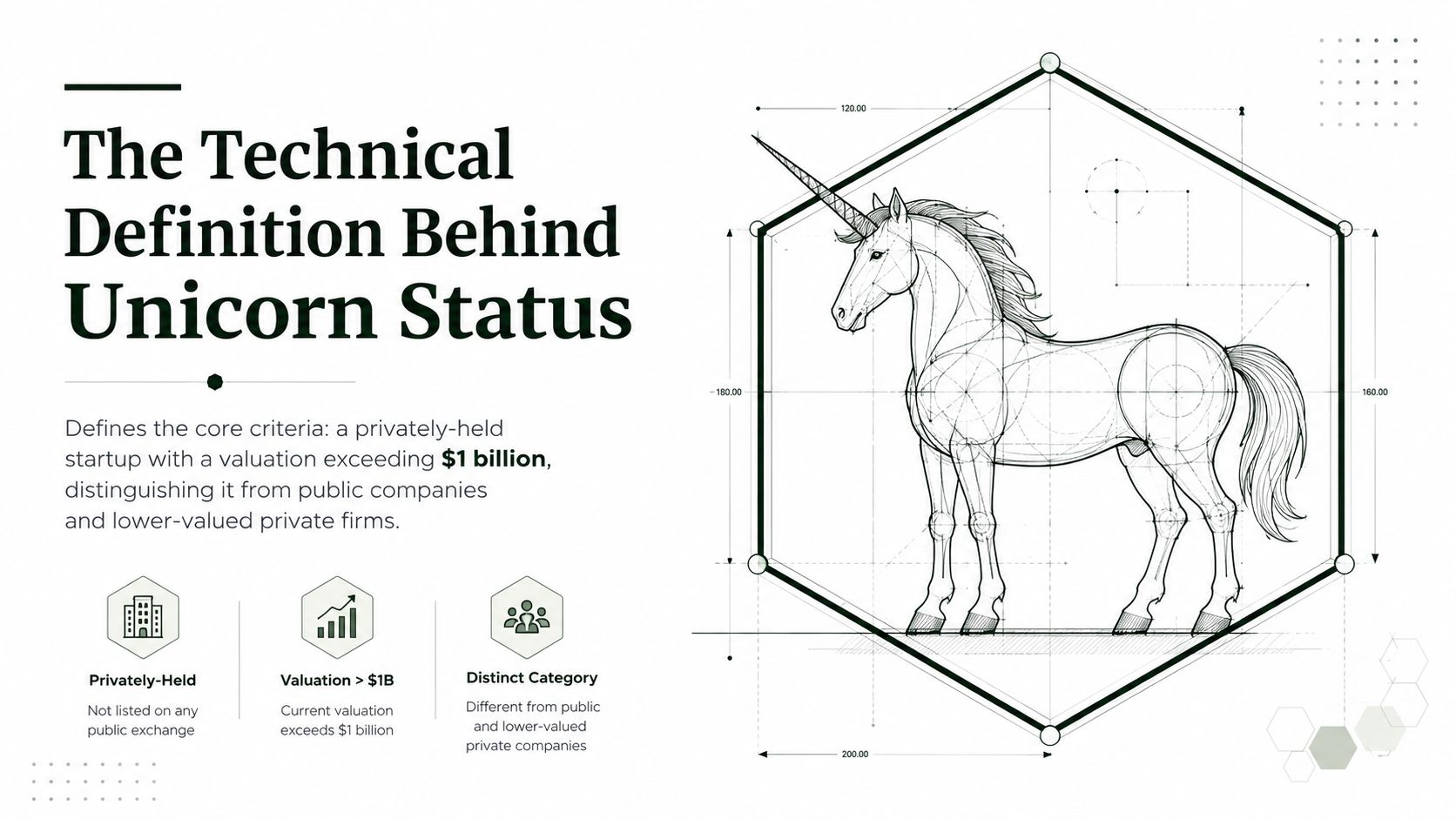
The operational definition is narrower than “a successful startup.” A unicorn is generally a private company valued at or above US$1 billion, but major venture databases apply additional rules around financing, ownership, and status changes.
PitchBook's explanation of unicorn startups defines a unicorn as a venture-backed company that has raised a financing round at a post-money valuation of at least $1 billion. Under that framework, a company can leave the unicorn set if it goes public, is acquired, falls below the threshold in a down round, or fails. CB Insights uses a simpler formulation, defining a unicorn as a private company valued above $1 billion.
Why post-money valuation matters
Post-money valuation is the company's implied value immediately after a financing round. Investors purchase newly issued shares, and the price and ownership terms imply a value for the entire company. If that implied private valuation reaches the threshold, the company may enter the unicorn category.
This is an event-based measure, not an operating milestone. It isn't equivalent to reaching a certain revenue level, achieving profitability, or proving product-market fit. A company may become a unicorn while still pre-profit if investors accept the financing price and the round meets the relevant database criteria.
That distinction creates several common misunderstandings:
- Revenue is not the trigger: A company doesn't become a unicorn because it reaches a specific sales figure.
- Profitability isn't required: The label can apply while the company is spending heavily to expand.
- Public status changes the category: A successful initial public offering generally moves the company out of the private unicorn cohort.
- Valuation can be revised: A later down round or business failure can reverse the designation in stricter trackers.
What analysts should verify
A company's website, employee count, or media profile isn't enough to confirm unicorn status. The stronger evidence is a priced financing event, the stated or implied post-money valuation, the company's private status, and the source's treatment of later rounds or exits.
Different trackers may therefore show different lists without one necessarily being careless. They may use different definitions of venture backing, different treatment of secondary transactions, or different rules for markdowns and exits. For market intelligence work, the key record is the financing event and its implied valuation, not the company's reputation.
How Startups Reach Billion-Dollar Valuation
There is no universal unicorn roadmap. The familiar progression from pre-seed to seed, Series A, and later rounds describes financing stages, not a guarantee of scale. At each round, investors reprice the company against product progress, customer demand, market size, competitive position, and execution.
At the earliest stage, founders sell a credible problem thesis and the team's ability to address it. By Series A, investors expect a more developed product and evidence of customer adoption. Later rounds focus on repeatable distribution, expanding demand, organizational scale, and the possibility of building a very large business.
The financing mechanics
A practical path usually involves five decisions:
Build a fundable wedge. Start with a narrow customer problem that produces learning quickly. A broad market story without a sharp initial use case rarely gives investors enough evidence to price long-term potential.
Turn usage into proof. Early customers, repeat usage, paid contracts, or strong engagement help distinguish a functioning product from an attractive concept. The relevant evidence depends on the business model.
Raise against the next milestone. Capital should have a defined purpose, such as expanding distribution, completing a technical platform, or entering a regulated market. Raising only to extend runway can leave the next valuation unsupported.
Create a credible scale story. Investors need a reason to believe the company can support a billion-dollar outcome. That case may rely on a large enterprise market, a defensible technical advantage, network effects, proprietary data, or a distribution system competitors cannot easily reproduce.
Manage the cap table. A high valuation with difficult terms can reduce future flexibility. Liquidation preferences, ownership dilution, secondary sales, and investor rights matter alongside the headline price.
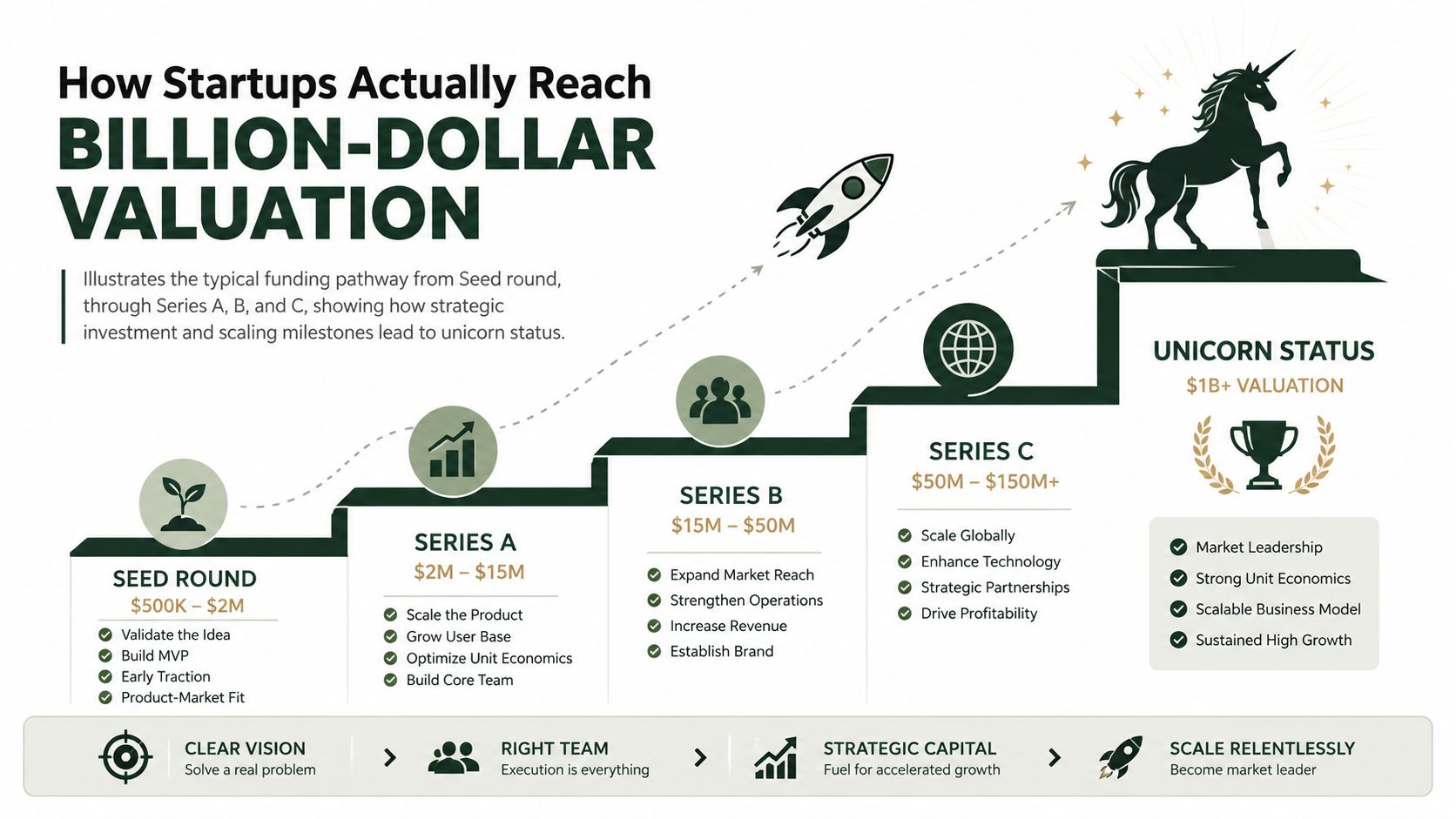
Some companies progress through several rounds as operating results improve. Others receive a sharp valuation increase because investors compete for access to scarce frontier-technical talent or a strategically important platform. That route can create speed, but it also widens the gap between the financing price and the proof the business has accumulated, a pattern reflected in the same Hurun reporting cited earlier.
Founders should maintain a financing record, a clear use-of-funds plan, and a valuation narrative tied to measurable business evidence. A structured startup funding intelligence resource can help teams study financing patterns, but no database replaces customer conversations or cap-table diligence.
A valuation is useful only when the company can explain what changed between the last round and the next one.
Where Unicorns Are Emerging in 2026
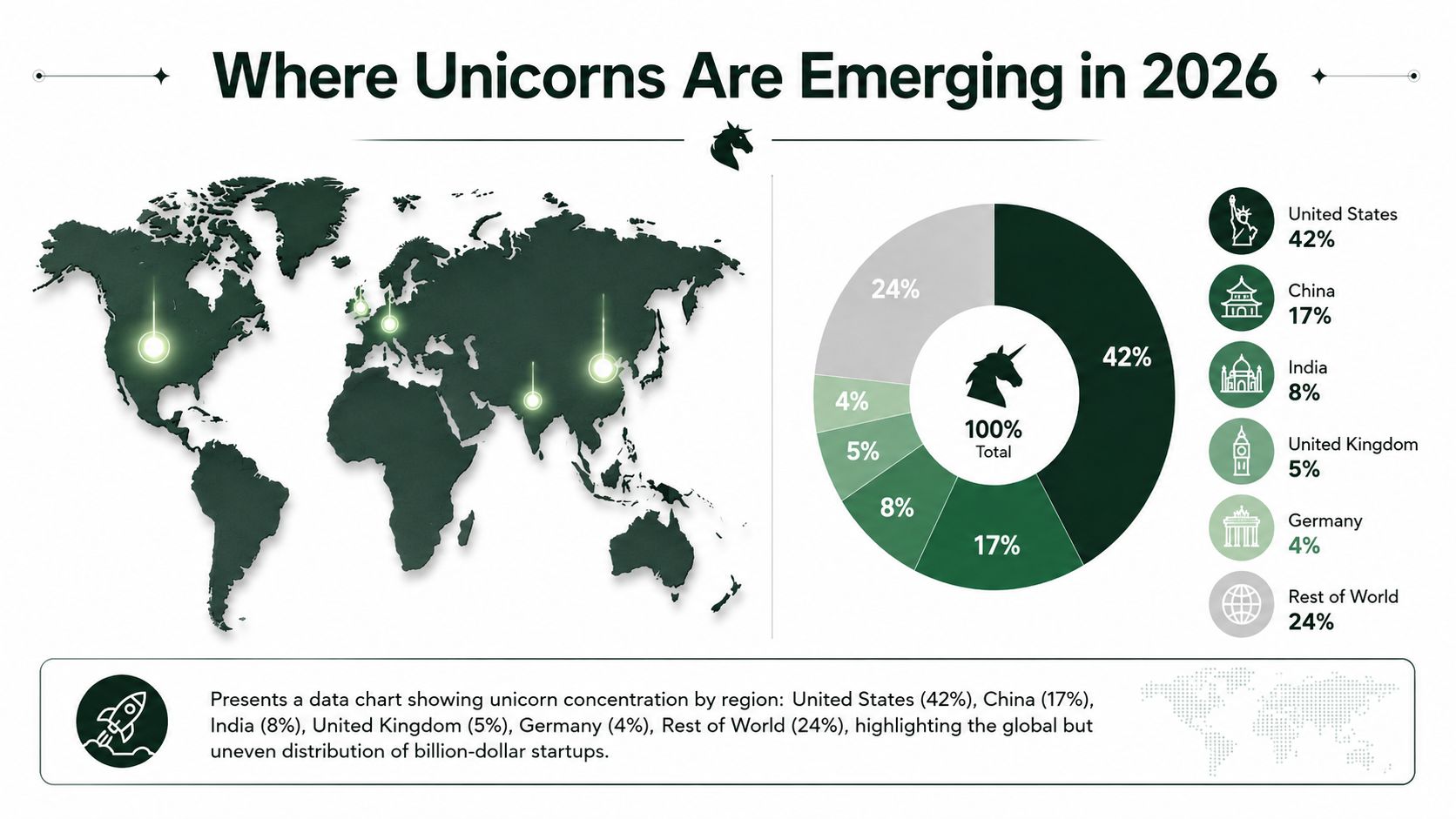
The geography of unicorns remains global, but creation is uneven. Hurun's 2025 index identified unicorns across 52 countries and 307 cities, showing broad international participation while also confirming that billion-dollar private companies cluster in particular ecosystems in its Global Unicorn Index reporting.
The more important change is sector concentration. Recent 2026 reporting describes AI and robotics as dominant sources of new unicorn creation, with some startups reportedly reaching the threshold in 18 to 24 months in the 2026 unicorn trend analysis. The same source says AI firms represented 60% of new Q1 2026 unicorns in one market snapshot. It also reports that ten companies crossed the threshold in a single June, with AI and semiconductors prominent, while aggregate value added across multiple months exceeded $500 billion.
AI versus ordinary venture categories
Frontier AI and robotics can attract valuation step-changes because investors are pricing technical scarcity, strategic importance, and the possibility of rapid market formation. That doesn't mean every AI company deserves a premium, nor does it mean ordinary software businesses have lost their path to scale.
For SaaS, consumer, fintech, and regional companies, the route often depends more heavily on repeatable distribution, customer retention, pricing power, and operational efficiency. Those businesses may need more time to demonstrate that growth is durable, especially when their markets are crowded and their technology is easier to reproduce.
The difference matters for founders. A company outside the most heavily funded categories shouldn't copy the fundraising tempo or valuation expectations of a frontier-AI startup. It should build a financing case around the evidence its business can produce.
The difference matters for investors, too. Concentration can make the unicorn cohort useful for tracking conviction, but less useful as a neutral sample of startup quality. A surge in one category may reflect genuine technological progress, aggressive capital competition, or both. Investors should inspect the round structure and operating proof before treating fast time-to-unicorn as evidence of lower business risk.
What Unicorn Status Means for Founders
For founders, unicorn status changes the company's strategic environment more than the business itself. A billion-dollar private valuation can make later fundraising easier, strengthen recruiting conversations, and add credibility with enterprise customers and partners. It can also help a team compete with better-funded incumbents for scarce technical and commercial talent.
The label does not remove execution risk. It raises the cost of poor execution because employees, investors, and prospective customers expect the company to justify a much larger implied value. Accepting a high valuation also creates a more demanding benchmark for the next financing round.
As noted earlier, the unicorn cohort has expanded substantially. The label still provides meaningful visibility, but it no longer guarantees distinctiveness on its own. For founders, that shift matters. A valuation milestone may attract attention, yet operating proof determines whether the attention converts into durable financing and customer confidence.
Benefits and liabilities
Founder benefit Corresponding trade-off Stronger fundraising signal A higher bar for the next round Greater recruiting visibility Pressure to hire and scale quickly A stronger negotiating position More complex investor expectations Competitive credibility Greater scrutiny of missed targetsFounders should protect optionality after a major financing event. New capital can create pressure to pursue growth that is not economically sound, hire ahead of demand, or enter markets before the product is ready. If valuation rises faster than the operating foundation, the team may spend more time defending the price than building the business.
The practical question is not “How do we get the unicorn label?” It is “What evidence will make this valuation defensible at the next financing event?” That framing keeps capital allocation, customer value, and organizational discipline ahead of status.
Teams mapping a market can use NowFunded's funding data platform to review recently funded companies, founder contacts, and leadership information in structured records. The tool supports research, but it does not replace diligence on the company's customers, finances, or execution.
What Unicorn Status Means for Investors
Investors should treat unicorn status as a portfolio and market signal, not as a return guarantee. It identifies a company that has crossed a private valuation threshold, but it doesn't establish the quality of the underlying revenue, the durability of customer demand, or the terms available to a new investor.
That distinction becomes sharper when valuations rise in frontier AI and robotics. Recent commentary describes a market where private prices can move in large steps as investors compete around scarce technology and strategic positioning in Investopedia's explanation of unicorn companies. A financing event can be valid while still leaving substantial uncertainty about margins, defensibility, governance, and exit timing.
A disciplined investor review
An investor evaluating a unicorn should separate four questions:
- What was priced? Confirm the financing round, post-money valuation, security type, and whether the event was primary capital, a secondary transaction, or a combination.
- What supports the price? Review revenue quality, retention, customer concentration, gross margins, pipeline conversion, cash consumption, and technical differentiation.
- Who bears the risk? Examine liquidation preferences, pro rata rights, protective provisions, dilution, and the relationship between preferred and common equity.
- What is the exit path? A private valuation doesn't guarantee an acquisition or public listing. The company still needs a credible route to liquidity.
A high valuation can create selection bias in a portfolio. Investors may feel safer because respected funds participated, yet that same consensus can increase entry price and reduce room for error. Sector enthusiasm can also make comparable-company analysis less reliable when business models are changing quickly.
The strongest process uses unicorn lists for sourcing and ecosystem mapping, then returns to primary diligence. Structured financing data helps identify which companies recently raised, who led the round, where they operate, and how their financing history has evolved. It shouldn't replace direct verification of company metrics or legal terms.
Investor discipline: Don't confuse the company's last round price with your expected return from the next round.
The label is most useful when combined with timing and evidence. A newly minted unicorn may be an important market signal, but the investment decision still depends on price, ownership, downside protection, and the company's ability to convert capital into durable enterprise value.
Looking Beyond the Label
A founder evaluating the unicorn path should track operating proof before valuation language. The relevant dashboard includes customer adoption, repeat usage, revenue quality where applicable, retention, margins, cash runway, hiring needs, and the specific product or technical advantage that competitors struggle to copy.
An investor should build a similar record from the outside. Financing history matters because the valuation event provides context, but the round alone is incomplete. A company can look powerful in a funding database while still facing unresolved questions about customer concentration, implementation complexity, regulatory exposure, or the economics of serving its market.
A more useful scorecard
Question What a strong answer looks like Why did the valuation change? A clear financing event tied to new evidence Can growth repeat? A distribution process that works beyond founder-led sales Is the product defensible? Technical, data, workflow, or network advantages Can the company fund its plan? Capital matched to realistic operating milestones What happens in a weaker market? A credible path to efficiency and strategic focusThe 2026 environment makes this discipline more important. The unicorn category has expanded dramatically since its rare 2013 origins, while new creation has become more concentrated in AI, robotics, semiconductors, and other capital-intensive areas. That doesn't invalidate the label. It means the label now carries more information about investor conviction and market access than it does about proven business quality.
For founders, pursue the conditions that make a billion-dollar valuation durable, not the badge itself. For investors, verify the financing event, inspect the terms, test the operating model, and compare the company with relevant businesses rather than with the entire unicorn population.
NowFunded provides structured, verified funding-event data from pre-seed through Series B, with founder and leadership contact enrichment delivered through MCP, REST API, webhooks, CSV export, or a dashboard. Visit NowFunded to track newly funded startups and build a more current view of companies moving toward the next stage of private-market growth.