What Is REST API: Architecture and Use
Most advice on what is REST API stops at “it's JSON over HTTP.” That description is convenient, but it's incomplete enough to mislead teams building production systems, especially when agents, automations, and webhooks depend on stable contracts. REST matters because it's an architectural style for distributed systems, not just a convenient payload format, and the difference shows up the moment your API has to scale cleanly or trigger work the instant data changes.
Table of Contents
- Beyond JSON Over HTTP
- Core Constraints That Enable Scale
- Mapping HTTP Methods and Status Codes
- Solving the Polling Problem with Webhooks
- Comparing REST with GraphQL and gRPC
- Practical Design and Consumption Rules
- Building an Automated Funding Intelligence Workflow
Beyond JSON Over HTTP
A casual HTTP API can move data and still fall short of REST. Roy Fielding described REST as an architectural style with constraints, not a protocol or a data format, in his 2000 dissertation at UC Irvine, where he framed it as a model for the Web itself (Fielding dissertation). That framing matters because the label alone does not guarantee consistency, interoperability, or scale.
The useful distinction is simple. A service can return JSON over HTTP and still be only loosely REST-like if it ignores core constraints such as statelessness or a uniform interface. MDN's REST glossary treats REST as a set of architectural principles and emphasizes resource identification, standard methods, and hypermedia rather than “JSON over HTTP” as the whole story (MDN REST glossary).
What makes the label meaningful
A useful REST API models domain objects as resources with stable identifiers, then exposes those resources through consistent operations. A path like /companies/123 tells clients what they are acting on, while a verb-heavy endpoint forces them to memorize ad hoc actions. When the contract stays predictable, SDKs, scripts, and automation tools are easier to build and safer to retry.
Practical rule: if a consumer needs tribal knowledge to know which method to call or which fields may disappear, the API may use HTTP, but it is not operationally well-designed REST.
Strict HATEOAS is uncommon in everyday systems, and that is fine. What matters more is stable naming, explicit error behavior, resource-oriented paths, and a response shape that automation can trust. A scalable API refuses hidden state and favors contracts that survive retries, failovers, and handoffs between teams. For teams that need a live funding feed with machine-friendly schemas, that difference is the line between a workflow that runs cleanly and one that needs constant patching, as with NowFunded.
Core Constraints That Enable Scale
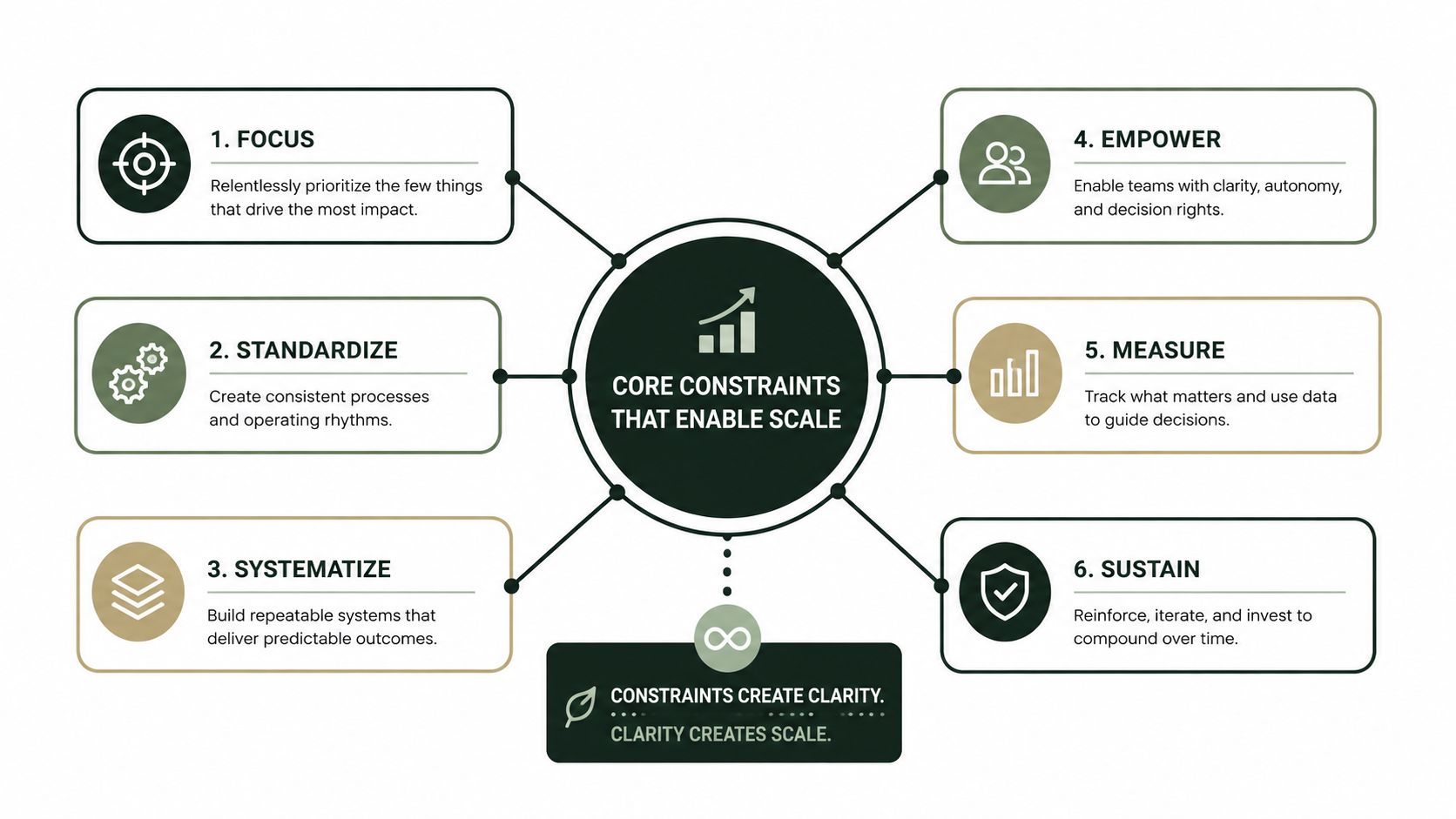
REST scales because it makes each request self-contained. Statelessness means the client sends everything needed to process the call, including authentication, filters, pagination, and versioning, so the server does not have to carry session state from earlier requests. In production, that lets any instance behind a load balancer handle any request without sticky sessions or shared session storage.
Why statelessness matters operationally
If a service does not depend on server-side session memory, infrastructure can send requests wherever capacity exists. That makes horizontal scaling simpler, and it reduces the hidden coupling that often breaks under burst traffic, failovers, or rolling deploys. For data APIs, a request like GET /funding-events?stage=seed&country=US works best when auth, filters, and paging are explicit in the request itself.
The other major constraint is the uniform interface. REST's resources, standard methods, and status codes give clients a shared vocabulary, which is what makes integrations predictable across languages and tools. A browser, a backend job, and an AI agent can all handle a standard GET, POST, PATCH, or DELETE request without custom transport code.
The constraints work together
The rest of REST's constraints matter because they support long-lived systems. Cacheability lets intermediaries reuse permitted responses, the layered system allows gateways and CDNs to sit between client and server, and the model builds on HTTP's existing methods, headers, caching behavior, and status codes instead of inventing a separate transport layer. The result is easier routing, safer scaling, and fewer moving parts for teams to maintain.
A scalable API is less about cleverness and more about refusing hidden state.
That is why REST remains a common choice for public-facing APIs and data services. REST endures because it builds on the web that already exists.
Mapping HTTP Methods and Status Codes
The easiest way to make REST useful is to treat HTTP methods as contracts, not suggestions. GET retrieves a resource, POST creates or submits something for processing, PUT replaces a resource, PATCH changes part of one, and DELETE removes it. That mapping gives SDKs, scripts, and agents a reliable way to infer intent without parsing custom endpoint names.
Method intent in practice
A well-shaped API keeps resource operations boring in the best sense. If a client wants a single startup record, it should call GET /funding-events/123. If it needs a filtered collection, it should use query parameters on GET /funding-events?stage=seed, not invent a new endpoint just to search.
Status codes do just as much work as methods. 200, 201, and 204 signal success in different ways, while 400, 401, 403, 404, 429, and 500 communicate failure modes that a machine can act on. That's why structured clients can retry safely, stop on authorization failures, or back off when rate limited instead of guessing.
Why consistency beats cleverness
Clients break when teams mix semantics. A POST that fetches data, or a 200 response that hides validation errors in the body, creates avoidable ambiguity for consumers. Standard HTTP semantics reduce that ambiguity, which is especially useful for agents that must decide whether to retry, refresh a cache, or escalate an exception.
Operational rule: if your error responses aren't machine-readable and consistent, every downstream integration becomes a custom parser.
That consistency also makes versioning survivable. A team can evolve fields and routes while preserving old behavior for existing clients, as long as the meaning of methods and status codes stays stable.
Solving the Polling Problem with Webhooks
REST is excellent for asking, “What's the current state?” It's a weaker fit for, “Tell me the instant something changes,” because repeated polling adds delay and burns requests even when nothing has changed. For time-sensitive workflows, the better pattern is REST for read access and webhooks for push notifications.
Pull for state, push for change
A funding intelligence system is a good example. The API can answer queries like GET /funding-events?stage=seed&country=US when a user wants historical context, but a webhook can fire the moment a new verified round lands so routing, enrichment, or CRM updates happen immediately. Postman's 2025 State of the API report shows REST remained dominant among surveyed developers at 93%, while webhooks were also widely used at 50% (Postman State of the API 2025).
That combination is the pattern to watch. REST acts like the control plane, webhooks act like the notification layer, and together they reduce staleness without forcing consumers to hammer an endpoint on a timer. For AI agents, that matters because a stale lead list is only useful to the extent that the market hasn't moved on.
Designing for duplicates and delay
Webhook consumers need to assume retries, duplicate deliveries, and occasional delivery lag. That means handlers should be idempotent, signatures should be verified, and downstream actions should tolerate repeated events without creating duplicate CRM records or double notifications. Teams that skip those controls end up with brittle automations that look fine in demos and fail under real event volume.
REST still has a place in that workflow. Teams use it for lookups, backfills, and audits, while the webhook carries the time-sensitive signal that something new is ready to process. That division keeps the system responsive without forcing one architecture to do two jobs poorly.
Comparing REST with GraphQL and gRPC
REST isn't always the right answer, even if it's the most familiar one. The right choice depends on who's consuming the API, how much data they need, and whether they care more about browser compatibility, payload precision, or low-latency service-to-service calls.
Where REST fits best
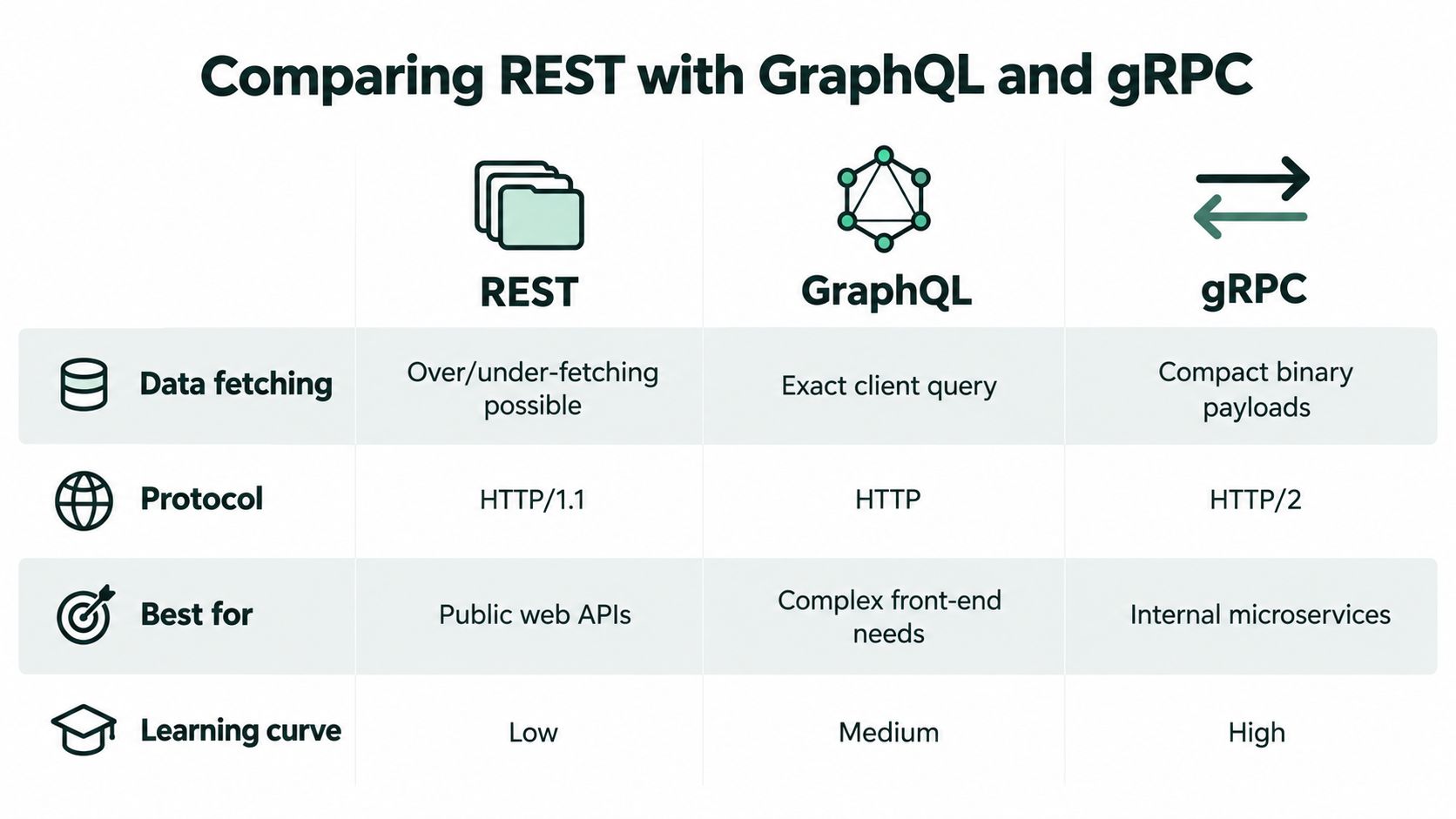
REST's strength is its broad compatibility and simple resource model. It works well for public APIs, data feeds, partner integrations, and any workflow where predictable HTTP semantics and cache-friendly behavior matter more than perfect payload minimization. That's why it remains the default for many external-facing systems.
GraphQL is useful when a client needs to shape the response very precisely and avoid over-fetching. gRPC is a different trade-off, it suits internal microservices that need compact binary payloads and efficient bidirectional communication, but it usually asks more from the client stack and infrastructure.
Technology Best fit Strength Trade-off REST Public web APIs and data feeds Broad HTTP compatibility Can over-fetch or under-fetch GraphQL Complex front-end data needs Client chooses exact fields More query complexity gRPC Internal microservices Efficient service-to-service calls Higher operational complexityChoosing by workflow, not trend
If a browser, a script, and an AI agent all need to consume the same endpoint, REST is usually the cleanest baseline. If a single frontend needs to assemble many nested views, GraphQL can reduce chatter. If two internal services need fast, structured RPC-like communication, gRPC may be the better fit.
The mistake is treating these as ideological camps. Mature teams choose based on payload shape, client control, and streaming needs, then keep the contract as boring and explicit as possible.
Practical Design and Consumption Rules
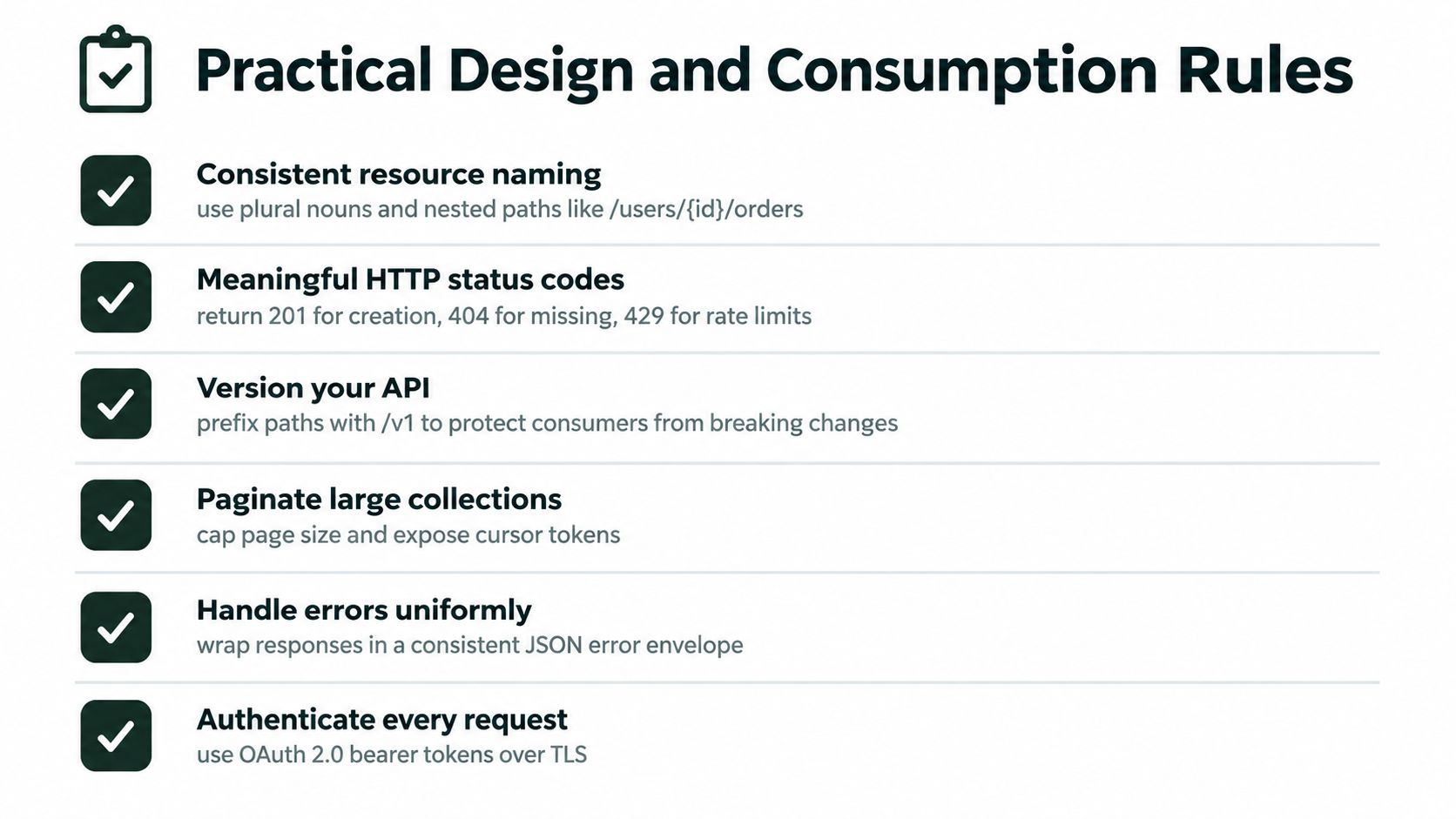
Good REST work lives in the details that make automation reliable. Consistent resource naming, explicit pagination, uniform error envelopes, and safe retries matter more than theoretical purity, because downstream tools need contracts they can trust.
The rules that prevent breakage
Plural resource names usually read better than verbs, and nested paths help show relationships without forcing clients to infer them. A path like /users/{id}/orders communicates structure directly, while a query string should filter or search, not replace the resource model itself.
Pagination deserves the same discipline. Large collections should not be dumped into a single response if a client only needs the first page, and cursor-based pagination is often easier to consume safely when data changes underfoot.
The contract should answer the next question
Error handling is where many APIs become painful. A consistent JSON error envelope gives clients one place to look for a code, message, and field-level detail, which reduces guesswork for SDKs and AI agents that need to decide what to retry and what to fix.
- Meaningful status codes: return the code that matches the outcome, so consumers can branch correctly.
- Explicit versioning: isolate breaking changes instead of forcing every client to relearn the contract.
- Idempotency on retries: let safe replays happen without creating duplicate side effects.
- Authentication on every request: do not rely on hidden session assumptions when the client may be stateless.
- Predictable nulls and field names: avoid surprising shape changes that force fragile parsing.
- Documented filters and limits: let consumers know what the endpoint can guarantee.
Strong API design reduces support work later, because the consumer can fail fast instead of failing mysteriously.
For teams working with automated research and outbound systems, tools like NowFunded can fit into this pattern as a structured funding feed with REST access, webhooks, and typed JSON schemas. For a worked example of these rules applied to a live funding feed, see the Synal blog at https://synal.to/blog. Automation only works when the response shape stays stable, so treat the contract itself as the deliverable.
Building an Automated Funding Intelligence Workflow
A practical funding workflow starts with lookup, not alerting. An operator or agent can query a REST endpoint for historical context, filtering by stage and geography, then enrich the resulting company record before any outreach goes out. That's where stateless requests matter, because every call needs to carry its own filters, authentication, and paging context.
A clean sequence from query to action
The first step is a current-state read, such as asking for newly funded companies in a specific stage. The second step is enrichment, where contact data or firmographic details get attached to the record so routing logic has something concrete to work with. The third step is notification, and that's where a webhook earns its place by pushing the verified event the moment it's ready.
In that setup, REST handles the lookback and the audit trail, while the webhook handles immediacy. A sales system can route the new account to the right rep, a recruiting workflow can flag a likely hiring signal, and an AI agent can decide whether to draft a first-touch email or open a research task.
The cleaner the contract, the less state your automation has to guess.
The production details are what keep it reliable. The consumer should verify the webhook signature, treat duplicate deliveries as normal, and handle cases where the downstream CRM is temporarily unavailable. If the event arrives twice, the workflow should still end in one record update, not two.
That's the answer to what is REST API in production. It's not a slogan about JSON, it's a disciplined way to expose resources, scale requests predictably, and combine pull-based querying with push-based event delivery where speed matters. If you're building startup intelligence, outbound automation, or agent workflows, visit NowFunded to see a live funding feed structured for REST, webhooks, and machine consumption.