What Is Data Verification and Why It Matters in 2026
Data verification is the process of checking that a record matches its real-world source or reported event, while validation checks whether the value is logically plausible for its intended use. In practice, that means a contact can look perfectly fine in your CRM and still be wrong.
You've probably felt this question before you phrased it.
An SDR pulls a list of recently funded startups, writes personalized outreach to founders, and hits send. The emails look sharp. The timing is good. Then bounce notices start landing. Not “out of office.” Not silence. Hard failures that tell you the mailbox doesn't exist.
At that point, many teams blame the list quality in a vague way. But the more useful diagnosis is narrower. The record wasn't verified. It may have been formatted correctly. It may even have passed a basic enrichment workflow. But nobody confirmed that the contact matched a real person, at a real company, through a real reachable mailbox.
That gap between collecting a record and trusting it is where data verification lives. Official statistical guidance treats verification as a core quality-control function, not a cosmetic cleanup pass. It includes checks for missing, invalid, inconsistent, or potentially erroneous data and metadata, plus comparisons across sources and over time, as described in OECD statistical guidance on verification and checking1/en/pdf).
If you've been searching for what is data verification, the biggest source of confusion is that many explanations blur it together with validation. They're related, but they aren't the same job. That distinction matters a lot when you're buying contact data, enriching startup records, or trusting a “deliverable email” claim.
Table of Contents
- The Bounced Email That Started This Question
- What Data Verification Actually Means
- Verification vs Validation and Why the Split Matters
- The Signals Behind a Verified Contact
- How Verification Works in a Live Funding Feed
- Why Pay on Successful Verification Changes the Math
- Your Data Verification Checklist Before You Trust the Record
The Bounced Email That Started This Question
An SDR sends 200 personalized emails to founders listed as recently funded. By lunch, 38 bounce back with “mailbox does not exist.”
That's not just annoying. It changes what happened that morning.
The rep spent time researching the accounts, tailoring copy, and sequencing follow-ups. The team used those records to estimate reachable pipeline. The sending domain also absorbed avoidable damage because mailbox providers now have evidence that some of those recipients were never valid destinations in the first place.
Why the bounce is a late signal
A bounce is often the first signal operators notice because it's visible. It hits the inbox fast. It hurts. But it's also late.
By the time the bounce appears, your team has already paid the cost in labor and opportunity. The mistake happened upstream, when someone accepted a contact record without asking the harder question: does this address correspond to a real mailbox for this person at this company?
A bounced email usually isn't an email-copy problem. It's a record-trust problem.
That's why “good data” is too fuzzy a diagnosis. Some bad records are obvious. A blank email field is easy to spot. The dangerous records are the ones that look complete and move cleanly through the system.
What probably happened upstream
In a typical outbound workflow, a contact gets collected from a press release, a founder page, a scraped profile, or an inferred email pattern. Then it lands in a CRM as if it were ready for use.
Several things can go wrong:
- The address is syntactically valid: It has the right shape, so the system accepts it.
- The pattern is plausible: It follows the company's naming convention, but nobody confirmed the mailbox exists.
- The person moved roles: The old work address may no longer map to the founder you meant to reach.
- The original source was weak: A scraped record may have copied an error into every downstream tool.
The core issue is simple. The team treated collection as proof.
Verification is the missing layer between “we found a record” and “we can trust this record.” In real operations, that's the difference between a list that merely populates fields and a list you can send against.
What Data Verification Actually Means
Verification works like checking a shipping label against the box that arrived. The label can look perfectly normal and still be attached to the wrong package. Contact data works the same way. A record can look complete in your CRM and still fail the basic question verification asks: does this record match the real-world person, company, and event it claims to represent?
That is the core idea.
In data work, verification means testing a record against evidence outside the field itself. The evidence might be a company site, a funding announcement, a source document, a mailbox check, or a cross-source match. The goal is not just to spot blanks or formatting mistakes. The goal is to confirm that the record corresponds to something real and current enough to use.
That definition matters because teams often collapse verification into a fuzzy idea of accuracy. Accuracy is the outcome you want. Verification is one of the ways you earn the right to believe a record is accurate.
The plain-English version
Data verification asks whether a record matches the underlying reality it points to.
If a startup announces a funding round, verification checks whether the company, founder, round details, and contact information line up with the event and with credible supporting sources.
The distinction is straightforward:
- Validation asks, “Could this be right?”
- Verification asks, “Is there evidence that it is right?”
That sounds subtle until you see it in contact enrichment.
An email like jane@startup.com may pass validation because it has the right structure and uses a real domain. Verification is a different claim. It asks whether that mailbox exists, whether it belongs to the intended person, and whether it fits the company and role attached to the record. A deliverable email is therefore a verification claim, not a validation claim.
A funded startup example
Say you are building a record for a startup that just announced a seed round. The record includes the company name, founder name, lead investor, website, and founder email.
Verification checks the joins between those fields and the evidence trail behind them.
If the press release names one founder but the website lists a different leadership team, the record needs review. If the email follows a plausible pattern but there is no support that the mailbox exists for that person, the contact is still unverified. If the record says “verified” but stores no check date, source, or method, the claim is weak because no one can inspect what was confirmed.
Field completion feels like progress, so the record moves forward. But filled fields are only surface signals. Verification asks whether those fields hold up when you compare them with the source event and the supporting metadata around the check.
Practical rule: Verification is an evidence-backed confidence claim, not a promise of absolute truth.
That mindset changes how you use enriched records. A verified contact is not “perfect data.” It is a record with a documented reason to trust it for the task at hand. For outreach, that reason often includes a real mailbox check, source alignment, and timing that is recent enough to matter.
You can see that evidence-first approach across contact enrichment discussions on the NowFunded blog, where useful workflows treat enrichment as record checking, not just field filling.
Verification vs Validation and Why the Split Matters
A funding record lands in your CRM with a founder email attached. The email field is filled, the format is clean, and your import accepts it. An operator sees a usable contact. A week later, the campaign bounces.
The mistake usually starts here. Many teams use verification and validation as if they are two labels for the same idea: accurate data. They are not the same check, and treating them as interchangeable hides the failure.
Validation asks whether a value fits the rules of your system. Verification asks whether the value holds up against evidence outside the system. The distinction appears across quality-control and statistical practice. The U.S. EPA, for example, describes verification as checking whether methods, procedures, and outputs conform to specified requirements, while validation addresses whether the resulting data are fit for their intended use.
Verification vs Validation at a Glance
Dimension Validation Verification Core question Does this value fit the rules? Does this value match the source or real event? Typical checks Format, required fields, allowed combinations Source reconciliation, recounting, cross-source matching Email example Does the email look correctly structured? Does the mailbox correspond to the intended person and accept mail? Failure meaning A failed check proves the data is wrong by rule A failed check shows the record doesn't match evidence Pass meaning The value is plausible in the system The value has supporting evidence outside the systemA simple analogy helps. Validation works like a ticket scanner at the stadium gate. It checks whether the barcode is in the right format and belongs to an active event. Verification works like checking whether the person holding the ticket is the person who should be using it. One check is about rule compliance. The other is about correspondence to reality.
That difference matters because the same record can pass validation and still fail verification.
Take sarah.chen@company.com. It passes validation if the syntax is correct, the field is present, and your CRM accepts the domain. Yet verification can still fail.
One failure is a typo in a clean-looking address.
Another is a real mailbox tied to the wrong Sarah Chen.
A third is an address that worked last quarter but no longer reaches the founder tied to the funding event.
Those are different operational problems, but they share one pattern. The system says the value is acceptable. The evidence says the record is not trustworthy for outreach.
Why this matters for contact enrichment
This split gets blurry fast in enrichment workflows.
If a vendor says an email is deliverable, that is a verification claim. They are not saying only that the string looks like an email or satisfies a schema. They are claiming evidence about the mailbox itself. In plain terms, the claim is that mail can reach that address for the intended contact.
That is why deliverability belongs on the verification side, not the validation side.
Validation still has a job. It filters malformed emails, impossible dates, and broken field combinations before bad records spread through downstream tools. But validation stops at plausibility inside the system. Verification starts where validation ends. It asks whether the record matches the person, company, or event you plan to act on.
A short rule helps keep the split clear:
Valid means the record fits your rules. Verified means the record has evidence behind it.
Once operators separate those two ideas, bounce analysis gets clearer, vendor claims get easier to evaluate, and teams stop mistaking a clean import for a trustworthy contact.
The Signals Behind a Verified Contact
A verified contact rarely comes from one single check. It usually comes from a stack of signals, where each one catches a different kind of mistake.
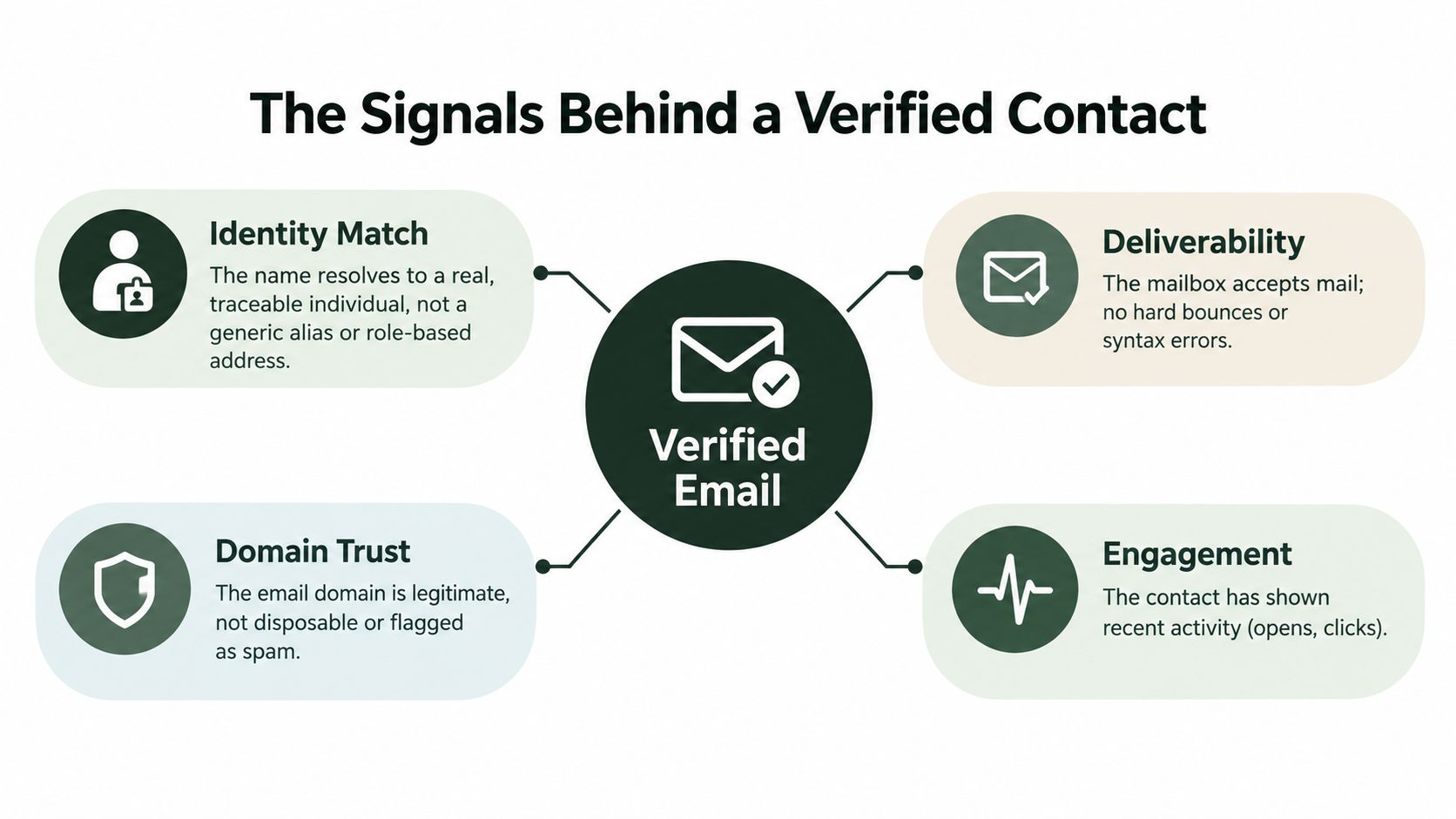
Identity match
First, the contact has to resolve to a real person.
That means the name isn't just floating in a spreadsheet. You can trace it to a company page, a professional profile, a funding announcement, or another credible artifact tied to the startup. This step prevents one of the most embarrassing failures in outbound: sending highly personalized outreach to a persona that doesn't exist in the form your data suggests.
A role inbox can also create confusion here. founders@company.com may be real, but it doesn't prove you've identified the founder you think you're contacting.
Deliverability
This is the signal many care about first, and for good reason. If the mailbox rejects mail, the record isn't usable for outreach.
In quality-control language, verification checks whether collected data matches source or transfer artifacts before downstream use. The U.S. EPA describes verification as a control layer that checks completeness, correctness, and compliance with method or procedural requirements before data moves further through the workflow in EPA guidance on data verification as a control layer.
For contact data, deliverability is one of those control checks. It prevents a silent falsehood from traveling downstream into campaigns, dashboards, and forecast assumptions.
Role accuracy
This one matters more than teams expect.
A real mailbox for the wrong employee still wastes effort. If your workflow is tied to newly funded startups, you usually need the founder or another relevant leader tied to the event context. Sending to an engineer, recruiter, or former advisor may produce no bounce, yet still represent a targeting failure.
Multi-source corroboration
A single scraped record is fragile. Two independent sources that agree are much stronger.
That doesn't mean every field must appear everywhere. It means the important identity claims line up across separate traces. The company site, a funding post, and a professional profile should tell a coherent story.
A strong verification stack often looks like this:
- One source establishes the event: the company raised funding.
- Another source establishes the person: the founder or leader is real and current.
- A contact check establishes reachability: the mailbox is usable.
- A context check establishes relevance: the role fits the reason you're reaching out.
Each signal blocks a different kind of bad record. Together, they turn a plausible contact into a defensible one.
How Verification Works in a Live Funding Feed
Verification becomes easier to understand when you watch it move through a pipeline instead of treating it like a label attached at the end.
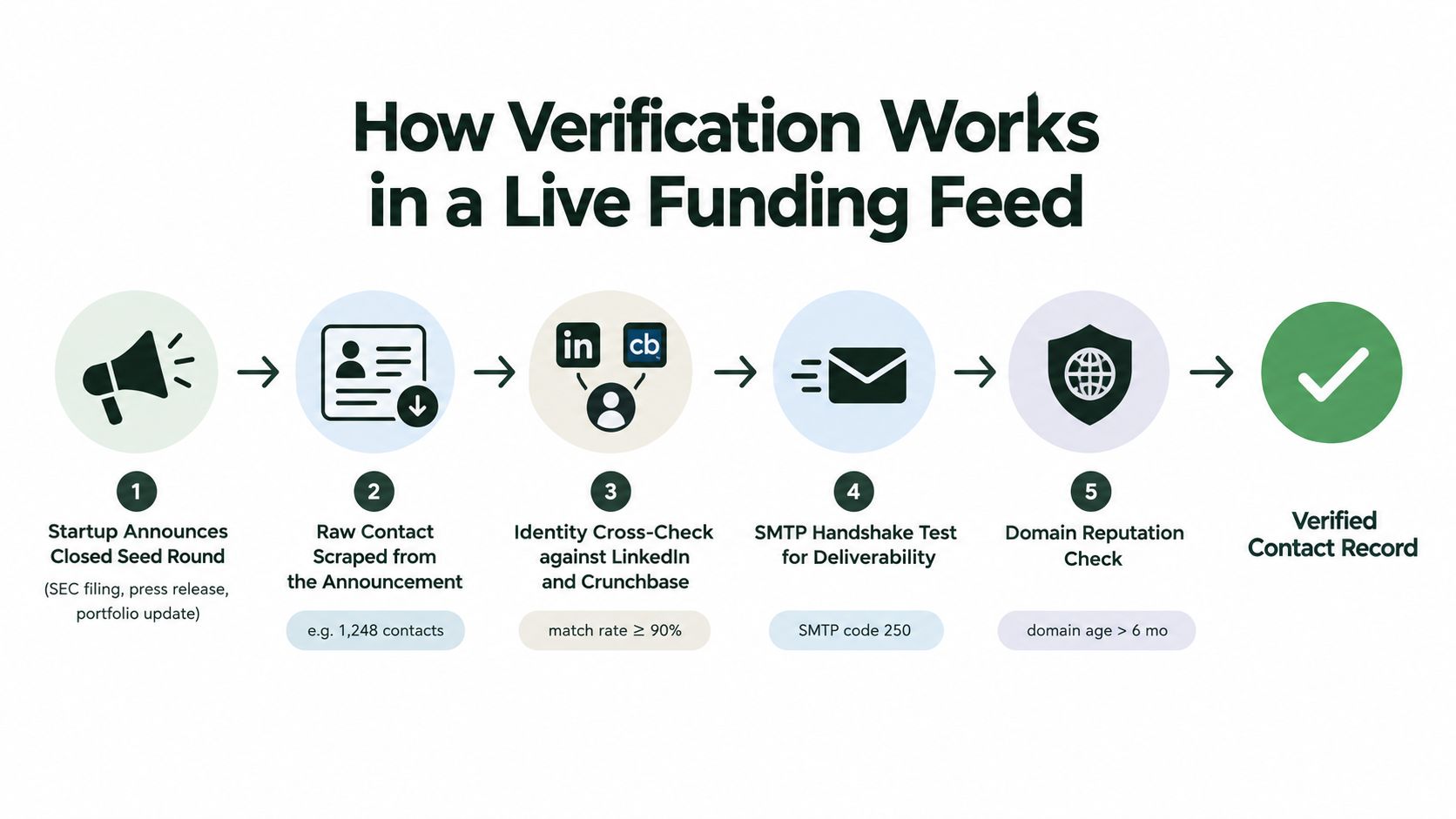
It starts with an event, not a contact
A startup closes a round. That event appears in a filing, a press release, an investor update, or a company announcement.
At this stage, the pipeline has a claim about the world: a funding event occurred. The contact record does not come first. The event does.
That sequencing matters because the event becomes the anchor for everything that follows. You're not enriching a random company record. You're building around a specific, recent business event.
The pipeline builds evidence in layers
Once the event enters the system, the workflow usually does several different jobs:
Extract the raw entities
Company name, round type, leadership names, and source artifacts get pulled into structured fields.Resolve identity
The system checks whether the founder or executive maps to a real, current person associated with the company.Test contact reachability
The record is checked for whether the mailbox is usable, not merely well-formed.Confirm role relevance
The person's role gets compared with the event context so the record fits the reason for outreach or research.Package the verification state
The output should include what was verified, when it was checked, and enough source context for an operator or system to trust the result.
The operational point is simple. Verification isn't one checkbox. It's a chain.
Where production systems usually break
Most failures don't happen because someone forgot what verification means. They happen because production pipelines cut corners under pressure.
Common break points include:
- Source drift: the original announcement changes or disappears
- Role drift: the person changes jobs after the event
- Stale checks: a once-good mailbox no longer represents current reality
- Weak packaging: the record says “verified” without exposing timestamp or evidence status
The EPA also separates verification from validation in operational workflows, noting that verification checks whether collected data satisfies predefined quality rules and matches source or transfer artifacts, while validation evaluates fitness for intended use against performance thresholds in EPA's explanation of verification versus validation.
That distinction is exactly why a live feed has to embed verification into the pipeline itself. If you want to see what that kind of event-driven delivery looks like in practice, NowFunded is one example of a system built around a live funding feed rather than static list exports.
Why Pay on Successful Verification Changes the Math
Pricing reveals what a provider is willing to stand behind.
If a vendor charges the same whether records are usable or not, the incentive is weak. The provider gets paid for volume. The buyer absorbs the cleanup risk.
Subscription vs Pay-on-Successful-Verification Pricing
Dimension Subscription Pricing Pay on Successful Verification What the buyer pays for Access or bulk volume Records that clear the provider's success condition Vendor incentive Maximize apparent coverage Maximize records that withstand checks Treatment of unverifiable contacts Often still included in the dataset More likely excluded or left unbilled Risk owner Buyer carries more downstream risk Provider carries more proof burden Meaning of “deliverable” Can slide into marketing language Moves closer to a contractual claimWhy the incentive shift matters
This isn't just a pricing preference. It changes behavior upstream.
When revenue depends on successful verification, the provider has a reason to reject weak records instead of passing them through. That pushes more effort into source reconciliation, identity resolution, and recency checks.
A useful way to consider this:
If the provider gets paid either way, “verified” can become a loose adjective. If payment depends on success, “verified” has to survive scrutiny.
That's especially important in contact enrichment, where the failure isn't always visible at purchase time. You often discover the weakness only when campaigns underperform or bounce notices start clustering.
Verification becomes an obligation
The strongest effect of pay-on-success isn't financial theater. It's accountability.
Once charges depend on successful verification, the deliverability claim stops being soft positioning and starts acting like a threshold. Providers must decide what they're willing to put through that threshold and what they're willing to reject.
For buyers, that means one simple question becomes very revealing: are you paying for records returned, or records successfully verified?
Your Data Verification Checklist Before You Trust the Record
If you only keep one thing from this article, keep this list. Use it when you evaluate a vendor, audit your CRM, or decide whether a contact is safe to use for outreach.
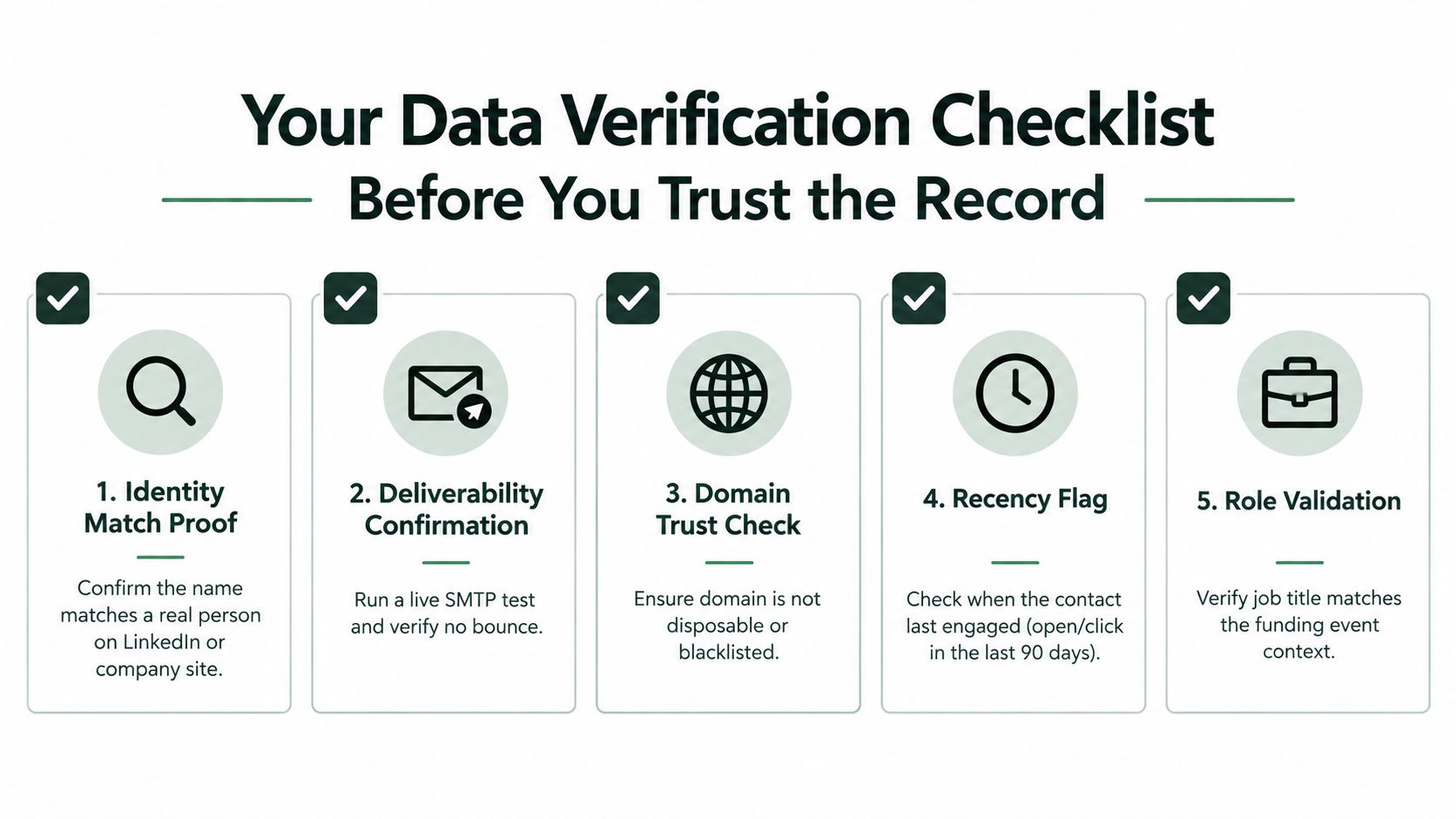
Ask these questions before you trust the record
What proves the identity match?
Ask how the provider knows this person is real, current, and tied to the company. A strong answer references company pages, leadership pages, event sources, or other traceable artifacts.Was deliverability checked?
Don't settle for “the email looks valid.” You want confirmation that the mailbox claim is based on a real verification process, not just formatting rules or inferred patterns.Does the role fit the event context?
If you're acting on a funding event, the contact should match that use case. A reachable email for the wrong employee is still a bad operational record.Is there corroboration beyond one scraped source?
Single-source records break easily. Better records have support from more than one independent trace.When was it verified?
Verification expires in practice, even if vendors don't like saying that out loud. A contact that was right months ago may now be stale because people move roles, inboxes change, and company pages get updated.Who eats the cost when verification fails?
This is the accountability test. If the provider bills you whether or not the record withstands use, you're carrying the risk.
What a good answer sounds like
Good vendors can explain the evidence trail in plain language. They can say what they checked, when they checked it, and what the verification status means.
Weak vendors usually hide behind generic quality words like “accurate,” “clean,” or “AI-powered” without drawing the line between source fidelity and system plausibility.
A recent practitioner framing captures the issue well: verification asks whether data matches its source or was captured and transmitted correctly, while validation asks whether it makes logical sense for its intended use. That source-fidelity boundary is especially useful in AI and BI workflows, as noted in Infomineo's practitioner guide on verification versus validation.
If you remember that one split, you'll make better decisions fast. A deliverable email is not just a valid field. It's a verification claim.
NowFunded gives teams a live feed of newly funded startups plus verified founder and leadership contacts, delivered through API, webhook, CSV, dashboard, or MCP. If this article helped you sharpen the difference between plausible data and source-true data, visit NowFunded to see how verified funding events and contact enrichment can fit directly into your outbound or research workflow.