10 Water Technology Companies to Know in 2026
The most popular advice about water technology companies is to start with the biggest or best-known brand. That shortcut often produces a poor shortlist. The stronger choice depends on project scale, water challenge, delivery model, geography, and required integration depth, not recognition alone.
This comparison uses five practical lenses: core capability, best-fit use case, implementation considerations, commercial friction, and partnership or prospecting relevance. It spans broad water-cycle delivery, industrial treatment, distributed systems, smart metering, desalination, and specialist components. The goal isn't to declare one universal winner. It's to clarify which type of provider deserves a closer technical and commercial review.
Use the list in three steps. First, shortlist by application. Next, validate regional availability, project scope, service requirements, and integration constraints. Then identify the right commercial, engineering, procurement, or leadership contact. If the research extends beyond established providers, NowFunded may also help teams monitor newly funded water startups and enrich verified founder or leadership contacts.
Table of Contents
- 1. Xylem
- 2. Veolia Water Technologies and Solutions
- 3. SUEZ
- 4. Ecolab Nalco Water
- 5. Kurita Water Industries
- 6. Pentair
- 7. IDE Technologies
- 8. Gradiant
- 9. Badger Meter
- 10. Energy Recovery ERII
- Top 10 Water Tech Companies Comparison
- Turn the List Into a Research Workflow
1. Xylem
Xylem is a strong starting point for buyers facing a water challenge that crosses equipment, utility operations, and digital infrastructure. Its portfolio spans pumps, treatment, smart metering, pressure management, analytics, and utility software, making it relevant to municipal networks as well as industrial water programs.
The Sensus business gives Xylem a clear position in advanced metering infrastructure and automated meter reading, with meters, communications networks, and analytics. Its utility applications also support asset and pressure monitoring. That combination matters when a buyer doesn't want to treat metering, leakage, pumping, and network visibility as separate projects.
Best fit and buying friction
Xylem is most relevant to municipal utilities, large infrastructure operators, and industrial organizations pursuing a broad modernization program. Its portfolio can support collection, treatment, reuse, and flood-control requirements, while the digital offering provides a route toward more connected utility operations.
The trade-off is implementation complexity. Enterprise sales processes and integration work can take time, and pricing isn't generally transparent because many solutions are engineered around the project.
Buyer question: Which part of the proposed architecture is standard, which part requires custom engineering, and who owns integration after deployment?
For partners and prospects, Xylem is more relevant when the opportunity involves utility transformation, infrastructure modernization, or a complementary technology that can fit into a broad ecosystem. It's less suitable as a quick, narrowly scoped purchase where a standardized product and short procurement cycle matter most.
2. Veolia Water Technologies and Solutions
Veolia Water Technologies and Solutions serves buyers that need more than a treatment device. The business combines water and wastewater technologies, design and construction, chemicals, and operations and maintenance, which makes it relevant to municipal and industrial projects with substantial lifecycle requirements.
Its catalog includes packaged and custom treatment systems. The company also operates across desalination, water reuse, and advanced process water, with industrial experience in areas such as semiconductors, energy, data centers, and food and beverage. That breadth can reduce the number of separate contracts a project team has to coordinate.
The delivery model is the central consideration. Veolia can combine equipment, chemicals, engineering, construction, and ongoing services, but that same breadth may create procurement overhead. Scope, regional organization, and project complexity can affect both lead times and commercial structure.
Where Veolia earns a place on the shortlist
Veolia is a sensible candidate for large industrial sites, complex process-water programs, advanced reuse, and projects where performance must be managed over time. Pilot capabilities and reference projects can help buyers evaluate an unfamiliar process before committing to a larger deployment.
It isn't an obvious fit for every smaller or highly standardized requirement. A buyer seeking a simple component, a compact building-level system, or a narrowly defined software layer may find the organization broader than necessary.
- Clarify the contract boundary: Determine whether the proposal includes design, construction, chemicals, operations, maintenance, or only selected equipment.
- Test regional delivery: Ask which local entity will sell, install, service, and support the system.
- Separate technology from service: Evaluate the treatment process independently from the operating model and renewal obligations.
For partnership research, Veolia is most relevant to engineering firms, process-technology suppliers, chemical providers, and digital vendors that can participate in a larger delivery chain.
3. SUEZ
SUEZ is oriented toward the entire water cycle, from drinking-water production and network performance to wastewater treatment, reuse, and resilience programs. That makes it a better match for cities and industrial operators looking for a coordinated program rather than a standalone treatment purchase.
Its capabilities include network and plant optimization, leakage programs, reuse initiatives, consulting, and operational support. SUEZ also brings a long municipal track record, with more than 160 years of domain experience, as described by the company's own positioning. That history can matter where public-sector buyers need institutional knowledge, regulatory familiarity, and continuity across a long engagement.
The decision is about program scale
SUEZ is most suitable when the requirement includes strategy, infrastructure performance, treatment operations, and long-term resilience. A municipality considering leakage reduction alongside plant performance and reuse may benefit from that integrated scope. An industrial customer may also value the combination of consulting and operational delivery.
The limitation is commercial and organizational rather than purely technical. Engagements tend to be multi-year and scope-heavy, and the company offers fewer obvious off-the-shelf options for smaller organizations.
A utility shouldn't compare SUEZ with a meter vendor using only a feature list. It should compare the full delivery model, including accountability for outcomes, operating responsibilities, and transition risk.
Buyers should ask how the proposed program will be divided between advisory work, capital projects, digital optimization, and operations. They should also identify what remains with the utility after implementation. For partners, SUEZ is most relevant where a technology can complement a city-scale program or improve a defined part of network, treatment, or reuse performance.
4. Ecolab Nalco Water
Ecolab, through Nalco Water, is a practical choice for industrial and commercial facilities where water treatment is tied directly to plant reliability, chemistry management, energy use, and on-site technical service. Its offering includes treatment chemistries, monitoring, and programs for cooling systems, boilers, and process water.
The distinction from municipal infrastructure providers is important. Nalco Water isn't primarily a smart-metering or utility-network platform. Its value is closer to the operating process, where water quality affects equipment, production continuity, maintenance, and resource consumption.
Match the commercial model to the plant
Ecolab can suit large plants that need regular technical support and a structured performance program. Its global service footprint and on-site expertise are useful when a facility can't rely on occasional equipment sales or remote monitoring alone. Sustainability analytics can also connect water programs with energy and operational reporting.
The trade-off is that chemistry and service contracts can become premium-priced and difficult to replace once embedded in plant routines. Buyers should evaluate the full relationship, not only the initial treatment recommendation.
- Review chemical dependency: Identify which consumables, dosing systems, and monitoring tools are required.
- Define service expectations: Confirm response arrangements, local technical coverage, and escalation procedures.
- Measure the right output: Agree whether success means lower water use, more reliable equipment, lower energy demand, or a combination.
Ecolab is a stronger prospecting target for industrial facilities, process-equipment partners, and sustainability teams than for organizations seeking municipal AMI or broad network software. Its fit depends on whether water is primarily an operational process issue rather than an infrastructure-visibility issue.
5. Kurita Water Industries
Kurita Water Industries is particularly relevant to manufacturers that require tightly controlled process water. The company provides ultrapure water, process water, wastewater, and zero-liquid-discharge solutions, with a strong fit for electronics and precision manufacturing.
Its offering includes ultrapure water supply programs, membrane and ion-exchange systems, advanced chemistries, and digital optimization. For semiconductor and other high-specification facilities, reliability and water quality can matter more than a broad catalog of general-purpose treatment equipment.
A specialist choice for precision manufacturing
Kurita's strength is also its limitation. Some offerings are concentrated in Asia, so regional availability, local service capacity, and project-specific support need to be validated before a buyer assumes a global delivery model. Custom ultrapure-water projects can also involve long lead times.
That makes the early technical conversation especially important. Buyers should provide detailed influent and process requirements, expected quality thresholds, production schedules, redundancy expectations, and wastewater constraints rather than asking for a generic water-treatment package.
Implementation test: Ask the vendor to distinguish the guaranteed water-quality specification from the assumptions about feedwater, facility operation, maintenance, and operator behavior.
Kurita's flexible models can combine equipment and services, including ultrapure water supply arrangements. That may help a manufacturer avoid treating every requirement as a one-time capital purchase, but it also makes contract terms and operational accountability central to the evaluation.
For partners, Kurita is most relevant to semiconductor equipment suppliers, precision-manufacturing contractors, membrane and sensor companies, and industrial developers entering regions where high-purity water infrastructure is expanding.
6. Pentair
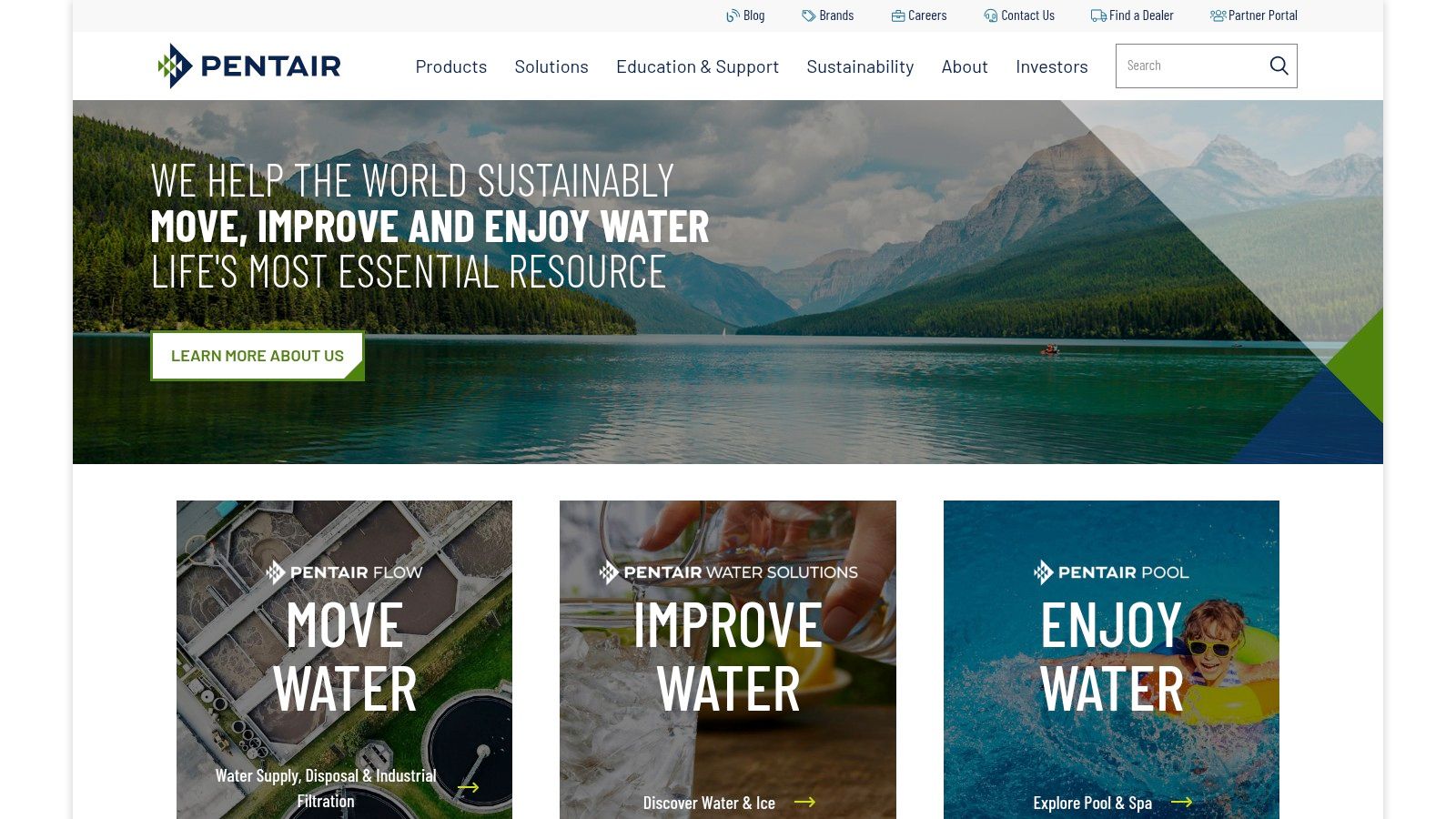
Pentair occupies a different part of the market from the large municipal and industrial integrators. Its portfolio covers residential, commercial, and light-industrial water quality, including softening, filtration, reverse osmosis, tanks, valves, and point-of-use or point-of-entry systems.
The company's component range includes Fleck, Autotrol, Pentek, and Structural products. That breadth supports building-level and distributed upgrades, especially where installation and replacement are handled through distributors, dealers, and local service providers.
Standardization is the main buying advantage
Pentair makes the most sense when the buyer values widely available equipment, standardized product lines, replacement parts, and documented support. A commercial building, dealer network, or residential water-quality provider may prefer that model over a custom industrial installation.
It isn't the natural first choice for heavy municipal treatment, complex industrial wastewater, or enterprise utility analytics. The company's analytics capabilities are also more limited than those of providers focused on connected utility infrastructure.
- Confirm the installer model: Establish who selects, configures, installs, and services the equipment.
- Check local pricing: Dealer-based pricing can vary, so compare the complete installed solution rather than the catalog item.
- Plan replacement support: Verify parts availability, certification requirements, and service continuity in the target geography.
Pentair is useful in a shortlist organized around distributed systems and building-level water quality. For partnership research, its ecosystem is more relevant to installers, distributors, component manufacturers, and property-focused service businesses than to large EPC contractors.
7. IDE Technologies
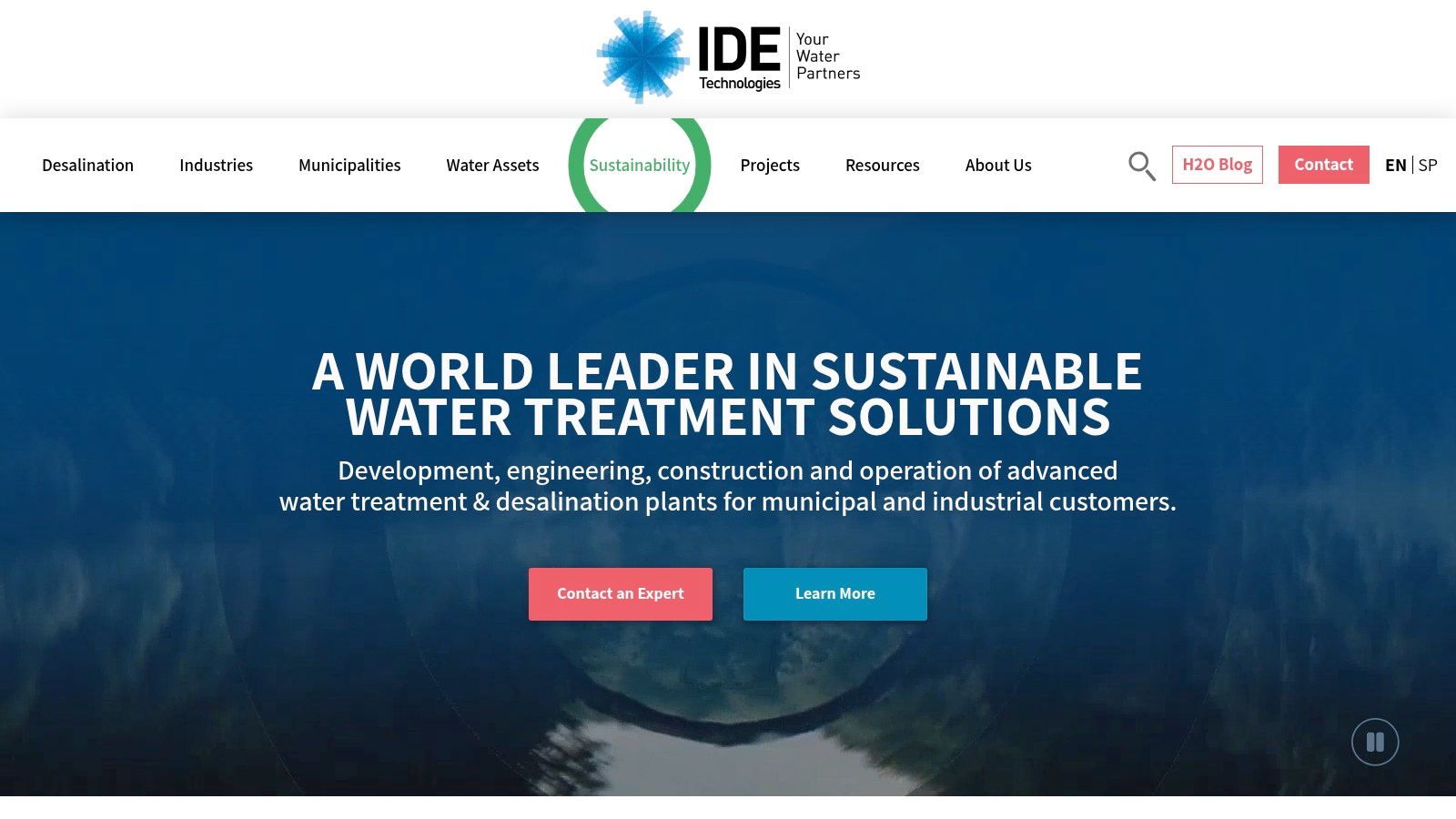
IDE Technologies is a project-focused provider for seawater and brackish-water desalination, advanced reuse, and high-recovery industrial treatment. Its capabilities include seawater reverse osmosis, brackish-water reverse osmosis, design-build-operation models, and high-recovery approaches such as MAX H2O and PFRO.
The company also offers thermal technologies, including MED and MVC, for high-salinity streams. That gives project teams more than one process route when feedwater quality, concentration limits, energy availability, or discharge constraints make a conventional approach unsuitable.
Use IDE for infrastructure-scale questions
IDE is a better match for large desalination plants and demanding industrial reuse projects than for incremental water-efficiency upgrades. Its ability to design, build, operate, and potentially guarantee performance can simplify accountability for a major project.
The downside is the project burden. Desalination infrastructure requires substantial development, permitting, financing, integration, and operational planning. Capital intensity can also make reuse or demand-management alternatives more attractive where the water challenge doesn't require new supply.
For buyers, the evaluation should include more than membrane performance:
- Define the project route: Confirm whether the proposed engagement covers EPC, O&M, performance guarantees, or a combination.
- Review high-recovery assumptions: Ask how concentrate management, pretreatment, and variable feedwater affect the design.
- Compare alternatives: Test desalination against reuse, leakage reduction, and distributed supply options before locking in the infrastructure model.
Teams tracking the sector beyond established suppliers can use NowFunded's startup funding feed to identify newly financed water companies that may introduce complementary treatment, monitoring, or financing models. Funding signals don't replace technical qualification, but they can improve early market mapping.
8. Gradiant
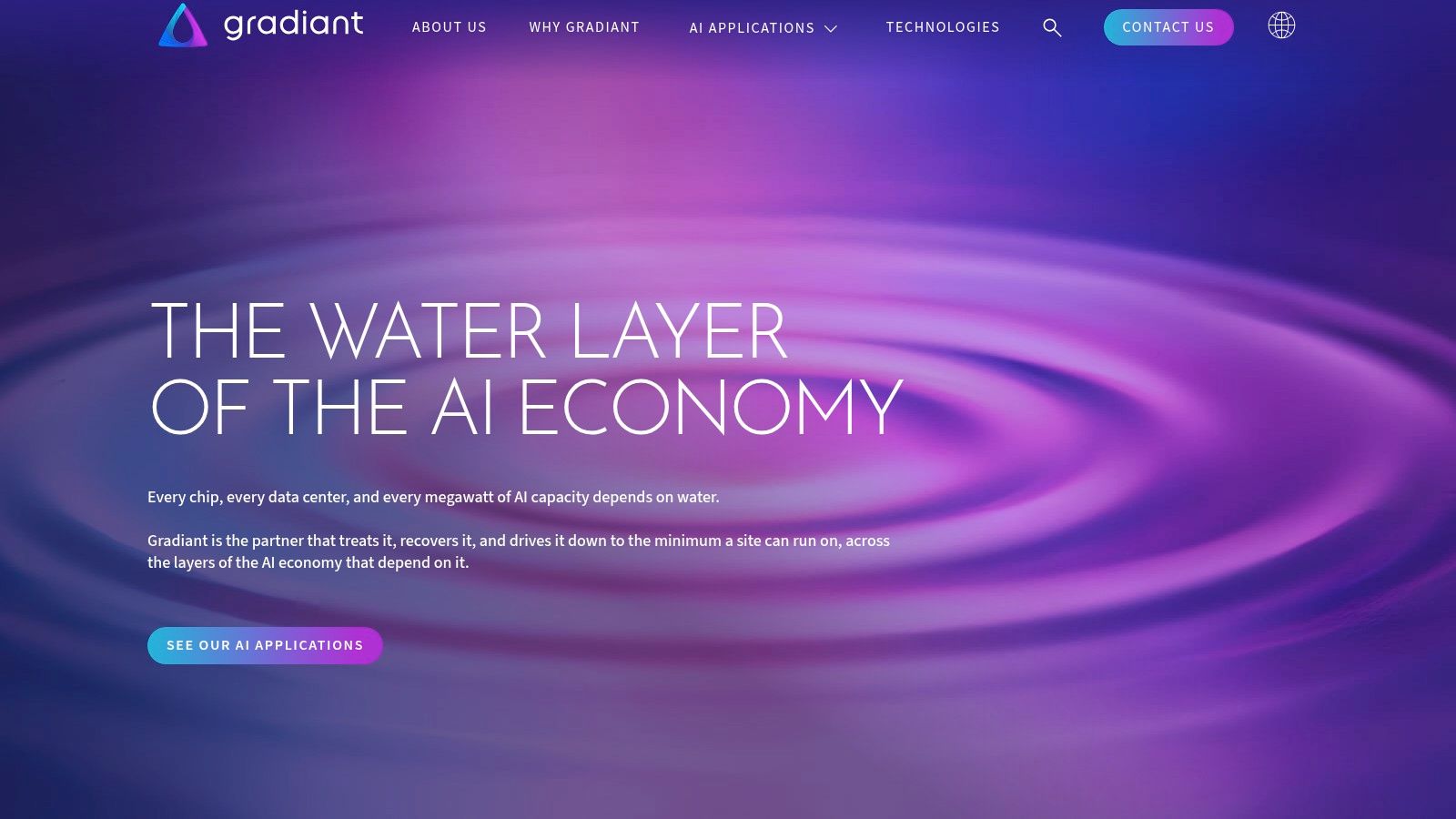
Gradiant focuses on industrial water problems where conventional treatment leaves too much residual volume, too much brine, or too little operating flexibility. Its work spans minimal liquid discharge, zero liquid discharge, reuse, and specialty processes for energy, mining, microelectronics, and pharma or biopharma.
The company offers high-recovery and brine-concentration technologies such as CGE, SCE, and CFRO. It also combines AI-assisted operations with performance guarantees and commercial models that can include build-own-operate or outcome-based arrangements.
Evaluate the process and the contract together
Gradiant is a useful candidate when the influent is difficult, water budgets are tight, or the site needs to recover more water while reducing liquid discharge. Flexible commercial models may appeal to customers that want to connect payment to availability, output, or operating performance rather than purchase every asset outright.
The company has less municipal emphasis than broad incumbents. Availability of build-own-operate and build-own-operate-transfer structures can also vary by region and regulatory context. Buyers should therefore avoid treating a successful industrial model as automatically portable to another jurisdiction.
Commercial question: Which performance obligations remain with the provider, and which operating conditions could void or narrow the guarantee?
Technical diligence should cover influent variability, concentrate handling, maintenance access, energy requirements, digital integration, and the path from pilot to full-scale deployment. For partners and prospecting teams, NowFunded's research blog can support broader monitoring of emerging companies and financing activity around industrial water, reuse, and related climate infrastructure.
9. Badger Meter
Badger Meter is designed for organizations modernizing flow measurement, water-quality sensing, advanced metering infrastructure, and utility analytics. Its BEACON Advanced Metering Analytics platform, ORION endpoints, field tools, and customer portals address both utility operations and customer engagement.
The company supports communication options including cellular and fixed networks. Its network-as-a-service and software-as-a-service models can reduce the need for a utility to manage every deployment and maintenance function internally.
A focused option for smart-metering modernization
Badger Meter is most compelling when the project is specifically about meter data, field workflows, leak awareness, customer portals, and recurring utility software. A mature AMI platform and predictable subscription structure can simplify planning compared with a fully custom digital-water program.
The economics depend heavily on system scale and deployment conditions. Smaller systems may face a longer path to return, while utilities mixing equipment from different vendors should examine hardware compatibility and lock-in risk.
- Map the installed base: Document existing meters, endpoints, communications infrastructure, and replacement cycles.
- Test field operations: Review mobile workflows, exception handling, installation support, and technician training.
- Clarify ownership: Determine who owns the data, devices, network relationship, and customer-facing configuration.
Badger Meter belongs in a different comparison set from Xylem, SUEZ, or Veolia. It may complement a broad infrastructure provider, but it should be assessed as a focused AMI and analytics platform. The right buyer is usually a utility seeking a defined metering modernization path, not an industrial site searching for wastewater treatment.
10. Energy Recovery ERII
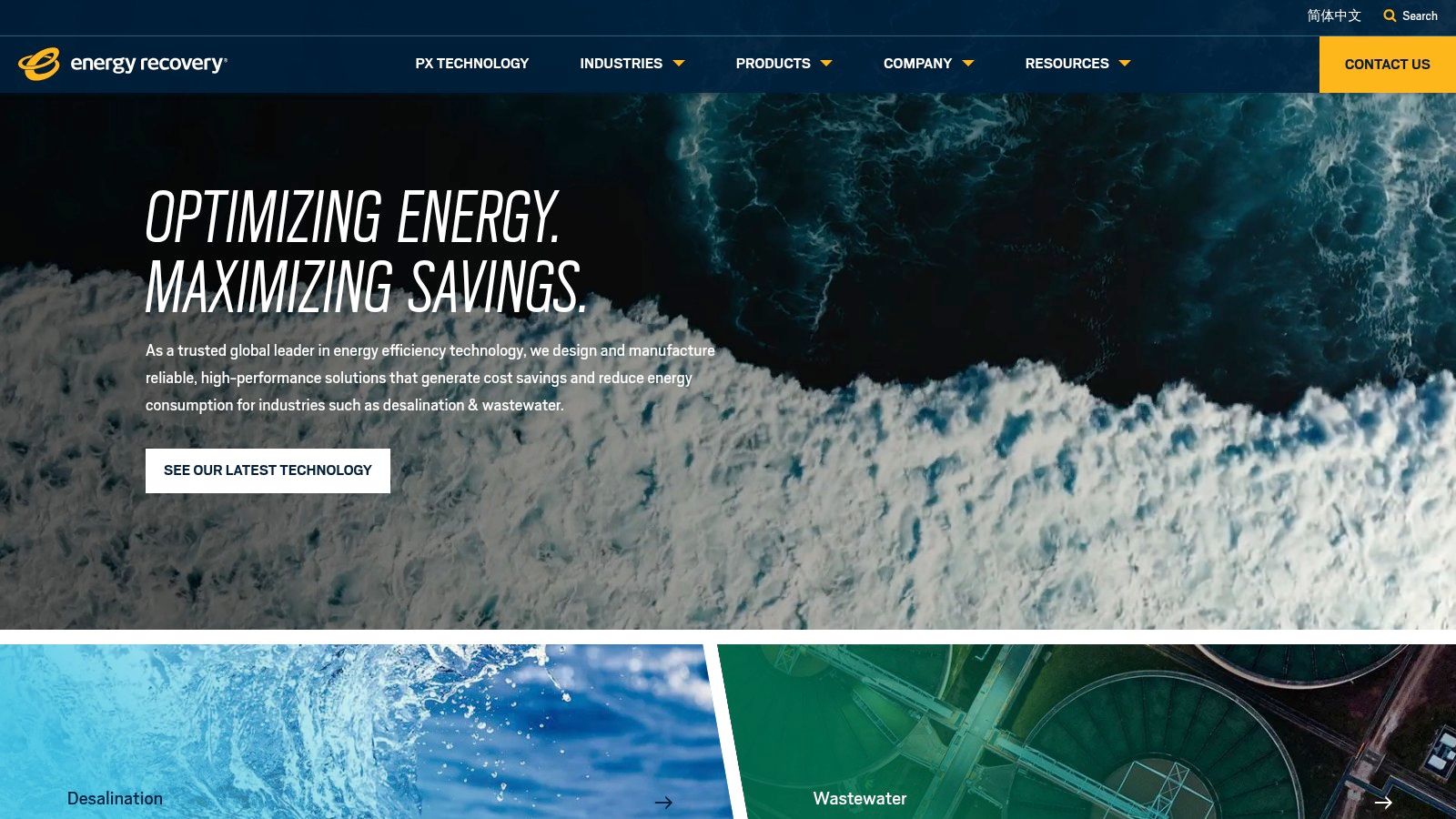
Energy Recovery is a component specialist rather than a full water-project integrator. Its PX Pressure Exchanger energy-recovery devices are used in seawater and brackish reverse-osmosis desalination, where pressure exchange can reduce the energy and operating burden associated with high-pressure pumping.
The company provides engineering support across a broad pressure range, along with field support and training. That makes it relevant to new desalination plants and retrofits where the project team already has an EPC, integrator, or plant operator responsible for the wider system.
Compare the component inside the system
Energy Recovery is not a substitute for a desalination EPC. Buyers need to assess how the PX device integrates with the pumps, membranes, controls, pretreatment, pressure vessels, and operating regime selected by the project integrator.
Its benefits are generally most relevant at medium and large plant scale. The component model can offer long service life and low maintenance requirements, but the financial case depends on plant size, operating pressure, energy conditions, retrofit constraints, and the integrator's design.
Integration rule: Request a system-level energy model, not an isolated component claim. The model should show assumptions, operating range, maintenance requirements, and responsibility for commissioning.
For partners, Energy Recovery is relevant to EPCs, desalination developers, membrane-system designers, and plant operators. It belongs on a shortlist when the buyer has already decided that reverse osmosis is part of the solution and is now optimizing plant efficiency, rather than when the buyer still needs to select the overall water-supply strategy.
Top 10 Water Tech Companies Comparison
Vendor Core offering Best fit / Target audience Unique selling points Typical commercial model & pricing Limitations Xylem Pumps, treatment, AMI/analytics, pressure & asset monitoring Municipal utilities; industrial water modernization Deep municipal footprint; Sensus AMI & systems integration Engineered solutions; enterprise sales; pricing often project‑based (opaque) Long sales/integration cycles; limited pricing transparency Veolia (Water Technologies & Solutions) Full‑stack treatment, desalination, chemicals, EPC, O&M Municipal & industrial (semiconductor, energy, F&B) Global delivery; bundle equipment+chemicals+services; pilot capability EPC + lifecycle O&M contracts; regional pricing variability Complex portfolio → procurement overhead; variable lead times SUEZ End‑to‑end water cycle, reuse, network optimization Cities (concessions), utilities, large industry 160+ years; integrated strategy → operations; strong municipal track record Multi‑year programs and concessions; scope‑heavy pricing Long, multi‑year engagements; fewer SMB/off‑the‑shelf options Ecolab (Nalco Water) Treatment chemistries, monitoring, plant performance programs Heavy industry, commercial facilities (cooling, boilers) Rapid technical service; proven water & energy savings programs Service + chemistry contracts; outcome/savings programs; premium pricing Sticky, premium contracts; less focus on municipal AMI/digital infra Kurita Water Industries UPW supply, membranes, ion exchange, digital optimization Semiconductor & precision manufacturing; UPW users Strong UPW reliability; flexible equipment+service commercial models Project & service combos; regionally variable availability Offerings concentrated in Asia; long lead times for custom UPW Pentair Filtration, softening, RO, POE/POU systems, components Residential, commercial, light industrial; building upgrades Standardized SKUs; broad dealer/distributor network; certifications Product sales via distributors/dealers; replacement parts market Not focused on heavy municipal/industrial treatment; limited enterprise analytics IDE Technologies SWRO/BRWO desalination, high‑recovery & thermal solutions, EPC/O&M Large‑scale seawater/brackish desalination; industrial reuse projects Landmark SWRO plants; performance guarantees; O&M capability EPC with O&M; capital‑intensive, long development/permitting cycles Very project‑centric; high capex and long timelines Gradiant MLD/ZLD, high‑recovery brine tech, AI‑assisted ops Energy, mining, microelectronics, pharma/biopharma Proprietary high‑recovery processes; AI ops; outcome‑based models Build‑own‑operate / outcome‑based commercial models; flexible contracts Less municipal focus; BOO/BOO‑T availability varies by region Badger Meter Water meters, quality sensors, AMI endpoints, BEACON AMA SaaS Utilities and commercial/industrial metering modernization Mature AMI platform; device compatibility; subscription/NaaS options NaaS / SaaS subscriptions + hardware sales; predictable recurring fees Best ROI at utility scale; hardware lock‑in risk for mixed vendors Energy Recovery (ERII) PX pressure exchangers (ERDs) for SWRO/BRWO SWRO/BRWO plants and retrofits focused on energy savings Industry‑standard PX ERD; proven energy & OPEX reductions Component sales to EPCs/integrators; CapEx for devices Component supplier (needs integrator for system); greatest benefits at medium–large scaleTurn the List Into a Research Workflow
A useful shortlist starts with the requirement, not the vendor. Classify the project as municipal, industrial, distributed, digital, desalination, or component-level. That first decision removes many false comparisons. A utility modernizing AMI shouldn't evaluate a component supplier as if it were a full-cycle operator, while a semiconductor facility shouldn't treat a residential filtration portfolio as an ultrapure-water strategy.
Select two or three candidates within the relevant category. Then test each one against the same evidence base:
- Scope: What exactly will the company deliver, and what remains with the buyer, EPC, integrator, or operator?
- Integration: Can the solution connect to existing meters, controls, plant systems, data platforms, and field workflows?
- Service model: Is support delivered through local technicians, a long-term O&M agreement, distributors, or a central team?
- Regional delivery: Are the proposed products, certifications, partners, and service capabilities available in the project geography?
- Procurement timeline: Does the engagement require a pilot, custom engineering, permitting, financing, or a multi-year contract?
The market context argues for disciplined qualification rather than broad enthusiasm. Dealroom reported that water technology companies raised about $1.2 billion in 2023, down 30% from the all-time high in 2022 but still 105% above 2019 pre-pandemic levels. Water technology represented less than 3% of the $48 billion raised by climate technology in 2023, according to Dealroom's water technology analysis. That combination suggests a sector with momentum but limited capital relative to its infrastructure importance.
The category is also not moving evenly. The smart water management market is projected to grow from USD 28.84 billion in 2026 to USD 52.15 billion by 2032, while recent demand is concentrating around water reuse, wastewater resource recovery, closed-loop cooling for data centers, and municipal leak detection, as described in MarketsandMarkets' smart water management research. Buyers should therefore ask which use case has an approved budget and operating owner, not just whether a vendor participates in “smart water.”
Capital timing can help with partnership research, but it shouldn't be confused with deployment readiness. Global Water Intelligence reported record equity commitments of $687 million in the first half of 2026, described as nearly two thirds of the prior year's total, in its water technology funding coverage. A newly funded startup may be strategically interesting while still lacking regional service capacity, certifications, reference deployments, or procurement maturity.
Document the internal sponsor and the next contact role for every candidate. The sponsor may be a utility innovation lead, plant manager, engineering director, procurement owner, sustainability executive, or infrastructure investor. Technology fit and organizational timing are separate questions. A technically suitable company may not be ready for the buyer's deployment window, while a newly funded provider may be actively building the partnerships and leadership relationships needed to scale.
NowFunded can support that second layer of research by providing a live, verified feed of newly funded startups from pre-seed through Series B, with company and round details, investor information, and structured delivery through MCP, REST API, webhooks, CSV export, or a dashboard. Its on-demand contact enrichment can help identify verified founders and relevant leaders when the research goal includes timely outreach to emerging water technology companies. Treat those contacts as a starting point for qualification, then verify technical fit, geography, funding use, and delivery capability before initiating a partnership conversation.
The best outcome isn't a longer vendor list. It's a documented decision showing why a provider fits the water problem, where implementation friction sits, who owns the next step, and what evidence would change the recommendation.
Use NowFunded to monitor newly funded water technology startups, enrich verified founder and leadership contacts, and route timely funding signals into your research or outreach workflow. Visit NowFunded to explore its structured feed, API, webhook, MCP, CSV, and dashboard options.