Venture Capital Leads: A Practical Playbook for 2026
You've just seen a startup announce a new round. The founder is still updating the website, the lead investor is sharing the news, and your competitors haven't built a sequence yet. If your team waits for a weekly funding list, verifies a stale CSV, and starts outreach days later, you're competing for attention after the useful window has narrowed.
The practical shift is to treat venture capital leads as a real-time event stream, not a static database. A funding event gives you timing, context, likely budget movement, and investor relevance. Your job is to capture those signals, verify the right decision-maker, and route a relevant message before the announcement becomes background noise.
Table of Contents
- Why Most Venture Capital Lead Programs Fail
- What a Lead Investor Actually Changes
- The Live Funding Feed as Your Discovery Layer
- Delivery Modes and Integration Options
- Verified Contact Enrichment That Actually Delivers
- Filtering and Prioritization Rules
- Outreach Templates and Timing
Why Most Venture Capital Lead Programs Fail
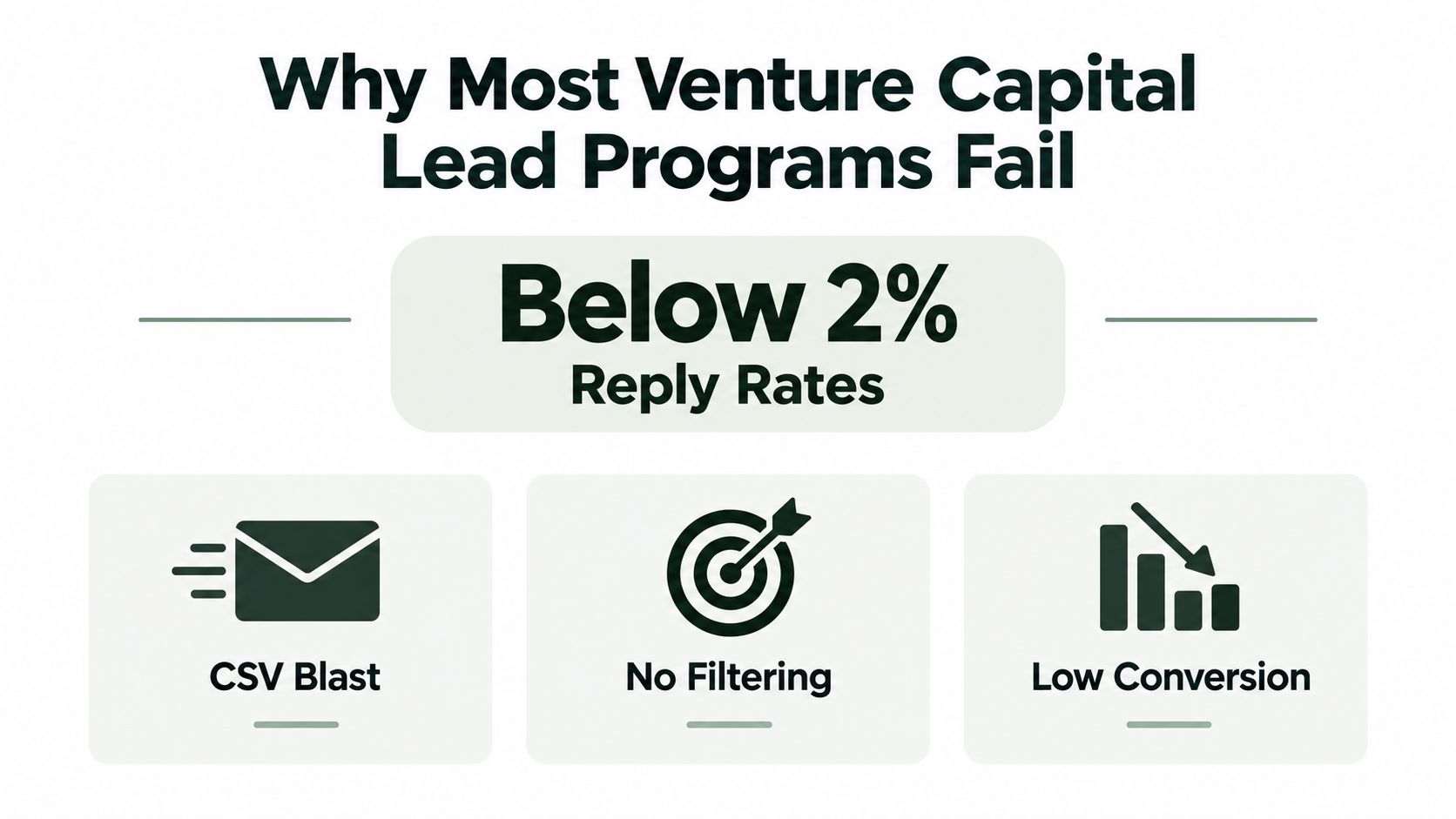
Most programs fail before the first email is written. An outbound team exports funded startups, appends contacts, loads the records into a sequence, and measures a weak reply rate as if the problem were copy. The underlying problem is usually stale timing combined with poor qualification.
A funding announcement is an event, not a permanent intent label. By the time a provider repackages it into a list, the founder may already have several sales conversations underway. A generic enrichment workflow makes the situation worse by treating a newly funded company, a mature scale-up, and a founder-led business as interchangeable accounts.
The stale-list trap
Cold outreach to investors is a particularly narrow funnel. One benchmark reports that 100 cold messages produce only 30 to 45 opens, 1 to 5 replies, 1 to 2 genuine-interest signals, 1 to 3 first meetings, and about one check, while warm introductions can produce 40 to 60% or higher reply rates and 10 to 20 times more meetings than cold outreach (the reported VC outreach funnel benchmark). The lesson applies to startup prospecting too. Volume doesn't repair weak relevance.
A live event stream changes the operating model:
- Detect the close or verified announcement.
- Normalize the round, stage, investors, industry, and location.
- Enrich only the roles that fit your buying motion.
- Score the account before a sequence starts.
- Send a message tied to the event and the company's likely next priority.
Practical rule: If your process can't tell a rep why this company matters today, it isn't a lead program. It's a database export.
The goal isn't to contact every funded startup. It's to identify the subset where timing, capital, company profile, and buyer role intersect. That requires event-level freshness and deterministic routing, not another batch refresh.
What a Lead Investor Actually Changes
A lead investor is more than a name in a financing announcement. In venture-backed companies, the lead often has disproportionate influence over governance, hiring priorities, operating support, and future financing strategy.
The governance evidence is clear. A peer-reviewed study reported that venture capital firms led 33.45% of their investments on average, and a VC's probability of receiving a board seat rose to 61.5% when it led, compared with 35% for a non-lead investor (the Journal of Law, Economics, and Organization findings summarized by Crunchbase). The advantage was strongest in early financings, where lead investors received a board seat in nearly 66.4% of first-round deals, compared with 48.2% in the fourth or later round.
That matters for outbound because governance changes who can approve a purchase. A founder who made every decision before the round may now be working with a board member, an operating partner, or a newly hired functional leader. Your previous champion might still be involved, but their buying criteria may have changed.
Score governance relevance, not just brand recognition
The lead investor's identity is useful only when you connect it to the account's likely operating motion. A specialist investor may introduce preferred vendors, influence hiring, or push a specific go-to-market model. A generalist investor may offer less direct relevance, but the round still indicates a change in available resources.
Signal Low Influence High Influence Investor position Participant with limited governance role Lead or co-lead with board involvement Likely buyer path Founder remains primary approver Founder plus executive or board stakeholders Outbound angle Product problem and immediate use case Product problem plus operating priority Qualification burden One-thread conversation may work Multi-thread account research is required Follow-up motion Direct founder outreach Founder, functional leader, and relevant investor contextThe study also found that VCs received board seats in 43.9% of deals overall, reinforcing that “lead” status often signals active involvement rather than a decorative label. Use it as a qualification layer. Don't assume the lead investor guarantees a purchase, but do treat it as a reason to research governance, hiring, and budget authority before writing.
The Live Funding Feed as Your Discovery Layer
A useful discovery layer captures the fields that change your routing decision. Company name and amount alone aren't enough. You need the round stage, lead investor, participating investors, announcement or close time, industry, location, headcount, website, and relevant social profiles.
The field announced_at determines freshness. round_stage supports stage-specific messaging. lead_investor_id lets you connect the event to investor thesis, portfolio patterns, or a known relationship. Typed fields turn an ambiguous research task into a rule your CRM or agent can execute consistently.
Map stage to operating intent
Stage is a starting point, not a buying conclusion.
- Pre-seed and seed: The founder may be hiring the first operators, selecting foundational tools, and making decisions personally. Lead with speed, implementation simplicity, and a concrete use case.
- Series A: The company is often formalizing go-to-market execution. Ask whether the new capital supports sales hiring, demand generation, recruiting, or operational infrastructure.
- Series B and later: The account may have existing vendors, more stakeholders, and procurement pressure. Position around expansion, consolidation, reliability, or measurable operational improvement.
A practical route might send a fintech Series A with a fintech-focused lead investor to a specialist SDR queue within minutes of the event being verified. A generalist consumer round can move to a nurture track if it doesn't match the company's buying profile. The distinction depends on structured fields, not a rep's memory of a spreadsheet.
The NowFunded startup funding feed is one example of a discovery layer built around newly funded companies, round details, investor data, and verified leadership contacts. Whatever source you use, insist on typed data, freshness, and a clear distinction between confirmed funding and unverified chatter.
A funding feed should answer three questions immediately: what happened, who matters, and why should this account enter the queue now?
Delivery Modes and Integration Options
Delivery method is an infrastructure decision. It determines how quickly your system learns about an event, how much work your stack performs, and how safely downstream actions run.
Polling is straightforward. A REST client checks for new records on a schedule, stores them, and passes them to enrichment. That works for teams running periodic CRM batches or daily research, but every interval creates delay and repeated reads of unchanged data.
Webhooks reverse the direction. The funding system sends an HTTP POST when a round is verified, allowing your workflow to start immediately. That fits event-driven stacks built with n8n, Zapier, Lambda handlers, or an internal queue.
Delivery Mode Typical Latency Best Fit Key Tradeoff REST polling On-demand or scheduled CRM batches and controlled enrichment jobs Simpler to operate, but can introduce delay and repeated requests Webhook push Near real time after verification Event-driven routing and agent workflows Faster response, but requires retry and idempotency handling MCP tool calls On-demand agent interaction AI agents that need typed research actions Flexible reasoning, but requires tool-aware orchestration CSV export Batch transfer Analysts and manual list review Easy to inspect, but weak for fresh event automationMCP is useful when an AI agent needs typed tool calls for discovery or enrichment. REST suits conventional application integrations. Webhooks fit systems where a verified event should enter a queue without waiting for a polling loop.
Build safety into the handoff
A webhook should not trigger outreach directly. First validate the signature, store the raw event, and apply an idempotency key so retries don't create duplicate records. Then normalize the payload, enrich contacts, score the account, and send only when the qualification rules pass.
Retries matter because delivery failures are normal in distributed systems. Your handler should acknowledge safely, record processing status, and make repeated deliveries harmless. The delivery method isn't a feature preference. It's the control plane for how quickly and reliably your prospecting system reacts.
Verified Contact Enrichment That Actually Delivers
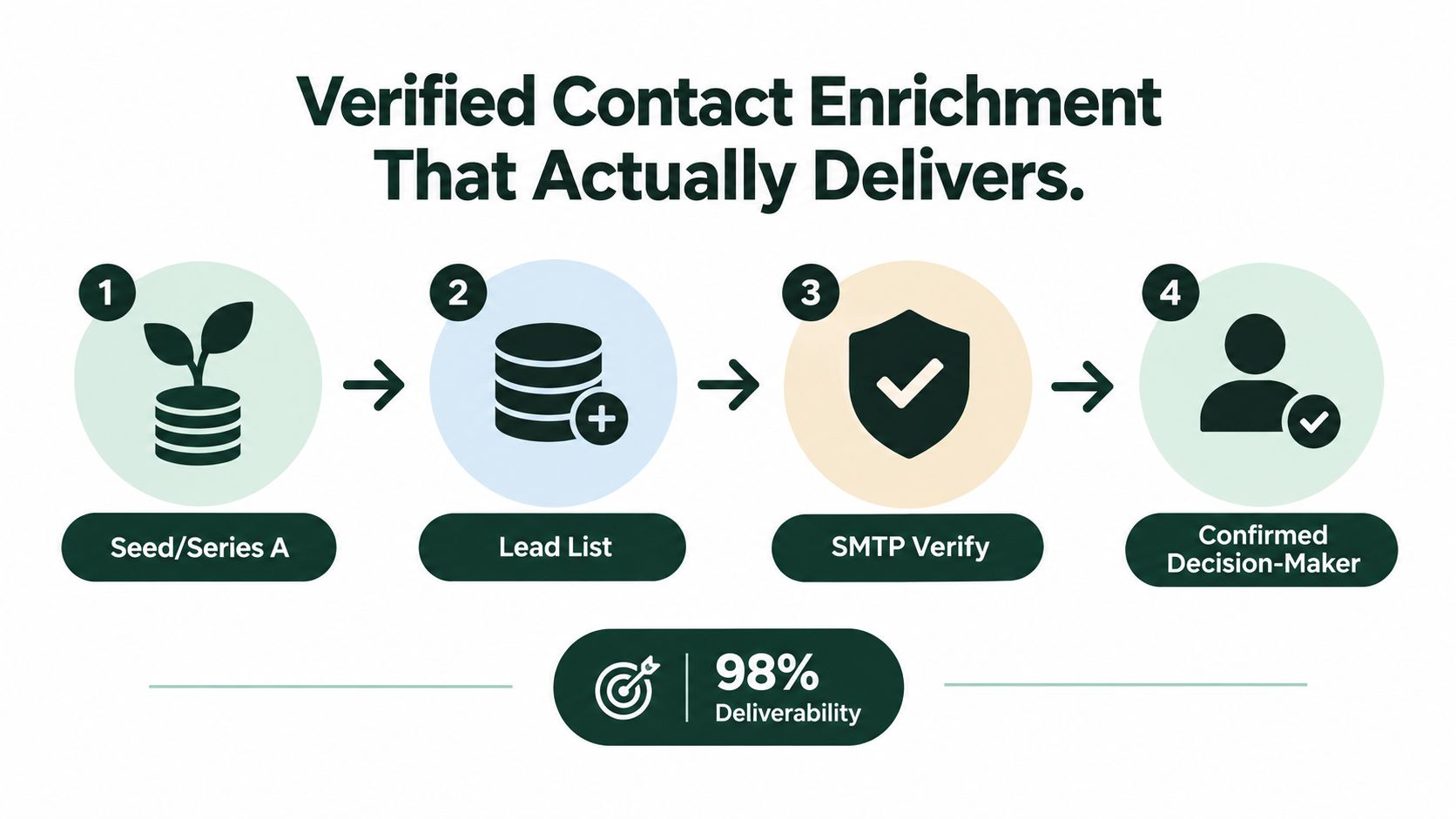
A funding event becomes actionable only when it produces a verified person and a defensible reason to contact them. Regex checks and guessed email patterns don't meet that standard. Verification should include SMTP handshake confirmation, MX record validation, catch-all classification, and role-mailbox filtering.
That distinction protects deliverability. Sending repeatedly to unverified addresses increases bounce risk and can damage the reputation of the sending domain. Once mailbox providers classify a domain as a poor sender, recovery is difficult and shouldn't be treated as a routine cleanup task.
Treat verification as a decision gate
Your enrichment response should include more than a name and email. Return the person's role, confidence score, verification status, source context, and a fallback path if the preferred contact can't be confirmed.
Use operational thresholds such as:
- Below 0.70 confidence: Send to manual review. Don't automate the first touch.
- 0.70 to 0.85: Permit sending with bounce and reply monitoring.
- Above 0.85: Allow full automation if the role and account rules also pass.
These thresholds don't replace judgment. A high-confidence email for a generic mailbox still isn't a confirmed decision-maker. Conversely, a slightly lower score for a clearly relevant founder may deserve human review rather than automatic rejection.
Wire the agent before the sequence
An MCP-enabled workflow can ask for a founder, revenue leader, recruiting owner, or other role based on the event and your ICP. The agent should receive the contact's confidence, role classification, and fallback options before it creates a task or drafts an email.
Enrichment is a contract with your sender domain. Every address you use either supports that contract or weakens it. Make verification explicit, log the result, and re-check records when the contact is about to enter a new campaign.
Filtering and Prioritization Rules
Filtering should explain why a company qualifies, not merely hide records from a CRM view. Start with the event fields that correlate with your sales motion: round size, stage, industry, headcount, geography, lead investor, and recent hiring.
Round size can act as a rough proxy for operating capacity, but it isn't a buying guarantee. A smaller round may still produce an urgent founder-led purchase, while a larger round may already have vendor decisions in place. Stage helps with context, but cash runway and execution priorities matter more than the label alone.
Use deterministic rules
Write the logic as a typed policy your team can inspect and change:
- Round and stage: Define the funding bands and stages your offer can serve.
- Industry: Match specific ICP categories, not a vague “technology” label.
- Headcount: Look for operating scale and relevant hiring activity.
- Geography: Route by territory, language, or legal coverage.
- Investor context: Add relevance when the lead investor supports your target motion.
- Recency: Prefer newly verified events over old funding records.
Avoid unsupported precision. The thresholds should come from your closed-won data, not a fashionable benchmark. A typed schema makes the logic auditable, testable, and portable across CRM views, agent prompts, and enrichment jobs.
Operating standard: A venture capital lead is not “a funded company.” It's a funded company that passes your explicit account, contact, timing, and relevance rules.
Review those rules against outcomes. If a queue starves reps, loosen the right constraint. If it produces meetings with no pipeline, tighten the buyer or problem filter. Keep the policy visible so marketing, sales, and operations agree on what enters the system.
Outreach Templates and Timing
A Series A announcement creates a narrow execution problem. You need to acknowledge the event without sounding like you scraped a press release, and you need to contact a person whose role connects to the likely use of the new capital.
Assume a verified funding event enters the feed. The webhook stores the payload, enrichment identifies the founder and the relevant functional leader, and the routing policy sends the account to an SDR who understands the company's industry. The first message should go out promptly, but speed doesn't excuse a generic pitch.
The first message
Send the opener within the first operational window after verification, while the event is still fresh. Reference the specific round and lead investor only when both fields are confirmed. Offer one useful asset, observation, or next step instead of a list of product features.
Subject: Supporting the next stage at [Company]
Hi [First name],
I saw that [Company] closed its [round stage] round with [lead investor]. Teams at this point often need to turn the new capital into [specific operating priority], without adding unnecessary process before the next hiring or growth push.
I put together [specific resource] for teams handling [relevant problem]. If that's on your roadmap, I can send it over and point out the parts most relevant to [Company].
Best, [Name]
The message works because it connects three verified facts: the company event, the investor context, and a plausible operating priority. It doesn't claim that funding automatically creates demand.
Follow up across threads
Use a short cadence across email and LinkedIn, with branching based on behavior:
- Day 3: Add a concrete observation about the company, role, or market. If the first email was opened but ignored, change the angle rather than repeating the ask.
- Day 7: Multi-thread to a relevant executive or operator. Keep the new message role-specific and explain why their responsibility is connected to the event.
- Day 14: Close the loop politely. Give the recipient an easy way to defer, redirect, or decline.
LinkedIn can support the sequence, but don't overload the connection request. A 2026 venture capital and private equity benchmark reports 34.9% average connection acceptance, 5.5% replies to connection notes, and 11.0% replies after acceptance (the LinkedIn prospecting benchmark). Use the connection note to establish relevance, then reserve the detailed context for the accepted connection.
If the round isn't public yet, don't expose private or questionable information. Wait for a verified public announcement or use only information the recipient is entitled to receive. A fast message that creates a confidentiality concern can destroy the account.
Keep the workflow measurable
The operational chain should look like this:
- A funding event enters through a webhook or scheduled API query.
- The system normalizes round, investor, industry, location, and timing fields.
- Contact enrichment returns role and verification status.
- Rules score the account and route it to the correct queue.
- An SDR reviews the context and dispatches the appropriate template.
- Replies, meetings, and pipeline value return to the funding event record.
Track time to first touch, verified-contact match rate, positive reply rate, and pipeline value per funding event. Set internal targets based on your own historical performance instead of copying unsupported market claims. The useful comparison is whether fresher events and better qualification outperform your old list process.
Common failure modes are predictable. A delayed feed makes the message late. Vanity emails create bounces. Over-filtered queues leave reps with too few accounts. A weak template makes a fresh signal sound like a mass campaign.
The NowFunded funding intelligence blog can support ongoing process research, but the operating discipline remains yours. Re-verify contacts before important sends, refresh templates on a regular schedule, and review round-size and industry rules against closed-won outcomes every 30 days.
NowFunded provides a live, structured feed of newly funded startups, with funding details, lead investors, and verified founder and leadership contacts delivered through MCP, REST, webhooks, CSV export, or a web dashboard. Use NowFunded to replace stale venture capital lead lists with event-driven discovery and a cleaner path from funding signal to qualified outreach.