10 Venture Capital Database Tools Compared
You've found a newly funded startup that fits your target market, but the investor database you're using still lists an old executive, an outdated fund thesis, or no usable contact details. Another tool has excellent market maps but can't deliver the event data into your CRM. Treating every venture capital database as interchangeable creates exactly this problem, because the right product depends on the job: discovering fresh funding, researching startups, enriching founder contacts, mapping a market, evaluating funds, or delivering structured data to developers.
The comparison below focuses on workflow fit, not a generic feature checklist. Each tool is assessed by coverage, implementation effort, pricing transparency, and limitations. NowFunded is positioned differently from broad private-market platforms, because it focuses on real-time early-stage funding events, verified contacts, and machine-friendly delivery.
Table of Contents
- 1. NowFunded
- 2. Dealroom
- 3. PitchBook
- 4. CB Insights
- 5. Crunchbase
- 6. Tracxn
- 7. Preqin
- 8. S&P Capital IQ Pro
- 9. PrivCo
- 10. Harmonic
- Top 10 Venture Capital Database Comparison
- Build a Shortlist Around Your Workflow
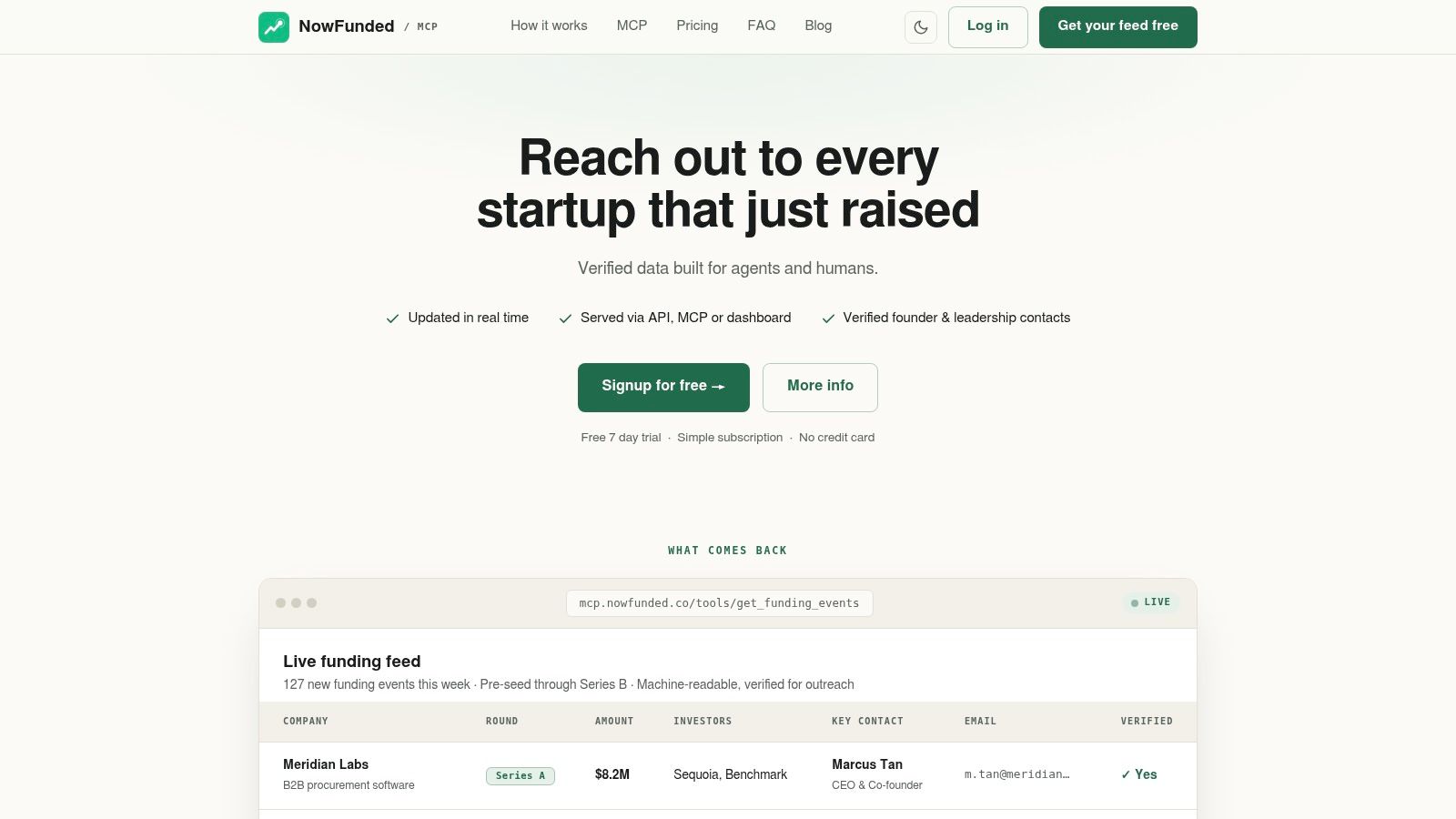
1. NowFunded
NowFunded is the strongest fit when your first question is, “Which startups just raised, and how can I act on that signal immediately?” It tracks verified funding events from pre-seed through Series B, with company facts including the round, amount, lead investors, headquarters, headcount, industry, website, and LinkedIn profile. New rounds are designed to appear within minutes of verification, which directly addresses the freshness problem that affects many investor and startup directories.
The product also adds on-demand founder and leadership enrichment. You're billed only when an email or phone number is confirmed deliverable, rather than paying for every unverified record. Funding-event data is free to query, while verified contacts currently cost $0.10 per email and $0.25 per phone, with no subscription or minimum spend required, as documented on the NowFunded website.
Built for agents and operators
NowFunded offers a native MCP endpoint, REST API, webhooks, CSV export, and dashboard access. Typed JSON schemas make the feed easier to use in deterministic automations, while webhook delivery lets teams receive an HTTP POST when a round is verified instead of maintaining polling loops. That distinction matters for sales, recruiting, and research teams that need an event to trigger an immediate workflow.
The historic database contains 10,000+ records from the last 12 months, and NowFunded tracks 100+ new startups weekly, with typically 2 to 5 verified contacts per company, according to the product information supplied for this comparison. Those records support lookbacks and trend analysis, although the platform's deliberate focus on early-stage companies means it isn't the best choice for growth-stage, public-market, or IPO research.
Best fit: Fresh early-stage funding discovery, verified founder outreach, recruiting triggers, and AI-agent pipelines without scraper maintenance.
The main trade-off is coverage scope. Contact costs can also accumulate for high-volume enrichment, and some companies may have fewer or no verified contacts. Still, for teams that value freshness over maximum historical breadth, NowFunded is a focused feed rather than a general-purpose directory.
2. Dealroom
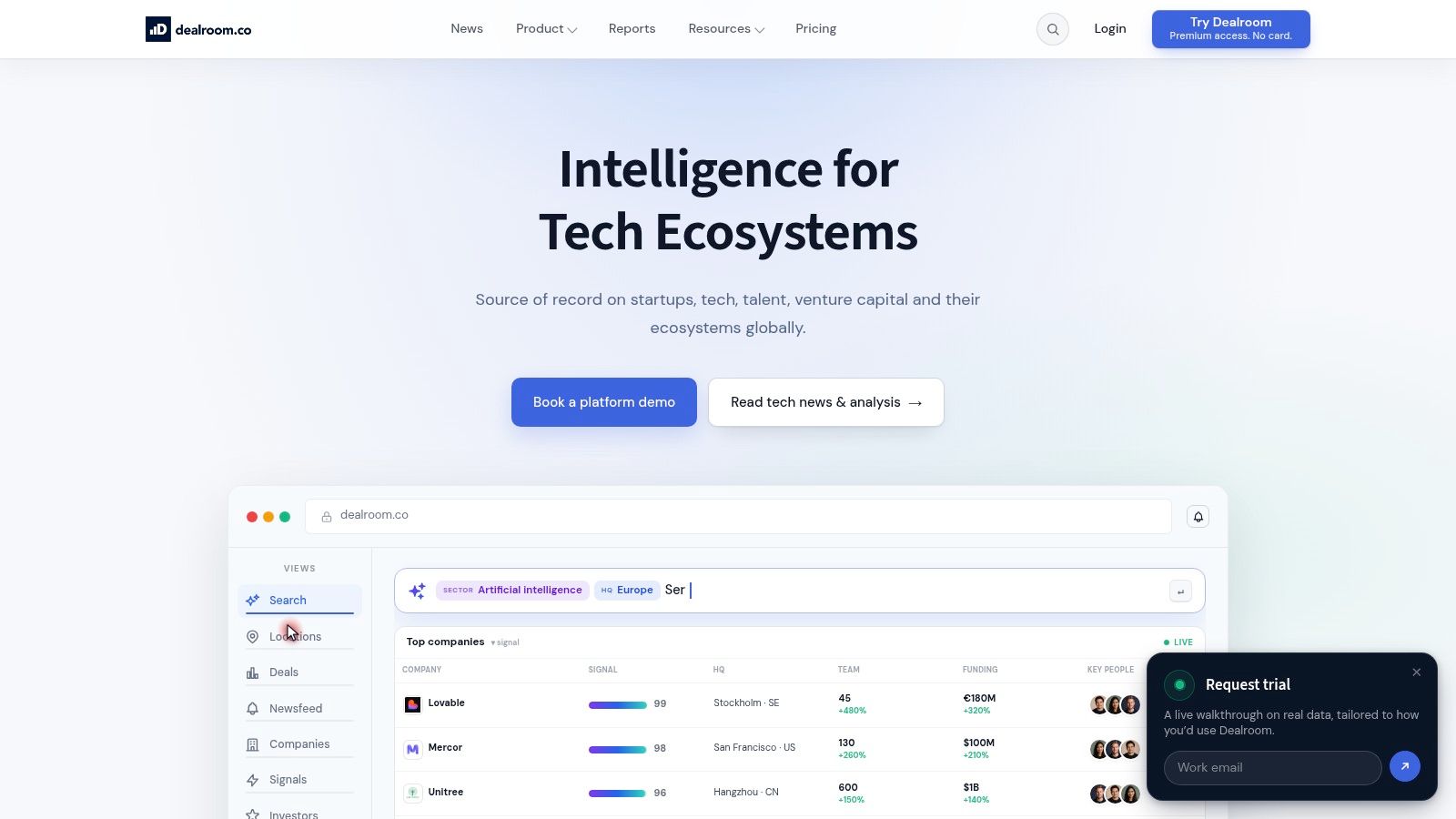
Dealroom suits teams that need startup, investor, and funding-round research inside an ecosystem-oriented platform. Its profiles combine company, investor, and transaction information with ecosystem dashboards, exports, and API endpoints for companies, investors, and transactions. The platform also supports MCP connections, which gives data engineers and AI-agent builders a route into structured workflows rather than limiting them to browser searches.
Its European strength is strategically important. Government and partner ecosystem feeds can provide context that a purely commercial directory may not capture, particularly for regional startup programs, accelerators, and public-sector mapping. That makes Dealroom a practical choice for economic-development organizations, European investors, and teams comparing startup ecosystems across locations.
Workflow and pricing considerations
Dealroom's packaged plans provide clearer planning signals than many sales-led enterprise platforms. Listed packages include export allocations per seat, with optional business-email credits, so a team can estimate usage before implementation. Full API access requires an Enterprise plan with custom pricing, and listed plans carry annual, multi-seat commitments.
That structure works well for organizations with recurring research needs and several users. It's less convenient for an individual analyst who wants a short, low-commitment test or a developer who needs production API access without an enterprise conversation.
Dealroom is most compelling when geographic ecosystem context matters as much as raw company discovery.
Use it for European market mapping, public-sector startup intelligence, accelerator research, and MCP-compatible data workflows. Use a more specialized feed when the priority is receiving newly verified early-stage rounds within minutes or enriching each event with deliverable founder contacts.
3. PitchBook
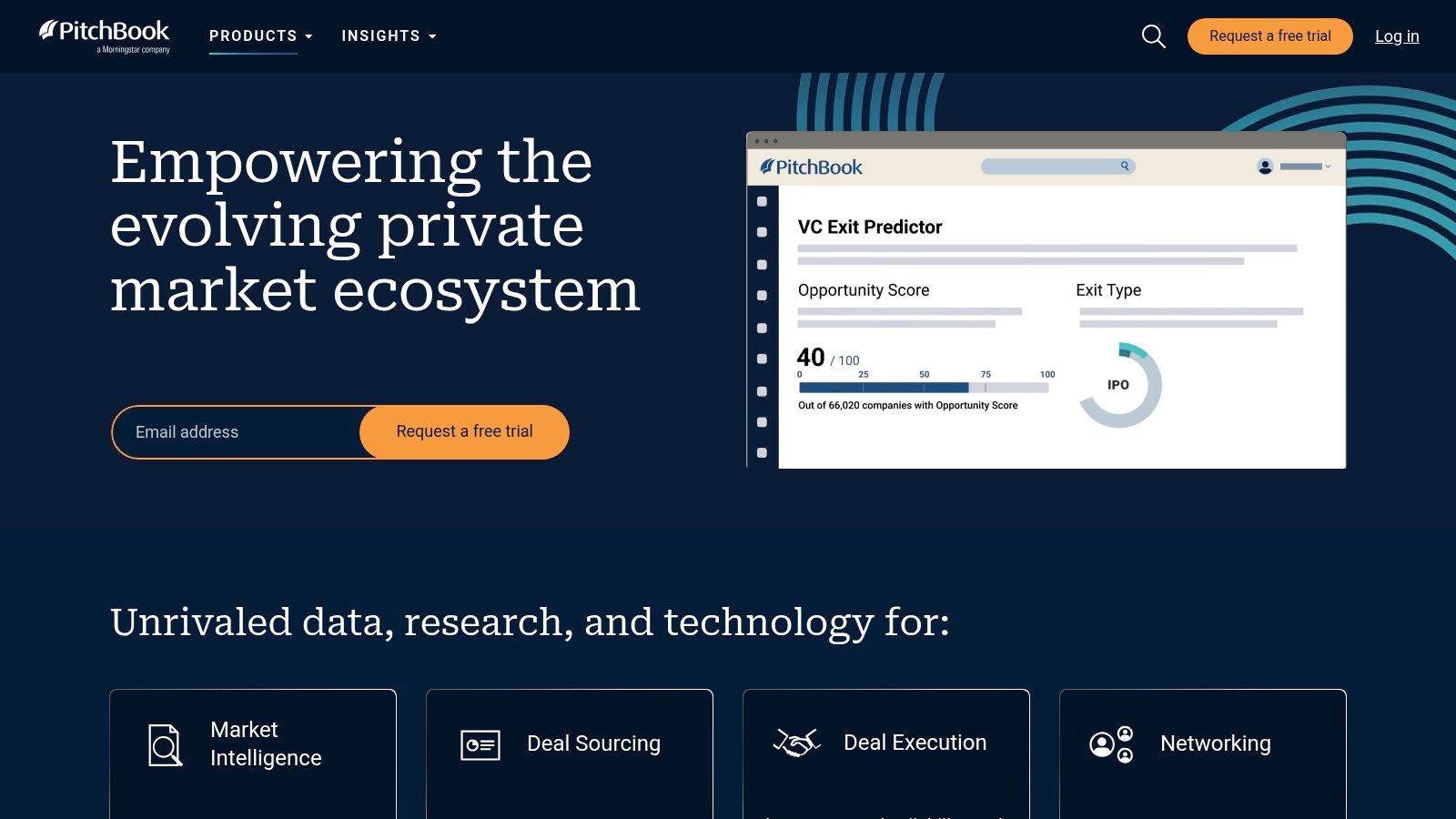
PitchBook is built for institutional private-market research rather than a narrow prospecting task. It covers venture capital, private equity, M&A, LPs, GPs, companies, funds, people, patents, and public-company comparables. That breadth lets an analyst move from a venture round to the investing firm, its fund history, comparable transactions, and related private-market context in one environment.
The platform's workflow integrations are a major differentiator. Desktop and mobile access are complemented by Excel and PowerPoint plugins, along with a Chrome extension. Analysts who already build models, committee materials, and benchmarking files in Microsoft Office can pull research closer to the point of use instead of repeatedly copying data from a browser.
Depth comes with commitment
PitchBook's public materials describe coverage of 759,000+ venture capital firms and 47,000+ venture capital deals, alongside dedicated venture-capital deal intelligence, as shown by its venture investor coverage information. University guidance also identifies PitchBook and Refinitiv Workspace as datasets that can provide coverage reaching as early as 1970 in some cases, with international private-company and fund data.
That historical depth is useful for benchmarking and cycle analysis, but it doesn't make every record complete or current. A study of venture databases found that widely used systems can vary materially in coverage, so institutional users should still reconcile important round-level fields against primary evidence. PitchBook's list pricing isn't public, and access commonly involves premium, multi-seat annual contracts.
For Office-heavy investment teams, allocator research, and deep venture diligence, PitchBook is a mature choice. For a small team that only needs fresh startup events and contact enrichment, its breadth may exceed the immediate job.
You can also use NowFunded's venture research resources when the workflow calls for a faster early-stage funding feed.
PitchBook
4. CB Insights
CB Insights is aimed at teams that need to interpret private-company data, not just retrieve it. Its company profiles include funding, valuations, comparables, and headcount, while proprietary signals such as Mosaic Score and Exit Probability add an analytical layer to the underlying records. ChatCBI provides natural-language questions across the dataset, which can shorten the path from a broad research question to a market overview.
That makes the platform particularly relevant to corporate strategy, product strategy, competitive intelligence, and innovation teams. A user researching a technology category can move beyond a list of funded startups and examine market maps, company comparisons, and forward-looking signals in the same research environment.
Useful for interpretation, less transparent for integration
The advantage is analytical framing. CB Insights can help a team organize a market and identify companies that deserve deeper review, rather than forcing analysts to construct every comparison manually. The limitation is that public information about exports and API access is less detailed than on platforms that foreground developer delivery.
Pricing isn't publicly listed and is generally positioned at an enterprise level. Reports commonly cite enterprise access above $10,000, but that figure isn't part of the verified product data for this comparison, so buyers should request a current quote rather than rely on a benchmark.
Research fit: Choose CB Insights when the deliverable is a market landscape or strategic signal, not just a clean stream of newly announced rounds.
The platform is less naturally suited to founder-contact enrichment or webhook-triggered outreach. If the team's goal is to identify a newly funded early-stage company and immediately receive a verified leadership contact, a purpose-built funding feed may require less operational translation.
Use NowFunded's research content alongside broader market-intelligence tools when speed and contact actionability matter.
5. Crunchbase
Crunchbase remains a practical option for teams that want broad startup and investor discovery without beginning with a large enterprise contract. It provides round-by-round funding information, company firmographics, prospecting tools, a public API, and a data marketplace. AI-assisted search and starter or professional subscription tiers make the platform accessible to teams that need a browser workflow first and programmatic access later.
The self-serve model is its clearest advantage. A budget-sensitive sales, research, or recruiting team can start with a monthly subscription and determine whether the records support its use case before negotiating a larger deployment. Developers can also work with extensive API endpoints, although access, exports, and quotas vary by plan.
A useful complement, not automatically a source of record
Crunchbase works well for initial company discovery, CRM prospecting, and broad market scans. It can also serve as one input in a data-reconciliation process. That matters because empirical research has shown that venture databases can omit financing rounds and committed capital, particularly in older or manually compiled datasets, and a separate benchmarking study found material differences among eight widely used providers.
The practical limitation is that some exports and features are gated by plan, while Pro exports can be restricted unless the account is upgraded. Data depth and verification may also lag more specialized enterprise systems in niche markets. The platform's lower barrier to entry doesn't remove the need to validate important fields before making investment, outreach, or market-sizing decisions.
For a team comparing a self-serve database with a real-time early-stage feed, NowFunded is the more focused option for verified new funding events and deliverable contacts. Crunchbase is broader and easier to adopt as a general research layer.
6. Tracxn
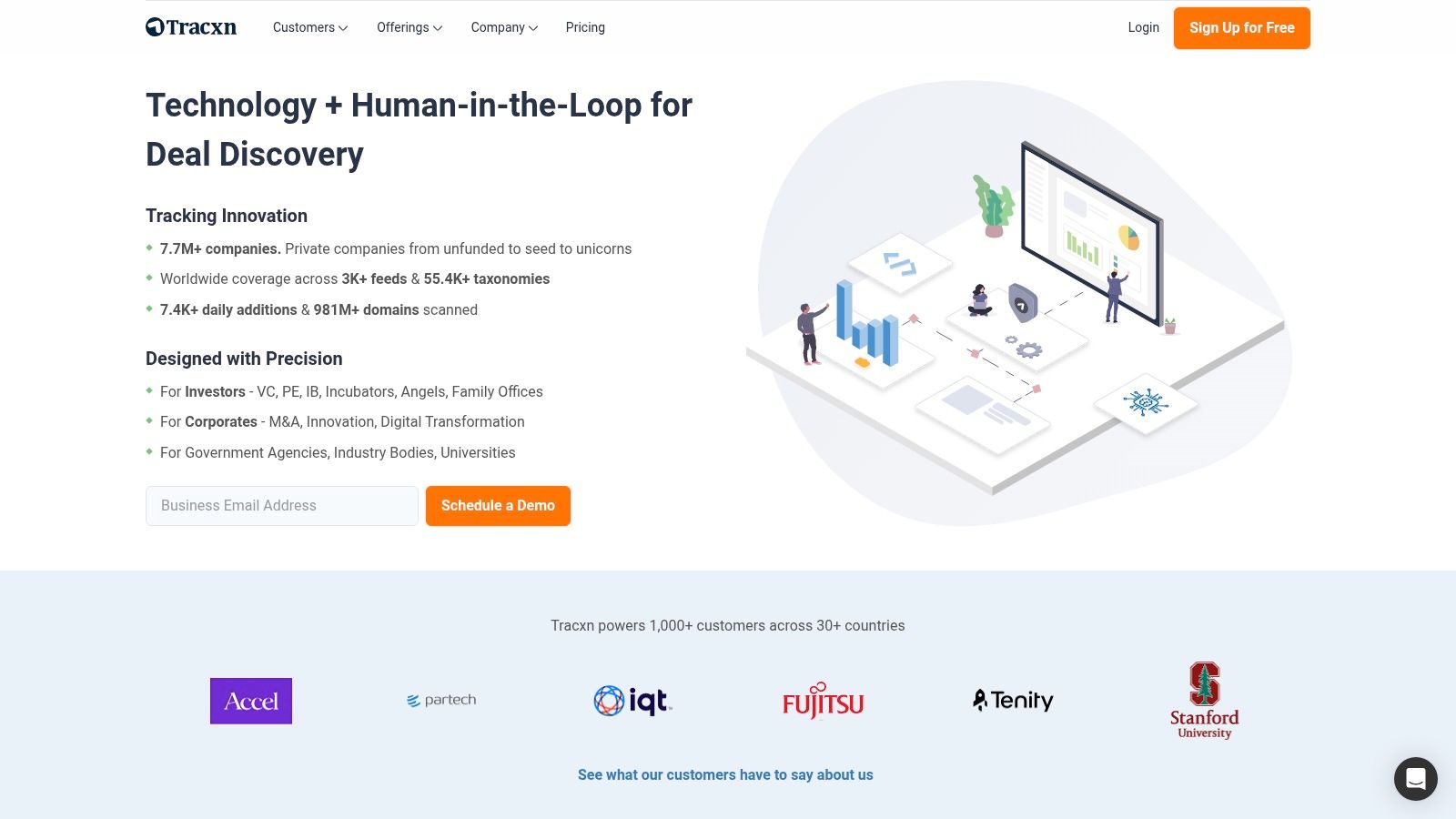
Tracxn is designed for broad startup intelligence, deal-flow management, and data delivery. Its platform combines company and funding-round research with live-deal tracking, reports, alerts, exports, and a deal-flow CRM. That combination makes it useful to venture teams that need to move from discovery into pipeline management rather than keep research in a separate tool.
The platform also distinguishes between internal research and commercial data use. Data-solutions packs include APIs and bulk data dumps, with volume pricing and licensing options for redistribution. That separation is valuable for data vendors, research providers, and companies embedding startup intelligence into another product.
Broad coverage, layered access
Tracxn advertises 7.7 million-plus companies, 1.8 million-plus funding rounds, and 290,000-plus investors in the plan notes supplied for this comparison. Those figures indicate a breadth-oriented product, but coverage volume alone doesn't establish freshness, completeness, or suitability for a particular geography. Teams should test the records that matter to their own market.
A free Lite tier supports hands-on evaluation, which is useful before a commercial commitment. Premium pricing and data-pack pricing require a sales conversation, while export credits and Lite limits can become restrictive at scale.
Best use cases include:
- Broad market mapping: Scan sectors, companies, investors, and rounds across a large startup universe.
- Deal-flow operations: Track live deals, alerts, and pipeline activity inside one workspace.
- Data licensing: Evaluate API, bulk-dump, and redistribution options separately from analyst access.
Tracxn is a strong candidate when the job includes coverage and licensing. It's less differentiated for instant early-stage event delivery or verified founder outreach, where a narrower feed may provide a more direct path from signal to action.
7. Preqin
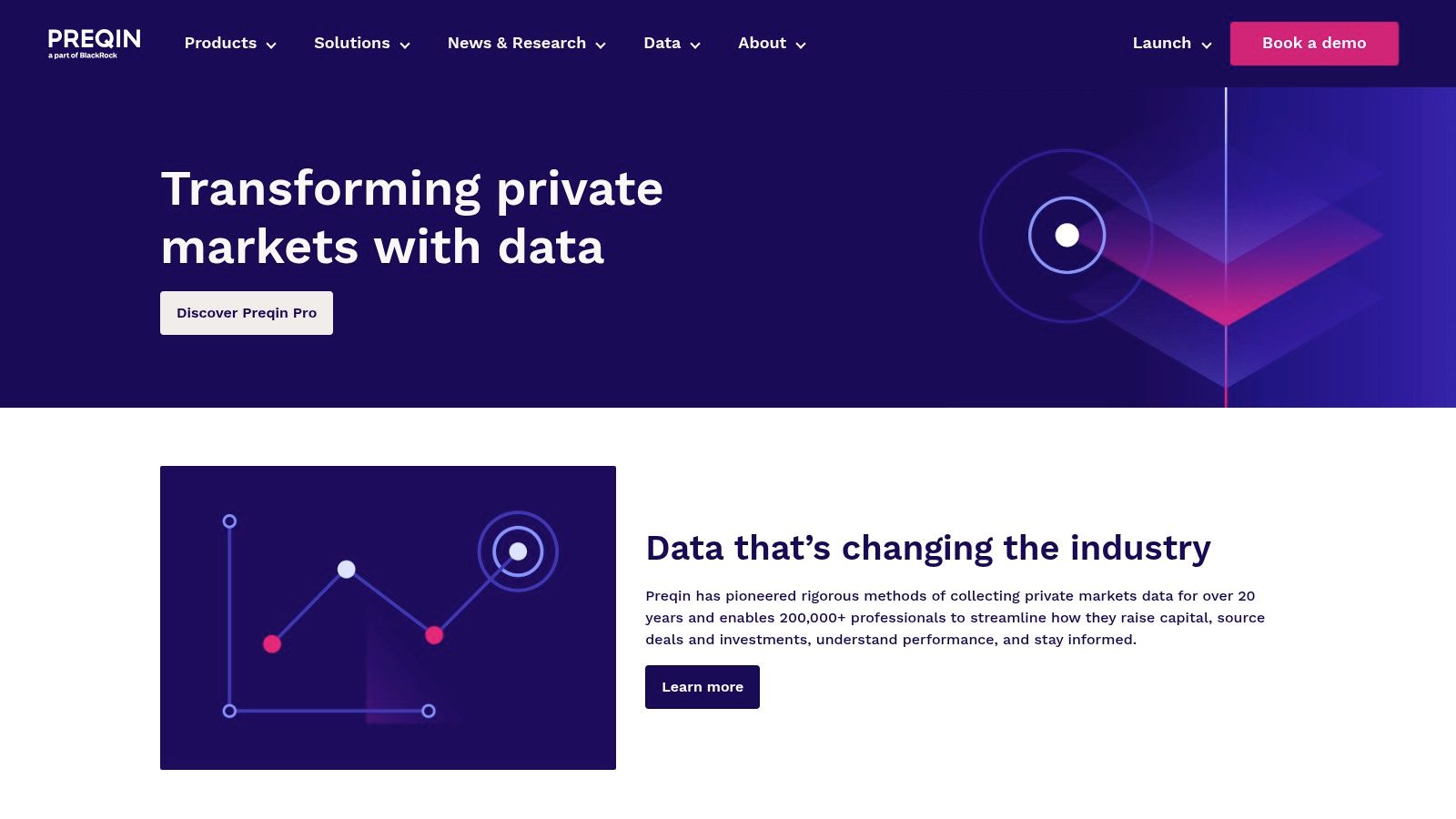
Preqin Pro is the most natural fit on this list for allocator diligence and manager research. Its core strength is the LP and GP perspective, with fund information, performance metrics such as IRR, TVPI, DPI, and RVPI, manager profiles, benchmarking, and transaction intelligence. Venture capital sits inside a broader private-capital suite, so users can compare venture with private equity and other private-market strategies.
That orientation changes how the database should be evaluated. A founder-contact workflow asks who raised money and how to reach the leadership team. An allocator workflow asks who manages the fund, how the vehicle has performed, what its strategy is, and how it compares with peers. Preqin is built around the second set of questions.
Strong for funds, limited for founder enrichment
Preqin's Transaction Intelligence draws on licensed portfolio reports, and its benchmarking tools support fundraising diligence and manager comparisons. Those capabilities are valuable when an LP is assessing a prospective commitment or a GP is preparing fundraising materials.
The limitation is equally clear. Preqin is less focused on founder-level contact enrichment, newly funded startup alerts, or developer-first event delivery. Enterprise pricing is quote-based and can become substantial when a buyer needs multi-asset access.
Allocator rule: Don't judge Preqin by how quickly it finds a founder. Judge it by how well it supports manager, fund, performance, and benchmark questions.
For LPs, fund-of-funds teams, consultants, and GPs conducting institutional diligence, Preqin belongs on the shortlist. For sales development or recruiting teams targeting companies after a round, it's the wrong center of gravity.
8. S&P Capital IQ Pro
S&P Capital IQ Pro makes sense when venture research sits inside a larger financial-analysis workflow. It combines private-company and venture or private-equity transaction information with public-company data, precedent transactions, investor profiles, credit context, and Office integrations. That cross-asset design is useful for analysts who need to connect a startup or investor to public comparables, M&A activity, or broader corporate-finance work.
Excel and Office plugins are central to the product's appeal. Analysts can pull data into models and presentations without rebuilding their process around a separate venture-only interface. ChatIQ and document intelligence add generative-AI and research capabilities across filings and news, supporting workflows that extend beyond startup funding.
The trade-off is specialization
Capital IQ Pro is powerful when venture analysis must be blended with public markets, credit, or M&A. It's less specialized than dedicated venture platforms for some round-level startup questions, especially when the analyst needs granular early-stage discovery rather than cross-asset context.
Pricing isn't public and contracts are sales-quoted. That means implementation should include a clear inventory of users, Office requirements, datasets, and export needs. Otherwise, a team may pay for breadth it rarely uses or underestimate the permissions needed for the intended model workflow.
Choose it for financial modeling, comparable-company work, and institutional Office processes. Choose a venture-focused database when startup ecosystem mapping is the primary task, and choose a live feed when the trigger is a newly verified raise.
S&P Capital IQ Pro
9. PrivCo
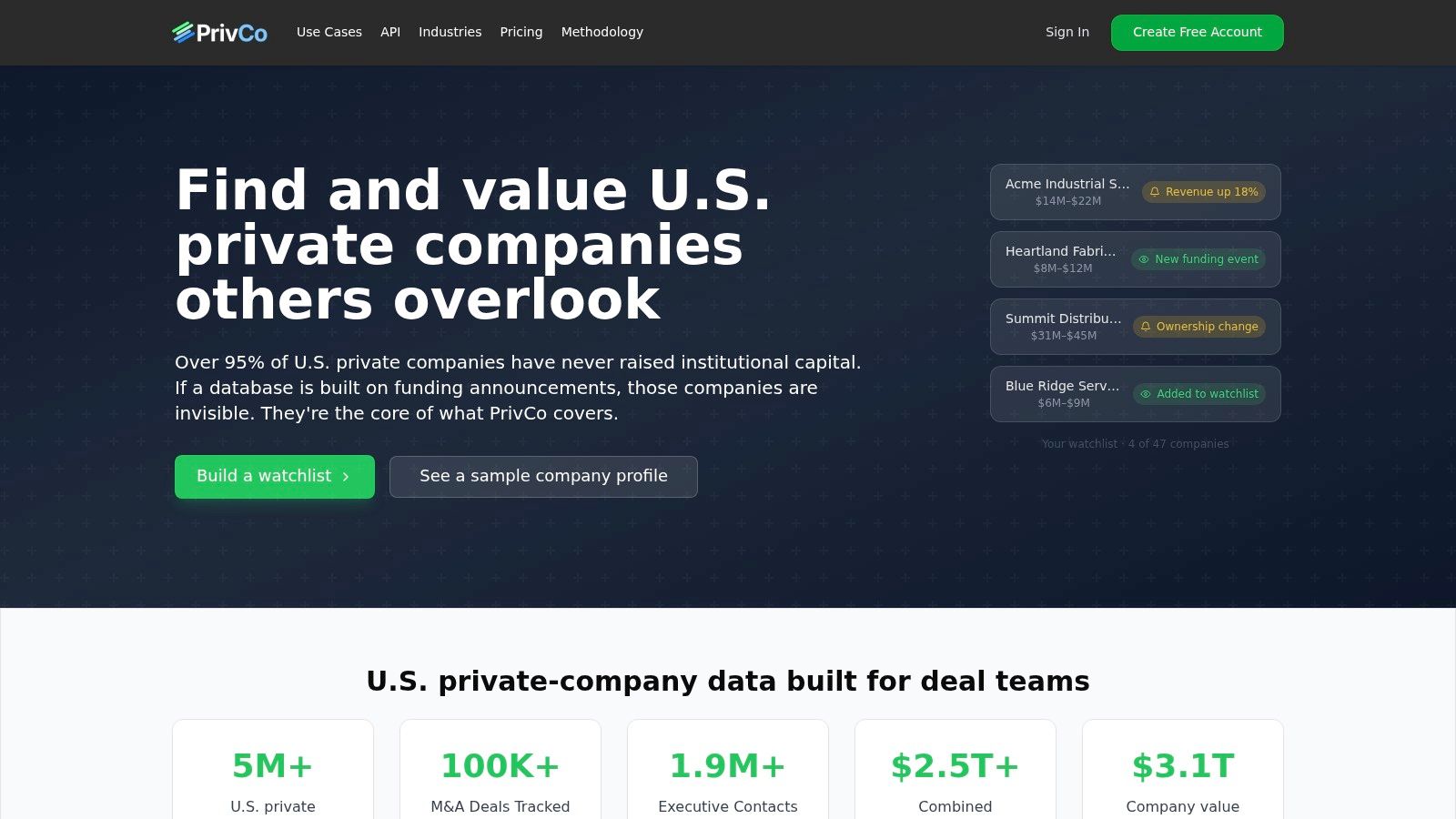
PrivCo is a strong candidate for U.S.-oriented private-company research, especially when financial estimates matter as much as funding history. The platform includes company, investor, funding, and deal search, with modeled revenue and EBITDA information, people data, and an investor database. An API supports record matching and enrichment, making it relevant to analyst, sales, and CRM workflows.
Its value comes from the financial lens. A team assessing a private company may want to understand estimated operating performance, ownership or investor context, and financing activity together. That's a different job from identifying the latest round or collecting a list of venture firms.
Useful enrichment, narrower international reach
PrivCo offers exports and watchlists, although limits vary by tier. Full-access plans require a sales conversation, so buyers should confirm which records, API functions, export volumes, and watchlist allowances are included before committing.
The main limitation is geographic. PrivCo is U.S.-oriented, and international coverage can be thinner than global platforms in some sectors. That doesn't make it unsuitable for cross-border research, but it does make market validation essential if the target universe includes companies outside the United States.
Use PrivCo when estimated private-company financials are central to the decision. Don't substitute it for a real-time funding alert system or a global allocator database.
For U.S. private-company diligence, financial prospecting, and API-based enrichment, PrivCo is well targeted. For broad international venture mapping or immediate post-funding outreach, another resource may fit better.
10. Harmonic
Harmonic takes an API-first approach to startup data. It offers structured company and person endpoints, natural-language search, bulk delivery to data warehouses, Postman collections, a Chrome extension, and integrations for prospecting workflows. That combination makes it attractive to early-stage investors, go-to-market teams, and developers who want startup and people data inside their own applications.
The developer experience is unusually visible. A public changelog provides insight into product development, while Postman collections can shorten the time between evaluation and a working prototype. Bulk warehouse delivery also gives data teams an option beyond repeated ad hoc API requests.
Production access needs technical diligence
Harmonic's strength is flexibility. Builders can create searches, enrichment flows, and internal tools around structured entities rather than relying only on a browser interface. The Chrome extension helps users capture that value during ordinary prospecting work.
Pricing isn't posted publicly, and production access is sales-led. Documented API behavior also indicates that snapshots can briefly lag the live state in some cases. That doesn't disqualify the platform, but it means teams should define acceptable freshness and test whether the delivery mode matches that requirement.
Harmonic is a strong option for API-first startup research, warehouse delivery, and custom agent applications. If the central requirement is verified funding events appearing within minutes, ask specifically about event freshness and verification workflows rather than assuming that a modern API automatically provides real-time data.
Top 10 Venture Capital Database Comparison
Provider Coverage & Freshness Contact verification & quality Integrations & delivery Pricing & licensing Best for / USP NowFunded Early‑stage focus (pre‑seed → Series B); 100+ new startups weekly; real‑time updates (minutes); 10k+ records (12mo) Deliverability‑verified emails & phones; billed only on successful verify; typically 2–5 contacts/company Native MCP, REST API, webhooks (push), CSV export, web dashboard; typed JSON schemas Free queries for funding events; contacts per‑pull ($0.10/email, $0.25/phone); no subscription or minimum; free trial AI‑agent first; instant outreach signals; low‑maintenance, machine‑friendly feed Dealroom Global startup & investor coverage with strong European & public‑sector feeds Email credits & optional business email credits; verification varies by feed API with MCP support, exports, ecosystem dashboards Packaged plans with annual multi‑seat minimums; Enterprise API gated European ecosystem insights; gov/accelerator inflows PitchBook Deep private‑markets & deal coverage (VC/PE/M&A); rich historical data People & firm data available; verification/refresh cadence enterprise grade Desktop/mobile, Excel & PowerPoint plugins, Chrome extension Premium enterprise pricing; multi‑seat annual contracts Analyst workflows; integrated Office tooling for modeling CB Insights Private‑company data + proprietary predictive signals (Mosaic, Exit Prob.) Company & people profiles; contact exports available but verification not core USP Web app, ChatCBI (NLP search); API/export details less prominent Enterprise‑level pricing (commonly high) Predictive scoring & future‑signals for strategy/product teams Crunchbase Broad startup coverage; self‑serve subscriptions; large community Basic contact/person data; verification depth varies by plan Public API, prospecting tools, data marketplace, exports Self‑serve monthly tiers; export quotas gated by plan Budget‑friendly, easy onboarding, developer APIs Tracxn Very large company & rounds claims; live deals & deal‑flow CRM CRM & live deals tracking; verification/details depend on pack APIs, bulk data dumps, reports/alerts, credit‑based exports Free Lite tier; premium/data packs require sales; export credits Free evaluation tier; clear redistribution licensing options Preqin (Pro) GP/LP fund data and benchmarking; venture included in multi‑asset suite Manager/fund performance data; founder‑level enrichment limited Web platform, reports, transaction intelligence; enterprise APIs Enterprise quotes; typically costly for multi‑asset access Allocator & fundraising diligence; LP/GP benchmarking S&P Capital IQ Pro Cross‑asset market intelligence (public + private); transaction depth Comprehensive people & company data; venture less specialized vs niche tools Excel/Office plugins, ChatIQ, document intelligence Sales‑quoted enterprise contracts Strong Excel integrations; useful when blending public comps & venture PrivCo U.S.‑focused private‑company financial estimates and modeled metrics API for enrichment; contact depth varies by tier; US emphasis API, exports, watchlists; CRM enrichment use cases Tiered access; full tiers require contacting sales U.S. financials & revenue/EBITDA estimates for analysts Harmonic API‑first startup database; bulk delivery & public changelog; active dev cadence Person endpoints & structured records; verification approach varies Strong API, bulk warehouse delivery, Chrome extension, changelog Sales‑led pricing; production access via sales Developer/builder friendly; bulk & warehouse delivery optionsBuild a Shortlist Around Your Workflow
The right venture capital database depends less on the size of its company index than on the action that follows a search. A sales team needs a fresh funding trigger and a reachable decision-maker. An LP needs manager performance and fund benchmarking. A strategy group needs market maps and predictive signals. A data team needs APIs, schemas, warehouse delivery, or webhooks. Those are different jobs, so one universal winner would be misleading.
Choose NowFunded when the workflow starts with a newly verified pre-seed through Series B round. Its combination of fresh funding events, deliverability-verified founder and leadership contacts, native MCP, REST API, webhooks, CSV, and dashboard access makes it the most direct option for agent-ready outreach, recruiting, and early-stage market monitoring. Its usage-based model also lets teams query funding data without a subscription, then pay for verified contacts when enrichment is needed.
Choose Crunchbase when self-serve access and a lower adoption barrier matter most. It's a practical general-purpose source for startup discovery, prospecting, and API experimentation, though teams should test export limits and validate records in important workflows. Choose Dealroom for European ecosystem research, public-sector and accelerator context, and MCP-compatible data operations, while confirming whether its annual, multi-seat structure fits your team.
For institutional research, PitchBook offers deep private-market coverage and mature Excel, PowerPoint, and workflow integrations. CB Insights is better suited to market analysis, predictive signals, and strategy research. Neither should be selected solely because it has a large dataset. Their value depends on whether your team can use the analytical depth and absorb enterprise pricing and implementation requirements.
Use Tracxn when broad startup coverage, deal-flow management, and data licensing are central. Use Preqin for LP and GP research, fund benchmarking, manager diligence, and allocator workflows. Select S&P Capital IQ Pro when venture analysis must connect with public comparables, credit, M&A, and Office-based financial modeling. Choose PrivCo when U.S. private-company financial estimates and API enrichment matter more than global breadth. Assess Harmonic when your developers need API-first startup data, structured person and company endpoints, and bulk warehouse delivery.
Before signing a contract, run representative searches from the workflow you care about. Check how quickly a recent funding event appears, whether round and investor fields are complete, how often contacts verify, what export and API limits apply, and whether the data can enter your CRM or warehouse without manual cleanup. For institutional platforms, ask for the exact seats, permissions, historical fields, and integrations your analysts will use.
Finally, compare total workflow cost rather than license price alone. A cheaper database can become expensive if analysts reconcile stale records manually, developers maintain scrapers, or sales teams pay for unreachable contacts. A premium platform can also be wasteful when a focused feed solves the job with less implementation. The best shortlist is the one that connects your required signal to a measurable next action.
NowFunded provides a live, verified feed of newly funded startups from pre-seed through Series B, with deliverable founder and leadership contacts and delivery through MCP, REST API, webhooks, CSV, or dashboard. If your venture capital database workflow depends on fresh events and agent-ready outreach, visit NowFunded to test the feed and see whether it fits your process.