Tech Crossover Ventures Explained with Examples and Impact

You've reached the stage where your startup needs a large round, but the investor list suddenly looks unfamiliar. A traditional venture firm may still be involved, yet the most consequential call could come from a fund that also owns public technology stocks, a mutual fund with a long-term portfolio, or a corporate investor looking for strategic access. The check may arrive without a board seat, hands-on operating support, or the familiar cadence of weekly founder meetings.
That investor is often described as a crossover investor. For founders, the label matters because crossover capital can change more than the amount raised. It can alter the company's valuation expectations, cap-table dynamics, exit timetable, diligence process, and the way future investors interpret the round.
Table of Contents
- When an Outsider Writes the Biggest Check
- What Tech Crossover Ventures Mean
- How a Few Rounds End Up Controlling Most of the Capital
- Named Players Who Shaped the Crossover Model
- Hedge Funds, Mutual Funds, and Corporate Crossovers Compared
- What a Crossover Round Changes on the Cap Table
- Tracking Crossover Activity in Real Time
- Misconceptions Founders Should Test Before Taking the Money
When an Outsider Writes the Biggest Check
A Series D founder expects the next financing conversation to begin with familiar names. The company has already built a strong product, hired a substantial team, and demonstrated enough traction to attract late-stage venture firms. Then an unfamiliar fund reaches out. Its team doesn't behave like a classic seed investor, and it doesn't ask for a board seat. Instead, it offers to fund half the round.
The founder initially wonders whether the offer comes with a catch. There are no weekly office hours, no promise to help recruit a head of sales, and no detailed operating plan. Yet other late-stage investors take the call seriously as soon as they hear who wants to participate. The outsider's reputation comes from a different market. It knows how public investors evaluate growth, margins, liquidity, and the path to an eventual listing.
That's the first useful intuition behind tech crossover ventures. A crossover investor enters the private market with experience, capital, or habits shaped by another part of finance. The firm may invest in private companies before an IPO, hold public shares afterward, or move between private and public positions as the company matures.
Why the founder feels the difference
The new check affects the founder immediately. A larger round can extend the runway, but it also creates more capital that the company must deploy effectively. A higher valuation can reduce dilution in the current financing, while raising the performance bar for the next one. The investor's presence can attract other funds, but it can also make those funds ask whether the company is already being prepared for a public-market outcome.
Crossover capital also changes the emotional texture of fundraising. The founder is no longer speaking only to investors who have spent their careers building private-company relationships. The conversation now includes people who may compare the startup with public-market peers, assess the timing of liquidity, and decide whether the company fits a portfolio construction strategy.
Founder takeaway: A crossover check isn't just another source of cash. It's a signal that the company is being evaluated as a potential public-scale asset.
The key question becomes less “Who can fund us?” and more “What kind of investor are we inviting into the company, and what behavior will that investor bring?”
What Tech Crossover Ventures Mean
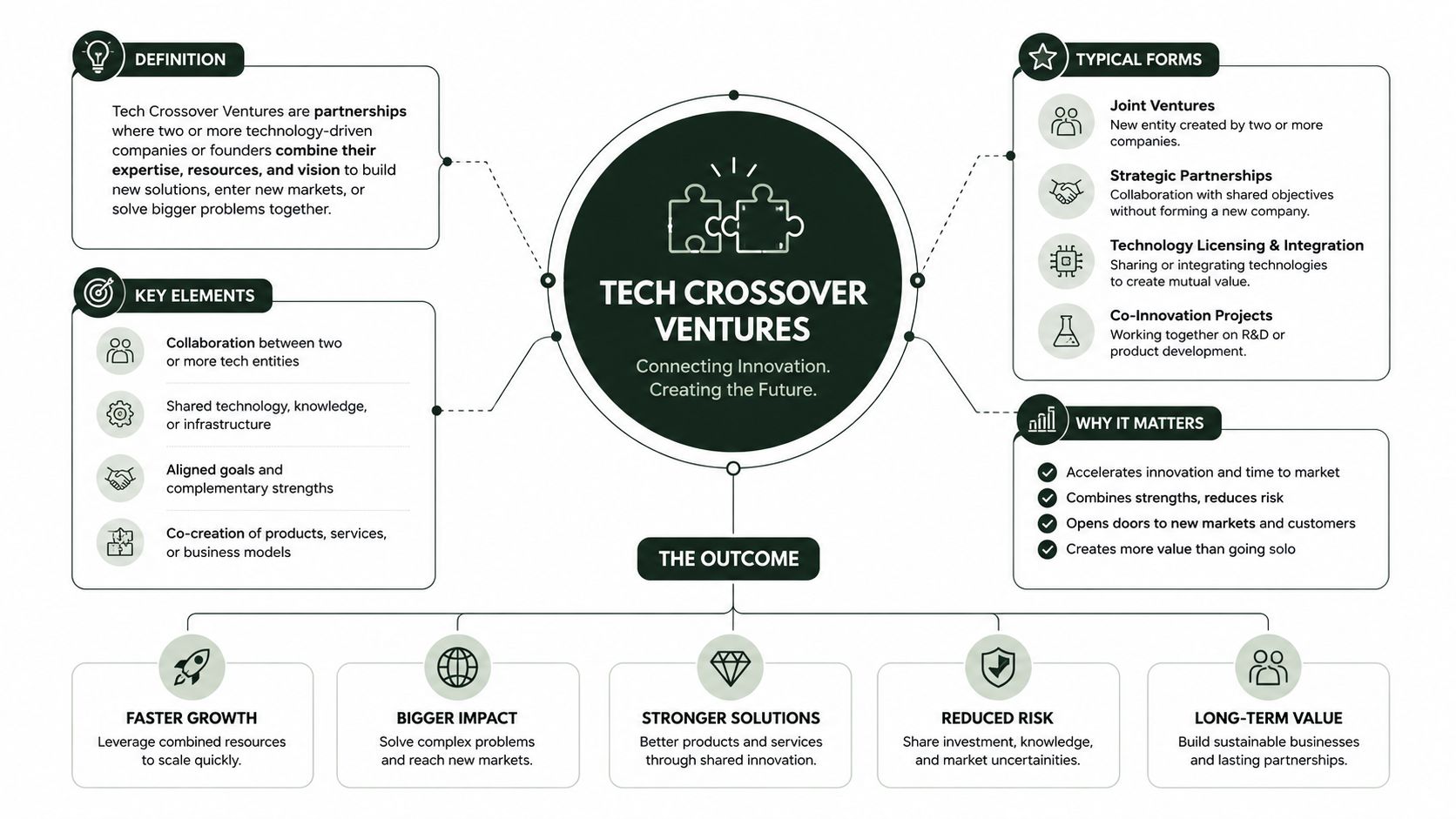
A founder may enter a late-stage financing expecting another institutional check and meet an investor whose habits come from public equities, hedge funds, mutual funds, or corporate investing. That encounter captures the basic idea: tech crossover ventures involve investors from outside traditional venture capital joining a private technology financing round. “Crossover” describes how the investor operates, rather than a specific legal structure or firm category.
A crossover investor typically does several things:
- It buys shares in a private company, often during a later financing round.
- It evaluates the company with public-market tools, including comparable-company analysis, liquidity expectations, and portfolio allocation.
- It may hold the investment after an IPO, or sell through a secondary transaction or another liquidity event.
- It can invest on both sides of the boundary between private and public markets.
How the investor types differ
A traditional venture capital firm usually builds relationships early, leads or joins seed and growth rounds, and accepts that many investments will fail while a small group produces the fund's strongest outcomes. Its contribution may include recruiting help, product advice, customer introductions, and board participation.
A growth-equity firm generally invests in a more mature business. It may buy a structured minority position, negotiate stronger protective rights, and focus on operating performance, efficient growth, and a credible exit path. Its financial model is often more developed than an early-stage VC's.
A crossover investor combines elements of both approaches. It may offer less operational support than a traditional VC and seek less control or structure than a private-equity investor. Its defining capability is evaluating a private technology company through private-growth and public-equity lenses at the same time.
What the founder experiences
The distinction usually becomes visible in a late-stage round, often after Series C. The investor may write a larger check, apply public-company valuation logic, and ask detailed questions about market size, retention, margins, governance, and listing readiness.
The round can therefore change the founder's working plan. A company may need to explain how it can support continued private growth, a strategic acquisition, a secondary sale, or a public listing. The investor connects these possible outcomes, while the company still carries the execution risk between financing and exit.
A crossover check is a financing event and a new evaluation lens. The founder should ask what assumptions the investor brings, how it handles a longer private period, and what evidence will support the next round.
How a Few Rounds End Up Controlling Most of the Capital
Late-stage venture financing can look broad when measured by the number of transactions. Capital deployment tells a different story. A small group of large rounds can absorb a disproportionate share of the money, while many smaller financings receive far less attention from major crossover funds.
The clearest available U.S. example comes from PitchBook's analysis of crossover venture activity. Crossover participation was linked to $89.6 billion in deal value in 2024, more than half of the $172.4 billion recorded in 2021. Over the last 10 quarters, these investors averaged about 170 deals per quarter, roughly one-third of their 2021 quarterly deal flow.
The key point is the relationship between transaction count and capital value. Crossover-backed deals represented only 4.9% of all U.S. venture deals in 2024, yet they accounted for 42% of total deal value, according to the same PitchBook analysis. A small slice of transactions therefore controlled a very large share of the dollars moving through the market.
Why concentration happens
Several forces create this imbalance:
- Later-stage focus: Crossover investors tend to enter when companies already require substantial financing.
- Large commitments: A fund may concentrate capital in companies it believes can reach public-company scale.
- Valuation discipline: Managers compare private opportunities with public technology companies and may avoid smaller rounds that don't fit their return requirements.
- Selective follow-on support: Once an investor commits, it can reserve capital for companies that continue to meet its growth and liquidity expectations.
The result resembles a funnel. Many startups seek funding, fewer reach late-stage financing, and an even smaller group attracts the largest checks. Capital then clusters around companies that appear capable of supporting institutional ownership and a future liquidity event.
The headline deal count tells you how often crossover investors participate. Deal value tells you where their influence is concentrated.
For founders, that concentration affects signaling. A crossover investor's participation can make a round look more institutionally significant, even when the company has only added a small number of new investors. For analysts, the same pattern helps identify where public-market capital is clustering before a potential listing, sale, or secondary transaction.
Named Players Who Shaped the Crossover Model
Technology Crossover Ventures, now widely known as TCV, provides one of the clearest examples of how the model became institutionalized. TCV was founded in 1995, and the firm says it has invested in more than 350 technology companies worldwide, with total invested capital exceeding $22 billion and portfolio outcomes including more than 150 IPOs and strategic acquisitions. Those figures come from TCV's company profile.
The firm's fundraising history shows the strategy's expansion. TCV's funds grew from $100 million in 1995 to $4 billion in 2020, followed by a $3 billion fund closed in 2024, as reported in the same profile. The progression illustrates a shift from a specialized approach to a large institutional market segment focused on technology companies with the potential to scale dramatically.

Different firms bring different instincts
TCV represents the specialist model, with a long history of focusing on technology-scale businesses. Other crossover participants developed from different starting points.
Tiger Global became known for moving quickly and taking a comparatively hands-off approach. That style can appeal to founders who want a large investor without extensive operational involvement, but it can also make the firm's future participation harder to infer from traditional relationship signals.
Coatue brings a public-markets orientation shaped by technology research and concentrated conviction. Its interest can indicate that an investor is assessing the company alongside listed technology opportunities rather than viewing it only through a venture portfolio lens.
General Atlantic has a growth-investing heritage and often approaches expansion-stage companies with a strong emphasis on international scale, durable growth, and institutional maturity.
These descriptions are useful as starting points, not rigid rules. A firm's strategy can change by fund, market cycle, team, and company stage. Founders should study the specific partner, vehicle, prior investments, follow-on behavior, and exit history rather than relying on the logo alone.
Reading the inbound email
An unexpected participant may be a pure-play crossover specialist, a public-market fund, a corporate investor, or a growth platform with flexible mandates. Each can bring credibility, but the key question is how that investor behaves after closing.
Ask whether it supports later rounds, how it handles difficult quarters, what information it expects, and whether it prefers an IPO, acquisition, or private liquidity. Those answers reveal more than the category name.
Hedge Funds, Mutual Funds, and Corporate Crossovers Compared
“Crossover” doesn't identify one type of institution. It describes the act of investing across private and public-market boundaries. A hedge fund, mutual fund, corporate venture arm, or specialist growth investor can all behave as a crossover participant, but their motivations and constraints may differ substantially.
Investor Type Holding Horizon Diligence Style Strategic Value Hedge fund crossover Often flexible and market-sensitive Focuses on growth, valuation, liquidity, and catalysts Fast capital and public-market perspective Mutual fund crossover Often oriented toward longer-term portfolio ownership Emphasizes durable growth, governance, and public comparables Stronger public-market signaling and patient ownership potential Corporate investor Depends on strategic priorities and business cycles Adds product, regulatory, partnership, and integration review Distribution, domain validation, and commercial access Pure-play crossover specialist Varies by fund and mandate Combines venture diligence with growth and public-market analysis Experience navigating late-stage technology financingA hedge fund crossover may prioritize momentum, valuation movement, and the timing of a liquidity event. Its participation can be valuable when the company needs a large check quickly, but founders should ask how the investor behaves when market sentiment changes.
A mutual fund, such as a public-market asset manager with a private-investment program, may bring a longer-duration perspective. It can evaluate the company as a future public holding, which may strengthen the IPO signal. That doesn't guarantee continued ownership, however. The fund's internal mandate and liquidity rules still matter.
A corporate crossover adds another layer. Corporate investors can validate domain fit and provide access to distribution channels, technical infrastructure, customers, or regulated markets. At the same time, corporate participation often introduces strategic-fit filters that can lengthen diligence or limit flexibility around partnerships and competitive relationships. LAVCA's ecosystem research tracks corporate investors and names active participants such as Citi Ventures, Qualcomm Ventures, TOTVS, Vivo Ventures, and SQM Lithium Ventures in Latin America.
Treat the label as an opening question, not a conclusion. The investor's mandate determines the relationship.
What a Crossover Round Changes on the Cap Table
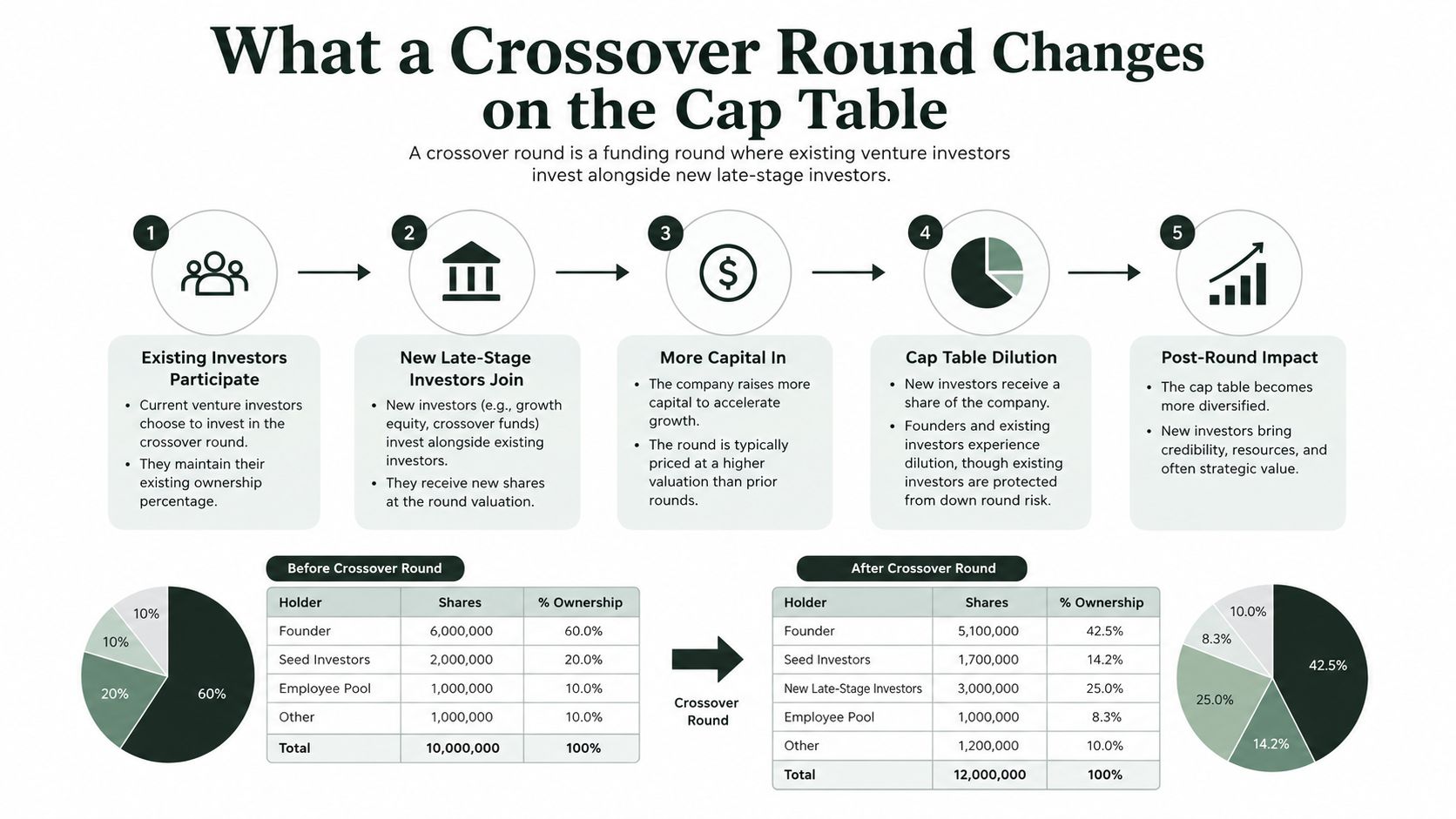
A crossover-led Series E or pre-IPO round can change the company's ownership structure without removing any existing venture investor. New shares are issued, the total share count increases, and every existing holder's percentage may decline. The size of that shift depends on the financing terms, the company's pre-money valuation, the option pool, and any outstanding convertible instruments.
The cap table is only the starting point. A new investor may also receive rights that affect future decisions:
- Pro-rata rights can let the investor maintain its ownership in later rounds.
- Information rights can require regular financial and operating reporting.
- Protective provisions can give preferred holders consent rights over specific actions.
- Board or observer rights can increase access to company deliberations.
- Drag-along thresholds can influence how an eventual sale is approved.
A founder may accept a higher valuation to reduce immediate dilution. That can preserve more ownership today, but it also establishes a demanding benchmark for the next financing. If the company's growth doesn't support that price, the startup may face a difficult reset later.
A flatter valuation can create more dilution in the current round, yet it may leave the company with greater flexibility. The right comparison isn't just “higher price versus lower price.” It's ownership retained versus expectations created.
Signaling changes alongside ownership
A mutual fund anchor may tell future investors that the company is being assessed for public-market readiness. A hedge fund anchor may signal that the investor sees a near-term catalyst or a compelling valuation. A corporate investor may indicate that the company has strategic relevance in a particular industry.
None of those signals replaces execution. They shape how the next investor frames questions about revenue quality, governance, retention, margins, and liquidity.
Crossover participation can also compress the timetable. Existing investors may exercise pro-rata rights, new investors may negotiate additional allocation, and the company may face pressure to reach the next milestone sooner than expected. The financing expands the cap table, but it can also narrow the range of acceptable outcomes.
Tracking Crossover Activity in Real Time
Analysts can't identify crossover activity reliably by looking only at a firm's brand. The same investor may act as an early-stage VC in one deal, a growth investor in another, and a public-market participant elsewhere. The useful unit of analysis is the investor's role in a specific financing event.
A practical workflow begins with structured funding data. The analyst captures the company, round, lead investors, participating investors, date, location, industry, and stage. Next, the analyst classifies each participant by behavior, not just by institutional label.
A repeatable monitoring workflow
- Ingest the event: Record the financing announcement and the parties named in it.
- Tag participation: Separate lead investors, co-investors, existing insiders, strategic participants, and secondary sellers.
- Check the mandate: Review the investor's private-market activity, public holdings, stage focus, and stated strategy.
- Resolve entities: Confirm that similarly named funds, affiliates, and corporate venture arms aren't being counted as the same organization.
- Enrich the record: Add company leadership, headquarters, industry classification, and relevant portfolio relationships.
- Prioritize action: Score the event for deal sourcing, investor relations, recruiting, partnership, or outbound relevance.
This approach matters because a sector label can hide the actual opportunity. Startup Genome's methodology analyzes more than 4 million companies across 350-plus startup ecosystems using multiple funding databases, AI, machine learning, and manual review. Its ecosystem model uses a 62-mile radius around a center point. The broader lesson is that entity resolution, deduplication, and location cleaning are essential when companies cross industry and geographic boundaries.
Signal Source Verification Step Investor joins a private growth round Funding announcement or structured feed Confirm the investor's role in the specific deal Investor operates across private and public markets Firm disclosures and portfolio records Match the fund or vehicle to its mandate Corporate participation appears in the round Company release and investor materials Check strategic relationship and operating affiliate The company enters a later financing stage Round documentation Validate stage, date, and participating investors A new contact becomes outreach-relevant Leadership and company records Confirm role, identity, and contact statusTeams that need a live, structured view of funding activity can also use NowFunded's startup intelligence platform as part of a broader monitoring workflow. The important principle remains the same: track verified events first, then turn those events into enrichment, overlap analysis, and prioritized conversations.
Misconceptions Founders Should Test Before Taking the Money
A crossover check can look like automatic validation for a smooth IPO path. It isn't. The investor may be preparing for a public listing, but it may also be seeking a private secondary sale, a tender offer, a strategic transaction, or another liquidity opportunity before the company ever lists.
Founders should test the investor's actual history instead of accepting the implied narrative. Ask whether the fund has held comparable companies through a full liquidity event. Find out whether it typically sells before listing, whether it has restrictions on holding public shares, and how its partners describe the expected holding period.
The legal terms deserve the same scrutiny as the valuation.
Questions to put in the diligence process
- Who controls the relationship? Identify the specific investment professional who will remain engaged after closing.
- What rights come with the check? Review information rights, observer rights, consent provisions, transfer rights, and any special exit language.
- How does the investor handle weak performance? Ask for examples of follow-on behavior when a portfolio company misses expectations.
- What does liquidity mean to this fund? “IPO-ready” can mean a public listing, a secondary transaction, or a higher private valuation.
- Can the investor sell early? Understand transfer restrictions, lockups, tender participation, and the effect of a secondary sale on the wider cap table.
- What happens in the next round? Clarify pro-rata participation, allocation expectations, and whether the investor expects preferential access.
A respected investor can improve your financing options, but it can't replace a careful review of rights, incentives, and exit behavior.
Crossover capital may bring credibility, substantial funding, and useful market knowledge. It can also introduce shareholders whose priorities differ from those of founders, employees, and long-term operating investors. A fund focused on liquidity may favor a faster transaction, while a founder may prefer to keep building privately. Neither preference is wrong, but the difference needs to be explicit before the documents are signed.
Founders looking for a broader framework for funding decisions can review the startup financing resources at NowFunded. Use the same standard for every investor: understand what the money enables, what the terms require, and which future decisions the new shareholder can influence.
If you're tracking tech crossover ventures, new funding rounds, or founders who may need timely capital intelligence, NowFunded provides a live, verified feed of newly funded startups with structured company and investor data. Explore its API, MCP, webhook, CSV, and dashboard options to turn confirmed funding events into focused research, sourcing, and outreach.