Startups That Need Funding: How to Find and Reach Them
In 2025, investors deployed $425 billion into more than 24,000 private companies worldwide, a 30% increase from 2024 and the third-highest venture-financing year on record, according to YouStartups' venture capital statistics. That doesn't mean startups can raise easily. Capital exists, but it's concentrated, selective, and increasingly committed to companies that can prove momentum.
For sales and recruiting teams, the implication is straightforward: the opportunity isn't finding every startup founder on the internet. It's identifying which startups that need funding have just received capital, verifying the right decision-maker, and reaching out while the round is still shaping the company's priorities. A live, time-stamped funding event can turn a stale prospecting project into a usable pipeline in minutes.
Table of Contents
- Why Finding Funded Startups Is Harder Than It Looks
- What It Actually Means When a Startup Needs Funding
- The Four Signals That a Startup Is Raising
- Where to Find These Startups and Which Source Wins
- Turning a Live Funding Feed Into Qualified Pipeline
- Outreach Playbook for Newly Funded Startups
- Quality Beats Quantity in Startup Prospecting
Why Finding Funded Startups Is Harder Than It Looks
The funding market has substantial capital, yet early-stage companies still face strict screening. Investment has shifted toward fewer, later-stage rounds instead of spreading evenly across the startup pipeline, as noted earlier. Founders must compete with a clear differentiation story, credible traction, and evidence that they can justify follow-on capital.
That selectivity creates a direct prospecting problem. A generic founder list rarely explains why a company should buy now. It may contain an old job title, an outdated email address, a startup that changed direction, or a company that raised capital long ago and already selected its vendors. The list appears large, but the buying context is absent.
Why scraped lists decay quickly
Consider a B2B SaaS founder who closed a seed round in March. By May, several sales representatives are pitching the company from a six-month-old aggregator export. They may still have the founder's name, but they lack the event that changed the founder's priorities, the investors involved, the likely use of funds, and the timing of upcoming hiring or tooling decisions.
Old records create operational drag:
- Stale company data: The startup may have changed its website, market, leadership team, or hiring plan.
- Missing funding context: A founder who just raised may be evaluating infrastructure, recruiting, finance, security, or go-to-market systems.
- Unsolicited contact risk: A scraped email provides no evidence that the prospect is researching your category.
- Deliverability exposure: Unverified addresses increase bounces and force representatives to clean lists instead of selling.
Practical rule: A larger unverified funnel does not create more pipeline when representatives spend the week repairing it.
Make timing the qualification layer
Ask, “Which newly funded startups matter this week?” rather than, “Which founder emails can we collect?” A verified funding announcement provides a time-stamped reason to open a conversation. It also gives representatives context for tailoring outreach around the round, lead investor, stage, location, industry, and likely operating priorities.
Build the workflow around fresh funding events first, then filter for fit. A live feed can compress research from weeks to minutes because representatives start with a confirmed event instead of reconstructing a company's situation from scattered records.
The best output is a smaller list of recent, verified companies. It gives the team a clear trigger, a current account context, and a practical reason to contact the right decision-maker before the company's new priorities become crowded with competing vendors.
What It Actually Means When a Startup Needs Funding
“Needs funding” doesn't describe one buyer state. In practice, startups that need funding usually fall into three distinct categories, and each requires a different sales motion.
The first is active fundraising. The founder is speaking with funds, taking warm introductions, responding to investor outreach, or preparing materials for term-sheet conversations. This is a real need, but it doesn't automatically mean the company is ready to buy from vendors. The team may be conserving cash, delaying commitments, or prioritizing investor diligence over operational changes.
The second is pre-emptive need. The company's runway is tightening, hiring has slowed, leadership is changing, or new advisors are appearing around finance and strategy. These signals can indicate that the founder is preparing for a raise, but they're indirect. Treat them as account research inputs, not proof of a live buying window.
The third is post-funding momentum. The company has closed capital recently and is beginning to deploy it against a plan. That plan might involve product development, revenue growth, hiring, compliance, customer success, or a more disciplined finance function. This is usually the cleanest prospecting target because the event is verifiable and the operating priorities are changing immediately.
Use the state to choose the motion
A founder actively fundraising may respond to a thoughtful insight, referral, or investor-relevant resource. Don't lead with a heavy implementation pitch. Help them understand how your offer supports the company they're trying to build.
For a pre-emptive account, monitor rather than over-sequence. Engage when the company publishes a concrete trigger, such as a financing announcement, executive hire, product launch, or expansion.
Post-funding momentum deserves fast, specific outreach. A company that recently closed a round is often deciding which initiatives deserve budget and attention. Your message should connect the financing event to one operational problem you can help solve.
A practical founder scenario
Take a 12-person seed-stage startup with nine months of runway that closed a bridge in February. It may not be broadly shopping for tools, but it could selectively buy systems that support a future Series A narrative, such as repeatable sales operations, stronger reporting, or more reliable hiring processes.
The response window is different in each state. Active fundraising calls for relevance and patience. Pre-emptive signals call for monitoring and light engagement. Post-funding momentum supports immediate, event-based outreach because the company has a confirmed capital event and a reason to reassess priorities.
All three states matter. Only the last one gives you the combination of real-time verification, clear timing, and immediate budget context.
The Four Signals That a Startup Is Raising
Not every funding signal deserves the same weight. Rank indicators by how close they are to a confirmed capital event and how directly they connect to a buying decision.
Four Funding Signals Ranked by Reliability
Signal Example in the Wild Confidence Announced or confirmed round The company announces a seed round, converts a SAFE, or confirms a financing event through a reliable source High New executive hire A startup adds a finance, sales, or operations leader after a period of founder-led execution Medium to high Investor and equity-platform activity Cap-table or company records show fresh investor activity on platforms such as AngelList or Crunchbase Medium Runway and leadership signals Hiring slows, advisors join, or leadership responsibilities shift toward fundraising preparation Low to mediumAn announced round ranks first because it's time-stamped. The company has either publicly disclosed the financing or provided enough confirmation to establish that capital changed hands. That gives a sales representative a defensible reason to reach out and a precise anchor for personalization.
A new executive hire is useful, particularly at Series A and later stages. A finance, sales, or operations leader often arrives when the company needs more structure, but the hire may reflect growth, replacement, or preparation rather than an active raise. Use the signal to shape your hypothesis, not to state an unverified conclusion.
Read platform activity carefully
Updates on AngelList, Crunchbase, and equity platforms can reveal investor movement or changes in company records. They're valuable for account research, especially when public announcements are incomplete. Their weakness is timing. An update can lag the actual event, reflect a partial record, or omit the commercial context a rep needs.
Runway signals belong at the bottom because they're ambiguous. A slowing job board may reflect hiring discipline, a finished recruiting push, or a shift in company strategy. A new advisor may support fundraising, governance, or product direction. These clues help you prioritize monitoring, but they don't justify a high-volume sequence.
Scraped job postings and podcast mentions sit even lower. They can generate useful context, but neither proves that a company is raising or buying. A podcast appearance may have been recorded long before publication, while a job posting can remain live after the role has been paused.
Verified event first, inferred intent second. Use weak signals to enrich an account after a funding event, not to replace the event itself.
Where to Find These Startups and Which Source Wins
Your discovery source determines how quickly you can act and how much manual work remains after a lead enters the system. Public databases, scraped lists, and live verified feeds each solve a different problem.
Public databases are strong for broad market research and historical analysis. They're less effective when your objective is first-response outreach. Company records can lag the actual funding event, and analysts often export data into another system where the record becomes even less current. The database may be wide-ranging, but completeness isn't the same as freshness.
Scraped lists look inexpensive because the apparent cost per row is low. That calculation ignores the work required to confirm the company, identify the right role, validate the email, determine whether a funding event occurred, and remove duplicates. A cheap row becomes expensive when it produces a bounce, a generic inbox, or an irrelevant sequence.
A live verified feed changes the workflow. It starts with a recent funding event, attaches company and round information, and provides verified founder or leadership contacts without requiring a separate enrichment project. NowFunded is one example of this model, with funding-event records and verified contacts available through structured delivery options.
Channel Avg. Latency Cost Model Data Quality Best For Public databases Delayed and variable Research access or seat-based pricing Broad, but timing and contact accuracy vary Market mapping and analyst research Scraped lists Unclear and often stale Low apparent cost, plus cleaning and verification work Inconsistent, with missing funding context Temporary account research Live verified feeds Minutes after a verified event Usage-based or platform access, depending on provider Time-stamped events with structured company and contact fields Event-based early-stage outreachChoose by workflow, not by sticker price
For early-stage outbound, compare three operating costs: latency, cost per usable contact, and deliverability risk. A database may win when an analyst needs broad historical coverage. A live feed wins when a sales representative needs a fresh event and a verified person now.
Your source should also match your team's technical maturity. A small team may need a dashboard or CSV. A larger operation may want webhooks, APIs, or an agent connection. The right choice is the one that removes the most manual steps between a confirmed round and a relevant first touch.
Turning a Live Funding Feed Into Qualified Pipeline
A funding feed only creates value when it enters the sales workflow cleanly. Your team should define the qualification rules before connecting the data source. Start with stage, sector, geography, round size, lead investor, headcount, and target role. Then decide what happens when an event matches.
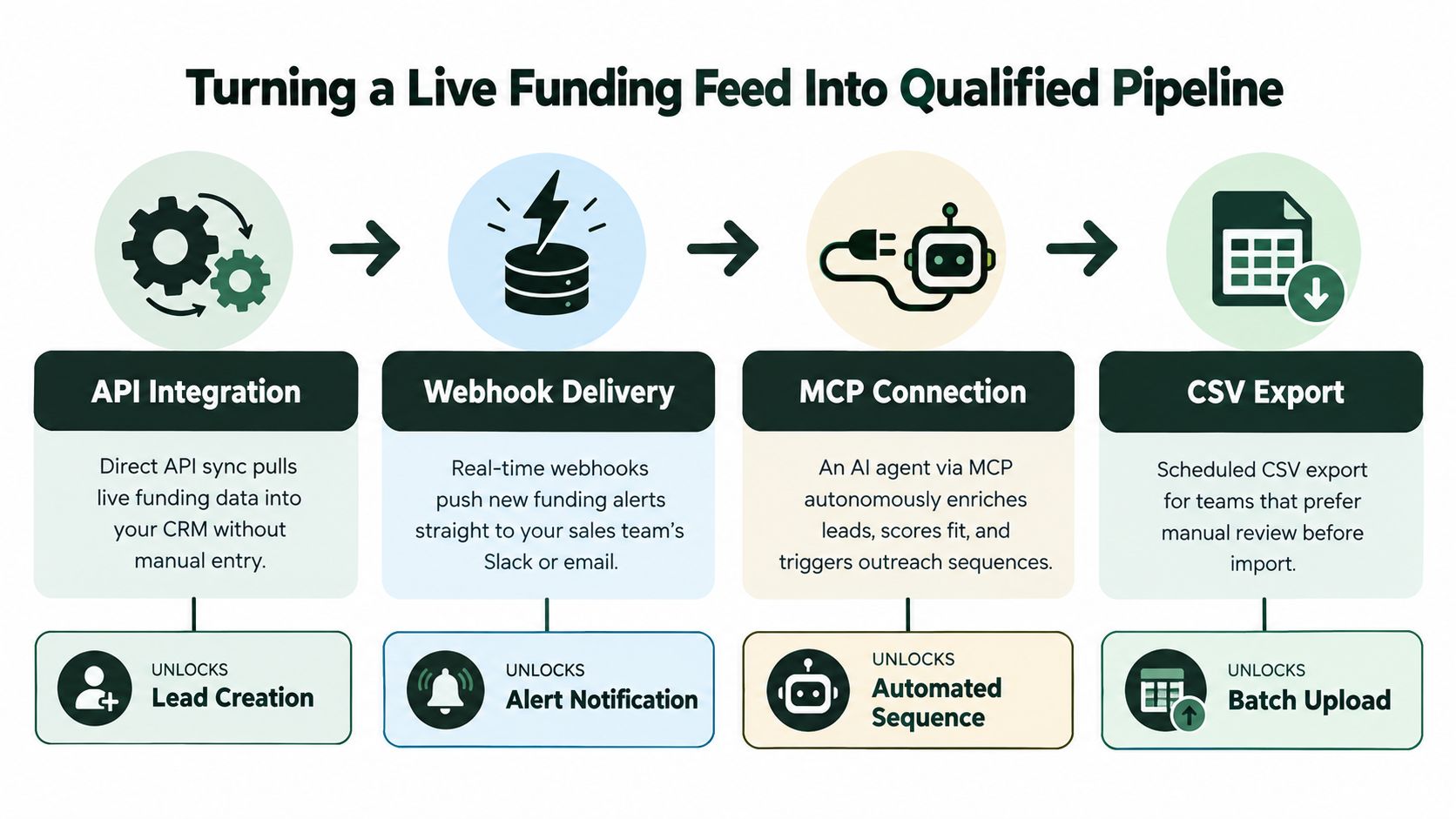
Use the delivery mode that matches the job
MCP connection: An AI agent can query newly funded startups by stage, sector, and geography during a research conversation. It can then draft an opener that references the round and lead investor, while a human reviews the message before sending. This works well for account research and personalized prospect preparation.
REST API: Pull structured records into a Postgres warehouse or another internal data store. SQL filters can separate SaaS seed rounds above your chosen threshold from European fintech Series A companies, then pass only qualified accounts into your CRM or sequencing layer.
Webhooks: Push a JSON payload to Slack as soon as a qualifying round closes. A channel notification can include the company, stage, amount, investor, location, website, and verified contact status. The representative can claim the account before it disappears into a weekly batch.
CSV export: Use a scheduled file when your team prefers review before import. A weekly CSV can be checked by operations, deduplicated against existing accounts, and uploaded into Outreach, Salesloft, or a CRM.
Preserve the fields that make timing useful
Don't reduce the event to a company name and email address. Keep the minute-level timestamp, round type, amount, lead investor, industry, location, company URL, LinkedIn profile, and verification status. These fields support routing, personalization, prioritization, and auditability.
The verified-contact layer should also stay inside the workflow. If representatives must enrich every event through another provider, you've recreated the delay the feed was meant to remove. Set a rule that only verified contacts enter an outbound sequence, while uncertain records remain in research.
A strong pipeline flow is simple:
- Detect: Receive a verified funding event.
- Filter: Apply your stage, market, and role criteria.
- Route: Assign the account to a representative or territory.
- Personalize: Build the first message around the event and one company-specific observation.
- Measure: Track response, meeting, opportunity, and disqualification reasons by trigger.
Outreach Playbook for Newly Funded Startups
Build the sequence around the funding event, not a generic persona. A chief executive at a newly funded company isn't valuable because of the title alone. They're relevant because the round may have changed their priorities, budget, hiring plans, and expectations from investors.
The first hour
Send a short email or LinkedIn note as soon as the event is verified. Name the round, identify the lead investor when available, and add one concrete observation about the company's product, market, hiring pattern, or customer motion. Offer one useful asset, such as a go-to-market teardown, integration map, or operating checklist.
Keep the call to action narrow. Ask whether the issue is on the team's current roadmap, rather than asking for a broad introductory meeting with no context.
The third day
Follow up with evidence that matches the company's stage. A relevant case study can work, but only if it addresses the bottleneck the new capital is likely to support. Ask a low-friction question tied to the company's stated use of funds or visible operating direction.
Don't send the same message to every recipient. A pre-seed company may need validation and founder-led selling support. A later-stage company may care more about repeatability, reporting, hiring capacity, or process control.
The seventh and fourteenth days
On day seven, switch to a lighter touch. Comment thoughtfully on a team post, respond to a founder thread, or share a relevant observation without repeating the pitch. This keeps the interaction useful and gives the prospect another way to recognize your name.
On day fourteen, send a clear breakup note. Reference the round once more, state the problem you thought might matter, and leave the door open without manufacturing urgency. Keep the sequence limited to verified contacts and throttle volume to protect sender reputation.
For additional practical material on funding-event research and startup outreach, use the NowFunded blog. The operating principle is consistent across channels: event relevance beats persona volume.
Quality Beats Quantity in Startup Prospecting
The lead-volume mindset is still damaging outbound teams. A 10,000-row scraped list sounds productive, but it often contains stale companies, unverified emails, duplicate records, and no evidence that the founder has a current reason to buy. Representatives then spend hours on list hygiene while their best prospects receive generic messages disconnected from any business event.
A smaller list of 200 freshly funded, verified startups can outperform a larger unverified list because it concentrates attention around a real trigger. The comparison should focus on three things: deliverability, conversion opportunity, and rep time.
Metric Unverified Scraped List (10k) Live Verified Funded Feed (200) Deliverability Exposed to stale addresses, bounces, and spam traps Limited to contacts with verification status Conversion context Usually no current funding or buying trigger Anchored to a recent, time-stamped financing event Representative effort High manual work for cleaning and researching Focused effort on qualification and personalization Opportunity cost Time spent repairing records and chasing weak fits Time spent inside active or recent buying windows Scaling risk More volume can multiply data and sender problems Controlled expansion preserves relevance and list qualityDeliverability comes before activity
Every bad address creates more than one failed touch. It consumes sequence capacity, distorts reporting, and can weaken confidence in the entire prospecting system. Verified contacts don't guarantee a meeting, but they remove one preventable failure before the message is sent.
Triggered relevance improves the conversation
A newly funded founder is more likely to recognize a message about a current operating priority than a cold pitch based only on title and industry. The funding event gives your representative a reason to research the company and a natural opening for a specific question.
The same logic applies to opportunity cost. When representatives work from a verified event feed, they spend less time discovering whether an account is real and more time deciding whether the account fits. The math is clear in operational terms: scaling volume without verification is a tax, not a tactic.
Sales-ops standard: Don't ask how many leads entered the system. Ask how many verified, timely funding events became qualified conversations.
NowFunded gives sales and research teams a live, verified feed of newly funded startups, with structured company data and verified founder and leadership contacts delivered through MCP, REST API, webhooks, CSV, or a dashboard. Use it to replace stale startup lists with time-stamped funding triggers, then visit NowFunded to build a faster, cleaner prospecting workflow.