Startup Lead Generation: How to Build a Predictable Pipeline
Your SDR team starts Monday with a spreadsheet full of prospects scraped on Friday. Two hundred names sit untouched, the sequence stalled at its second step, and the VP of Sales is asking why pipeline is flat even though activity is up. The problem usually isn't effort. It's that the system treats startup lead generation as a list-building exercise instead of a timing, data, and infrastructure problem.
A startup doesn't need more contacts who vaguely resemble its ICP. It needs a reliable way to identify companies with a current reason to buy, find the right decision-makers, reach them without damaging sender reputation, and route meaningful replies to a human quickly. Funding events provide the clearest starting signal, while enrichment, qualification, and deliverability determine whether that signal becomes revenue.
Table of Contents
- The Outbound Problem Most Startup SDRs Get Wrong
- Why Funding Signals Beat Cold Lists for Startup Lead Generation
- Building a Live Funding and Enrichment Pipeline
- Outreach Sequences That Book Startup Meetings
- Deliverability and Domain Health: The True Funnel Bottleneck
- Choosing MCP, API, Webhooks, or CSV for Your Stack
- Your 30-Day Startup Lead Generation Operating Plan
The Outbound Problem Most Startup SDRs Get Wrong
The Monday spreadsheet looks productive because it contains names, titles, company domains, and perhaps a few LinkedIn URLs. It doesn't answer the questions an SDR needs: Why this company, why now, and why this person?
That missing context creates four predictable failures. First, the list carries stale intent. A company that matched your ICP months ago may have changed direction, hired a new leader, or already chosen a vendor. Second, personalization becomes cosmetic. Adding a founder's first name or mentioning a generic industry challenge doesn't make a message relevant when every account receives the same pitch.
The third failure happens at the infrastructure layer. Reps keep sending from the same few domains because the list is large and the sequence is automated. Poor targeting creates weak engagement, while excessive volume and bad addresses erode domain reputation. The campaign then reaches fewer inboxes, which makes the team blame copy for a problem that copy can't solve.
The fourth failure is economic. SDRs spend time researching and calling people who fit a demographic description but lack a buying trigger, authority, or operational need. The company pays for activity that never had a credible path to a meeting.
Diagnose the leak before adding volume
Run a quick audit against the source currently producing your leads:
- Source: Are records arriving from a live event feed, a manually maintained list, or an old export?
- Trigger: Does each account have a verifiable reason for outreach, or only firmographic fit?
- Sequence: Are follow-ups adding new information, or repeating the same request?
- Domain coverage: Are all messages leaving through a single primary domain or a controlled sending setup?
- Qualification: Do reps measure qualified meetings and opportunities, or celebrate MQL volume?
- Response handling: Does a positive reply reach a human immediately, or wait in an automated inbox?
The benchmark data explains why this distinction matters. The median B2B cost per lead reached $213 in early 2026, while only 0.94% of leads became closed-won revenue, or roughly 1 in 106 captured leads, according to the B2B lead-generation benchmark dataset. The same source recorded median funnel movement of 47.1% from MQL to SAL, 31.7% from SAL to SQL, and 59.3% from SQL to Opportunity, which indicates that qualification losses happen early.
Practical rule: A lead isn't valuable because it entered your CRM. It's valuable because your team can explain the account's current problem and the contact's likely role in solving it.
The operating model should therefore be predict, prioritize, and pipeline. Predict the event that creates urgency. Prioritize accounts using fit and timing. Pipeline only the contacts who survive verification and qualification. That approach reduces wasted SDR hours before a message is ever written.
Why Funding Signals Beat Cold Lists for Startup Lead Generation
A static list answers, “Who might buy?” A funding event answers, “Who may be making decisions now?”
When a founder closes a round, the company often enters a period of active planning. Leadership may be evaluating software, agencies, recruiting partners, infrastructure, and operating processes. The event doesn't prove that a specific product is required, but it creates a credible reason to investigate the account before its priorities become harder to see.
Funding recency is now treated as a first-class outbound filter. A startup sales playbook on funding-stage prospecting recommends building outbound pools around companies funded in the last 30, 60, or 90 days, with the most urgent tier limited to the last 30 days. That logic is stronger than a generic “CEO at SaaS company” filter because it combines account fit with a time-sensitive business change.
The same account can have two very different scores
Consider a SaaS company found on a scraping list. Its age, sector, and headcount may fit your ICP, but the record offers no evidence that the company is reviewing tools or has budget available. A second record for the same company arrives immediately after a Seed extension closes. The account now has a public event, a likely planning window, and a reason to mention the company specifically.
Metric Static cold list Funding-signal outbound Account context Firmographic fit only Firmographic fit plus recent financing event Message relevance Generic pain-point personalization Trigger-led opening tied to a verifiable change SDR priority Often mixed with inactive accounts Ranked by funding recency and ICP fit Reply quality Difficult to predict Easier to qualify against current expansion plans Pipeline value Depends heavily on list freshness Benefits from earlier entry into stack decisionsThe right comparison isn't list size. It's qualified conversations per reachable account. Broad B2B cold email commonly produces a 3% to 6% reply rate, while highly targeted, intent-driven campaigns can reach 8% to 12% or higher, according to cold-email industry benchmarks. Campaigns producing only 1% to 2% replies often have list-quality, relevance, or deliverability problems.
Funding volume can look small if you use funding as the only filter. It becomes more useful when funding identifies the account and secondary signals expand the reason to engage:
- Hiring activity: New roles can reveal which department is scaling.
- Technology changes: A recent install or replacement can expose an active systems decision.
- Leadership changes: A new executive may bring different tools and vendor preferences.
- Round details: Stage, investors, geography, and sector can refine account priority.
Funding should remain the primary trigger. Hiring and technology signals should enrich the same account, not replace the original event with an unrelated list-building exercise. That is the operating logic behind NowFunded's startup funding data, where fresh funding records can support account selection and follow-up research.
Building a Live Funding and Enrichment Pipeline
Treat the prospecting stack like a production data pipeline, not a collection of browser tabs. Every record should move through four ordered stages, with clear fields, validation rules, and ownership.
Stage one pulls the event
Start with a live funding feed from sources such as Crunchbase, Crunchbase Enterprise, TechCrunch's funding coverage, or a startup-tracking API. Ingest new rounds as they appear, normalize the company domain, and deduplicate before creating a second account record.
The key fields are the event date, round type, amount when available, lead investors, headquarters, industry, headcount, website, and LinkedIn profile. A system that stores only the company name makes later debugging painful because names change, duplicate, and collide.
Stage two enriches the people
Once the account is accepted, enrich it through a contact-data provider. Clay can orchestrate enrichment, while Apollo or Cognism can supply contact and firmographic data. Triggerful or custom webhooks can initiate the workflow when a relevant event arrives.
Return normalized titles, work email addresses, phone numbers when available, and technographic information. Verify emails before they enter a sequence. Enrichment and verification can run in parallel for independent fields, but contact selection should wait for account deduplication and ICP filtering.
The NowFunded funding feed and research workflow is another example of how a live event source can sit upstream of contact discovery and outbound routing.
Stage three applies the ICP
Score the account and contact separately. Account scoring should consider stage, sector, geography, and headcount. Contact scoring should consider role, seniority, functional ownership, and whether the person can reasonably influence the purchase.
Avoid opaque scores that reps can't interpret. A record should tell the SDR why it qualified, such as “recent Series A, target geography, engineering headcount expansion, operations leader identified.” That explanation matters during both outreach and review.
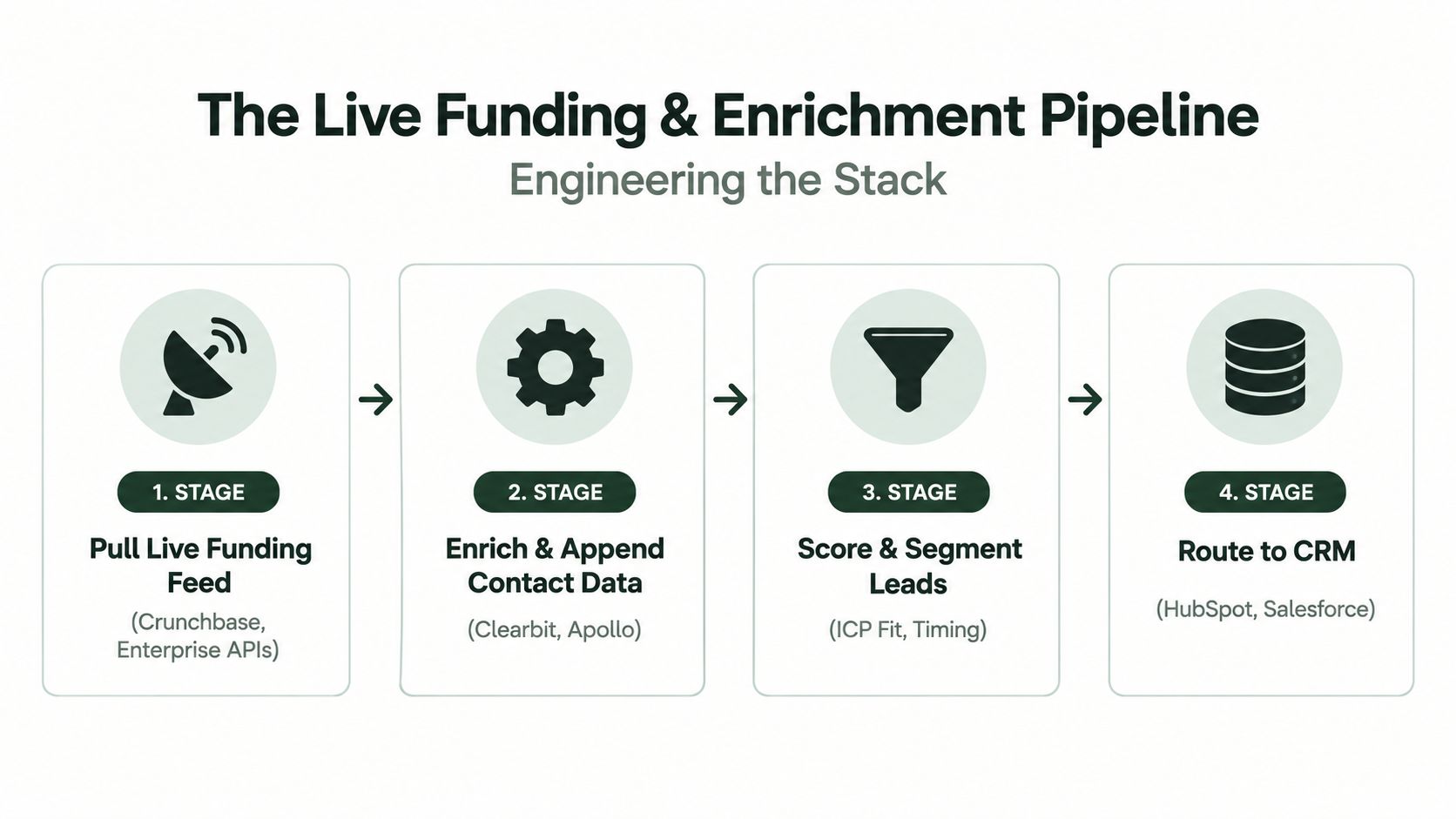
Stage four routes context into the CRM
Push only qualified contacts into HubSpot, Salesforce, or the CRM your team uses. Include custom fields such as trigger_event_date, round_type, signal_source, signal_confidence, and enrichment_status.
Log every record's origin and confidence score. If positive replies fall, you need to isolate whether the issue came from one feed, one enrichment provider, one segment, or one sequence. Without source-level observability, your team will rewrite copy blindly and keep the faulty input alive.
Outreach Sequences That Book Startup Meetings
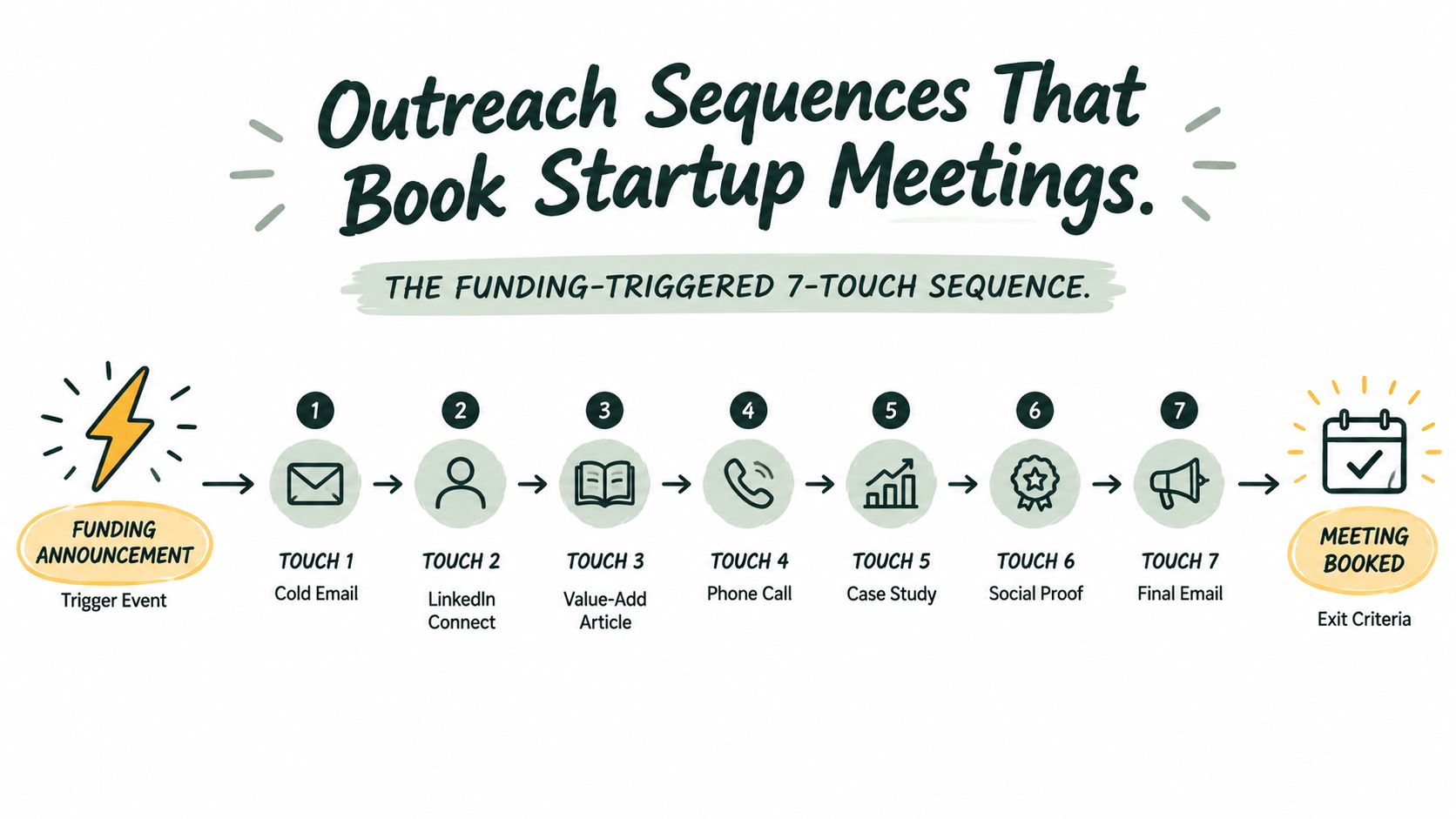
A sequence should behave like a small engineering artifact. Define the trigger event, channel mix, spacing, exit conditions, and reply-handling branch before the first record enters it.
For a funding-triggered campaign, use seven touches spread across email, LinkedIn, and phone. Send during the recipient's local working window, space touches by 2 to 3 business days, and stop automatically when the person replies, books, opts out, or becomes disqualified.
Build every touch around a new reason
A practical sequence can follow this structure:
- Touch one, signal-first email: Subject pattern, “Funding and [specific operating area].” Open with, “Saw that [Company] announced its [round type] round.” Connect the raise to one operational problem your product addresses, then ask a low-friction question.
- Touch two, LinkedIn connection: Keep the note short. Mention the funding event and the business area, not a full product pitch.
- Touch three, evidence email: Reference the announcement again, but add a useful observation, checklist, or relevant operational question. Don't resend the original ask.
- Touch four, phone call: Call the likely owner of the problem. If nobody answers, leave a brief voicemail: “Hi [Name], this is [Rep]. I'm calling because [Company] recently raised [round]. I had one question about how you're handling [specific process]. I'll send the context by email.”
- Touch five, proof asset: Share a case study, relevant workflow, or implementation note only if it matches the account's likely situation. Don't invent customer outcomes.
- Touch six, LinkedIn DM: Continue the thread naturally. Ask whether the issue sits with the recipient or someone else.
- Touch seven, breakup email: State that you're closing the loop, summarize the trigger and problem, and offer a simple reply path if the timing changes.
Use subject lines that lead with the event, not an abstract value claim. “After [Company]'s new round” is more grounded than “Improve your growth efficiency.” The opening line should name the trigger because that proves the message isn't a blind blast.
Route replies before automation creates friction
Positive replies should go to a human within 30 minutes. A simple branch works well:
- Positive or curious reply: Pause all automation, notify the owner, and offer two relevant meeting times.
- Referral to another person: Create or update the referred contact, preserve the original funding context, and restart only after verification.
- Not now: Record the stated timing, suppress the active sequence, and schedule a deliberate re-entry based on the next relevant signal.
- No fit or unsubscribe: Suppress immediately and retain the compliance record.
Optimize for reply quality, not opens. Modern privacy features make open data noisy, while a useful reply shows that the trigger, contact, and problem were aligned.
Deliverability and Domain Health: The True Funnel Bottleneck
A startup can send a well-timed funding-triggered message and still generate no replies if the message never reaches the inbox. Recent B2B cold-email benchmarks reported bounce rates around 1.71% to 2.0%, but inbox placement weakened after spam filtering, authentication, and domain reputation were considered. One benchmark recorded only 84.3% of delivered mail reaching the inbox, while another found placement could fall below 60% at scale, as described in B2B lead-generation deliverability trends.
Set up the sending foundation before testing subject lines. Authorize legitimate providers in SPF, sign messages with DKIM, and publish DMARC with reporting enabled. Begin with a monitoring policy, then apply stronger enforcement after you understand alignment. Use a custom tracking domain, and remove tracking links when plain text can support the message.
The minimum technical baseline
Record Type Purpose Example Value SPF TXT Authorizes approved sending providersv=spf1 include:approved-sender.example ~all
DKIM
TXT
Adds a cryptographic signature to outbound mail
selector._domainkey.example.com
DMARC
TXT
Defines handling and reporting for authentication failures
v=DMARC1; p=none; rua=mailto:dmarc@example.com
Tracking domain
CNAME
Separates click tracking from the primary website domain
track.example.com
These formats are examples, not DNS values to copy without verification. Your DNS administrator should confirm the entries required by each sending platform, including provider-specific authentication and reporting settings.
Ramp volume instead of forcing it
Warm a domain gradually over 3 to 4 weeks, moving from 5 to roughly 50 sends per mailbox per day, based on the operating guidance in the brief. Keep new domains below 20 daily sends while reputation develops. Separate the primary company domain from controlled sending domains, then monitor spam placement, bounce rate, and replies as one operating view.
Use the benchmark guidance of 3% as a bounce-rate monitoring threshold. It is an operational warning, not proof of inbox placement. A campaign can remain below that threshold while authentication failures, repetitive content, or declining reputation push messages into spam.
A burned domain removes access to every future campaign. Ten new templates cannot compensate for that loss.
Choosing MCP, API, Webhooks, or CSV for Your Stack
The delivery mode determines how quickly a funding event becomes an actionable record. It also determines how much engineering your team must maintain.
MCP fits AI-agent workflows where Claude, Cursor, or an internal agent needs structured access during research. It supports interactive investigation and lets an agent request only the fields it needs, but it requires a compatible client and careful permission design.
A REST API works for synchronous enrichment pulls and custom applications. Your service controls the request, response, retries, and field mapping. That flexibility costs engineering time, especially when you need rate handling, authentication, logging, and failure recovery.
Webhooks are the natural choice when timing matters. The provider pushes an HTTP event as soon as a funding record is verified, so your system can enrich, score, and route without a polling loop. The team must still handle retries, duplicate events, signature validation, and downstream outages.
CSV remains practical for one-off uploads, small experiments, or teams with limited integration budgets. It has the lowest setup burden but the highest staleness risk, and it makes deduplication and source observability harder.
Delivery Mode Latency Cost per Record Engineering Effort Best For MCP On-demand Usage-based Moderate AI-agent research and interactive workflows REST API Near real-time when polled Usage-based Moderate to high Custom applications and synchronous enrichment Webhook Push-based Usage-based Moderate Event-driven outbound automation CSV Batch Usually low setup cost Low initially One-off tests and manual CRM importsPick orchestration based on the team
A raw MCP connection into a custom agent gives developers maximum control, but it creates a larger maintenance surface. Zapier gives non-technical operators a visual builder and familiar application connectors, although complex branching can become expensive or difficult to inspect.
Make suits teams that need branching logic, transformations, retries, and lower execution overhead without building every integration from scratch. For an early-stage team that wants speed without hiring an integrations engineer, MCP plus Make is a sensible starting architecture. Keep the business rules in documented scenarios, not hidden inside an agent prompt, so the workflow remains auditable.
Your 30-Day Startup Lead Generation Operating Plan
A reliable rollout starts with infrastructure, not a giant campaign. The first month should prove that your system can receive a fresh signal, identify a valid contact, reach the inbox, and respond to interest before you increase volume.
Week one protects the sending system
Set up domain separation, SPF, DKIM, DMARC reporting, and a custom tracking domain. Begin the warmup ramp and run inbox placement tests across the providers your prospects use. Establish a baseline for spam placement, bounce rate, reply rate, and mailbox health before any sequence becomes a performance experiment.
Week two connects data to action
Connect the live funding feed to your enrichment layer. Deduplicate on domain, verify contacts, apply account and contact ICP filters, and route qualified records into the CRM. Store the trigger date, round type, source, confidence, and verification status on every record.
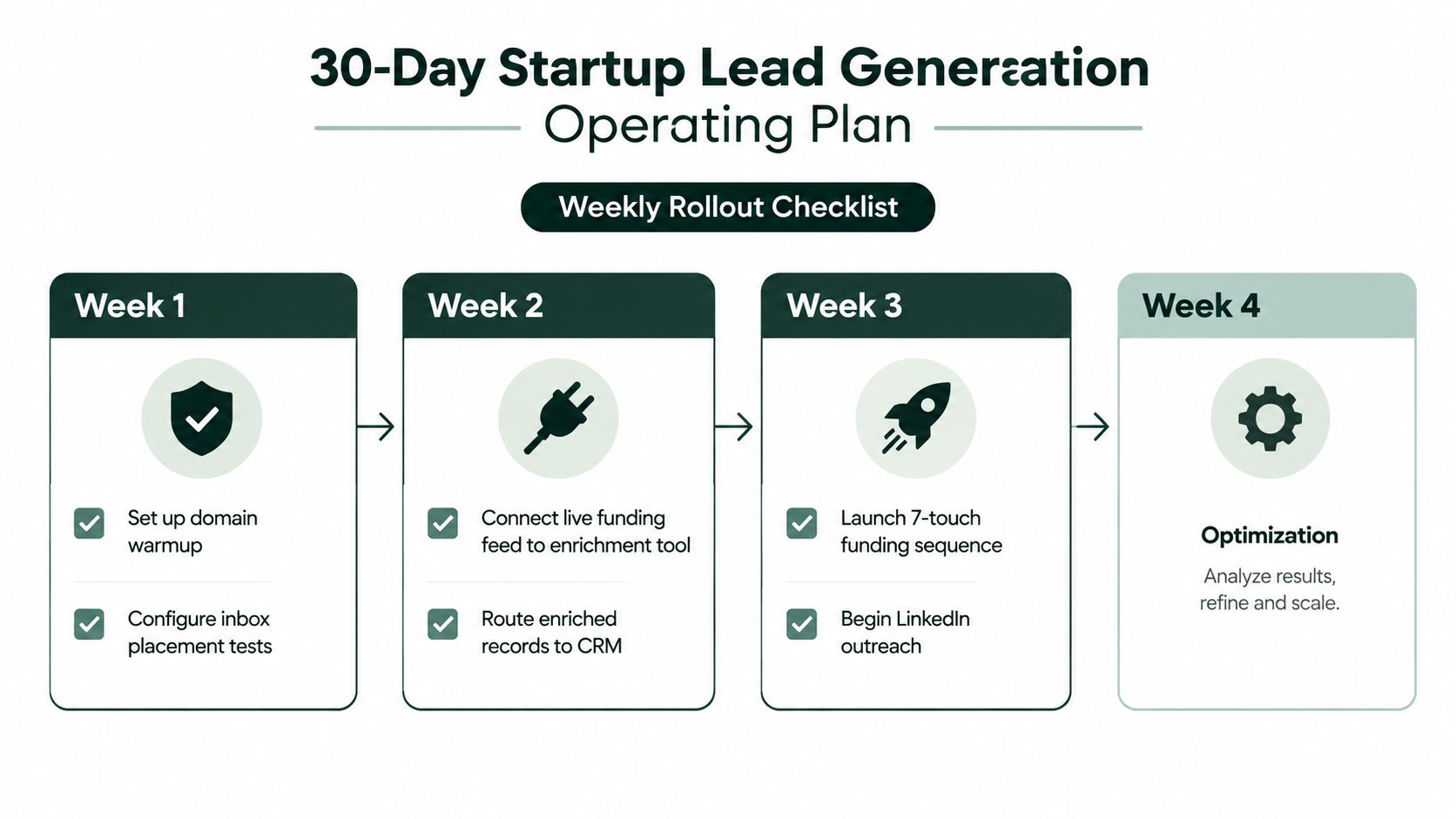
Week three tests a controlled cohort
Launch the seven-touch sequence against a 200-record funding-event cohort, as specified in the operating plan. Mix email, LinkedIn, and calls, but keep the segment narrow enough that reps can review replies and identify patterns. Positive responses should reach a human within 30 minutes.
Set a daily SDR quota around verified, prioritized accounts rather than raw sends. The quota should reflect your mailbox capacity, the number of active reps, and the time required to research each trigger. More activity isn't automatically better if it causes rushed qualification or reputation damage.
Week four reviews evidence
Review open rate, reply rate, positive reply rate, meetings booked, and domain health score each week. Treat open rate as directional, not decisive. Reply quality, meeting attendance, opportunity creation, and the accuracy of the trigger should drive decisions.
Kill or pause a sequence when inbox placement drops, spam placement exceeds 4%, or reply rate remains below 1.5% after 500 sends, using the campaign thresholds in the plan. Diagnose the source before rewriting the message. A weak segment, unverified address set, or damaged domain can make a good offer look ineffective.
Use this final checklist before scaling:
- Authentication: SPF, DKIM, and DMARC are configured and monitored.
- Tracking: A custom tracking domain is active and unnecessary tracking is limited.
- Sourcing: Every account has a live funding event or a documented secondary signal.
- Enrichment: Role, work email, phone where available, title, and verification status are present.
- ICP logic: Account fit and contact fit are scored separately.
- CRM stages: Trigger, qualified, contacted, replied, meeting, opportunity, and disqualified states are defined.
- Sequence: Each touch adds a new angle and has clear exit criteria.
- Reply handling: Positive replies pause automation and reach a human quickly.
- Measurement: The team reviews qualified meetings and opportunity conversion, not just lead volume.
Healthy leading indicators appear before revenue does. You should see fresh records processed without duplication, verified contacts reaching the inbox, replies that reference the trigger, meetings booked by the right roles, and fewer disqualified accounts entering sequences. Those signals tell you the machinery is working. Pipeline becomes predictable only after the machinery stays reliable.
NowFunded provides a live, verified feed of newly funded startups from pre-seed through Series B, with structured company data and on-demand verified founder and leadership contacts delivered through MCP, REST API, webhooks, CSV, or a dashboard. If funding-triggered outreach fits your ICP, visit NowFunded to connect fresh events to your enrichment and CRM workflow.