Startup Funding Types: A Complete Guide for Founders
More than half of early-stage technology companies have never raised venture capital, and VC ranked only fifth among funding sources in a 2025 survey of 1,500 U.S. entrepreneurs. The right startup funding type isn't the most prestigious option, it's the one your revenue, cash cycle, collateral, and growth urgency can support.
Founders often choose capital by copying companies they admire. A software startup raises equity because a famous competitor did. A hardware company takes a loan because the founder wants to avoid dilution. A business with uneven revenue signs a revenue-share agreement because it closes quickly. These decisions can work, but only when the operating model can carry the terms.
Funding isn't a popularity contest. It changes who controls the company, how much cash leaves the business each month, how quickly you can hire, and what happens if growth slows. Treat each option as a financial operating decision, not a badge of ambition.
Table of Contents
- Why Most Founders Choose the Wrong Funding First
- The Four Main Categories of Startup Funding Types
- Bootstrapping, Angels, Grants, and Revenue-Based Options Compared
- Pre-Seed Instruments, SAFEs and Convertible Notes Explained
- How Venture Capital Rounds Progress from Seed to Series B
- Why Headline Funding Totals Mislead Founders
- Matching Startup Funding Types to Your Operating Signals
Why Most Founders Choose the Wrong Funding First
A founder with early customer demand may assume venture capital is the obvious next step. The evidence points elsewhere. A 2025 survey of 1,500 U.S. entrepreneurs ranked venture capital fifth among funding sources, behind self-funding, business loans, revenue-based financing, and friends and family, while more than half of early-stage technology companies had never raised VC. Those findings are reported in the survey coverage on founder funding choices.
That doesn't make VC a bad choice. It means founders should stop treating it as the default benchmark. A company with recurring revenue, strong margins, and a large hiring opportunity may benefit from equity. A profitable niche business with predictable invoices may be better served by debt or revenue-based financing. A research-heavy company may need grants before it has the commercial evidence investors expect.
Prestige hides the real cost
Consider two founders. One runs subscription software with stable renewals and limited customer concentration. The other is building hardware, has long manufacturing lead times, and won't collect cash until after production and delivery. Both may need capital, but they don't have the same financing problem.
The software founder can potentially absorb repayment because revenue arrives repeatedly. The hardware founder may need equity or grant funding because debt payments can begin before customers pay. Choosing the same instrument for both businesses confuses the amount of money needed with the company's ability to carry the obligation.
Practical rule: Match the funding term to the way cash enters your business, not to the way other founders describe their fundraise.
Start with four signals:
- Revenue predictability: Can you forecast collections with confidence?
- Cash-conversion cycle: How long does money stay tied up in inventory, production, or receivables?
- Collateral: Do you have assets a lender can reasonably underwrite?
- Growth urgency: Will delayed hiring or product investment cause you to miss a time-sensitive opportunity?
These signals determine whether repayment pressure, dilution, eligibility restrictions, or investor control is the primary risk. The best funding decision may combine several sources, such as founder capital with a grant, or equity with carefully sized debt. A clean cap table matters, but so does keeping enough cash in the business to execute.
The Four Main Categories of Startup Funding Types
Most startup funding types fit into four structural categories. The category tells you what the capital costs, who carries the risk, and whether the founder gives up ownership.
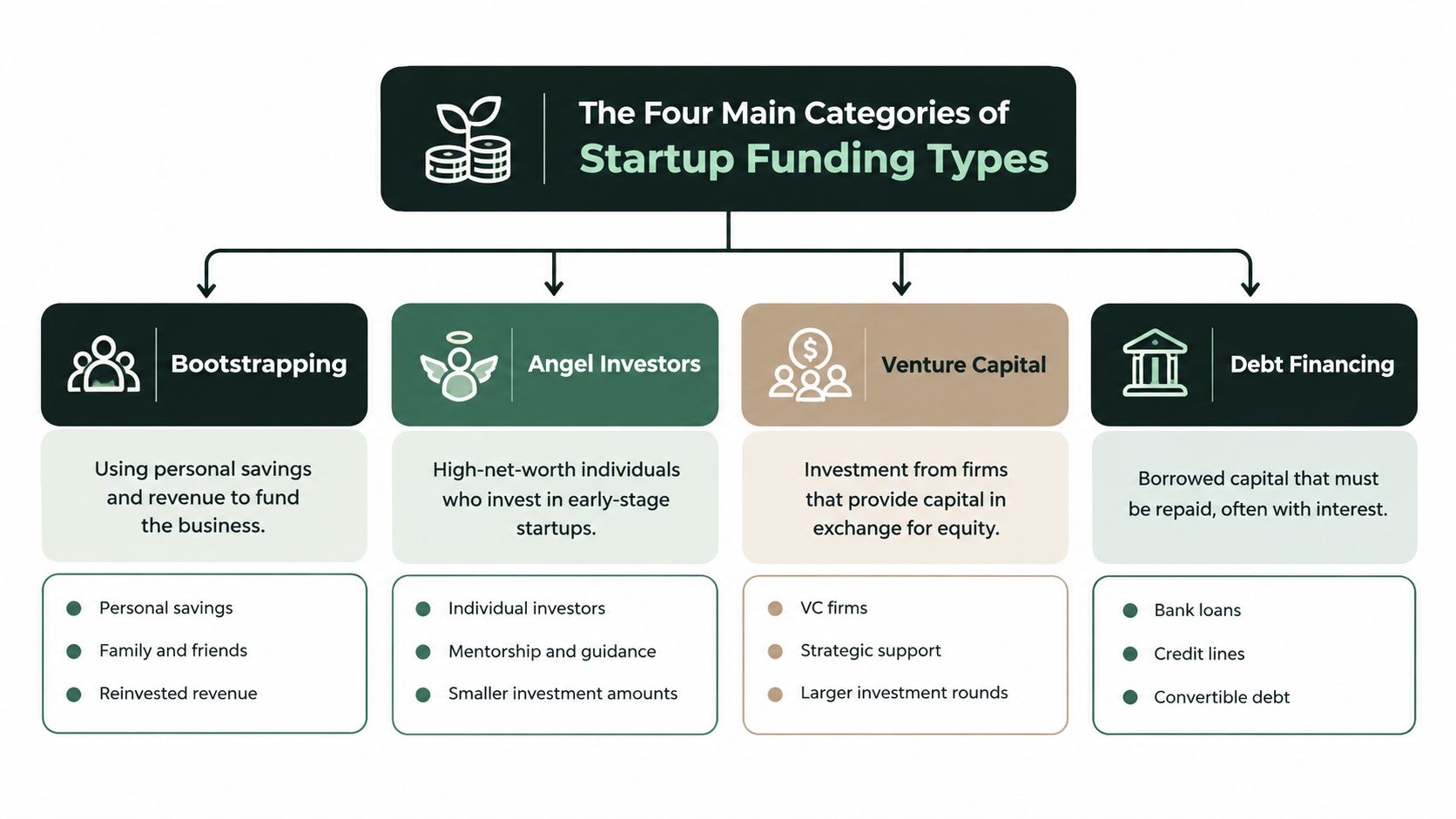
Equity funding
Equity financing exchanges capital for ownership. Angel investors and venture capital firms generally receive shares or rights that convert into shares. The company avoids scheduled repayment, but founders accept dilution and may give investors influence over decisions, hiring, strategy, or governance.
Equity fits companies that need substantial capital before revenue becomes predictable, especially when the business has high growth potential and capital intensity. It doesn't fit automatically just because the company is called a startup. If the business can grow steadily from customer cash flow, selling ownership may be an unnecessarily expensive trade.
Debt funding
Debt financing preserves ownership but creates an obligation to repay, usually with interest. Banks, lenders, and venture-debt providers assess repayment capacity, risk, and sometimes collateral. Debt works best when cash inflows are visible and the company can withstand a weak month without cutting essential operations.
A founder who chooses debt solely to avoid dilution may protect the cap table while putting the business at risk. Ownership isn't useful if repayment pressure forces damaging cuts.
Hybrid instruments
SAFEs and convertible notes defer the valuation question. They let early investors participate in a future equity conversion rather than requiring a fully priced round immediately. Convertible notes are debt, while SAFEs aren't, so their legal and financial consequences differ sharply.
These instruments can speed up an early raise, but they don't eliminate the cost of capital. Caps, discounts, interest, maturity dates, and conversion triggers determine what founders and future investors ultimately receive.
Non-dilutive capital
Grants, certain crowdfunding structures, and some alternative financing can avoid direct ownership dilution. The trade-off is usually tighter eligibility, a slower application process, reporting requirements, repayment linked to revenue, or a limit on how the money can be used.
Equity crowdfunding is a distinct regulated category. The SEC's Regulation Crowdfunding data records 8,492 initiated offerings by 7,134 issuers from May 16, 2016 through December 31, 2024, with approximately $1.339 billion raised across 3,869 offerings reporting proceeds. The JOBS Act became law on April 5, 2012, Regulation Crowdfunding became usable on May 16, 2016, and the maximum offering limit rose from $1 million to $5 million after SEC amendments effective March 15, 2021. Those fields matter when evaluating a campaign, especially offering status, target, proceeds, intermediary, and filing date.
Bootstrapping, Angels, Grants, and Revenue-Based Options Compared
Early-stage founders usually weigh control against speed. Bootstrapping offers maximum control but can slow product development. Angels add capital and often useful experience, but they take ownership. Grants avoid dilution but restrict eligibility and use. Revenue-based financing can move quickly, yet future revenue becomes a payment obligation.
Funding Path Ownership Impact Speed Repayment Pressure Best Fit Bootstrapping No dilution Controlled by founder cash flow None beyond operating commitments Businesses that can validate through sales Angel investment Equity dilution and possible influence Often relationship-driven No scheduled loan repayment Founders who need capital plus strategic help Grants No direct dilution Application and award timing varies Usually no repayment, but restrictions apply Research, innovation, and eligible sector projects Revenue-based financing Usually no ownership dilution Often faster than an institutional equity raise Payments rise with revenue and can constrain reinvestment Companies with predictable, healthy revenueBootstrapping
Bootstrapping is strongest when customers can fund the next step. It forces discipline and preserves control, but it can also keep a founder from hiring or building fast enough. Use it when the next milestone is achievable without large upfront investment and when delay doesn't create a serious competitive disadvantage.
Angel capital
Angel investors can be valuable when their operating experience matches the company's problem. Don't accept an angel merely because the check is available. Ask whether the investor can help with customers, hiring, partnerships, or future fundraising without creating unwanted interference.
Grants
Grants make sense when your work matches a defined research, technical, regional, or industry program. They aren't general-purpose runway. Build the application effort into the decision, and confirm whether the award permits the expenses you really need to fund.
Revenue-based financing
Revenue-based financing suits a company with recurring or otherwise dependable sales, strong gross margins, and a clear cash-conversion pattern. It becomes dangerous when revenue is concentrated in a few customers or fluctuates sharply. A payment tied to sales can still reduce hiring capacity during a weak period, even though the founder retains ownership.
Founders comparing operators, funding workflows, or adjacent company-building resources can also review the Synal startup and growth resources, but the financing decision should remain anchored to cash behavior rather than general startup advice.
Pre-Seed Instruments, SAFEs and Convertible Notes Explained
At pre-seed, founders often lack a reliable valuation. That makes a priced equity round cumbersome, especially when the company is still testing its product, market, and commercial model. SAFEs and convertible notes solve the timing problem by postponing the full valuation negotiation, but they don't create identical obligations.
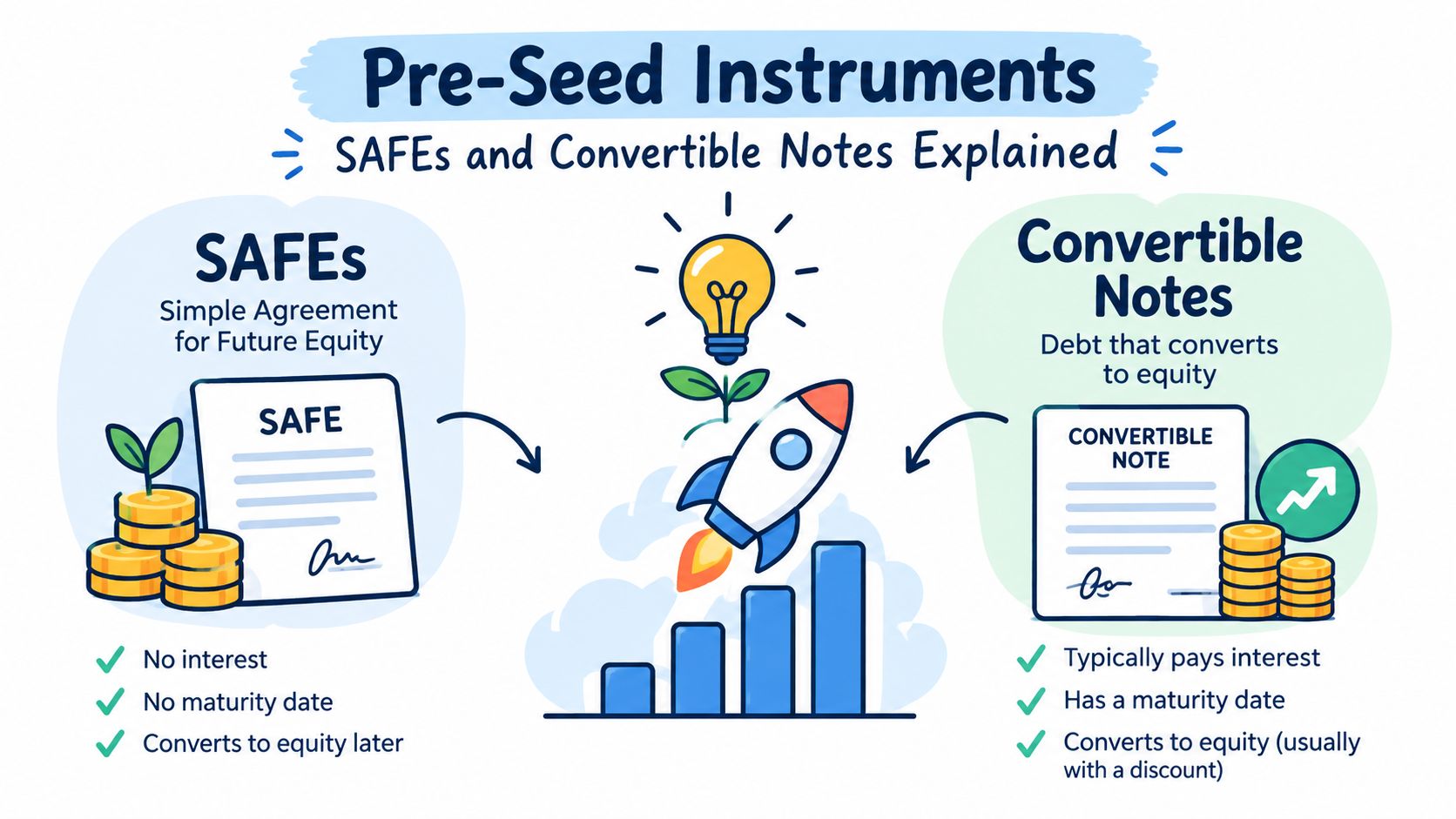
A convertible note is legally debt. It generally accrues interest, includes a maturity date, and converts into preferred stock after a qualifying financing or another contractual trigger. If the company can't raise a priced round before maturity, the note can create repayment pressure or force a renegotiation.
A SAFE is a contractual right to receive future equity after a trigger, commonly a financing, acquisition, or IPO. It generally has no interest or maturity date, and the holder doesn't own equity before conversion. That makes it less like a loan, but it can still create significant future dilution through a valuation cap or discount.
Why SAFEs dominate early rounds
Carta's Q2 2024 State of Pre-Seed report found that SAFEs represented 88% of pre-seed deals, compared with 12% for convertible notes. The appeal is practical. Founders can raise without immediately setting a priced valuation, while investors receive a conversion mechanism through a cap, discount, or both.
That convenience can hide the ownership cost. A founder who accepts several SAFEs may focus on each individual amount and overlook the combined conversion effect. A post-money SAFE makes the implied ownership calculation more deterministic because it uses a defined post-money framework, but multiple instruments still need to be modeled together.
What to record before signing
Track the instrument and its terms in a financing schedule, not just in an email folder.
- Instrument type: Record whether the investment is a SAFE, convertible note, or priced equity.
- Valuation cap: Identify the maximum conversion price and whether different SAFEs use different caps.
- Discount: Note the discount applied at conversion and how it interacts with the cap.
- Note terms: Record interest, maturity, and conversion triggers for every note.
- Aggregate exposure: Model all outstanding instruments together before promising a future ownership percentage.
The headline amount raised tells you how much cash entered the business. It doesn't tell you how much ownership the founders will retain after conversion. Have counsel model the cap table before accepting a fast instrument, particularly when you expect several investors to participate.
How Venture Capital Rounds Progress from Seed to Series B
Venture capital rounds are milestones tied to company maturity, not rungs every startup must climb. Seed capital commonly supports product development, early hiring, customer validation, and initial commercial expansion. Series A usually reflects stronger institutional validation and a need to turn early traction into a repeatable business. Series B is for scaling after the company has evidence that the model can support larger investment.
In 2024, more than 70% of exiting U.S. venture-backed companies had raised no further than Series A, according to the 2024 Venture Monitor from NVCA and PitchBook. Founders shouldn't build a plan that assumes Series B is inevitable.
Read the round as an operating checkpoint
A seed announcement suggests that investors are funding validation and initial execution. A Series A suggests a different level of evidence, even when the amount overlaps with another company's seed round. A Series B signals that the company needs to scale a model that already shows meaningful traction.
Round names alone are weak intelligence. Pair them with:
- Amount and date: These show the size and recency of the financing event.
- Lead investor: The lead can reveal sector focus, stage preference, and likely influence.
- Prior financing history: A new round means something different for a first-time issuer than for a company extending an earlier institutional raise.
- Valuation context: Where available, valuation helps interpret the price of growth and the dilution trade-off.
- Company maturity: Headcount, product status, customer evidence, and commercial momentum explain what the capital can fund.
Decide what the next round must prove
A seed founder should define the evidence needed for a future financing or a sustainable operating model. That may involve product reliability, customer validation, repeatable acquisition, or initial commercial expansion. A Series A founder should focus on whether the company can scale acquisition, delivery, hiring, and retention without losing control of the economics.
Series B capital can accelerate a proven engine, but it won't repair weak margins or unclear demand. If the business needs a new round merely to discover whether customers want the product, the company may be raising too far ahead of evidence.
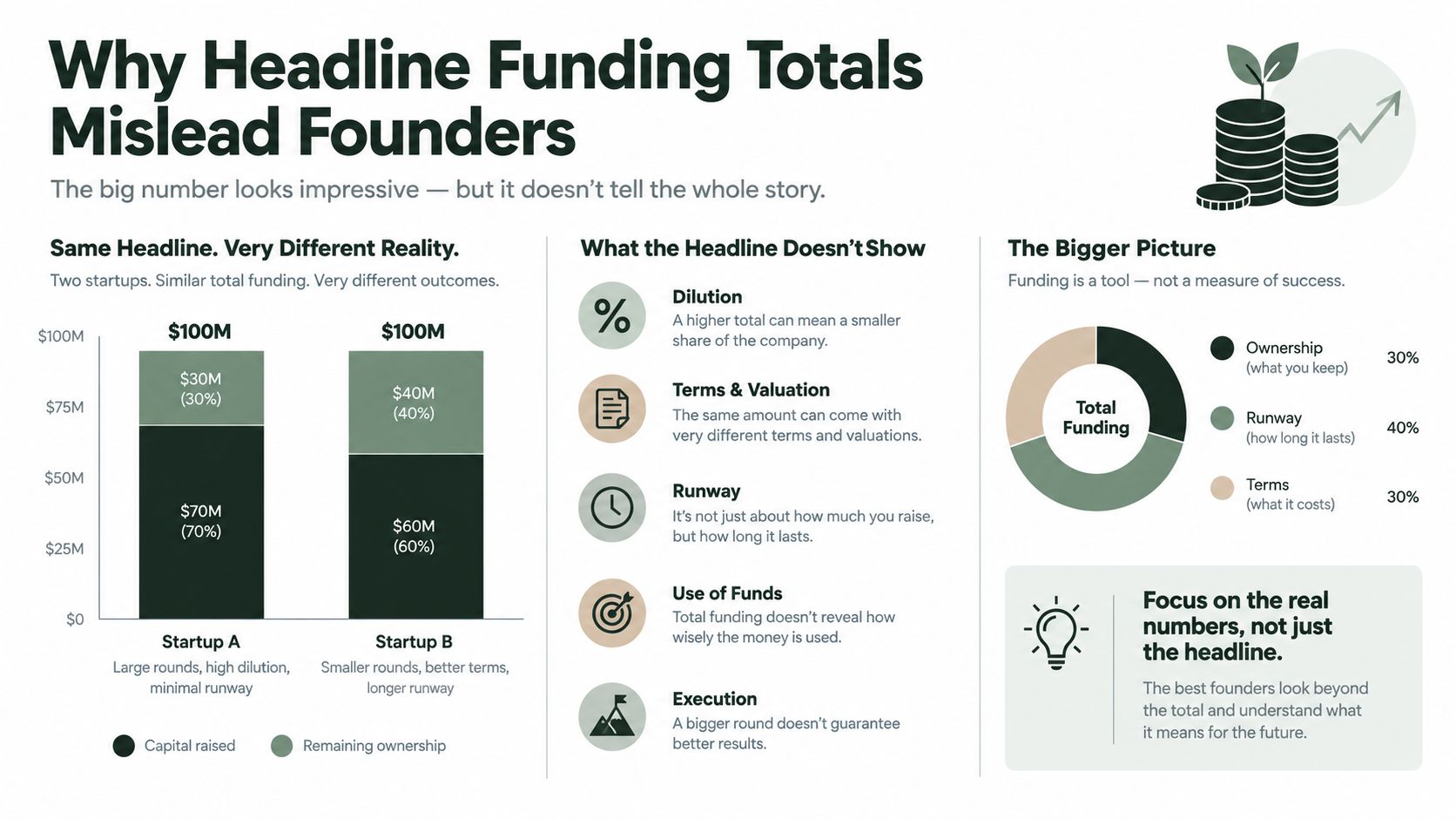
Why Headline Funding Totals Mislead Founders
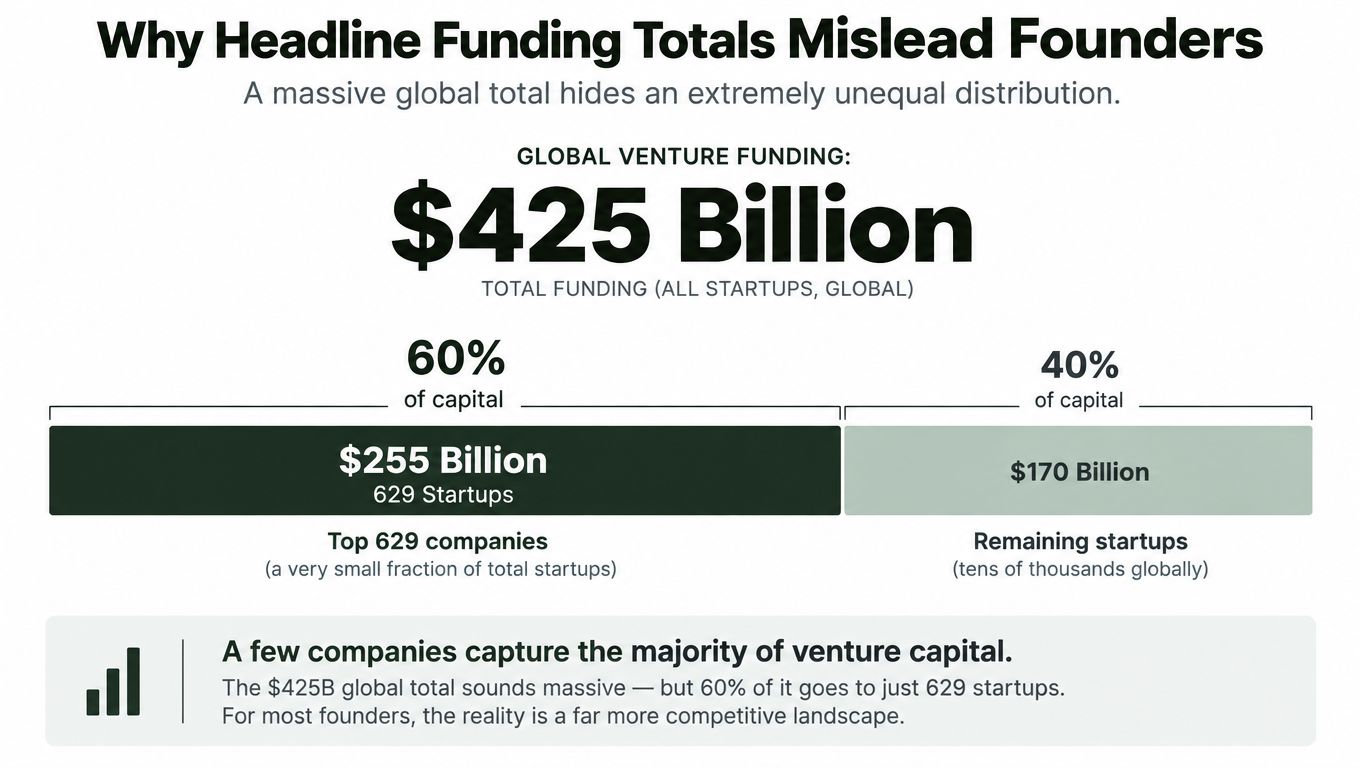
A rising venture total can make the market look open while hiding who received the capital. One 2025 estimate placed global venture funding at $425 billion, yet nearly 60% of invested capital went to 629 companies raising at least $100 million, and more than one-third went to 68 companies raising at least $500 million, according to Founder Reports' funding statistics analysis.
That concentration changes the meaning of every funding headline. More money in the aggregate doesn't mean a pre-seed founder in a less concentrated market can access capital more easily. It may mean that a small group of mature or unusually large companies absorbed most of the available investment.
Use the denominator before drawing conclusions
Funding news needs context. A large AI Series A may indicate strong demand for a particular category, but it doesn't establish that ordinary seed companies can raise on similar terms. A venture-debt facility isn't equivalent to equity because it creates a different obligation and may support a different operating plan.
Regional differences matter too. Recent pre-seed analysis reports substantially lower valuations in Africa and Latin America than in the United States, which can mean founders outside major U.S. hubs face higher dilution for less capital. The location of the company, the investor base, and the instrument all affect what the announced amount means.
Segment companies by financing context
For research, sales, and recruiting, classify newly funded companies using more than a headline amount:
- Stage: Separate pre-seed, seed, Series A, and Series B events.
- Instrument: Distinguish SAFEs, priced equity, crowdfunding, and venture debt.
- Investor type: Identify angels, institutional funds, strategic investors, and lenders.
- Geography: Compare the company's headquarters and investor market.
- Operating implication: Estimate whether the event likely supports product work, hiring, expansion, or balance-sheet management.
A $1 million pre-seed round, a $20 million AI Series A, and a venture-debt facility represent different buying signals. They imply different hiring capacity, sales urgency, runway needs, and leadership priorities. Treating them as identical “funded startups” produces weak targeting and shallow market analysis.
Matching Startup Funding Types to Your Operating Signals
A funding round can look attractive on paper and still be wrong for the business. The test is simpler: Can this company carry the payment, dilution, and control terms without slowing the next milestone?
Start with revenue predictability. Stable recurring revenue supports revenue-based financing and makes debt easier to size. Erratic revenue does the opposite, because payment schedules can hit before cash is collected. Customer concentration matters just as much. If one buyer drives a large share of sales, a revenue-linked structure can turn fragile the moment that account pauses or churns.
Gross margin is the next filter. High-margin businesses have more room to fund hiring, repay capital, and reinvest. Thin-margin businesses do not. Fixed obligations become dangerous fast, and revenue-share payments can crowd out the cash needed to operate.
Use a signal-based decision screen
- Stable revenue and short cash cycles: Use modest debt or revenue-based financing if payroll and growth spending still stay covered.
- Long production cycles or heavy inventory needs: Choose staged equity, grants, or carefully structured working capital. Avoid repayment that starts before collections.
- Limited collateral: Skip traditional loans. Grants, equity, crowdfunding, angels, and SAFEs fit better, depending on eligibility and dilution tolerance.
- High growth urgency: Equity can fund hiring and expansion before revenue catches up, but only if the business can justify the dilution with a credible growth path.
- Unclear valuation and early validation: Use a SAFE or convertible note only after modeling the conversion terms and the downside if growth stalls.
- Strong control preference: Bootstrap or use non-dilutive sources where possible, but do not protect ownership by missing the milestone the company actually needs.
The right capital is the capital your business can repay, convert, or absorb without breaking its next step.
Cheap capital still carries a cost. Revenue-share payments can squeeze reinvestment in slower months. Debt can create repayment risk at the company level or the founder level, even if ownership stays intact. Grants can drain management time and come with spending limits. Equity preserves cash flow, but it transfers control and future upside.
Write down the facts before you choose. Current recurring revenue, gross margin, customer concentration, cash-conversion cycle, collateral, runway, and the next urgent milestone should drive the decision. Then compare each funding type against those signals. A live view of newly funded companies makes this kind of targeting practical. NowFunded structures funding-event data from pre-seed through Series B. For more company-building reading, see Synal.
Do not raise money that creates a better headline and a worse business. Match the funding type to the operating signal, model dilution and repayment before you sign, and build the next milestone around the capital's real constraints.