Startup Funding Timeline: A Stage-by-Stage Guide
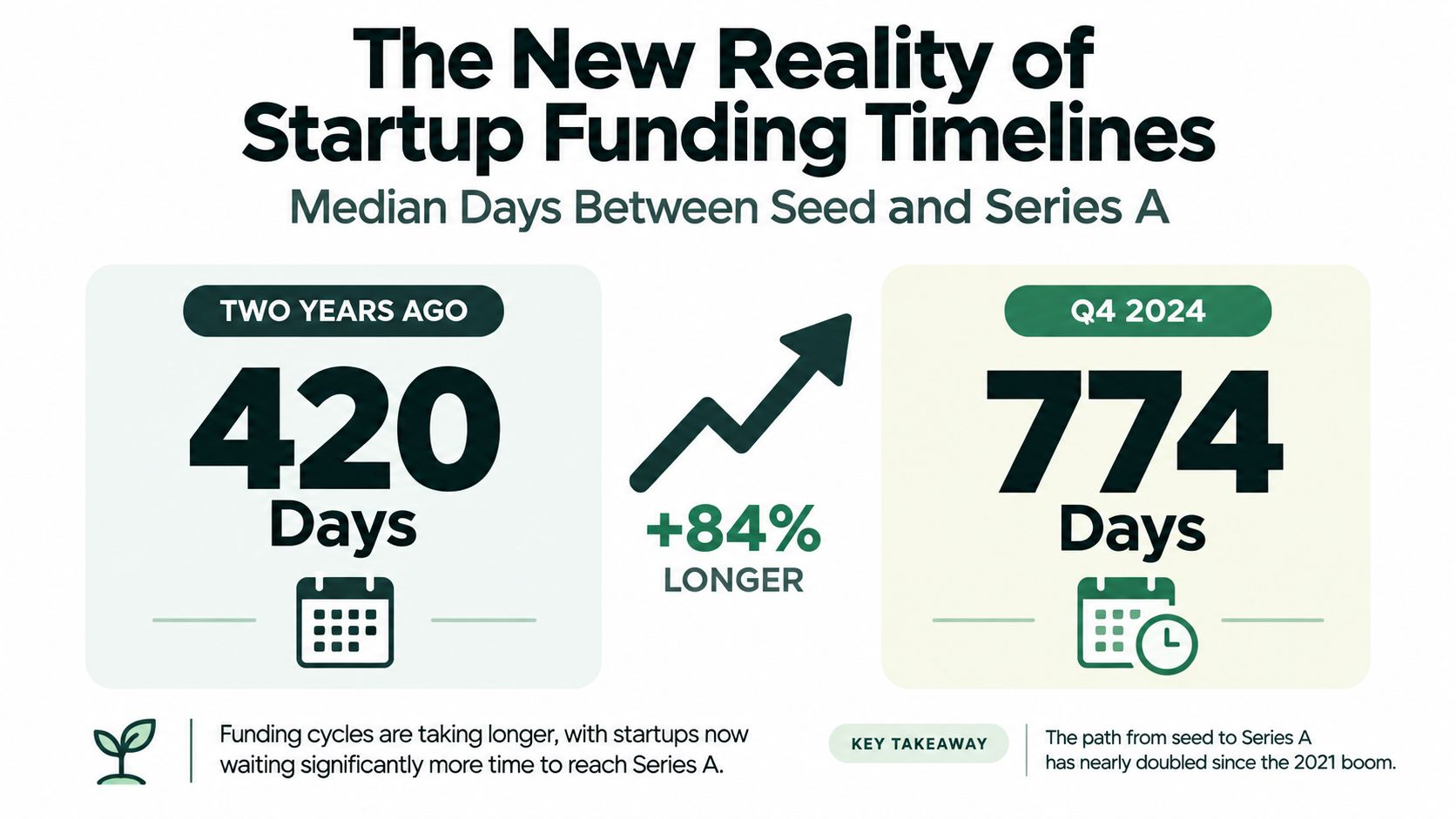
The median seed-to-Series A interval reached 774 days in Q4 2024, up from 420 days in Q4 2021, an 84% increase that has reshaped the startup funding timeline. A responsible plan now treats 24 to 30 months between rounds as a realistic operating horizon, not an unusually cautious assumption.
That shift matters beyond founders preparing a pitch. Investors, recruiters, sales teams, and market-intelligence analysts all use funding events as signals, yet a funding announcement no longer tells you when the next round will happen. The useful question is no longer, “When does a startup raise?” It's, “Where is this company in its financing cycle, what evidence suggests progression, and how should the next action change?”
Table of Contents
- The New Reality of Startup Funding Timelines
- From Pre-Seed to Series B, What Each Stage Looks Like
- How Sector and Pathway Create Timeline Variance
- Why Timeline Is Only One Dimension of Progression
- Practical Timing Frameworks for Operating Teams
- Event-Driven Prospecting Versus Stale Assumptions
- A Founder's Journey Through the Extended Timeline
The New Reality of Startup Funding Timelines
774 days is the current median gap between seed and Series A for startups that reached Series A in Q4 2024, up from 420 days in Q4 2021, an 84% increase, according to recent startup fundraising timeline data. That change has reset how teams should read the startup funding timeline. The old pattern, raise seed, build for about 18 months, then line up Series A before cash runs short, fit the 2021 capital market. It does not fit the median company now.
Why the gap has widened
Investors have tightened the bar between rounds. A product that looks promising is no longer enough by itself. Founders are being asked to show demand that holds up over time, spending discipline, and a believable case that the business can scale without depending on constant new capital.
That stretches the proof period. In practice, companies use the extra time to improve retention, test pricing, make sales more repeatable, and cut waste that would get exposed in diligence. Those are healthy steps, but they change the calendar. The next round comes when the company can support the story, not when a standard runway model says it should.
Practical rule: Treat the last verified funding date as the start of an operating clock, not as proof that the next round is already in motion.
This matters most when two startups look similar on the surface but sit in very different financing positions. One company may be 14 months past seed with weak conversion and no urgency from investors. Another may be deeper into the same elapsed period but showing sharper retention, better margins, or an inside round that extends runway while it prepares for a priced raise.
That is why static averages are only a starting point for research teams. Good prospecting work tracks elapsed time alongside operating signals and recent financing behavior. Tools such as Synal's platform can support that workflow, but the principle is broader than any single product: fundraising plans need elapsed time, sector context, and operating evidence together.
For founders, the planning implication is simple. Two to three years between rounds is now a reasonable baseline, and the actual timeline still moves with investor selectivity, company traction, and the market the startup is trying to win.
From Pre-Seed to Series B, What Each Stage Looks Like
A stage label tells you what investors expect, but it doesn't tell you exactly how long the process will take. Preparation, outreach, diligence, negotiation, and closing each consume time, and companies often move through them at different speeds.
Pre-seed and seed
At pre-seed, founders are usually validating the problem, building an initial product, or testing whether a market exists. Investor decisions often rely heavily on the founding team, the insight behind the company, and early evidence of customer demand. Preparation can take one to three months, while closing may take two to four months once investor interest is established.
Seed financing usually supports early product development, customer acquisition, and the first meaningful proof of demand. A seed raise may take three to six months, but treating that period as the main timeline misses the harder question: how long will the company need before it can credibly raise Series A?
Series A
Series A investors expect a more developed operating case. The company generally needs evidence that customers want the product, that the business can acquire them efficiently, and that growth can continue beyond founder-led experimentation.
Preparation should begin well before the first formal meeting. Founders need a clean cap table, a coherent financial model, reliable operating metrics, and a clear explanation of what the new capital will accomplish. After preparation, active fundraising can take four to eight months, depending on investor interest, diligence requirements, lead-investor availability, and the quality of the company's evidence.
Series B
Series B marks a move from proving the model to scaling it. Investors look for a business that can support larger teams, broader distribution, and more aggressive market expansion. The company needs a management rhythm that doesn't depend on the founders solving every operational problem personally.
The timeline between Series A and Series B is therefore not just a matter of elapsed runway. Hiring plans, sales efficiency, revenue consistency, and expansion readiness all influence whether the company is ready to raise. A company that starts outreach before those pieces are credible may spend months collecting feedback without creating a fundable process.
A useful stage-by-stage operating view looks like this:
- Pre-seed: Validate the problem, prototype the product, and establish an investable founding story.
- Seed: Convert early demand into repeatable traction and define the milestones that justify institutional follow-on capital.
- Series A: Prove product-market fit, revenue quality, and a scalable operating model.
- Series B: Scale distribution, leadership, and market reach after the core model has earned investor confidence.
These ranges are planning tools, not promises. Founder reputation, warm investor relationships, market timing, product complexity, and readiness can compress or extend any stage.
How Sector and Pathway Create Timeline Variance
Sector averages hide the operating reality. Two companies can both be at seed and still be on very different clocks because the work required to earn the next round is different. Regulation, implementation burden, sales-cycle length, capital needs, customer mix, and investor specialization all change how quickly a company can build a credible Series A case.
Fintech usually stretches the timeline for practical reasons. Teams often need to show more than product interest. They may need working compliance processes, stronger security evidence, deeper enterprise adoption, and a clearer route to repeatable revenue before a lead investor is comfortable stepping in. Consumer companies face a different test. The question is less about regulatory readiness and more about whether demand holds, acquisition stays efficient enough, and retention supports a durable growth story.
That distinction matters for prospecting teams and operators alike.
If you treat every seed company as though it should raise on the same schedule, the model breaks fast. A company that looks “late” against a generic benchmark may be progressing normally for its sector. Another may look on pace by elapsed time while still lacking the proof investors expect. Good timing analysis is cohort-adjusted, not calendar-only.
Pathway matters as much as sector
Round pathway changes the interpretation of speed. A bridge financing can close relatively quickly because the investors already know the company, the process is narrower, and the goal is often runway extension rather than a full market reset. An institutional round is different. If the company enters the market underprepared, the process can drag for months through diligence, partner meetings, revised materials, and repeated objections. Those pathway dynamics are summarized in fundraising process guidance.
Geography adds another source of variance. Investor density, founder networks, legal norms, and the presence of sector-focused funds all affect how fast a company can assemble momentum. The same gap between rounds can read as ordinary in one market and unusually slow or unusually fast in another.
Sector or pathway Median interval Range Key driver Fintech Longer than broad seed-to-Series A norms Company-specific Regulation, enterprise diligence, and capital intensity Consumer Shorter than some regulated categories, but still highly variable Company-specific Demand validation, retention, and distribution Seed to Series A overall As noted earlier in the article Materially shorter cases to much longer intervals Product-market fit, traction, and investor selectivity Bridge financing Not a comparable progression metric Approximately 30 to 60 days Existing-investor familiarity and simpler process Institutional raise Not a comparable sector median Approximately six to ten months when poorly prepared Diligence, negotiation, and repeated feedbackUse the timeline in context. Compare stage, sector, geography, round type, and days since the last verified close. A bridge can support runway planning, but it should not be counted as evidence that a company is on a clean path to Series A.
Why Timeline Is Only One Dimension of Progression
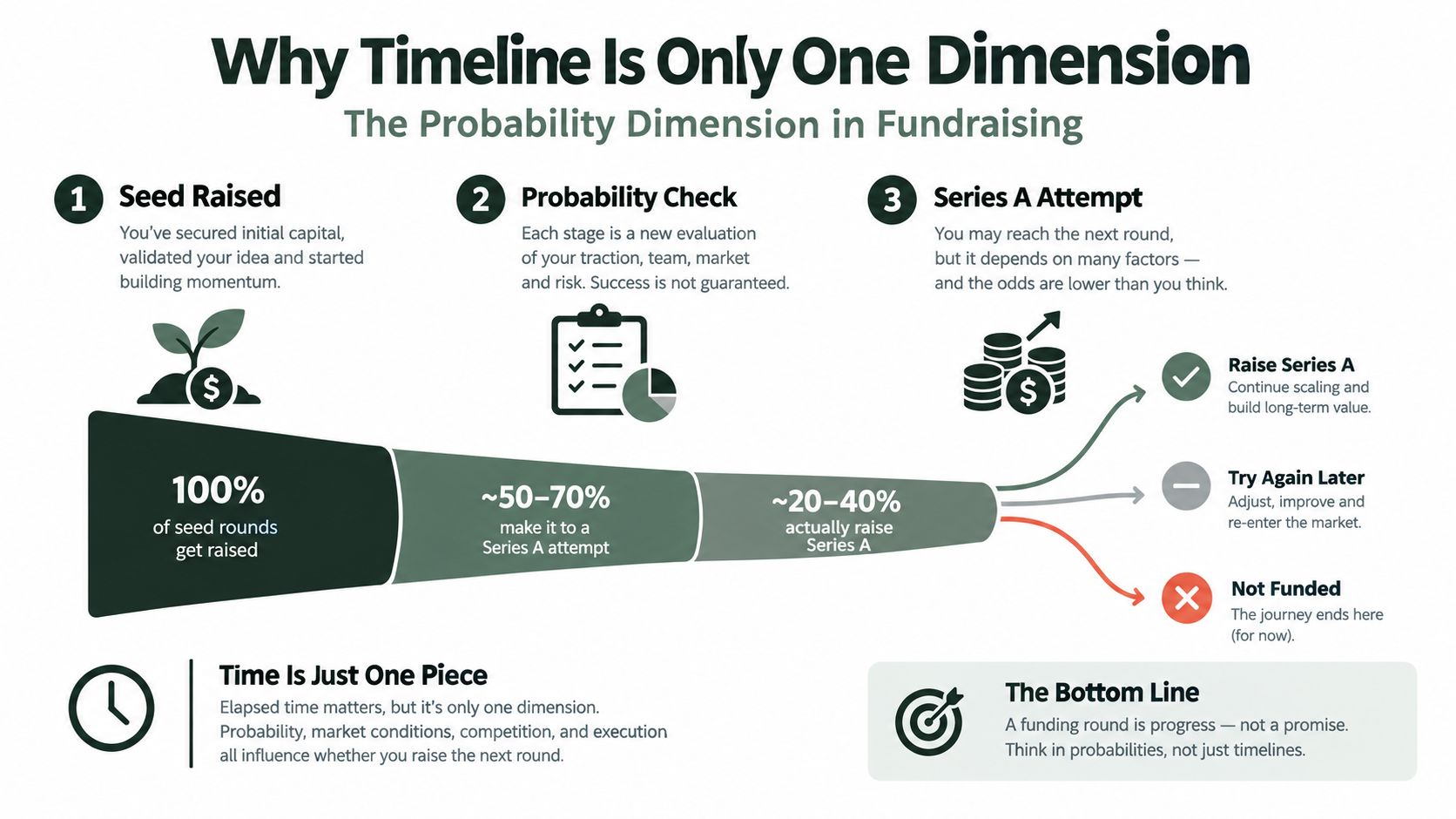
Only 15.4% of startups in the 2022 seed cohort raised a Series A within two years, versus 30.6% of the 2018 cohort, according to the startup funding progression benchmark. That gap matters because elapsed time captures age, while progression depends on whether a company can clear the next institutional threshold.
That is the mistake in a lot of timeline analysis. It treats fundraising as a clean sequence, then assumes a company moves forward if enough months have passed. In practice, the same age can describe very different situations: one startup is building toward a real round, another is stretching runway, and a third has stalled out. Time gives context. It does not tell you which case you are looking at.
Read events as milestones, not forecasts
A funding announcement confirms one thing. Capital closed on a specific date.
It says nothing by itself about whether a Series A is close, whether the company will need an extension first, or whether institutional investors will engage at all. Teams that prospect off a generic “recently funded” tag miss the substantive work. Keep the event date, round type, stage, sector, geography, investor mix, and any later financing evidence. Those details are what separate a dated financing event from a credible progression signal.
A stronger model uses two dimensions at the same time:
- Aging: How many days have passed since the last verified round?
- Evidence: What has happened since then that suggests progress, delay, or a runway extension?
The second dimension is where static timeline guides usually fall short. Evidence can include leadership hires, sustained hiring, customer wins, product expansion, or follow-on participation from existing investors. None of those signals proves readiness on its own. Together, they give operating teams a better read on who is approaching a financing window and who is still living on old capital.
A seed round is a dated fact. A Series A is a future possibility that requires new evidence.
This changes how experienced teams prioritize accounts. A company that just raised may be a good fit for recruiting, tooling, or infrastructure because budget is fresh. It may be irrelevant for investors or advisors focused on the next round. A company deeper into the inter-round cycle, with visible execution and expanding operations, often deserves more attention even if its last financing is older.
Practical Timing Frameworks for Operating Teams
A funding date becomes useful when it triggers a repeatable workflow. Sales development teams, recruiters, and intelligence analysts shouldn't rely on a vague “recently funded” field. They need a precise close date, round type, stage, sector, and evidence of what happened afterward.
Use aging thresholds
A practical alerting model flags companies at 18, 24, and 30 months after their last verified round, following the runway and inter-round planning guidance from Carta. These thresholds don't predict a raise. They create review points.
- At 18 months: Check whether hiring, headcount growth, product releases, and investor activity indicate preparation for a new round.
- At 24 months: Prioritize companies with credible traction signals and inspect whether a bridge or extension changed the runway picture.
- At 30 months: Separate likely late-stage fundraisers from companies that are conserving cash, operating without follow-on capital, or no longer progressing.
Rank each alert by sector, headcount movement, open roles, leadership changes, and subsequent financing evidence. A fintech company at the same age as a consumer company shouldn't receive identical priority because their comparable timelines differ.
Keep bridges in the right category
A bridge can buy time, but it shouldn't automatically reset the progression clock. Record it as an interim financing and retain the original institutional-round date. A new priced round or clearly verified stage transition may reset the relevant clock, while a bridge usually changes the runway interpretation without proving that the company has reached the next stage.
For recruiting teams, timing data can help identify companies that may soon expand engineering, sales, or leadership hiring. For sales teams, a fresh close can signal new budget, while an aging round combined with hiring activity may signal an upcoming operational push. Analysts can use the same fields to build comparable cohorts rather than sorting companies by announcement recency alone.
A webhook triggered at the verified close date starts the aging clock immediately. That matters because announcement dates, press coverage, and database updates don't always arrive together. Structured records can then feed CRM sequences, recruiting alerts, analyst dashboards, or agent workflows. Teams building these systems can use funding intelligence workflow ideas to connect date-based signals with human review instead of treating the timeline as a static spreadsheet column.
Event-Driven Prospecting Versus Stale Assumptions
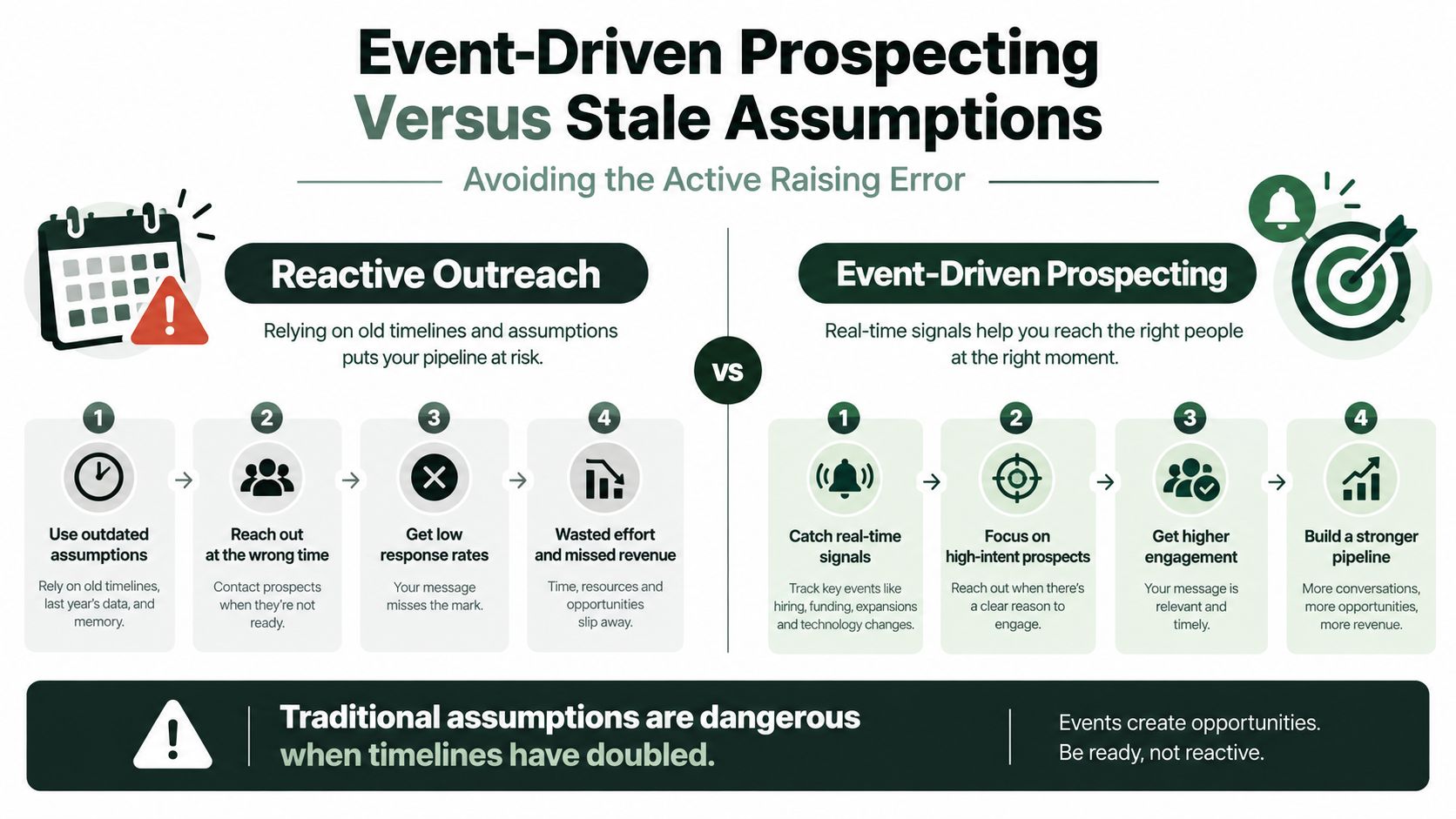
Traditional prospecting often starts with a weak assumption: a company that raised recently must be preparing to raise again. The extended startup funding timeline makes that assumption expensive. A company may have just closed and be focused on hiring, infrastructure, or product delivery, while another company with an older round may be entering a financing process.
The timing problem works in both directions. Outreach to a company that raised long ago may arrive when leadership is conserving runway or concentrating on execution. At the same time, teams may miss a newly verified round because they depend on stale lists that update only when someone manually refreshes them.
Compare the operating models
Prospecting model Trigger Typical weakness Better use Reactive outreach Old funding list or manual research Dates become stale and round context disappears Occasional account review Event-driven prospecting Verified close or structured financing update Requires clean data and routing rules Timely, automated prioritization Cohort-based monitoring Stage, sector, and days since last round More setup than a simple list Strategic market intelligenceEvent-driven teams don't treat every event as an immediate sales opportunity. They use the event to start a context-rich workflow. The record should include the round date, stage, amount, lead investors, company metadata, and relevant contacts. From there, the team can decide whether to contact the company now, monitor it, or wait for a more relevant signal.
Why structured data changes execution
A precise event can trigger different actions by function:
- Sales teams: Route fresh raises into post-funding campaigns, then use aging and hiring signals to identify later expansion opportunities.
- Recruiters: Monitor companies whose capital and hiring activity suggest team-building priorities.
- Analysts: Compare financing intervals by sector, geography, stage, and investor participation.
- Automation teams: Push verified events into CRM, enrichment, scoring, and notification systems without maintaining fragile scrapers.
The advantage isn't just speed. It's better timing judgment. A live event feed prevents teams from confusing a historical financing fact with a current buying signal, while a structured history makes it possible to understand what the company did after the round.
A Founder's Journey Through the Extended Timeline
Consider a composite founder who closed a seed round in early 2023. The original plan was familiar: use the capital to build traction, begin Series A conversations around month 18, and close before the company needed another financing event.
The first year produced meaningful progress, but not enough for a strong institutional case. Investors wanted clear evidence of revenue quality, repeatable growth, and operating discipline. The founder stopped treating the calendar as the pitch and began treating each quarter as a test of readiness.
The bridge changes runway, not the story
At month 18, the company raised a bridge from existing investors. That decision created breathing room, but it didn't magically turn the business into a Series A candidate. The founder kept the original seed close date in the operating model and recorded the bridge separately.
That distinction shaped the next decisions. Hiring focused on roles tied directly to customer delivery and repeatable growth. Investor updates became more consistent, with clear milestones, risks, and evidence rather than broad optimism. The company used the extended period to improve the parts of the business that institutional investors would examine later.
By month 24, the team had a disciplined review rhythm. Every quarter, leadership assessed product usage, revenue quality, hiring efficiency, and cash needs. The founder also maintained a financing narrative that answered three practical questions:
- What changed since the last round?
- What remains unproven?
- What will the next capital fund?
At month 30, the company had stronger operating evidence and a credible path to profitability. The Series A process began and closed within four months. The outcome wasn't the result of waiting passively for the market to improve. The company used the longer inter-round period to convert early promise into a more defensible investment case.
The lesson applies to operating teams as well. A long gap isn't automatically a failure signal, and a short gap isn't automatically proof of quality. The useful interpretation combines elapsed time with sector context, financing type, operating progress, and verified follow-on evidence.
NowFunded provides a live, verified feed of startup funding events, structured for human operators and AI agents, with round details, company metadata, historical context, and verified leadership contacts. Use NowFunded to track the startup funding timeline from the moment a round closes, prioritize accounts by stage and age, and connect fresh financing intelligence to sales, recruiting, or research workflows.