Startup Funding Terms: A Plain-Language Glossary

A post-money SAFE makes ownership mathematically knowable when it's issued, while a $3 million SAFE with a $30 million post-money valuation cap represents 10% ownership before a later priced round, option-pool changes, and other conversion effects. Startup funding terms therefore aren't neutral definitions. Each one determines ownership, control, investor payouts, and the choices available in the next round.
You're likely reading a term sheet with a spreadsheet open beside it, trying to work out whether “10%” really means 10%, whether the option pool comes out of your share, and what happens if the next round is priced lower. The words look familiar enough to skim, but liquidation preference, pro rata, post-money cap, and anti-dilution don't operate independently.
A funding term is a decision with a long tail. Read this glossary as a decision map, not a vocabulary list. The useful question isn't only “What does this mean?” It's “What does this change when we raise again, hire employees, sell the company, or run short of cash?”
Table of Contents
- Why These Terms Feel Like a Foreign Language
- Valuation, Dilution, and Ownership
- The Cap Table as the Operating Layer
- SAFEs, Convertible Notes, and Priced Equity
- Liquidation Preference, Participation, and Anti-Dilution
- Pro Rata, Most-Favored-Nation, and Protective Provisions
- Run Rate, Burn, and Runway
- How the Terms Connect Across Multiple Rounds
- Quick-Reference Card of Startup Funding Terms
- Reading a Funding Announcement Beyond the Headline
Why These Terms Feel Like a Foreign Language
A founder can understand every word in a term sheet and still misunderstand the deal.
The problem usually starts with a document that appears orderly. There's an investment amount, a valuation, ownership percentages, and a page of legal clauses. Then the less familiar language arrives: liquidation preference, participation, pro rata, protective provisions, and anti-dilution. Each term has a plain-English definition, but the definitions overlap in practice.
A post-money valuation cap, for example, can make an investor's ownership calculable when the SAFE is issued. That clarity doesn't mean the founder's final ownership is fixed. A later priced round adds new money, an option-pool increase may issue more shares, and conversion mechanics determine how the earlier SAFE sits inside the new structure.
Practical rule: Never approve a funding term because it sounds standard. Ask what it does to the fully diluted cap table at the next financing and at a plausible exit.
Why definitions aren't enough
Most funding explainers stop after identifying the instrument. A SAFE is future equity. A note is debt that may convert. Preferred stock has special rights. Those statements are useful, but they don't answer the questions founders face across multiple rounds:
- Does a second SAFE dilute the first investor, the founders, or both?
- Does the option pool expand before or after the new investor's ownership is calculated?
- Does a discount apply when a valuation cap already exists?
- Can an investor invest again to preserve their percentage?
- If the company sells, does an investor receive money back first and then share in the remainder?
The right mental model is a chain. The cap table records the chain, the financing instrument starts it, conversion changes it, and investor rights determine who benefits when the company grows or struggles.
That's why a founder-to-founder reading of startup funding terms must stay concrete. Don't memorize clauses in isolation. Trace each clause forward to ownership, control, cash distribution, and negotiating power.
Valuation, Dilution, and Ownership
These three ideas form the arithmetic underneath a funding round.
Pre-money valuation is the company's negotiated value before new investment enters. Post-money valuation is the value after the investment is added. Dilution is the reduction in an existing holder's percentage when the company issues new shares or equivalent rights. Ownership is the percentage of the company held by each shareholder or instrument holder after the relevant transaction.
A simple priced-round example
Suppose a startup raises $3 million at a $12 million pre-money valuation. The post-money valuation is $15 million, because the new capital is added to the pre-money value.
The investor's ownership is:
$3 million ÷ $15 million = 20%
The founders' combined ownership falls from 100% before the round to 80% after the round. The founders haven't necessarily sold any existing shares, but the company has issued new shares to the investor. Their percentage shrinks because the total number of shares has increased.
Before the round After the round Founders 100% New investor 0% Total 100% Founders 80% New investor 20% Total 100%The cash raised doesn't tell you the dilution by itself. You need the valuation basis and the capitalization assumptions behind the price per share. An option-pool increase, outstanding SAFEs, or convertible notes can change the calculation.
The distinction that causes trouble
A post-money cap is not the same thing as a priced-round valuation. It's a conversion parameter that helps determine how a SAFE turns into equity. Treating the cap as the company's definitive valuation can make a funding database, investor update, or internal model misleading.
Ownership is a snapshot taken at a particular point in the financing sequence. It isn't a permanent promise.
When reviewing a term sheet, write down four separate values: the investment amount, the valuation type, the capitalization definition, and the resulting ownership. Then model what happens after the next money arrives. That extra step is where dilution becomes visible.
The Cap Table as the Operating Layer
A term sheet names the deal. The cap table shows what the deal does.
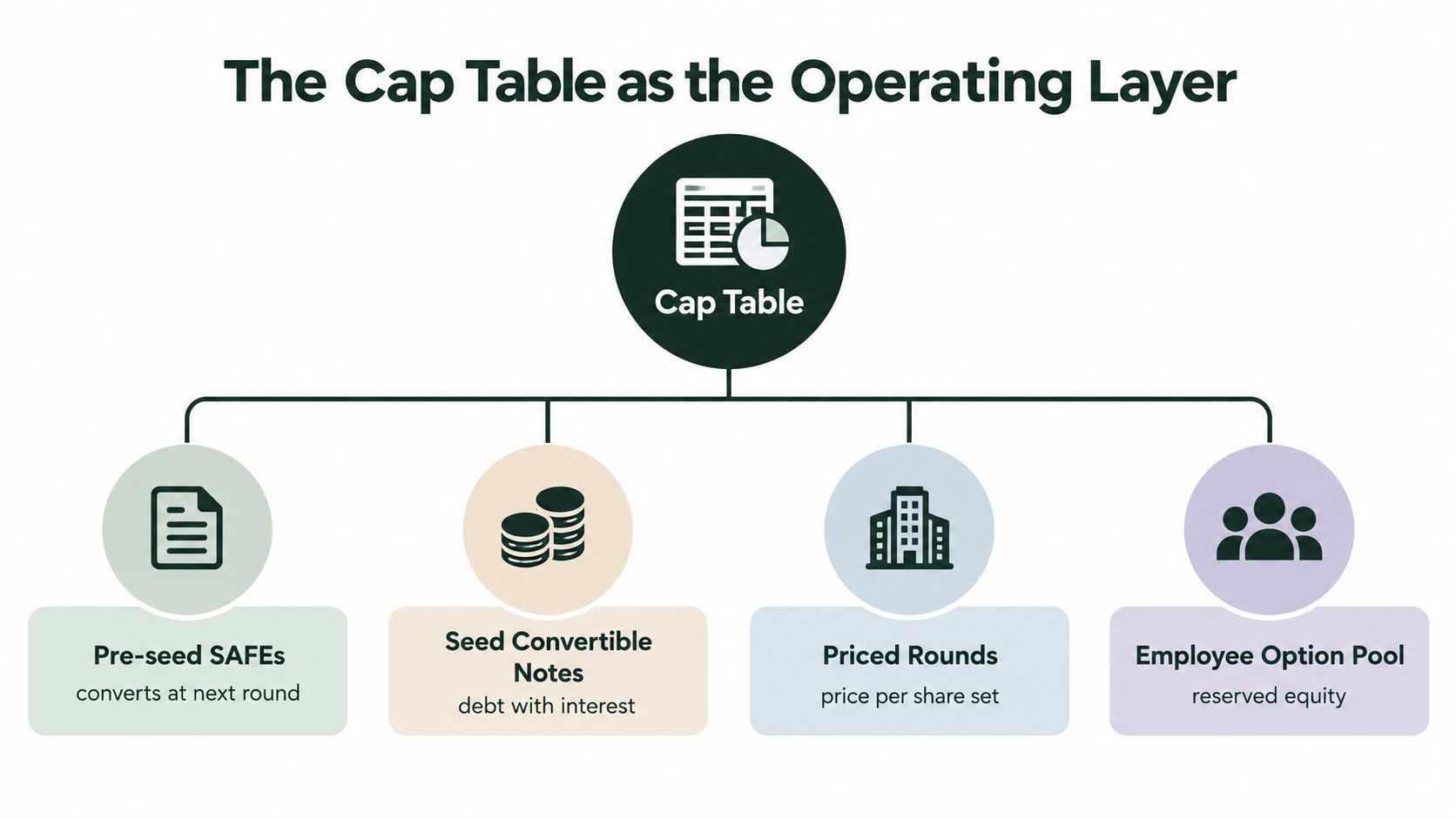
Founders often treat it like a static ownership report, then get surprised when a later round changes more than one line. A cap table works more like the company's operating map for financing decisions. It records current ownership, but it also tracks claims that can turn into ownership later, and those future claims are where confusion usually starts.
Typical entries span founders, employees, advisors, preferred shareholders, SAFE holders, and convertible-note holders. What matters is not only who is on the sheet, but how each row behaves. A useful cap table tracks the holder, security type, share class, share count or principal amount, conversion mechanics, and ownership on a fully diluted basis.
Here is why that matters in practice. One financing choice rarely stays isolated.
Add a SAFE, and cash comes in now while the ownership math waits for later. Issue a convertible note, and the future share count can shift again because principal, interest, maturity, cap, and discount all affect conversion. Close a priced round, and the company sets a share price, converts eligible instruments, issues preferred stock, and may expand the option pool at the same time. Refresh the option pool, and the denominator changes even before anyone new joins the cap table as a shareholder.
That is why experienced founders model the cap table as a sequence, not a snapshot. The same company can look founder-friendly or heavily diluted depending on when SAFEs convert, whether the pool increase happens before or after the financing, and which securities are included in the fully diluted count.
Post-money SAFEs are a good example. The purchased ownership is measured after all SAFE proceeds are counted, but before the next priced round happens. That helps you understand what the SAFE bought without pretending it tells you the final ownership after new money, pool changes, and conversions stack together.
A clean cap table lets you test the questions that matter before signatures turn into surprises. Which instruments convert first? Is the option pool expanded before the investor money goes in? Does the new investor's target percentage apply before or after existing SAFEs convert? If your spreadsheet cannot answer those questions clearly, you do not yet have an operating model.
SAFEs, Convertible Notes, and Priced Equity
You are at the table with a term sheet, and all three choices put cash into the company. What changes is when price and ownership are determined, and that timing changes what happens in the next round.
A SAFE, or Simple Agreement for Future Equity, gives an investor a future equity claim for money invested now. It often includes a valuation cap, a discount, or both. It usually is not debt, so there is no principal to repay on a maturity date in the way a note may require.
A convertible note begins as debt. It usually includes principal, interest, a maturity date, and conversion terms. That means the company is not only setting up future equity math. It is also setting up a clock, and sometimes a negotiation, if the note reaches maturity before a financing closes.
A priced equity round sets the share price at closing. The investor receives preferred stock immediately, and the parties negotiate ownership, economics, and control rights in the same transaction. It is more explicit up front, but also more document-heavy.
Early Round Instruments Compared
Instrument When It Converts Interest or Cap Default Outcome SAFE Usually at a future priced financing or defined liquidity event May include a valuation cap, discount, or both Converts into equity under the agreed mechanics Convertible note Usually at a future financing or another defined event Accrues interest and may include a cap or discount Debt converts, is repaid, or requires a maturity decision Priced equity No later conversion is required for the initial shares Price per share is set at closing Investor owns preferred stock immediatelyHow a cap gives an early investor a better price
Suppose an investor puts $500,000 into a SAFE with a $5 million valuation cap, and the next priced round values the company at $10 million. If the SAFE converts using the cap, it converts as if the company were worth $5 million, not $10 million. In plain terms, that gives the investor roughly 10% of the company before the new money and any option-pool changes, instead of roughly 5% if the conversion happened at the priced round valuation. The cap bought a better entry price.
That is the core idea. Early money takes more risk, so a cap can let that investor convert into more shares than a later investor paying the round price.
The final percentage still moves. Other SAFEs may convert at the same time. The option pool may increase. New preferred shares enter the cap table in the priced round. So the better mental model is not “What does this document mean by itself?” It is “What price does it lock in now, and how does that choice flow through the next financing?”
That is why post-money and pre-money terms matter. The Y Combinator SAFE documentation separates those mechanics clearly. For founders, the practical habit is simple: record the cap type, investment amount, discount, and conversion order for each instrument, then model the ownership before and after the round closes.
Liquidation Preference, Participation, and Anti-Dilution
These terms matter most when the company sells, winds down, or raises capital at a lower price. They can make two rounds with the same headline valuation and investment amount economically different.
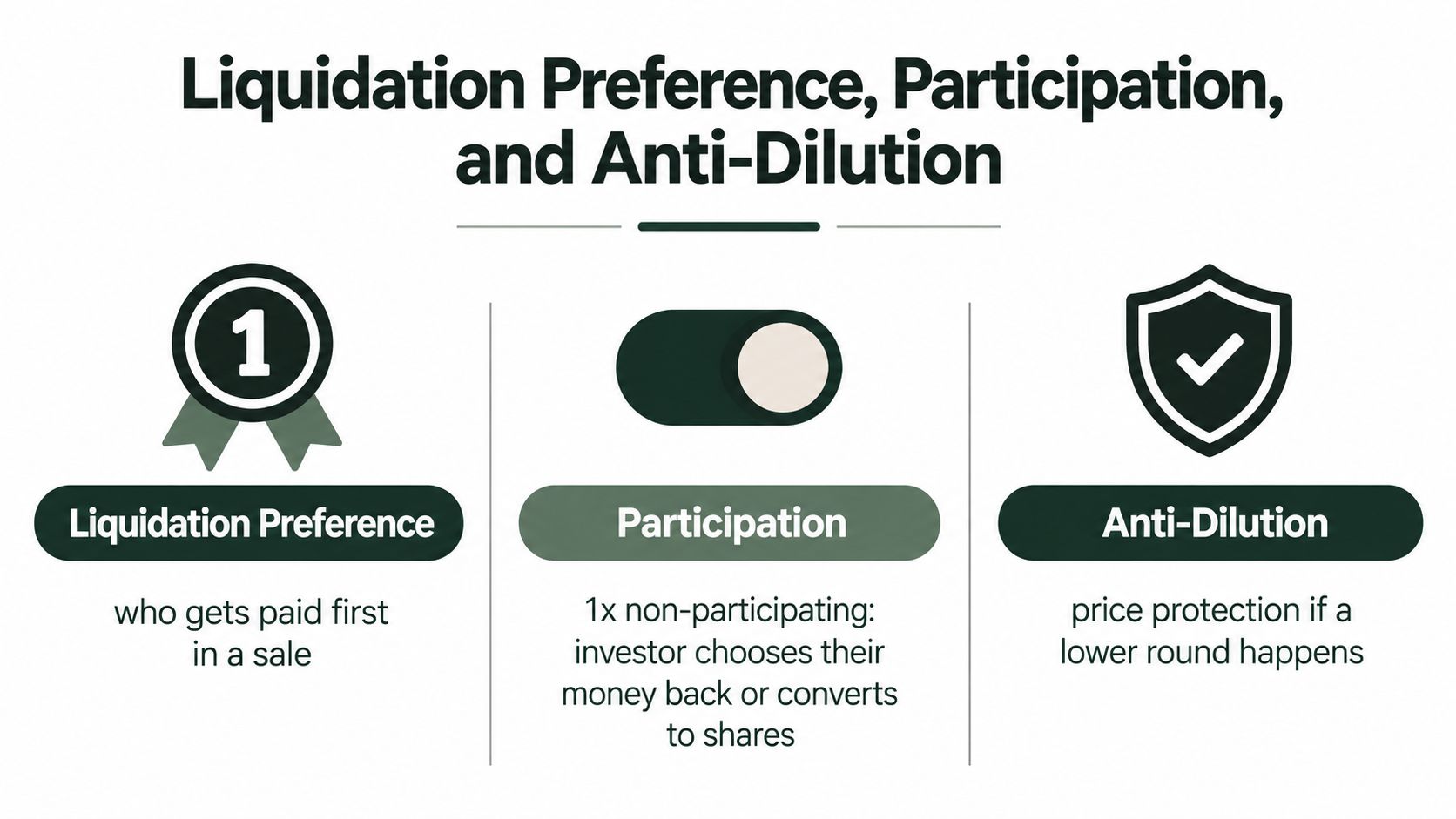
Liquidation preference determines who receives proceeds first. Under a 1x non-participating preference, the preferred investor chooses between receiving the original investment back or converting to common stock and receiving the amount represented by that ownership. The investor doesn't receive both.
Participating preferred stock changes the result. The investor receives the preference first, then shares in the remaining proceeds with common holders. A participation cap can limit that second claim.
Why the exit waterfall matters
Think of the preference as a distribution rule, not a valuation label. At a modest exit, a preference may determine whether founders receive anything after the investor's priority claim. At a strong exit, conversion to common may be more valuable than taking the preference.
The NVCA contract overview describes the fields that deserve separate treatment in a term-sheet model: preference multiple, participation status, participation cap, dividend terms, conversion mechanics, anti-dilution formula, and protective-provision thresholds.
Protection in a down round
Anti-dilution provisions adjust the preferred conversion price if a later financing occurs at a lower price. Broad-based weighted-average anti-dilution considers both the lower issuance price and the relative size of the new issuance. It's materially less aggressive than full-ratchet protection, which resets the conversion price entirely to the new lower price regardless of the size of the new round.
This difference affects founder dilution. A full ratchet can create a larger adjustment in the investor's conversion ratio, while a weighted-average formula shares the effect across the broader capitalization context.
Don't compare only the valuation and amount raised. Read the payout hierarchy and down-round formula beside the ownership percentage.
Pro Rata, Most-Favored-Nation, and Protective Provisions
A round can look simple on the headline, then get complicated once the side rights start to matter. One investor wants to keep their stake in the next financing. Another wants the benefit of better terms if someone else gets them later. A third may be able to stop certain company actions unless they consent. These are different rights, and they create different pressures in the next round.
Pro rata rights let an investor buy enough in a later round to keep their ownership percentage. The investor is not getting extra shares. They are getting a seat at the table when new shares are sold. For a founder, that affects how much room is left in the allocation for new investors.
Most-favored-nation, or MFN, provisions can let an earlier SAFE or note investor adopt better terms later granted to another investor. If a later instrument carries a lower cap, a better discount, or related economic improvements, an earlier investor may be able to match those terms, depending on the wording.
Protective provisions give investors consent rights over major actions such as a sale of the company, a new class of stock, significant debt, changes to governing documents, or board changes. The label matters less than the exact list and the voting threshold.
A useful way to sort them is by the decision each one controls:
- Who gets to keep buying in future rounds?
- Who gets to upgrade terms across instruments?
- Who gets to block major company actions?
Pro rata answers the first. MFN answers the second. Protective provisions answer the third. Because these rights sit in the documents, not the headline valuation, track each one separately. An investor with pro rata rights and a blocking threshold behaves very differently in the next round from one without either right.
Run Rate, Burn, and Runway
A founder can agree to a term sheet that looks acceptable on paper and still end up cornered six months later. The missing piece is usually cash timing.
Run rate is annualized revenue based on the company's current pace. If one month or one quarter is unusually strong, run rate can make the business look bigger than it will be. If sales are seasonal or lumpy, it is a snapshot, not a promise.
Burn measures how much cash the company is using over a period, usually each month. Runway is the time left before that cash runs out at the current burn.
The simple version is easy. A startup with $1.2 million in the bank and $100,000 of monthly burn has 12 months of runway if both numbers stay the same.
Real life rarely stays the same.
A new hire, a delayed customer payment, legal costs for a financing, or a slower fundraise can shorten that runway fast. That is why founders track these terms together. Run rate describes momentum. Burn shows how expensive that momentum is. Runway tells you how much time you have to prove the story before the next financing discussion starts.
This is also why cash terms belong in the same mental model as dilution terms. A valuation cap, discount, option-pool increase, or liquidation stack changes who owns what. Burn and runway change who has time to negotiate. Time affects price.
One useful way to read the numbers is to treat them like three clocks running at once:
- Operating clock: how long current cash supports the business at the present burn
- Ownership clock: how each SAFE, note, pool, and priced round changes the cap table over time
- Negotiation clock: how much time the company has before urgency starts shaping the deal
When those clocks line up, founders usually get more choice. When runway gets short, a term that creates more dilution or tighter control rights can become harder to resist, because the company is buying time as much as capital.
How the Terms Connect Across Multiple Rounds
The easiest way to get lost in a financing is to read each term sheet as a separate event. Founders feel that confusion all the time. A $500,000 pre-seed SAFE with a $5 million post-money cap, a $2 million seed SAFE with a $10 million post-money cap, and then a $10 million Series A at a $30 million pre-money valuation can sound like three clean milestones. On the cap table, they behave more like stacked decisions that keep changing one another.
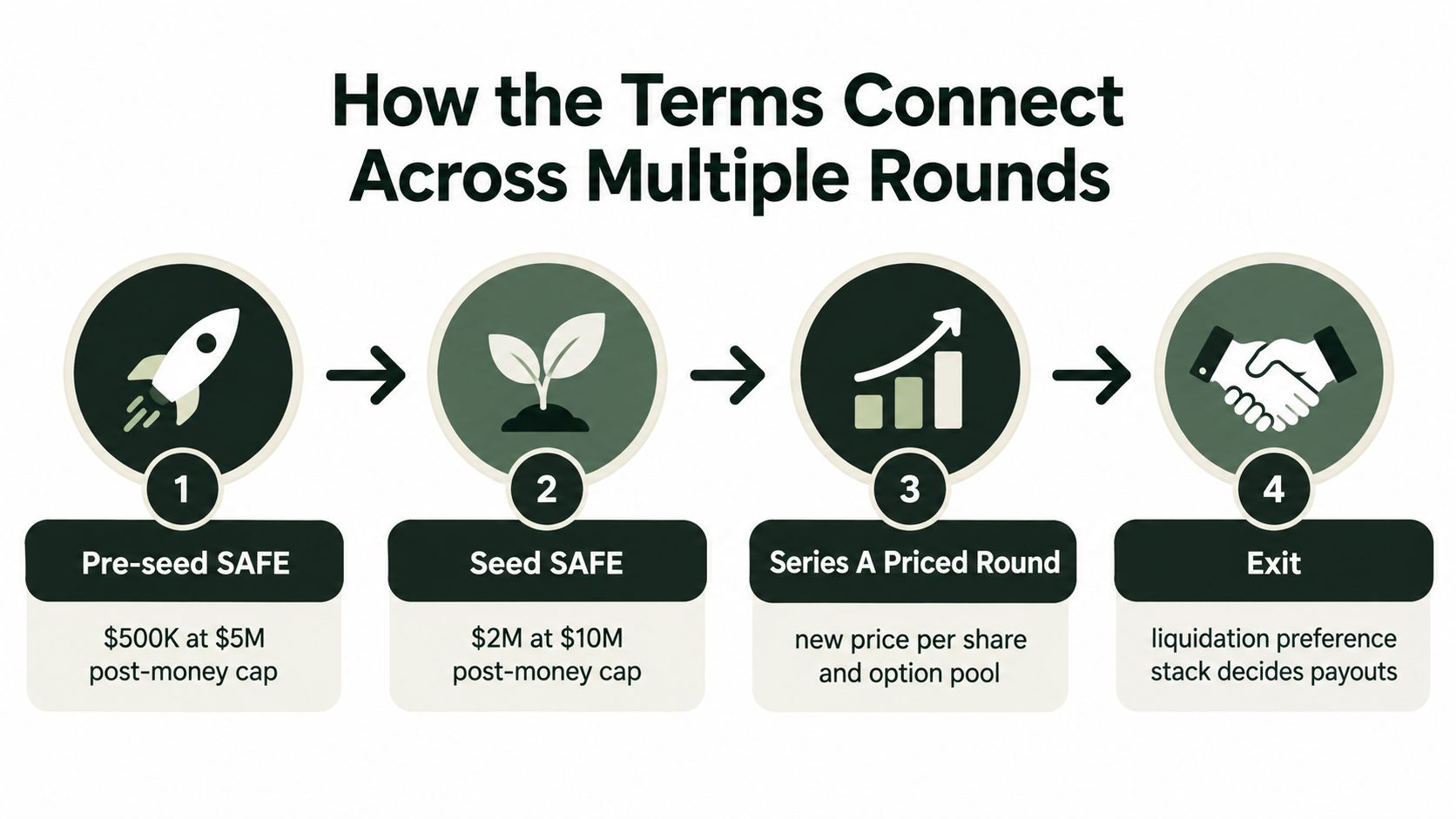
A useful mental model is a queue. Earlier instruments get in line first, but later rounds decide how that line resolves. The first post-money SAFE usually makes the investor's purchased ownership measurable when it is signed. The second SAFE adds another claim, with its own cap and its own place in the math. Once the Series A arrives, those SAFEs generally convert before the new preferred shares are issued, and then the new money dilutes everyone already in the company.
That order matters more than the headline numbers.
The $30 million pre-money valuation is the pricing reference for the Series A. It does not rewrite the earlier SAFE caps. Those caps were conversion terms, not statements that the company was "worth" the same thing at every stage. Founders often blur those ideas together, then get surprised when ownership after conversion looks different from the simple story they told themselves between rounds.
Another place founders get caught is the option pool. If the Series A requires the pool to be created or expanded before the investor's target ownership is calculated, more dilution can land on founders and existing holders than the headline Series A percentage suggests. The term sounds administrative. The consequence is economic.
So the clean way to read a multi-round financing is to trace the company forward in actual order: start with founders and the existing pool, layer in each SAFE under its own terms, convert those instruments under the financing documents, account for any pool refresh at the agreed moment, issue the Series A shares, and only then look at rights attached to those shares, including liquidation preference.
A term that feels founder-friendly in a small early round can become expensive once several instruments stack before the first priced round. A cap table that only shows money raised and valuation hides that chain reaction. The record needs the original SAFE terms, conversion math, pool changes, share classes, and preference rights, because exit outcomes depend on all of them together.
Quick-Reference Card of Startup Funding Terms
Use this card when a conversation moves quickly and you need the plain-English meaning without losing the economic consequence. For deeper workflow ideas around structured company research, see the Synal blog.
Funding Terms at a Glance
Category Term Plain-Language Reminder Ownership mechanics Pre-money Company value before new investment Ownership mechanics Post-money Company value after new investment, or a SAFE cap measured after SAFE proceeds Ownership mechanics Dilution Existing holders' percentages shrink as new claims or shares are added Ownership mechanics Fully diluted Ownership view that includes relevant options and conversion rights Instruments SAFE Future equity claim with defined conversion terms Instruments Convertible note Debt that may convert, with interest and maturity considerations Instruments Priced round Shares issued now at a negotiated price per share Investor rights Pro rata Right to invest again to maintain a percentage Investor rights MFN Right to adopt better later terms, if the clause allows it Investor rights Protective provisions Consent rights over specified major company actions Exit economics Liquidation preference Rule for who receives proceeds first Exit economics Participation Whether the investor can take preference and share in the remainder Exit economics Anti-dilution Conversion-price protection during a lower-priced future roundThe card is a starting point, not a substitute for a pro forma cap table or legal review.
Reading a Funding Announcement Beyond the Headline
You open a press release that says a startup raised a Series A. Before you treat that as a clean signal of momentum, pause. The headline confirms money was announced, but it does not tell you how the round was built, what rights came with it, or how much real operating room the company gained.
A “Series A” can cover very different situations: a standard priced round, an insider-led extension, a bridge, a flat round, or defensive financing. The number in the headline can also blend new primary capital with secondary share sales or debt. That is where readers get misled. A round label is only the cover of the book. The terms underneath shape dilution, control, and what the next round is likely to look like.
The wider funding picture also helps set expectations. Global venture funding reached $425 billion across more than 24,000 private companies in 2025, while early-stage funding was $37 billion (Crunchbase's 2025 funding analysis). In May 2025 alone, AI companies raised $5.9 billion, representing just over a quarter of that month's global venture funding, per the same analysis.

A practical reading checklist
- Identify the capital type: Separate primary equity from secondary sales and debt.
- Find the lead investor: Distinguish the lead from participating investors and insiders.
- Interpret the label carefully: Ask whether the round is a new priced milestone, a bridge, an extension, or defensive financing.
- Connect capital to runway: Compare the announced amount with the company's burn and likely hiring plans.
- Record structured fields: Capture stage, amount, investors, location, industry, leadership, and the company website rather than saving only the press-release headline. A workflow for organizing those fields is described at Synal.
This reading habit matters because one announcement can hint at several downstream consequences. A bridge may signal that pricing the next round is still unresolved. An insider-led extension may help the company buy time, but it can also reshape who has influence in the next financing. Secondary-heavy rounds can produce a large headline without putting much fresh cash on the balance sheet.
For teams turning funding news into research or outreach, NowFunded provides a live feed of funding events with structured company and round details, plus delivery through MCP, REST API, webhooks, CSV export, or a web dashboard. That added context helps you read a financing announcement as an operating signal, not just a milestone.