Startup Funding Rounds Explained from Pre-Seed to Series B
You see a headline announcing that a startup has raised a new round. The amount looks impressive, but the announcement leaves practical questions unanswered. Is the company still testing an idea, hiring aggressively, entering new markets, or simply extending its runway? For a founder, the answer affects fundraising strategy. For an SDR, recruiter, or market researcher, it can indicate fresh budget, new hiring needs, and a narrow window for relevant outreach.
Startup funding rounds are operating signals, not just financial milestones. They show how a company is reducing risk, what it needs to prove next, and which investors believe in that path. They also help you distinguish a company that has just secured resources from one that merely appears in a noisy funding headline.
The market deserves that careful reading. Global venture funding reached $425 billion in 2025 across more than 24,000 private companies, up 30% from $328 billion in 2024, making 2025 the third-highest venture financing year on record after 2021 and 2022, according to Tracxn's funding database. Yet aggregate growth doesn't mean capital is equally available to every founder, especially at pre-seed through Series B.
This guide follows the funding ladder from pre-seed to Series B, explains common size and valuation benchmarks, and examines what headline totals hide. It also turns funding announcements into a practical workflow for sales, recruiting, and research teams that need current, verified information. If you want a broader starting point for understanding funding activity, NowFunded can serve as a reference point while you build that process.
Table of Contents
- Introduction Why Startup Funding Rounds Matter Right Now
- How Startup Funding Rounds Work From Idea to Scale
- Pre-Seed to Series B Breakdown of Sizes Valuations and Investors
- What Headline Funding Numbers Hide About Early Stage Access
- How to Use Funding Signals for Outreach and Research
- Valuation Dilution and Runway What Founders and Prospectors Miss
- Putting It All Together Your Next Steps With Funding Data
Introduction Why Startup Funding Rounds Matter Right Now
A round announcement gives you more than a number. It gives you a timestamp.
A founder who closes a seed round may be preparing to turn an early product into something repeatable. A Series A company may be building sales, product, or customer success capacity around a business model that has shown traction. A Series B company may be making larger operational bets, such as entering markets, expanding its team, or increasing distribution. The exact plan varies, but the round provides a useful clue about the company's immediate priorities.
That clue matters to several audiences:
- Founders: The stage helps frame the milestones investors will expect before the next raise.
- Sales teams: New capital can create a reason to reassess a prospect's budget, priorities, and buying timeline.
- Recruiters: A newly funded company may be preparing to fill leadership or specialist roles.
- Researchers: Round type, investors, location, industry, and company maturity create a clearer view of market movement.
The mistake is treating every announcement as equivalent. A large late-stage financing and a small early round don't carry the same meaning, even when both appear in a funding feed. A company that raised recently may have fresh resources, but it may also be under pressure to meet demanding milestones before it can raise again.
Practical rule: Read a funding event as a statement about the next business problem the company intends to solve.
Timing makes the signal more useful. Soon after a verified round, leaders are often translating the announcement into hiring plans, technology decisions, market expansion, and operating budgets. Outreach that's connected to those likely priorities has a better chance of being relevant than a generic message sent months later.
The rest of the guide builds a simple mental model first, then adds stage benchmarks, market context, and an actionable research workflow. You won't need to memorize every financing term. You need to understand what changed, what the company must prove next, and how to act on that information without confusing market noise for genuine opportunity.
How Startup Funding Rounds Work From Idea to Scale
Think of a startup as climbing a mountain. Each funding round pays for the next stretch of the route, while investors decide whether the company has reduced enough risk to justify continued support. The labels matter because they describe the company's development, not merely the size of a cheque.
Level one is the idea
At pre-seed, the company may still be validating the problem, assembling the founding team, or building an early product. Capital often comes from founders, personal networks, angels, accelerators, or other supporters willing to accept substantial uncertainty. The immediate question is simple: can this idea become a product that real users want?
The seed round moves the company from a promising concept toward evidence. The team may have an early product, initial customers, or signs of demand, and it needs resources to improve the product, test distribution, and hire key people. Investors aren't expecting a finished machine. They want credible progress toward one.
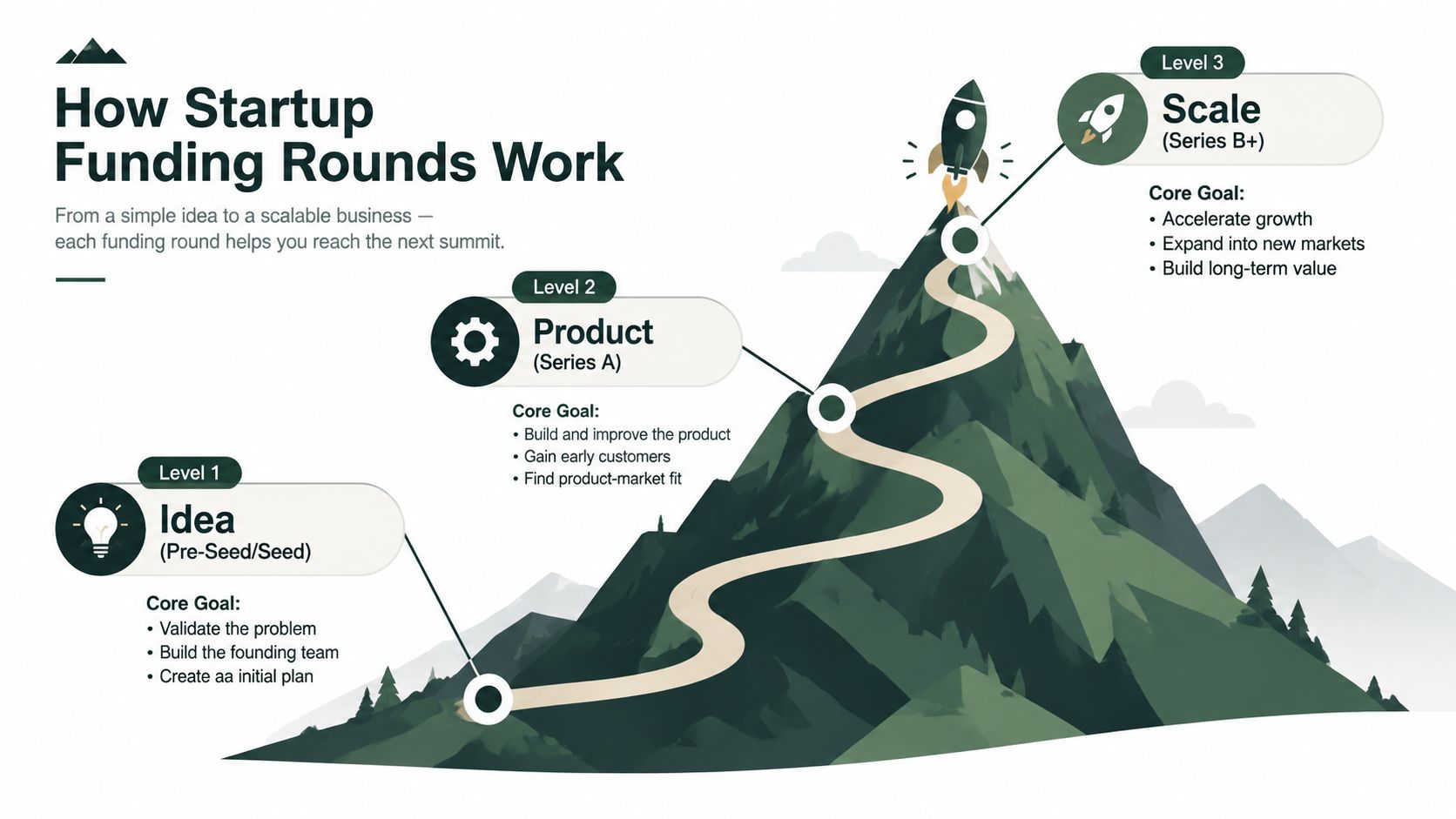
Level two is the product
Series A usually marks a shift from experimentation to repeatable execution. The company must show that its product serves a defined market and that growth can be supported by a credible business model. Investors examine customer behavior, retention, acquisition efficiency, revenue quality, and the team's ability to turn early traction into a system.
This isn't just a bigger seed round. The risk has changed. At seed, investors may be underwriting the possibility that the company can find a scalable model. At Series A, they want evidence that the model is beginning to work and that additional capital can accelerate it.
Level three is scale
Series B funds a company that's trying to expand a proven model. The business may be increasing its sales capacity, entering new markets, enlarging the product team, or strengthening operations. Investors expect stronger evidence that the company can grow without allowing costs, complexity, or customer problems to outrun revenue.
The stages form a ladder of proof:
- Pre-seed: establish the idea and founding team.
- Seed: build and test the early product.
- Series A: demonstrate a repeatable business model.
- Series B: scale that model with greater operational discipline.
A startup can stop at any stage, raise extensions, pursue other financing, or exit without following a fixed sequence. The round label is useful because it summarizes the company's current financing position, but the underlying milestones matter more than the label itself.
Pre-Seed to Series B Breakdown of Sizes Valuations and Investors
Round sizes vary by geography, sector, business model, and market conditions, so benchmarks should guide interpretation rather than act as a pricing rule. Recent summaries using data from Carta, PitchBook, and Crunchbase show a clear increase in capital intensity as companies move from early validation to scale.
Stage Median Round Size Post-Money Valuation Typical Investors Pre-seed $750K to $1.5M $4M to $6M Founders, angels, accelerators, early-stage funds Seed $4.1M median $24M Angels, seed funds, accelerators, venture capital firms Series A $19.4M median $78.7M+ Venture capital firms, corporate venture investors, existing backers Series B About $40M $120M to $160M+ Growth-stage VC firms, venture capital firms, private equity investorsThese benchmarks are summarized in Crunchbase's 2025 funding data coverage. The practical pattern is more important than any individual figure: each stage generally asks investors to commit more capital against a company that has already reduced some earlier risk.
Pre-seed and seed
Pre-seed investors back the team, the problem, and the possibility of a useful product. They may accept limited revenue evidence because the company is still establishing its foundation. Seed investors want more than a compelling idea. They look for early proof that customers care, that the team can build, and that the next milestone is reachable.
At seed, capital typically supports product development, market testing, initial hiring, and the first repeatable acquisition experiments. A founder should be able to explain not only how much money is needed, but what specific evidence that money will create.
Series A
Series A investors typically lead a more formal process. They examine whether the company can retain customers, acquire them efficiently, and grow without relying entirely on one-off wins. A strong round narrative connects the capital to a measurable operating plan, such as expanding a sales motion that already works or building infrastructure required by growing demand.
Series B
Series B investors evaluate execution at scale. They care about growth quality, retention, unit economics, leadership depth, and whether the organization can absorb a larger operating footprint. The company isn't just asking for permission to experiment. It's asking investors to finance acceleration.
The stage-to-stage jump also changes ownership conversations. The verified benchmarks note that dilution and check sizes rise sharply with each stage, so investors use milestone density, retention evidence, efficiency, and category momentum to justify higher pricing. A headline valuation can therefore look attractive while still creating difficult expectations for the next round.
What Headline Funding Numbers Hide About Early Stage Access
A strong venture market can still feel tight to an early-stage founder. The reason is concentration.
Global venture funding reached $425 billion in 2025, but the increase was concentrated in the largest rounds and in AI, according to Venture Capital Tracker. That means a market can produce a record-level total while many smaller companies compete for a limited share of investor attention.
Funding growth is not the same as broad availability
One recent market view reported that 72% of trailing-four-quarter VC capital went to scaleup rounds above $100 million, while only 8% went to startups under $15 million, as summarized in Dealroom's global venture guide. The same source also reported that deal count fell 17%, while mega-rounds surged 77% and absorbed 65% of total venture funding.
Those figures create two different stories:
- Headline story: Total venture funding is expanding.
- Operator story: Capital is concentrating in companies that have already achieved scale or occupy highly favored categories.
Founders raising pre-seed, seed, Series A, or Series B capital should therefore avoid using aggregate funding totals as proof that fundraising has become easier. Large AI financings can lift the average and dominate news coverage without improving access for a non-AI company with a smaller round requirement.
Why this matters for research and outreach
A funding database that only shows the amount raised can mislead a prospecting or research team. The useful question is whether the event belongs to a company that's newly resourced at the stage you care about, and whether the company is likely to make decisions connected to that capital.
For example, an SDR targeting early-stage software companies shouldn't rank prospects solely by round size. A smaller Series A may be more relevant than a massive later-stage financing if the offer supports hiring, revenue operations, infrastructure, or customer acquisition at the exact point of expansion.
The same logic applies to analysts. Separate market totals, deal counts, stage mix, and sector concentration before drawing conclusions. Aggregate growth describes the top layer of the market. Stage-level availability tells you what founders and operators can access.
The right question isn't “Is venture funding up?” It's “Which companies, stages, and categories are receiving the available capital?”
How to Use Funding Signals for Outreach and Research
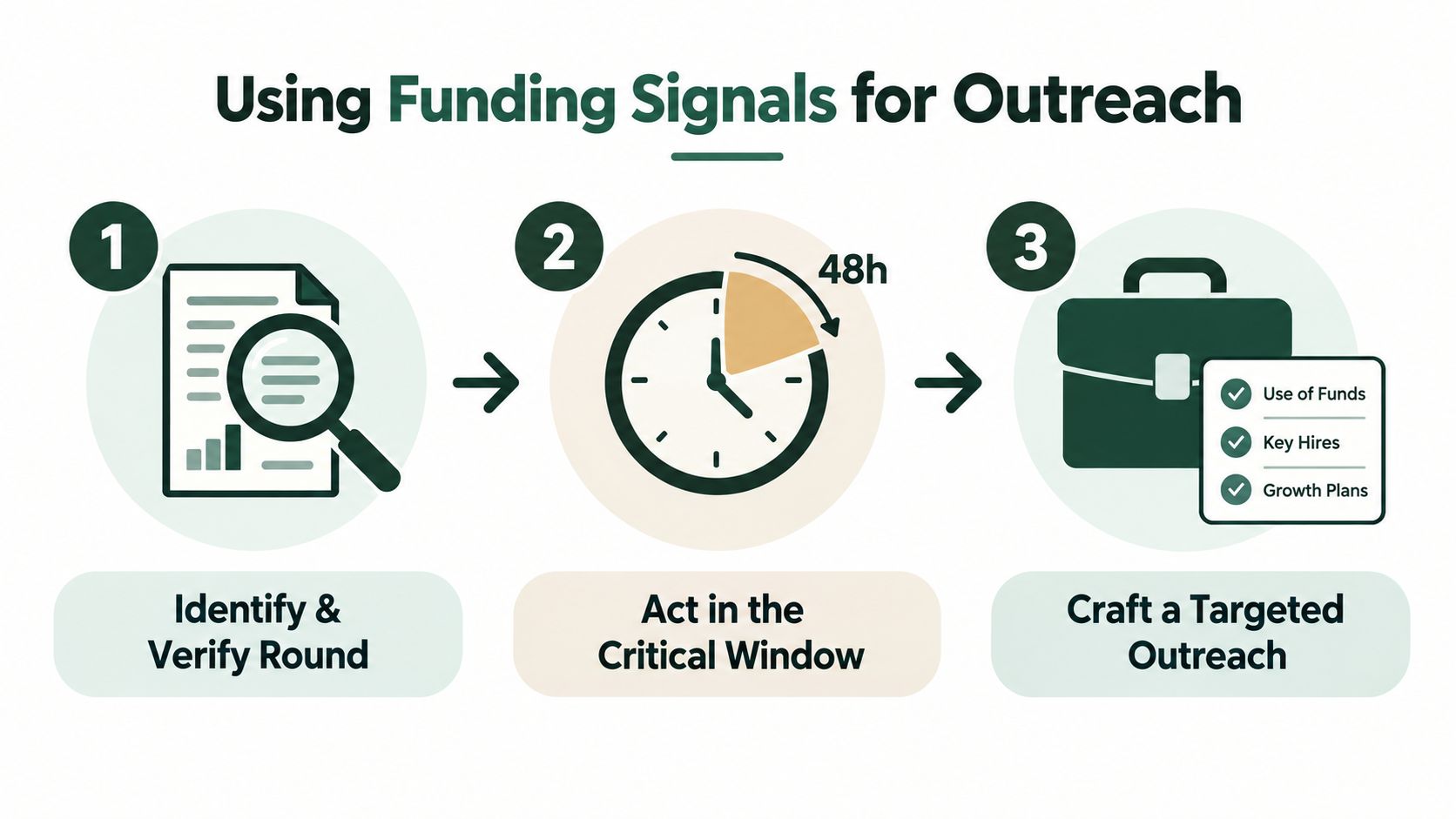
A funding announcement becomes useful when you turn it into a verified record and connect it to a specific action. Treat the process like a short research sprint, not a reason to send an immediate generic pitch.
Start with the event record
Capture the core fields first:
- Company identity: Confirm the legal or trading name, website, location, and relevant LinkedIn profile.
- Round details: Record the stage, amount, announcement date, and whether the financing is new, an extension, or another structure.
- Investor context: Identify participating investors and, where available, the lead investor.
- Operating clues: Note industry, headcount, stated use of funds, leadership changes, and hiring activity.
Verification matters because announcements can describe financings inconsistently. A company may use language that doesn't fit the benchmark stage, combine multiple financing events, or omit important terms. Cross-check the company announcement, investor communication, and a structured funding record before assigning a prospect priority.
Act while the plan is still forming
The most useful outreach window opens after the round is verified and before the company's new priorities become routine. Don't assume every company will buy immediately. Instead, use the announcement to form a focused hypothesis.
A sales message might connect your product to the company's stated expansion plan. A recruiting team might look for newly created leadership roles or technical hiring signals. A research analyst might compare the round with prior financings, investor participation, and category activity.
Use a simple priority model:
- Match the stage to the offer. A seed company may need foundational systems, while a Series B company may need scale-oriented infrastructure.
- Match the use of funds to the problem. Product expansion, hiring, international growth, and go-to-market investment imply different conversations.
- Match the contact to the decision. Reach the founder, functional leader, or relevant operator instead of relying on a generic inbox.
- Log the evidence. Store the source, verification status, event date, and reason for prioritization.
Teams can monitor these events through live feeds, APIs, webhooks, CSV exports, or a dashboard. A structured source such as the NowFunded blog can also support ongoing education while operators decide which fields belong in their own workflow.
The goal isn't to automate thought. It's to remove repetitive discovery work so a human can spend more time interpreting the event and writing a relevant message. A push notification for a verified round is usually more actionable than a stale list that forces the team to rediscover whether the company still fits.
Valuation Dilution and Runway What Founders and Prospectors Miss
The amount raised is only the visible part of a financing. Founders also need to understand valuation, dilution, runway, and the time required to reach the next milestone.
Carta reported that median dilution in new rounds declined across every stage from seed through Series D in Q1 2025. At Series A, median dilution was 17.9%, compared with 20.9% a year earlier, according to Carta's State of Private Markets report. That shift can mean founders retain more ownership in a new round, but it doesn't remove the pressure to deliver stronger results at the next financing.
Valuation can rise while access gets harder
The same Carta data showed that seed valuations rose even as the number of seed rounds fell 28% year over year. A higher valuation may look like straightforward good news, but it can increase the performance expectations attached to the company. If the business can't grow into that price, the next round may become more difficult, especially when investors are selective.
Separate reporting in the verified data also noted that fundraising remained well below 2021 levels, with time between rounds stretching to 24 to 30 months post-Series A. Longer gaps change the runway calculation. Founders must plan for the possibility that the next raise takes longer, while prospectors should avoid assuming that a fresh round means unlimited spending.

For founders, evaluate a round by asking:
- What milestone does this capital fund?
- How much ownership changes after the financing?
- What happens if the next round takes longer than expected?
- Which operating metrics must improve before follow-on funding?
For prospectors, the same questions improve qualification. A company with new capital may still be cautious, selective, and focused on preserving runway. The strongest outreach acknowledges that reality instead of treating the announcement as an open invitation to sell.
Putting It All Together Your Next Steps With Funding Data
Startup funding rounds become easier to interpret when you read them as stages of risk reduction. Pre-seed and seed financing support discovery and early proof. Series A supports a model that has begun to work. Series B funds the expansion of that model. The amount and valuation matter, but the next milestone matters more.
Keep the market context in view. $425 billion in global venture funding doesn't mean every early-stage company has equal access to capital, particularly when large rounds and AI-related financings dominate the total. Separate headline growth from stage availability before you make a market claim, prioritize a prospect, or advise a founder.
Use this checklist for your next workflow:
- Verify the event: Confirm the company, round, date, amount, and investor details.
- Classify the stage: Decide what the company is likely trying to prove next.
- Read the operating signal: Look for hiring, expansion, product, or go-to-market priorities.
- Enrich carefully: Find the leader whose role matches the likely decision.
- Act with relevance: Tie your message to the company's stated direction.
- Track the outcome: Preserve the event record and update your research as the company progresses.
A live, structured feed can replace brittle scrapers and stale spreadsheets, while verified contacts reduce the time spent checking whether a person or company is still reachable. The advantage comes from combining fresh data with sound judgment, not from sending more messages.
NowFunded provides a live, verified feed of newly funded startups from pre-seed through Series B, with company, round, investor, location, headcount, industry, and website fields. It also offers verified founder and leadership contacts through MCP, REST API, webhooks, CSV export, and a dashboard, so visit NowFunded to turn funding events into timely research and targeted outreach.