Startup Funding News: Track, Filter, Act on Early-Stage

In 2024, roughly $314 billion flowed into startups globally, up from about $304 billion in 2023, according to Crunchbase's 2024 funding analysis. That headline sounds broad, but about $100 billion went to AI alone, while North America gained funding and Asia fell to a 10-year low. The market recovered in dollars without recovering evenly for the median startup.
That distinction changes how a sales, recruiting, or market-intelligence team should read startup funding news. A funding announcement isn't automatically a buying signal. It's an unprocessed event that may contain a useful account, a stale duplicate, a secondary tranche, or a mega-round that says almost nothing about the early-stage companies you can reach.
The practical job is to turn each announcement into a verified operational signal. That means separating dollar volume from deal activity, checking the event's fields, enriching the company, scoring it against your ICP, and delivering only alerts someone can act on.
Table of Contents
- Why Startup Funding News Now Looks Different
- What a Funding Event Actually Contains
- Early-Stage Volume vs Late-Stage Concentration
- Turning Raw Announcements Into Outreach Signals
- What a Raise Means for the Next 90 Days
- Delivery Modes Compared Side by Side
- Common Misconceptions About Funding Alerts
- Putting It All Together This Week
Why Startup Funding News Now Looks Different
The most recent market data shows why funding headlines need context. PitchBook-NVCA's venture monitor says $100 million-plus megadeals captured 87.5% of H1 2026 venture dollars, while AI absorbed 86% of all venture dollars. The same report says three firms captured 48.1% of capital raised. A small group of transactions can therefore make the market look healthy even while many founders face a much tighter financing environment.
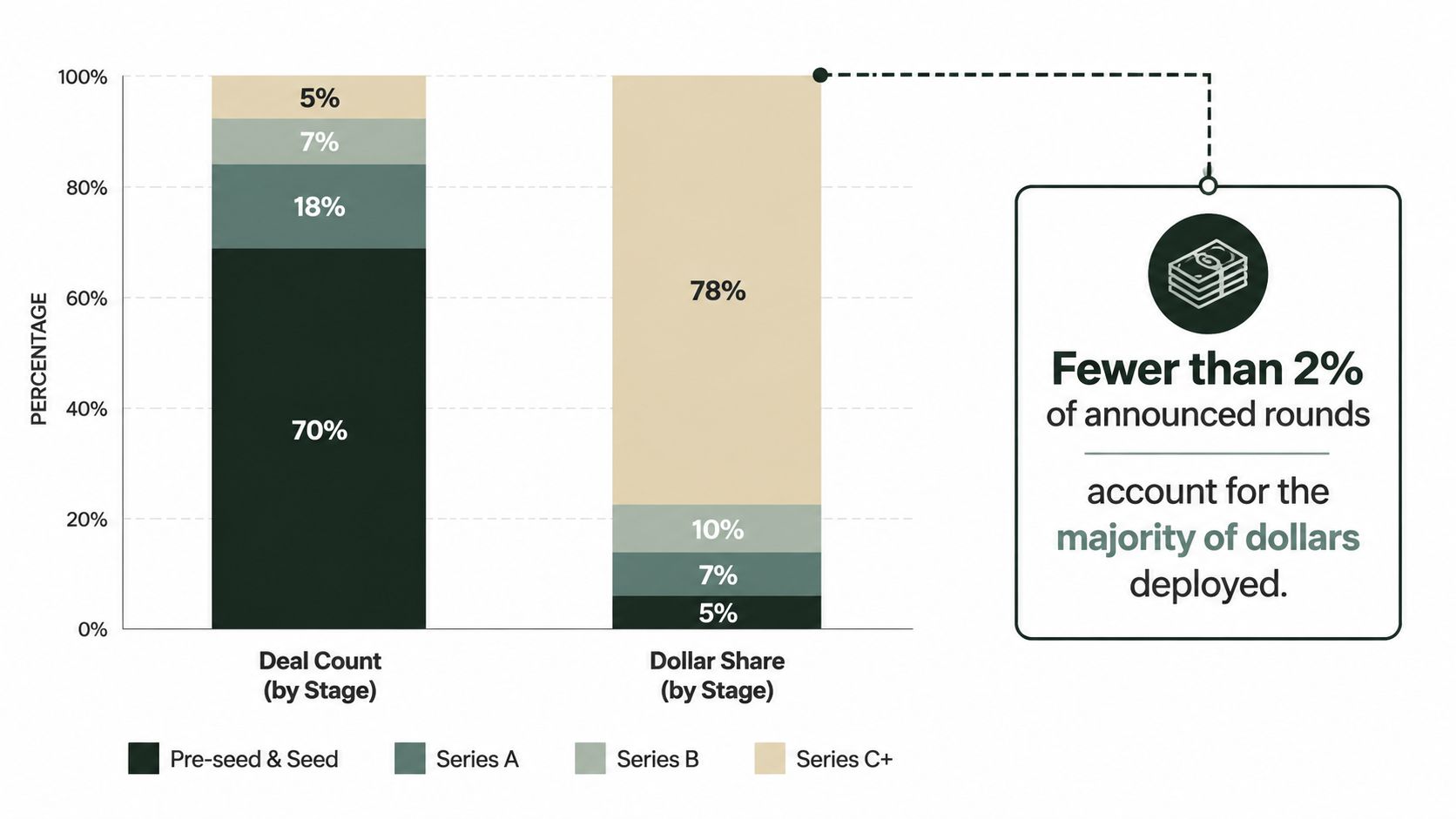
Deal count and dollar volume now answer different questions. Deal count tells you how widely investors are participating. Dollar volume tells you where capital is concentrating. KPMG's 2024 global venture report recorded $368.3 billion across 35,684 deals, compared with $349.4 billion across 43,320 deals in 2023. More money moved through fewer deals, and the Americas accounted for much of the increase while Europe and Asia-Pacific declined.
The operational distortion
Media coverage follows the largest checks because they're easy to summarize and attract attention. A sales team that watches only those headlines may overestimate competition for heavily funded AI accounts and miss the dense pool of pre-seed, seed, and Series A companies where founders are still choosing vendors, hiring partners, and building basic infrastructure.
That doesn't mean large rounds are irrelevant. They can indicate a category shift, a new competitor, or an investor thesis worth tracking. They just need a different workflow from early-stage alerts.
Practical rule: Treat dollar volume as a concentration signal and deal volume as a coverage signal. Never substitute one for the other.
What a Funding Event Actually Contains
A useful funding record is more than a company name and a round amount. It's a structured object that lets a system identify the company, understand the transaction, verify the source, and decide whether the event belongs in an operator's queue.
At minimum, require these fields:
- Company identity: Legal name, trading name when different, company domain, website, and location.
- Transaction details: Announced date, round label, amount raised, resolved amount, and an explicit undisclosed status when the amount isn't public.
- Investor structure: Lead investor, participating investors, and whether an investor is new or returning.
- Governance changes: Board additions or changes when disclosed.
- Company intent: Stated use of proceeds, such as hiring, product development, market expansion, or infrastructure.
- Context and provenance: Valuation when disclosed, primary source URL, secondary source URLs, and verification status.
The domain is a particularly important field. Without it, enrichment may attach the wrong LinkedIn page, the wrong technology profile, or a similarly named legal entity. Without a round label, you can't reliably distinguish a seed account from a later-stage company. Without the lead investor, account mapping loses one of the strongest routes into a founder relationship.
Primary sources versus republished records
Primary sources include company announcements, regulatory filings such as SEC Form D, and investor portfolio pages. They can still be incomplete, but they provide the closest available evidence of what was announced. Secondary aggregators are useful for discovery and historical context, yet they may normalize dates differently, merge tranches, or publish after the original announcement.
Before subscribing to a feed, ask whether it exposes both the normalized value and the original evidence. A field that says “amount raised” without showing whether the figure was disclosed, inferred, or unresolved creates avoidable review work.
A feed is only operationally useful when every important value has a clear meaning and a traceable source.
Early-Stage Volume vs Late-Stage Concentration
Early-stage funding news is difficult to read because the most actionable companies often generate the least polished coverage. Pre-seed and seed announcements may appear in a founder post, an investor portfolio update, a regulatory filing, or an aggregator record. Some companies disclose the round quickly, while others surface it only after hiring begins or a new product launches.
That means there isn't a reliable universal baseline for “normal” pre-seed, seed, or Series A activity without a defined dataset, geography, sector, and reporting window. A sharp increase in records may reflect better discovery, an accelerator batch, delayed announcements, or genuine financing activity. The raw count alone won't tell you which one occurred.
Read changes as clues, not conclusions
Use stage trends as prompts for verification:
- Pre-seed and seed volume rises: Check whether the increase clusters around an accelerator, a geography, or a particular investor group.
- Seed round amounts appear larger: Verify whether companies converted earlier instruments into priced equity or whether multiple tranches were combined.
- Series A activity weakens: Watch for companies that recently raised seed capital but have not added hiring, product, or investor signals. A financing gap can affect their ability to buy or expand.
- Series C and later activity spikes: Separate market intelligence from outbound prospecting. Large late-stage rounds can move total dollars dramatically while adding few founder-level accounts to an early-stage pipeline.
A practical weekly classification should use your own rolling baseline. Call a week busy when verified records materially exceed the recent pattern for the same stage and coverage area. Call it normal when the mix and pace are consistent. Call it quiet when records fall below that pattern after you've ruled out feed failure and reporting lag.
The useful comparison
The contrast isn't “early stage good, late stage bad.” Early-stage announcements often provide better timing for founder outreach, but they contain less complete data. Late-stage announcements offer stronger public signals and richer reporting, but the company may already have mature procurement, established vendors, and a crowded inbox.
Track both. Route them differently. Early-stage records should feed tightly scored outreach and recruiting workflows. Late-stage records should inform competitive research, investor mapping, and strategic account planning.
Turning Raw Announcements Into Outreach Signals
A raw announcement shouldn't reach a rep's inbox. Put it through a staging and verification workflow first.
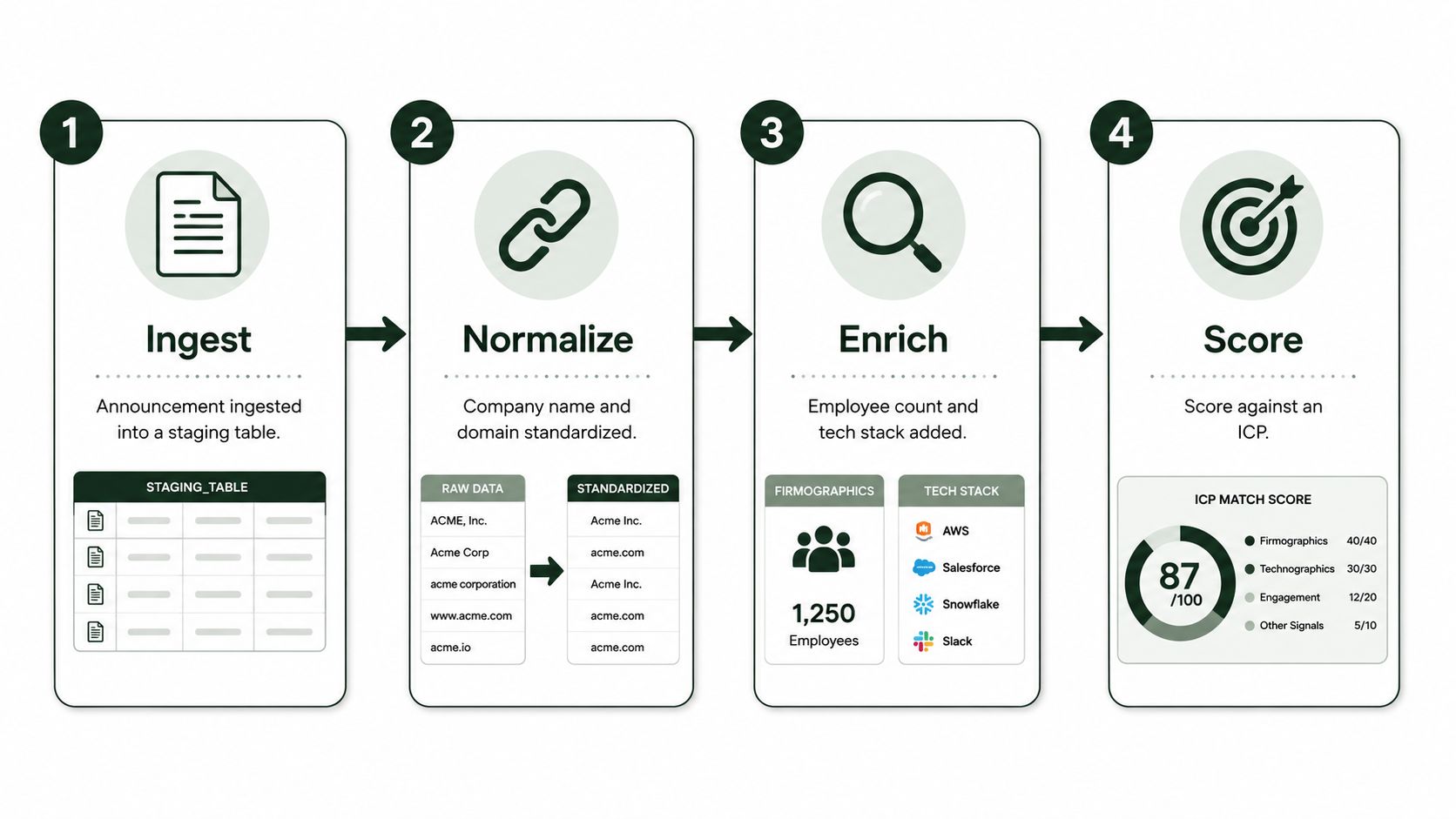
Start with a staging table
Ingest the record exactly as received. Preserve the source text, source URL, publisher, detected date, round label, amount, investor names, and ingestion timestamp. Don't overwrite raw values during normalization. You need the original record when a duplicate or dispute appears later.
Then normalize the company name and domain. Strip legal suffixes for matching, retain the legal name separately, resolve redirects, and compare the domain against the company's official site. A company can raise through a parent entity, a subsidiary, or a renamed legal entity, so name matching alone is unsafe.
Enrich only after identity is stable
Add employee count, technology stack, industry, headquarters, LinkedIn URL, hiring page URL, and recently posted roles. For outreach, the most useful event fields are usually round size, lead investor, hiring page, and active roles. They connect the financing event to a plausible business action.
Verification should include:
- Compare the aggregator's round date with the company announcement date.
- Check whether an SEC Form D represents the same financing or a separate filing.
- Search for duplicate records under different legal entities.
- Mark announcements that describe a tranche, extension, or debt facility.
- Keep undisclosed amounts separate from zero values.
The deduplication key should combine normalized company identity, round label, lead investor, and a date window rather than relying on the company name alone. A later tranche may be related to the same financing without being a new round, so store the relationship instead of creating another alert.
Score for fit and timing
A $4 million seed led by a known operator fund, with three open engineering roles, may deserve a higher score than a $12 million round from a conglomerate with no hiring signal. The smaller company has a clearer operating trigger and a more reachable buying group. The larger company may have capital but no visible near-term need that matches your offer.
For implementation patterns and structured funding workflows, review the funding research and workflow resources, but keep the scoring logic specific to your market. A useful score should combine stage, sector, geography, investor relevance, hiring activity, technology fit, and contact availability. Speed matters only after the record passes those checks.
What a Raise Means for the Next 90 Days
A funding event changes a company's operating options, but it doesn't reveal the entire plan. Founders may allocate capital toward hiring, product work, infrastructure, sales, compliance, or extending runway. The announcement is the starting signal, not proof that a budget has been approved for your category.
Hiring is often the earliest visible clue. Watch the company careers page, job board activity, leadership changes, and technical hiring language. A new role can tell you more about near-term demand than the round announcement itself, especially when the company doesn't publish a detailed use-of-proceeds statement.
Use timing windows without pretending they're guarantees
The first outreach window is immediately after verification. Congratulate the company, reference the lead investor or stated purpose, and keep the message narrow. Don't send a generic “you raised, so you must need our product” pitch.
The next useful window opens when the company's internal planning becomes clearer. Hiring managers may publish roles, founders may announce priorities, and technical pages may change. Procurement signals can appear later still, when a team evaluates vendors against the new operating plan.
A practical cadence looks like this:
- Early window: Confirm the event and send a relevant, low-pressure note tied to a public fact.
- Planning window: Recheck hiring, leadership, product, and technology signals before following up.
- Evaluation window: Contact the owner of the problem with a concrete workflow, not a funding congratulation.
Some signals decay quickly. The announcement date becomes less useful every day, and investor references lose force if the message doesn't connect to an operating issue. Hiring pages and technology changes can remain useful for longer, while a stale employee estimate should be treated cautiously.
Follow-on financing deserves the same discipline. A seed round can support growth, but it doesn't guarantee a Series A, continued hiring, or procurement expansion. Score follow-on likelihood using observable progress, such as product activity, customer evidence, hiring quality, and investor participation, rather than treating the round label as a forecast.
Delivery Modes Compared Side by Side
Delivery choice determines whether funding data becomes a live workflow or another spreadsheet someone checks occasionally. The right option depends on urgency, engineering capacity, recovery requirements, and how much schema control your team needs.
Delivery mode Latency to first record Integration cost Failure recovery Schema risk Historical backfill Polling Depends on interval Low Simple retry and replay Moderate Usually straightforward Webhooks Near real time when configured Moderate Requires retries, logs, and replay handling Moderate to high if payloads change Limited unless the provider supports replay MCP On demand for an agent or workflow Moderate Agent can retry queries, but orchestration matters Lower at the interface, higher in tool behavior Strong for query-based research CSV Batch timing Low initially Manual re-import and reconciliation High if columns change Good for bulk analysisPolling
Polling suits a low-volume team with a simple stack. A scheduled job checks for new records, stores a cursor or last-seen value, and retries failed requests. It's easy to understand, but an aggressive interval increases unnecessary requests while a slow interval delays outreach.
Verdict: Choose polling when response time can be measured in hours or longer and your team wants the least integration complexity.
Webhooks
Webhooks fit event-driven pipelines. A verified event can trigger enrichment, scoring, CRM creation, and notification without waiting for the next scheduled job. The trade-off is operational responsibility. Your endpoint needs idempotency, retry handling, dead-letter storage, and a way to process payload changes safely.
Verdict: Use webhooks when you need push delivery and can operate a reliable receiver.
MCP and CSV
MCP is useful when an AI agent needs structured access to funding records without owning the provider's underlying schema. The agent can query for a narrow set of companies, apply research instructions, and retrieve context on demand. It isn't a replacement for event delivery when every new record must trigger an immediate action.
CSV remains practical for batch analytics, territory planning, and historical review. It performs poorly for real-time outreach because files create versioning, import, and duplicate-management work.
For teams evaluating structured access and live funding workflows, NowFunded's platform provides a relevant reference point for comparing these integration patterns.
If your outreach SLA is under four hours, webhook or MCP access should be the default starting point. Polling and CSV require a clear reason to accept delay.
Common Misconceptions About Funding Alerts
More notifications don't create better pipeline. They create more sorting, more duplicate research, and more opportunities for reps to contact companies with no relevant need.
The first misconception is that alert count equals coverage. It doesn't. Coverage depends on whether the feed finds the right companies, resolves identities, captures stage and amount correctly, and exposes a usable contact or route to one. A large queue can hide missing fields and make the team feel busy without improving account quality.
The second misconception is that every announcement represents a buying signal. A round may fund research, extend runway, support an acquisition, or replace an earlier financing record in an aggregator. Even a genuine equity raise may not create demand for your product. The company needs to match your ICP, show a relevant operating trigger, and have a reachable decision-maker.
Speed versus relevance
Fast delivery helps when the event is fresh and the company is actively planning. Speed doesn't rescue a bad match. A stale but well-verified account can be more valuable than an instant alert with the wrong domain, an incorrect round date, or a duplicate legal entity.
Avoid using performance thresholds that aren't grounded in your own historical data. The correct qualified-contact rate, daily alert cap, and response benchmark depend on your segment, message, and rep capacity. Establish a baseline first, then tighten the system until reps can review every alert properly.
Guardrails that hold up
- Cap the queue: Set a daily alert limit per rep so review quality doesn't collapse.
- Score before delivery: Keep low-fit records in a research table instead of the active notification stream.
- Require core fields: Don't alert until company identity, stage, amount status, date, and source evidence are present.
- Deduplicate aggressively: Merge repeated coverage of the same financing and preserve every source behind one canonical record.
- Review stale records: Recheck unresolved events before sending a second or third touch.
A good alerting system is selective by design. Its success is measured by useful conversations and efficient research, not by how many pings it can generate.
Putting It All Together This Week
A sales engineer can put the workflow into production with a small, explicit operating loop. Start with two funding trackers, not an uncontrolled collection of feeds. Compare their overlap, source quality, date behavior, and field completeness before adding more.
Define the canonical record next. Capture company name, domain, amount, stage, announced date, lead investors, sector, geography, source URLs, and verification status. Keep raw and normalized values separate so a reviewer can understand what changed.
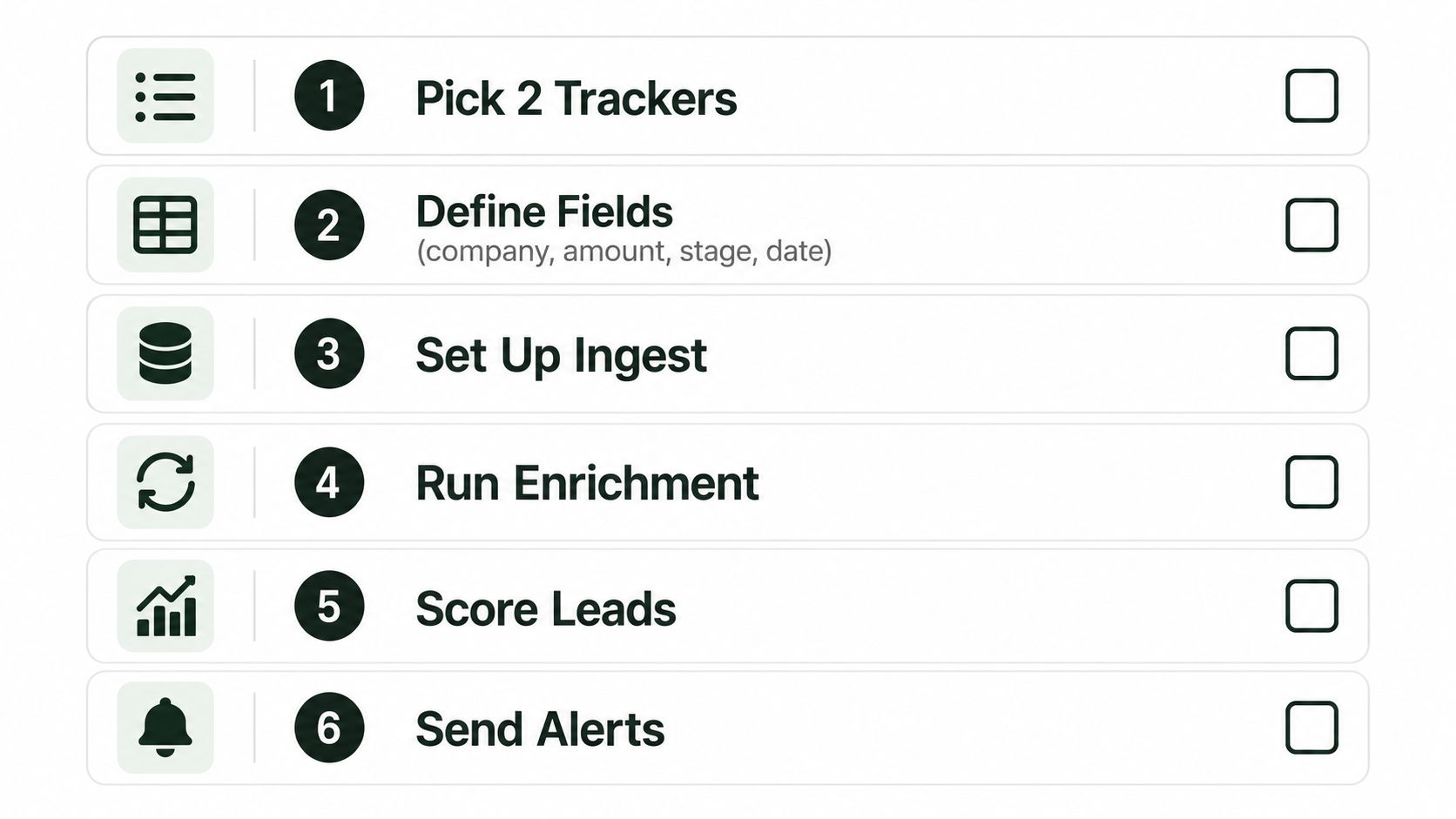
A Monday-to-Friday operating checklist
- Pick two trackers: Test their coverage against the accounts your team already knows.
- Define fields: Decide which values are required before an event can enter the queue.
- Set thresholds: Filter by stage, sector, geography, and round-size relevance to your offer.
- Wire delivery: Use polling for a simple low-urgency stack, webhooks for push workflows, or MCP when an agent needs structured research access.
- Assign ownership: Give each alert type one rep or operator, such as seed software, technical hiring, or investor-led accounts.
- Review on Friday: Remove noisy filters, merge duplicates, inspect missed records, and document exceptions.
Enrichment should run after identity normalization. Score the account before creating a CRM task. A rep should receive the reason for the alert, the evidence behind the round, the relevant operating signal, and a suggested next action.
Track the system for a full operating cycle before changing everything at once. Useful benchmarks include qualified meetings booked from funded-startup alerts, cost per verified signal, and time from announcement to first touch. Add failure metrics too, such as duplicate rate, unresolved amount rate, and records rejected because the domain couldn't be verified.
The goal isn't a perfect feed. It's a repeatable loop that gets cleaner each week without requiring someone to babysit every announcement.
NowFunded provides a live, verified feed of newly funded startups with structured funding fields, enrichment options, and delivery through MCP, REST API, webhooks, CSV, or a dashboard. Use NowFunded to turn startup funding news into filtered, outreach-ready signals instead of stale lists and duplicate alerts.
Drafted with the Outrank tool