Startup Funding Models: A Founder's Practical Guide
VC isn't the default: in one study, it represented only 1.85% of small-business finance, and a May 2025 survey found it ranked fifth among preferred funding sources. Most successful startups layer funding models over time, matching each instrument to the business's cash flow, ownership goals, and required growth speed.
The popular advice says to pick a lane. Bootstrap if you want control, raise venture capital if you want speed, borrow if you want to avoid dilution. That advice is tidy, memorable, and often wrong.
Founders usually finance a company in stages. They use personal savings to build the first version, customer payments to fund delivery, a grant to support technical work, an angel round to reach product-market evidence, and debt only after repayment becomes credible. The right question isn't, “Which funding model should I choose?” It's, “What combination of capital gives this company enough runway without creating obligations it can't carry?”
That distinction matters because funding changes more than the bank balance. It affects ownership, governance, repayment pressure, hiring pace, investor expectations, and future financing options. A capital stack that works for a recurring-revenue software company may damage a hardware business, while a service company may create unnecessary dilution by raising equity before it needs it.
Table of Contents
- The Hidden Truth About Startup Funding
- Understanding Each Startup Funding Model
- When Venture Capital Is Not the Right Choice
- Real-World Funding Scenarios That Actually Happen
- Building Your Capital Stack Strategically
- Your Actionable Framework for Choosing Funding Models
The Hidden Truth About Startup Funding
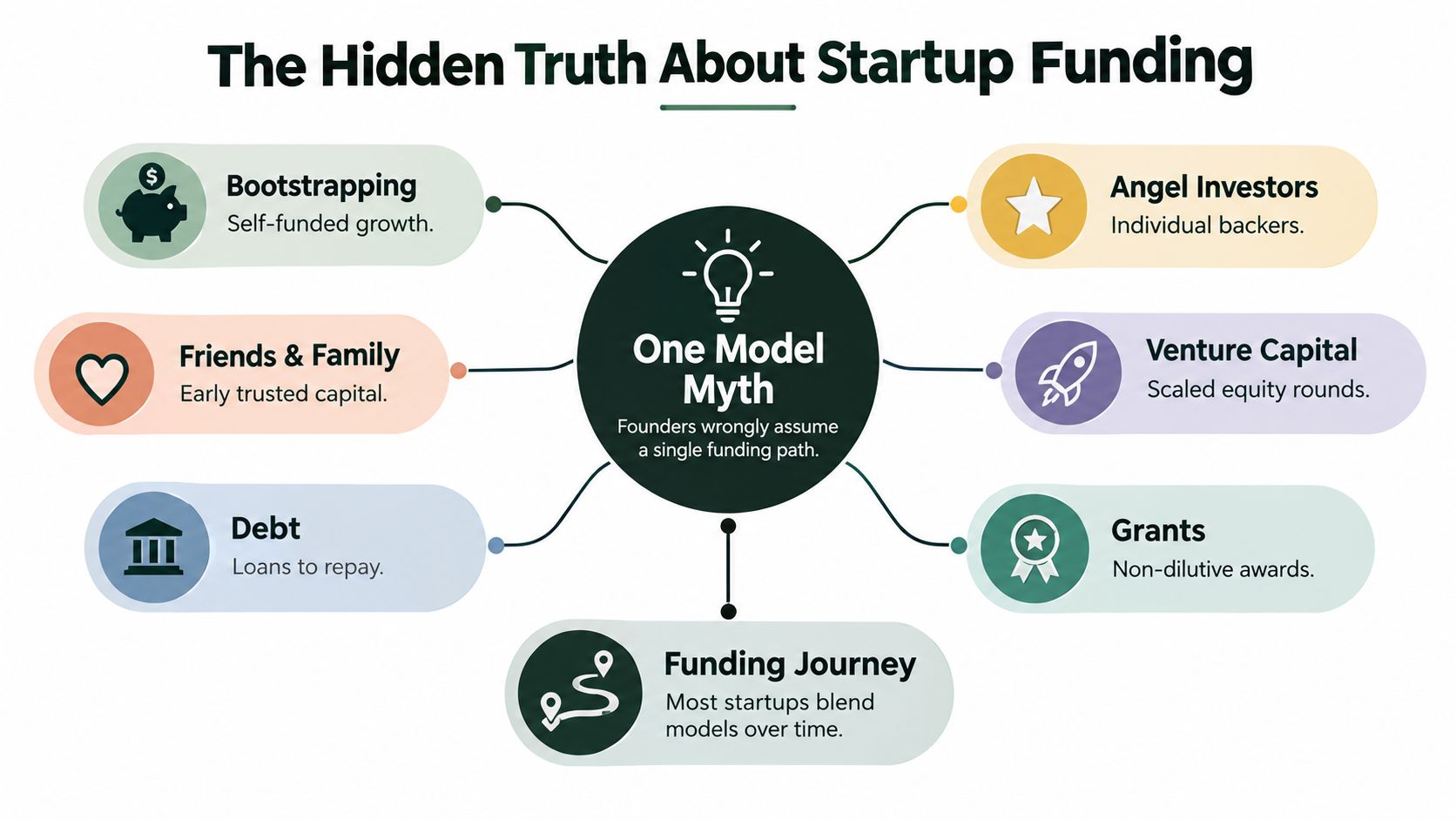
The best startup funding strategy is rarely a single model. Founders who treat financing as a permanent choice often create the wrong ownership, repayment, or growth constraints. Stronger companies build a capital stack, changing instruments as the business moves from idea to product, repeatable sales, and expansion.
Academic research identifies bootstrapping, friends and family, bank loans, angel investment, venture capital, government programs, accelerators, and crowdfunding as distinct financing models. A review of 30+ startup financing studies in the International Journal of Entrepreneurial Behaviour & Research found that approximately 95% of firms used at least some bootstrapping activities (a review of 30+ startup financing studies in the International Journal of Entrepreneurial Behaviour & Research). Bootstrapping therefore appears inside many externally funded companies through founder labor, delayed compensation, customer deposits, supplier terms, and reinvested revenue.
Historical finance data also puts venture capital in context. The 1993 U.S. National Survey of Small Business Finances estimated that angel financing represented 3.59% of small-business finance, while venture capital represented 1.85%, as reported in the same academic review of financing models. VC receives disproportionate attention because it funds visible, high-growth companies. Across the wider small-business universe, however, it is only one source among many.
Think in layers, not labels
Each source should have a defined job in the capital stack:
- Validation capital: Founder funds, friends and family, grants, or small angel checks can finance discovery and an initial product.
- Working capital: Customer prepayments, milestone billing, supplier terms, and revenue-based facilities can support delivery without selling more ownership.
- Expansion capital: Priced equity, venture capital, or venture debt can fund hiring, inventory, geographic expansion, or a larger sales motion.
- Resilience capital: Retained earnings and an available credit facility can protect the company when sales arrive later than planned.
Practical rule: Match permanent capital to permanent risk. Use equity for uncertain, long-duration growth. Use operating or debt capital only when the repayment path is visible.
Tools such as the funding-stage and instrument tracking platform NowFunded can help teams compare funding events across different capital stacks. The practical lesson is straightforward: match structure to revenue predictability, dilution tolerance, repayment capacity, and desired growth speed. Preserve ownership where possible, accept dilution when speed creates real value, and avoid repayment obligations the business cannot yet carry.
Understanding Each Startup Funding Model
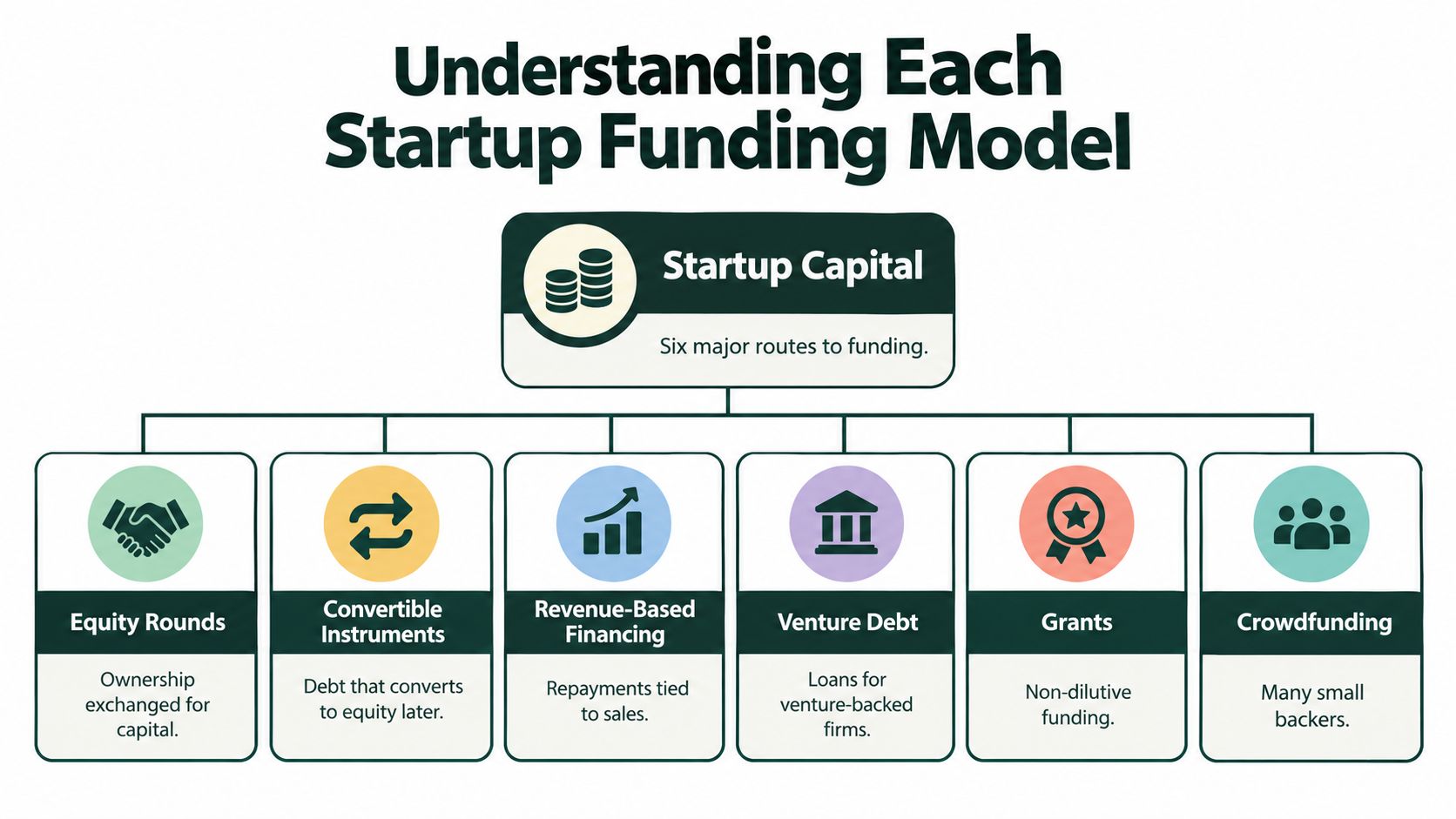
Funding models are building blocks for a capital stack, not labels on a menu. Each one changes the company's ownership, cash obligations, governance, or future financing options. Match the instrument to revenue predictability, dilution tolerance, repayment capacity, and the speed the business can support.
Funding model What the company receives Main founder cost Usually fits Priced equity Cash in exchange for shares Dilution and governance rights Companies pursuing substantial expansion Convertible instruments Cash that may convert into future equity Deferred dilution and cap-table complexity Early rounds before a clear valuation Revenue-based financing Cash repaid as a share of revenue Variable repayment that rises with sales Businesses with predictable revenue Venture debt Loan capital Interest, repayment, and lender protections Companies with dependable cash or equity backing Grants Non-dilutive funding Competition and restricted use Research, innovation, or public-purpose work Crowdfunding Capital from many backers Campaign effort and fulfillment obligations Products with an engaged potential customer baseEquity rounds
A priced equity round establishes a valuation and issues shares, often preferred stock. Investors may receive information rights, consent rights, liquidation preferences, or board participation in addition to ownership. This structure fits a company with a growth plan that operating cash flow cannot fund, particularly when investor expertise or distribution access justifies the governance cost.
The cost is permanent dilution. Founders also take on expectations for the next round, which can push the company toward a larger market, faster hiring, and a fundraising timetable that does not match its actual economics. Equity makes more sense when the capital funds uncertain, long-duration growth than when it merely covers predictable working capital.
Convertible instruments
A SAFE, or Simple Agreement for Future Equity, postpones a priced valuation until a later financing round or another triggering event. Y Combinator introduced the original SAFE in late 2013, and its post-money version, released in 2018, made the ownership impact of multiple SAFEs easier to see (Y Combinator's SAFE documents).
A SAFE can shorten negotiations and reduce legal expense in an early round. “Simple” does not mean consequence-free. Valuation caps, discounts, and most-favored-nation provisions shape future ownership. Several SAFEs can obscure dilution unless the founder models the full cap table before signing.
Revenue-based finance, debt, grants, and crowdfunding
Revenue-based financing ties repayment to sales. That can protect cash during slower months, while the same obligation becomes more expensive as revenue accelerates. Venture debt requires scheduled repayment and interest, so it belongs where the company has a credible cash source or equity backing, not only an ambitious forecast.
Grants avoid dilution, but they commonly restrict spending and may require applications, reporting, or technical eligibility. Crowdfunding combines fundraising with public demand testing. It also requires marketing, community management, production planning, and reliable fulfillment. The campaign creates a visible promise to customers, not just a source of capital.
When Venture Capital Is Not the Right Choice
Venture capital is a financing model, not a badge of company quality. It makes sense when a company can deploy substantial capital into a very large opportunity, sustain rapid expansion, and offer investors a plausible path to an exceptional return. A profitable business with moderate growth may be healthier without it.
A May 2025 survey of 1,500 U.S. entrepreneurs found that VC ranked fifth among preferred funding sources, behind self-funding, business loans, revenue-based financing, and friends-and-family capital. More than half of early-stage technology companies surveyed had received no VC funding (the May 2025 entrepreneur survey). Those findings challenge the assumption that every ambitious founder should optimize for a venture round.
The economics test
Ask four questions before preparing a VC deck:
- Can additional capital produce outsized growth? If every new dollar mainly supports delivery capacity or incremental hiring, equity may be an unnecessarily costly source of working capital.
- Does the market reward speed? Some categories benefit from rapid distribution and network effects. Others reward careful execution, customer trust, or specialized expertise.
- Can the company support investor expectations? VC investors generally need a path toward a much larger outcome than a comfortable owner-operated business.
- Is founder control negotiable? Equity investors can influence strategy, hiring, budgets, future fundraising, and exit decisions.
Revenue-based financing can be safer than equity when revenue is recurring, margins are healthy, and customer concentration is manageable. Debt can work when cash conversion is reliable and the company can make payments without diverting funds from product or support. Neither option is automatically superior. A repayment obligation becomes dangerous when sales are lumpy, customers pay slowly, or the founder must borrow again to meet the first facility's terms.
Where grants fit
Grants are especially useful for research, technical development, climate work, or other projects that align with a public program's objectives. They can fund a defined milestone without changing the cap table. They rarely replace a complete financing strategy, though, because eligibility and spending rules can narrow the company's freedom.
Non-AI companies may also find equity investors more selective while still operating sound cash-flow businesses. That makes customer-funded growth, specialist angels, grants, and carefully sized debt worth evaluating before a founder accepts dilution just because VC is the most visible option.
Real-World Funding Scenarios That Actually Happen
Consider three companies with three different financing problems. None needs a single permanent answer.
A pre-seed SaaS company with recurring contracts and strong gross margins may start with founder capital and a small SAFE to build the product and validate retention. Once customers pay consistently, revenue-based financing can fund sales hiring or implementation capacity without pricing the company too early. The founder must still model the repayment share against slower months, churn, and customer concentration. If the company needs aggressive market capture, a priced equity round may eventually be more suitable than continuously diverting revenue to financing.
A hardware startup faces a different cash cycle. It may need to pay suppliers before customers pay for finished inventory, and delays can tie up cash for longer than expected. Angel investment can fund engineering and certification, while a bank facility or venture debt can support inventory and purchase orders once repayment evidence exists. Pure VC may provide more flexibility, but it also brings dilution and an expectation that the company will pursue a much larger outcome than a focused hardware business may want.
A service business can finance itself
A consultancy, agency, or specialist services firm with signed contracts and fast receivables may not need external equity at all. Customer deposits, milestone billing, interim personnel, and reinvested operating cash can finance controlled growth. The main discipline is separating genuine capacity expansion from founder overwork. If the company needs a permanent team, it should forecast payroll against contracted and repeatable revenue rather than treating every signed proposal as cash in the bank.
The experience of founders in less mature or regionally constrained ecosystems reinforces this practical view. In a study of 71 founders, 50.7% identified bootstrapping as their primary funding source and 29.6% relied primarily on friends and family, meaning more than 80% used informal or self-generated capital. Bank and non-bank financial institution loans represented 12.7%, angel investment 7%, while venture capital, grants, and crowdfunding were negligible as primary sources in that sample (the 71-founder study).
These figures aren't a universal market share, but they describe a financing reality many founders recognize: access depends on geography, networks, collateral, sector, and timing. The NowFunded blog offers a useful place to follow funding activity, but founders still need to distinguish visible rounds from capital that is realistically accessible to their own stage.
Building Your Capital Stack Strategically
A capital stack should answer three questions before it answers “How much can we raise?” The first is how quickly the business must grow. The second is how much ownership the founders are willing to exchange. The third is how much repayment the company can carry without weakening operations.
Fast growth often favors equity because uncertain expansion doesn't produce immediate cash for repayment. Moderate growth with strong cash conversion may favor retained earnings, customer financing, or revenue-based capital. Low dilution tolerance points founders toward grants, operating cash, and debt, but only if the repayment capacity is real.
Founder test: Don't ask whether an instrument is cheap. Ask what happens to the company during a slow sales period, a delayed product launch, or a lower-than-planned renewal cycle.
Start with the business constraint
A founder should map the capital need to the underlying bottleneck:
- Product uncertainty: Use founder funds, grants, accelerators, or carefully limited angel capital until the product risk falls.
- Working-capital timing: Consider deposits, milestone invoices, supplier terms, or a facility tied to receivables and inventory.
- Distribution speed: Use equity when hiring and market expansion must happen before revenue can fund them.
- Technical or public-purpose work: Pursue grants before selling ownership for a narrowly defined research milestone.
- Predictable sales: Evaluate revenue-based financing or debt, then stress-test repayment under weaker revenue conditions.
The sequencing matters. Founder or relationship capital can help a company reach a financeable milestone. At that point, the founder can choose among angels, grants, debt, crowdfunding, or VC based on collateral, investor value-add, dilution tolerance, and scalability.
What the evidence says about the trade-off
Bootstrapping can improve profitability because the founder preserves ownership and avoids mandatory investor returns. It can also restrict the resources available for expansion. A longitudinal study of 214 new ventures found that bootstrapping was positively associated with profitability but generally negatively associated with growth and survival outcomes, while VC equity showed a positive relationship with growth-related performance (the longitudinal venture study).
That isn't an argument for VC by default. It means the correct metric matters. If the objective is cash efficiency and control, bootstrapping may be rational. If the objective is rapid scaling in a market where timing matters, equity may justify its dilution and governance costs.
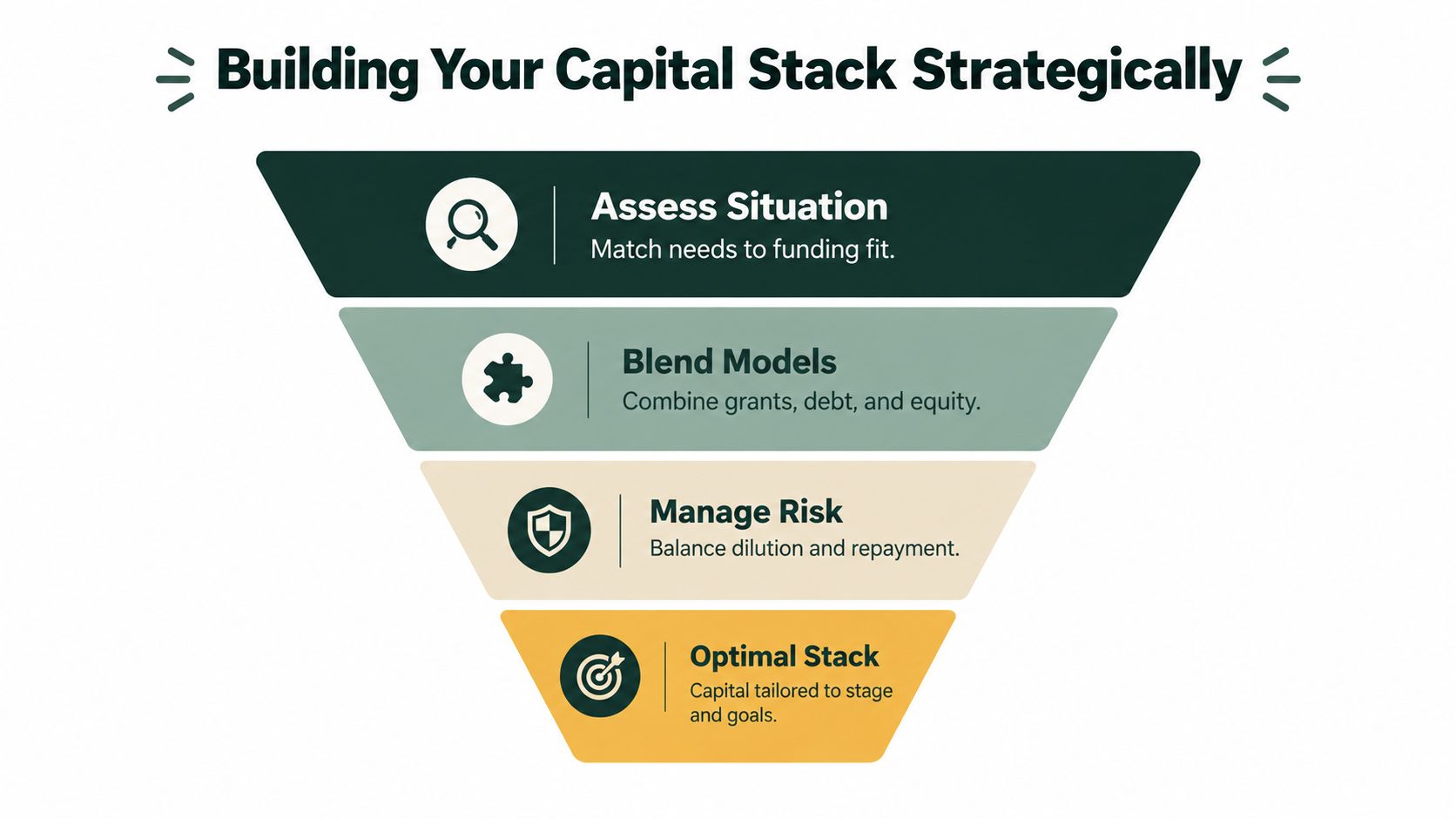
Keep every new instrument reversible where possible. Raise enough to reach a defined milestone, avoid stacking repayment obligations on the same revenue stream, and model how new equity interacts with existing SAFEs, option pools, and future rounds. Flexibility is a financing asset. Once a company gives away ownership or commits future cash flow, it can't easily reclaim either.
Your Actionable Framework for Choosing Funding Models
Start with the business's cash engine and milestones, not with the funding source currently available. An investor's offer can be useful, but it should fit the company's economics rather than set its strategy. Use the sequence below to build a capital stack around revenue predictability, repayment capacity, dilution tolerance, and desired growth speed.
1. Map the cash engine
Record how revenue arrives, not only the amount forecast. Review predictability, gross margins, customer concentration, payment timing, and the cash conversion cycle. Recurring invoices from diversified customers support a different financing decision than a business dependent on a few annual contracts.
Commercial terms may provide capital before an outside investor does. Deposits, annual prepayment, milestone billing, and faster collections can reduce the permanent capital required. Customer-funded growth will not suit every company, but it can preserve ownership while testing real demand.
2. Define the required growth speed
Separate faster growth from required speed. A competitor, regulatory window, or distribution advantage may create a genuine timing constraint, making equity appropriate despite dilution and governance costs. If repeat sales and disciplined hiring can support the plan, internal capital or a revenue-linked facility may preserve more choices.
Set the milestone before setting the round size. The target could be a working product, repeatable retention, a validated sales channel, production readiness, or a contract base that supports hiring. Capital should purchase evidence or capacity, not just extend an undefined runway.
3. Set dilution and control boundaries
Decide the ownership and governance terms you can accept before investor discussions become emotional. Model the full SAFE stack together, as covered above, alongside the option pool and expected future rounds. Y Combinator introduced the SAFE in late 2013 and stated in 2025 that almost all of its startups, as well as numerous non-YC companies, had used it as a principal early-stage financing instrument (Y Combinator's SAFE documentation).
A founder might set a pre-seed dilution ceiling of 15% across the planned SAFE financing, then reject or resize commitments that exceed it. The exact boundary depends on the company's goals, but writing it down makes trade-offs visible. Keep the cap table current, and ask counsel to explain terms you cannot model yourself.
4. Test repayment under stress
Calculate debt or revenue-share payments during a weak period, not only in the base case. Include delayed invoices, churn, hiring costs, refunds, inventory delays, and a later-than-expected next round.
Sequence the stack around those risks. Use low-cost or non-dilutive sources for defined milestones, relationship capital where trust can bridge early uncertainty, and institutional equity when its scale and network justify the governance cost.
5. Preserve optionality
Before signing, identify what each instrument makes harder later. Debt may restrict future borrowing. Revenue share can consume cash as sales accelerate. A large SAFE stack can obscure ownership, while VC can influence strategic priorities through board rights and return expectations.
Keep new instruments reversible where possible. Raise enough to reach a defined proof point, avoid placing repayment obligations on the same revenue stream, and review how each new equity instrument interacts with existing commitments. The strongest funding strategy gives the company enough capital to reach the next valuable proof point while keeping the founder's future choices open.
NowFunded provides a live, structured feed of verified startup funding events from pre-seed through Series B, including round details, investors, company information, and verified founder or leadership contacts through its API, MCP endpoint, webhooks, dashboard, or CSV export. Visit NowFunded to research markets, prioritize newly funded companies, or build an outbound workflow.