Startup Funding Details: A Field-Level Reference Guide

U.S. venture-backed companies received approximately $215.4 billion across 14,320 deals in 2024, but that total doesn't describe an evenly recovering market. It describes a funding environment dominated by artificial intelligence and machine learning, alongside a relatively small number of very large financings.
The headline total rose from $165.1 billion in 2023, a 30% increase in invested capital, while the market remained highly concentrated. The National Venture Capital Association's 2025 Yearbook also reports that the United States represented 57% of worldwide venture-capital deal value, with AI and machine learning attracting nearly half of U.S. venture investment.
That context changes what “startup funding details” should mean. A funding record isn't a sentence scraped from a press release. It's a typed, time-aware object that distinguishes the company, the financing event, the security, the investors, the evidence, and the confidence attached to each field.
A serious buyer or research agent should be able to answer more than “How much did this startup raise?” It should identify which legal entity raised it, when the money was first sold, how much was announced versus sold, who led the round, what rights investors received, and whether the event has been independently verified.
Table of Contents
- What Startup Funding Details Actually Mean
- Core Fields of a Funding Event Record
- Round Size, Valuation, and Stage Economics
- Regulatory Anchors and Filing-Based Fields
- Capital Concentration and Amount-Band Fields
- Geography and Sector Normalization Fields
- Lead Investor and Syndicate Fields
- Company Context Fields Beyond Headquarters
- Verified Contact Enrichment Fields
- Delivery Mode and Integration Fields
- Quick-Reference Schema Card
- Schema Questions Buyers Actually Ask
What Startup Funding Details Actually Mean
A funding event is best modeled as a structured record with several related objects, not as one flat row. The company is one object. The round is another. Investors, filings, securities, contacts, and delivery events should connect to those objects through stable identifiers.
The 2024 U.S. market makes the problem visible. $215.4 billion across 14,320 deals sounds like a broad recovery until the analyst separates deal count from invested capital, stage from sector, and ordinary rounds from unusually large financings. The same aggregate can rise because a small group of companies closes very large rounds while many other startups struggle to access capital.
Analyst's rule: A funding amount has no stable meaning until its date, stage, currency, source, and status are known.
At minimum, a record should distinguish the following:
- Company identity: The legal issuer, trading name, domain, headquarters, and persistent company identifier.
- Event identity: The specific financing event, its stage, announcement date, first-sale date, and verification date.
- Amount status: Announced amount, amount sold to date, remaining amount, or confirmed closed amount.
- Economic terms: Valuation basis, security class, liquidation preference, participation rights, conversion rights, and dilution.
- Investor participation: Lead, co-lead, follow-on, participant, strategic investor, or undisclosed role.
- Evidence: Press release, regulatory filing, registry entry, investor disclosure, or human verification.
This is why the phrase startup funding details should refer to field semantics, not just a larger collection of news articles. Every number is derived from the surrounding schema. A reported raise can be a public announcement, a regulatory notice, a partial close, or a reconciled event supported by several sources. Treating those states as interchangeable produces unreliable research and brittle automation.
Core Fields of a Funding Event Record
A practical schema starts by separating company-scoped fields from round-scoped fields. Company fields describe the issuer and should persist across multiple financings. Round fields describe one event and should never overwrite the company's earlier financing history.
Field Scope Example Valuecompany_id
Company
company_example
legal_name
Company
Example Technologies Ltd.
primary_domain
Company
example.com
hq_country
Company
United States
hq_city
Company
Austin
founded_year
Company
illustrative year field
headcount_band
Company
early-stage band
round_id
Round
round_example
round_type
Round
Series A
announced_date
Round
YYYY-MM-DD
announced_amount
Round
amount with status
currency
Round
USD
lead_investor_ids
Round
[investor_example]
participant_ids
Round
[investor_a, investor_b]
source_url
Evidence
press-release URL
The examples above show field shape, not a claim about a real company. In production, each value should also carry provenance. A press release may support the announcement date and announced amount. A regulator filing may support the issuer identity, filing date, exemption, and sold-to-date amount. Human verification may be necessary for a current executive role or a lead investor classification.
Preserve identity across time
The company identifier must remain stable even when the company changes its brand, domain, headquarters, or legal structure. The round identifier must remain stable even when the round receives an amendment, extension, or later press coverage.
A flat string such as “Example Technologies raised a Series A from Investor A and Investor B” loses nearly everything an agent needs. It can't reliably deduplicate the event, compare financing stages, detect an amended filing, or trigger an outreach workflow based on the lead investor.
A typed record can support those operations because each field has a defined meaning, an allowed value type, and an evidence trail. This is the foundation for structured funding research workflows, whether the consumer is a human analyst, a CRM, or an AI agent.
Round Size, Valuation, and Stage Economics
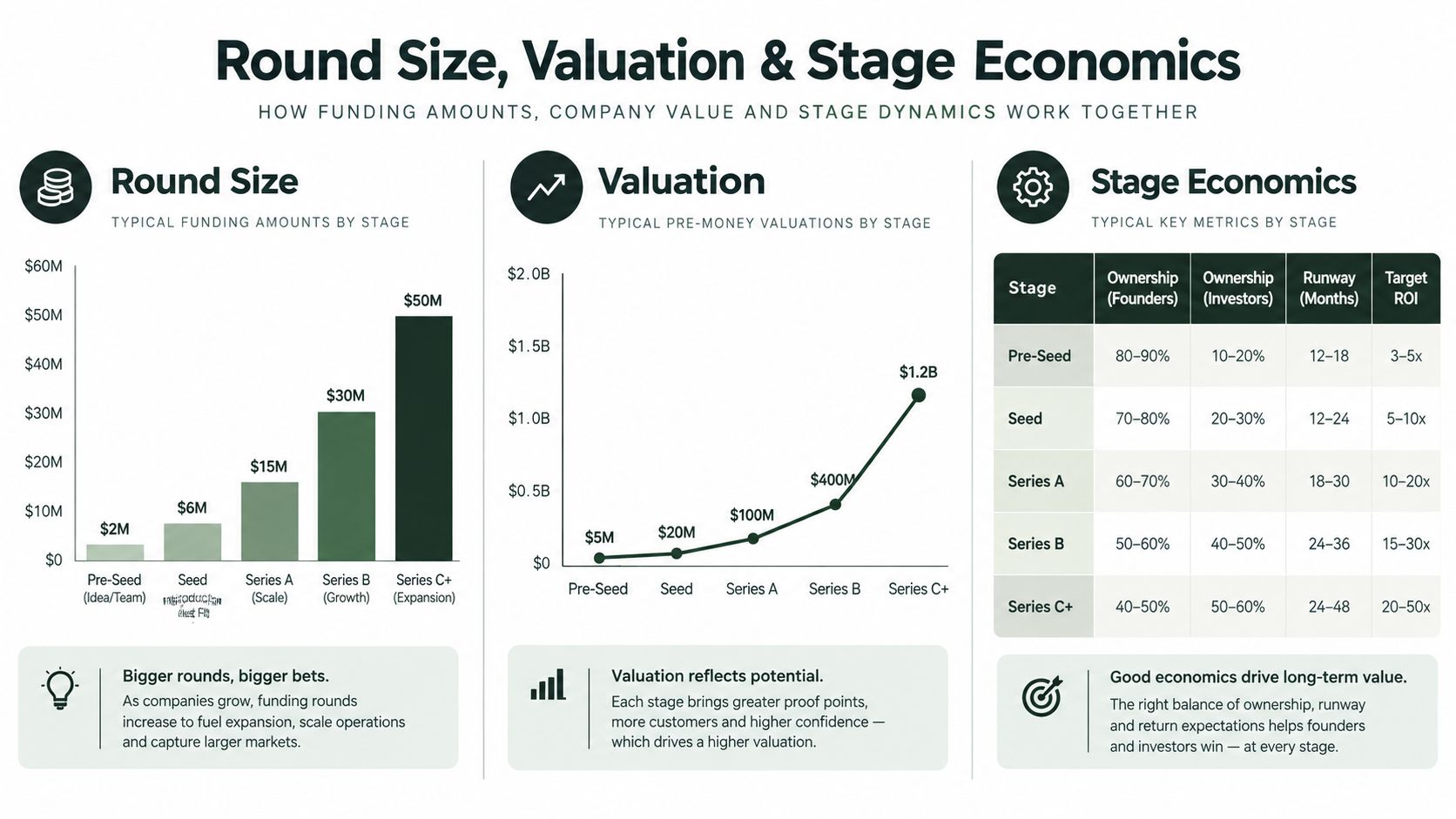
Round size becomes misleading when stage is missing. OECD research reports that global venture investment increased from $31 billion across approximately 3,500 startups in 2006 to $336 billion across 26,800 startups in 2020, but its stage analysis shows how unevenly capital is distributed. Across nine countries between 2018 and 2023, seed-stage companies received 7.5% of total venture investment on average, compared with 45.3% for start-up or early-stage companies and 47% for late-stage companies, according to the OECD analysis of government support for venture capital.
The implication is important. A database focused on pre-seed through Series B sits close to the transition between formation risk and institutional scale, but it can't interpret that transition from amount alone.
Store the valuation basis
A round should expose separate fields for:
pre_money_valuationpost_money_valuationimplied_valuationlast_post_money_valuationoption_pool_treatmentdilution_pctdilution_denominator
The last post-money valuation belongs to the previous financing and shouldn't be confused with the current round's valuation. Likewise, an implied valuation derived from amount and ownership isn't necessarily comparable with a disclosed negotiated valuation.
Security terms matter just as much. The NVCA model term sheet describes a common 1x liquidation preference, with a non-participating alternative that allows the investor to choose between the preference and conversion to common, and a participating alternative that permits recovery of the preference plus continued pro-rata participation.
That means the record should capture security class, original issue price, liquidation-preference multiple, participation type, dividend treatment, conversion rights, anti-dilution formula, voting rights, board rights, and pro-rata rights. The same source set records a median seed-stage dilution of 18.8% in Q1 2025, down from 21.4% a year earlier. Use that as an anomaly check, not as a substitute for cap-table math.
Regulatory Anchors and Filing-Based Fields
For U.S. offerings under Regulation D, a press release isn't the final authority on whether a financing event occurred or how much capital closed. The Securities and Exchange Commission's Form D guidance states that Form D must be filed electronically through EDGAR within 15 days after the first sale of securities. An annual amendment is required when an offering remains open for more than 12 months, and specified information changes can also trigger amendments.
The filing should anchor a separate regulatory object connected to the round. It should preserve the issuer's legal name, CIK, filing date, first-sale date, exemption claimed, total offering amount, amount sold, remaining amount, security type, filing identifier, and amendment status.
Regulatory Field Semantic Role Common Modeling Errorissuer_legal_name
Identifies the legal issuer
Replacing it with the brand name
cik
Connects filings to the issuer
Treating each filing as a new company
first_sale_date
Marks the first reported sale
Using the announcement date
filing_date
Records regulatory submission timing
Calling it the close date
exemption_claimed
Identifies the regulatory basis
Leaving the offering type blank
total_offering_amount
States the offering size
Treating it as capital already sold
amount_sold
States sold-to-date capital
Replacing it with the press-release amount
remaining_amount
Shows the unsold portion
Omitting open-offering status
amendment_status
Preserves filing history
Overwriting the initial notice
A production system should store announcement date, first-sale date, filing date, and verification date as independent timestamps. They answer different questions and can produce different “newly funded” dates.
Form D is a regulatory notice, not SEC approval and not a guarantee that an announced round fully closed. Amounts therefore need explicit labels such as announced, sold_to_date, remaining, or closed_verified. Overwriting the original filing with an amendment destroys the evidence needed to understand partial closes and changing offering details.
Capital Concentration and Amount-Band Fields
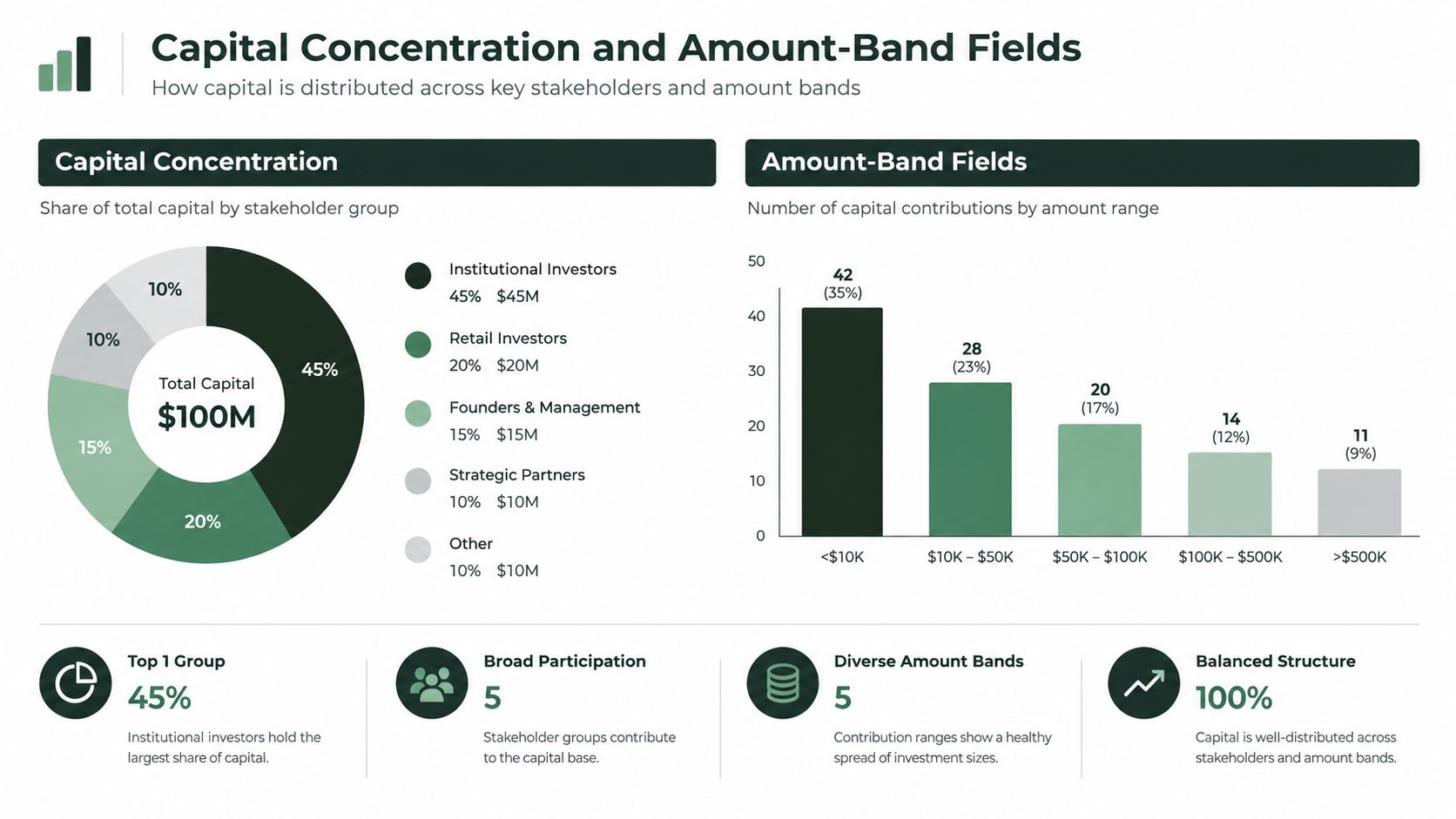
Aggregate capital can conceal access risk. Crunchbase reported that private companies received $425 billion across more than 24,000 companies in 2025, while nearly 60% of capital went to 629 companies raising at least $100 million. More than one-third went to only 68 companies raising $500 million or more, according to Crunchbase's 2025 funding analysis.
Those figures make deal count and amount bands essential. A market can post a strong capital total while the typical pre-seed or Series B company sees little improvement in access.
A useful amount_band should be a controlled enum rather than a free-form label:
under_5m5m_to_25m25m_to_100m100m_plus
The exact amount remains available for analysis, but the band supports consistent aggregation across currencies, jurisdictions, and reporting systems. It also makes it easier to compare ordinary rounds with concentrated mega-round activity.
Prevent concentration errors
Stage, geography, and amount band must travel together. A record missing stage can make late-stage capital look like early-stage momentum. A record missing headquarters can distort regional comparisons. A record missing tranche or closing identifiers can count one large financing several times.
The schema should also distinguish:
- Primary financing: New capital issued by the company.
- Secondary transaction: Existing shares sold by current holders.
- Extension: Additional capital under an existing round structure.
- Tranche: A scheduled or separate release of capital.
- Bridge financing: Interim capital with its own terms and timing.
The OECD stage taxonomy provides a useful comparative backbone, but local labels still need normalization. “Seed,” “pre-Series A,” “venture round,” and “early-stage” shouldn't be treated as identical without an explicit mapping and confidence field.
Geography and Sector Normalization Fields
A headquarters city is a useful filter, but it isn't a complete geographic profile. A company may be legally incorporated in one jurisdiction, operate from another, employ teams across several regions, and target a market that differs from its base.
The record should therefore separate hq_country, hq_region, hq_city, operating_countries, incorporation_jurisdiction, msa, and hq_status. The status field can distinguish a verified headquarters from an inferred operating location or a former address.
Geography matters because funding conditions diverge. In the first half of 2025, Asia-based startups received $26.2 billion, down about one-third year over year, while Latin American venture funding increased 16% year over year. Mexico also surpassed Brazil as Latin America's leading VC destination for the first time since 2012, according to Crunchbase's regional funding report.
Field Controlled Vocabulary? Supports Filter vs Normalizationhq_country
Yes
Both
hq_region
Yes
Both
hq_city
Yes, with canonical names
Filter
incorporation_jurisdiction
Yes
Normalization
operating_countries
Yes, multi-valued
Both
msa
Yes, where applicable
Filter and comparables
sector
Yes
Both
sub_sector
Yes, multi-valued
Normalization
taxonomy_version
Required
Reproducibility
ai_classification
Controlled status
Sector comparison
Sector classification needs the same discipline. AI should be a controlled classification with evidence, not a loose keyword found in a company description. The taxonomy should support multi-valued tags, retain its version, and record whether the label came from a company statement, investor description, registry, or analyst review.
AI concentration can make a region or sector appear healthier than it is for comparable non-AI companies. A useful buyer should be able to remove AI-tagged events, compare sectors within the same geography, and distinguish a true regional baseline from a capital-concentration outlier.
Lead Investor and Syndicate Fields
An investor name isn't enough. The same firm may lead one round, follow on in another, participate through several fund vehicles, or appear in a press release without a disclosed investment amount.
Use an investor object with a stable firm_id, fund_id where available, investor_role, participation_amount_usd, is_lead, is_follow_on, strategic_or_financial, and source_attribution. The role should be an enum, not a sentence copied from an article.
investor_id
String
Stable investor identity
firm_id
String
Parent investment organization
fund_id
Optional string
Fund-vehicle participation
investor_role
Enum
Lead, co-lead, participant, follow-on
is_lead
Boolean
Machine-readable lead status
participation_amount_usd
Nullable amount
Known investor contribution
strategic_or_financial
Enum
Distinguishes capital purpose
prior_participation_count
Integer or null
Identifies returning investors
source_attribution
Evidence object
Explains how the role was established
Lead status changes the interpretation of a round. A lead may negotiate pricing, receive board rights, or shape governance. A co-lead can indicate shared risk or a split syndicate. A follow-on investor may signal continued conviction, but it can also represent a contractual pro-rata right rather than a new underwriting decision.
Practical rule: Store what the source establishes, not what the investor's reputation suggests.
Syndicate-level fields add another layer: syndicate_size, participant_count, investor_geographies, strategic_investor_count, and undisclosed_participant_count. One crossover fund and several specialist seed funds represent different financing signals even when the announced amount is identical.
For automation, the distinction supports useful routing. A sales agent might prioritize a newly led round. A recruiting system might prioritize a company backed by investors known for operational hiring support. A research analyst might use follow-on participation to study investor persistence without confusing it with new lead conviction.
Company Context Fields Beyond Headquarters
Company context should explain what the issuer is and how its operating profile may have changed, not just where its registered office sits. A solid record separates registered_address, hq_city, operating_locations, and remote_or_distributed_status.
The context object should also include founded_year, headcount_band, headcount_change_since_prior_round, website, linkedin_url, industry codes, and taxonomy sources. These fields serve different workflows. A city supports filtering. A website supports identity resolution. A LinkedIn profile supports research and contact matching. Headcount and its change over time support a view of hiring intensity and operating scale.
Use bands and deltas
Headcount should be represented as a band when the source doesn't establish an exact figure. The database can still store a headcount_band_delta between financing events, provided the underlying observations have dates and sources.
Industry tags should be multi-valued because a company can operate across software, financial services, healthcare, AI, or machine learning categories. Each tag needs a taxonomy_source and taxonomy_version, such as a vendor category system, a registry classification, or a schema.org subtype.
Without taxonomy metadata, conflicting classifications look like contradictory company facts. With it, an analyst can retain both labels, explain their origins, and reclassify records when the ontology changes.
The same principle applies to URLs. Store canonical website and LinkedIn fields separately, preserve redirect history where relevant, and attach a last-checked timestamp. A domain isn't proof of current operations, and a profile URL isn't proof that the person or company still holds the same role.
Verified Contact Enrichment Fields
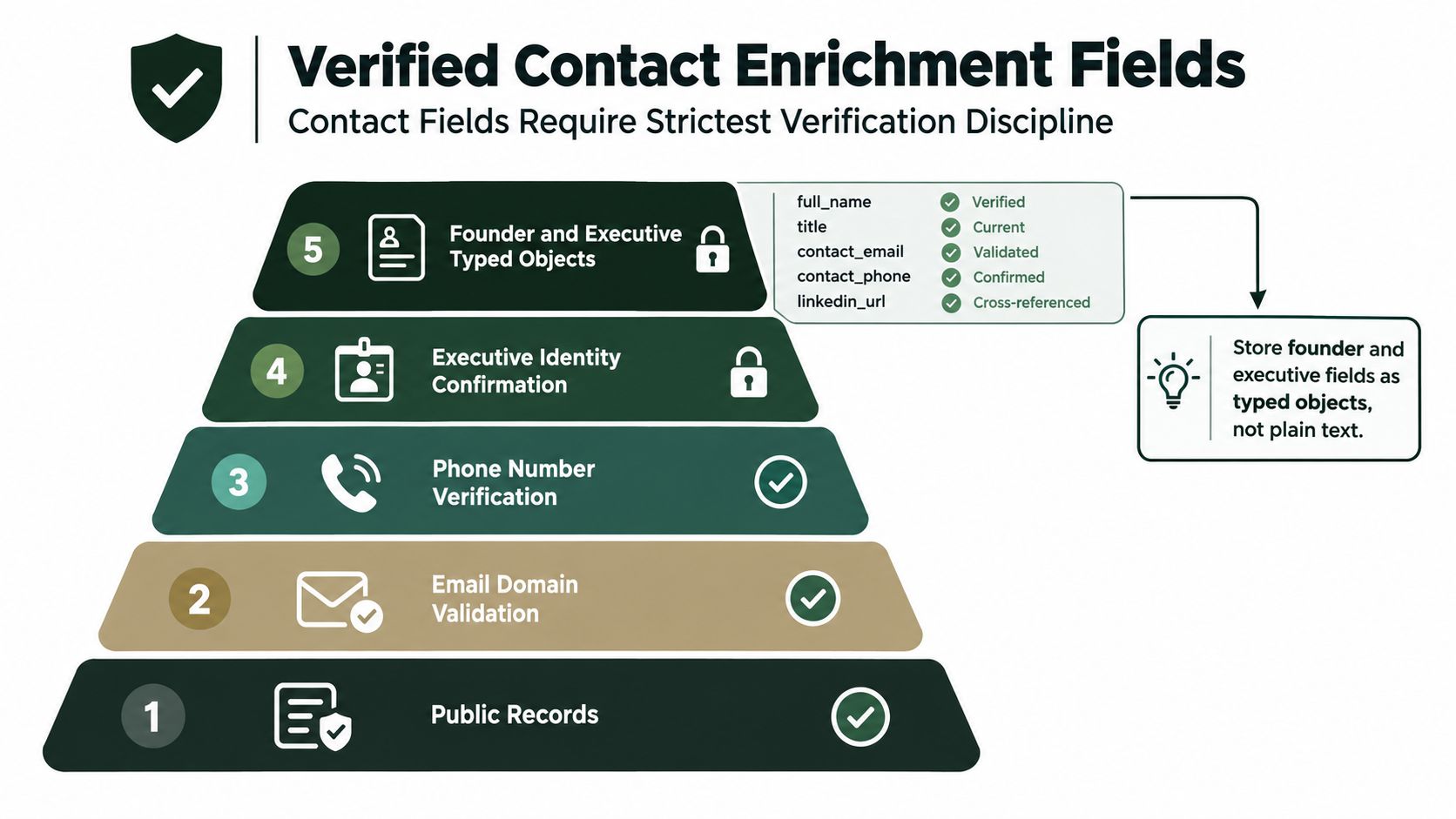
Contact data belongs at the strictest end of the evidence hierarchy. A parsed name or guessed email can look plausible while remaining unsuitable for billing, outreach, or an automated action.
Store founders and executives as typed objects with fields such as full_name, title, email_status, contact_email, linkedin_url, contact_phone, source_attribution, last_verified_at, verification_method, and bounce_flag. The status should distinguish unverified, catch_all, and verified. A contact with a valid-looking format isn't the same as a contact whose deliverability has been confirmed.

Make verification time-bound
Every contact needs evidence attached to the verification event. Useful fields include:
- Role evidence: The source supporting the person's current title.
- Identity match: The evidence connecting the person to the correct company.
- Email status: Whether the address is unverified, catch-all, or verified.
- Verification method: SMTP, API, manual review, or another documented method.
- Last verified timestamp: The point at which the status was last established.
- Bounce flag: A persistent signal that later delivery failed.
Billing rule: Outreach charges should fire only for contacts with an explicit verified status, never for a parsed guess.
Staleness is a schema problem, not just a data-cleaning problem. A contact can be accurate at one point and wrong later because the person changes roles, the domain changes, or the address stops accepting mail. Keeping verification status and timestamps beside the contact object lets a buyer set its own freshness policy instead of treating enrichment as permanent.
Delivery Mode and Integration Fields
Delivery should be modeled as part of the data contract. The same verified funding event should retain its identity, evidence, and version whether a consumer reads it through MCP, REST, a webhook, or a warehouse file.
Channel Semantics Freshness Idempotency Best For MCP In-session tool read On demand Event ID required AI agents REST Synchronous pull Query dependent Cursor and event ID Applications Webhook Push on verification Event driven Delivery ID and replay logic Alerts and fan-out CSV or Parquet Batch warehouse drop Scheduled File and row keys AnalyticsMCP needs a tool_manifest_name and tool_manifest_version so an agent knows which fields and actions are available. REST needs rate_limit_ceiling, cursor, pagination_token, and schema_version. Webhooks need delivery_id, delivery_status, retry metadata, and an event key that lets the consumer reject duplicates.
Flat files need their own safeguards. A buyer should receive a schema version, export timestamp, stable event identifier, source status, and a clear distinction between new, changed, and withdrawn records. Otherwise, a warehouse job may interpret every export as a fresh funding event.
NowFunded is one example of a funding-data service that provides structured startup financing records through MCP, REST API, webhooks, CSV export, and a dashboard. The important architectural test isn't the channel name. It's whether an event can move between channels without losing timestamps, source status, investor roles, or amendment history.
Quick-Reference Schema Card
The following card is designed for a data contract, agent tool definition, or warehouse specification. Required fields establish event identity and evidence. Optional fields add economic, investor, context, enrichment, and delivery detail.
Field Type Required Source Domainevent_id
String
Yes
Internal record
Event identity
event_type
Enum
Yes
Internal classification
Event identity
announced_at
Timestamp
Yes when public
Press release
Event identity
first_sale_at
Timestamp
Conditional
Form D or registry
Event identity
verified_at
Timestamp
Yes
Human or system review
Event identity
round_size
Amount object
Yes if disclosed
Press release or filing
Economics
pre_money
Amount or null
Optional
Term disclosure
Economics
post_money
Amount or null
Optional
Term disclosure
Economics
security_type
Enum
Optional
Filing or term sheet
Economics
dilution_pct
Decimal or null
Optional
Cap-table analysis
Economics
lead
Investor object
Optional
Company or investor source
Investors
co_lead
Investor array
Optional
Company or investor source
Investors
follow_on
Investor array
Optional
Prior-round matching
Investors
syndicate_size
Integer or null
Optional
Round evidence
Investors
legal_name
String
Yes
Registry or filing
Company
hq_city
Canonical string
Optional
Registry or company source
Company
hq_country
ISO-style code
Yes
Registry or company source
Company
headcount_band
Enum
Optional
Company or enrichment source
Company
industry_tags
Array
Optional
Versioned taxonomy
Company
founder_emails
Contact objects
Optional
Verified enrichment
Enrichment
verification_status
Enum
Conditional
Verification system
Enrichment
last_verified_at
Timestamp
Conditional
Verification system
Enrichment
channel
Enum
Yes for delivery
Integration layer
Delivery
schema_version
String
Yes
Data contract
Delivery
webhook_status
Enum
Conditional
Delivery system
Delivery
The record should also preserve source_url, source_type, filing_identifier, jurisdiction, currency, amount_status, and evidence_notes. Those fields prevent a consumer from mistaking a missing value for a zero value or an announcement for a confirmed close.
Schema Questions Buyers Actually Ask
A vendor's answers should map to fields, not promises. If a buyer asks what “verified contact” means, the response should identify the allowed email_status values, the verification_method, the last_verified_at timestamp, and the bounce_flag. “We check contacts” isn't a usable specification.
Freshness needs the same treatment. Ask whether timestamps exist at the record level and at the field level. A funding event may have a recent verification timestamp while its executive title or headcount value remains older. The schema should expose those differences.
Other questions should be resolved before integration:
- Can stage changes be subscribed to separately? A change from Seed to Series A should have a distinct event type or versioned field change, rather than appearing only as a replacement record.
- Are Form D amendments versioned? The initial notice should remain available, with amendments linked by filing identifier and amendment history.
- Can participation be exported by fund vehicle? A firm-level investor name may be insufficient when several funds participate on different terms.
- Are amount statuses explicit?
announced,sold_to_date,remaining, andclosed_verifiedshould be machine-readable states. - Can consumers replay events safely? Stable
event_id,delivery_id, schema version, and idempotency behavior should be documented. - Is contact billing tied to verification? The contract should state whether unverified or catch-all records are excluded from billable results.
A strong buyer test is simple: ask the vendor to return one financing event through every supported channel, then compare the objects. If the timestamps, investor roles, source status, or security terms change during transport, the system isn't delivering one record. It's delivering channel-specific interpretations.
NowFunded provides a live, verified feed of startup funding events from pre-seed through Series B, with company, round, investor, geography, and industry fields designed for machine use. Visit NowFunded to evaluate structured funding data, verified leadership contacts, and delivery options for your research, sales, recruiting, or agent workflow.