10 Startup Funding Database Options Compared
The biggest startup funding database is not automatically the best one. Teams lose time when they buy depth they'll never use, or when they trust a broad dataset that can't deliver fresh, verified records fast enough for outreach, recruiting, or market monitoring. The right comparison is operational: how far back the coverage goes, how the data gets verified, how easily you can export it, whether the API or webhook layer fits your stack, and how much implementation work your team can absorb without slowing down.
That matters because the market has split into different jobs. Some tools are built for immediate outreach, some for diligence, some for regional ecosystem mapping, and some for broad private-market intelligence. This list compares ten options through that lens, so you can match the database to the workflow instead of forcing the workflow to fit the database.
Table of Contents
- 1. NowFunded
- 2. Crunchbase
- 3. PitchBook
- 4. CB Insights
- 5. Dealroom
- 6. Tracxn
- 7. PrivCo
- 8. Owler
- 9. Beauhurst
- 10. S&P Capital IQ Pro
- Top 10 Startup Funding Databases Compared
- Choose the Database That Matches Your Data Loop
1. NowFunded
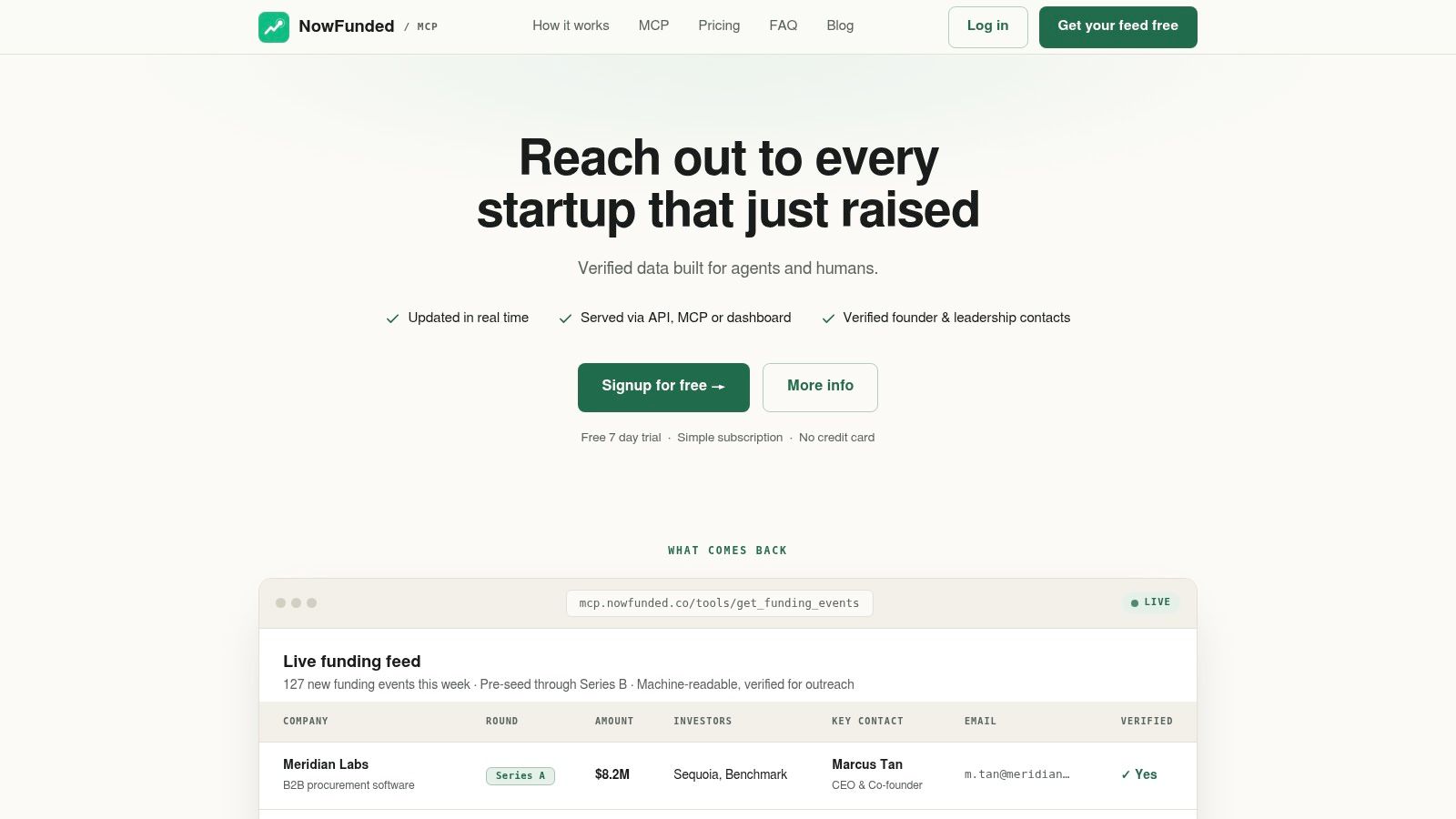
NowFunded is narrower than institutional databases, and that is its main operational value. It is built around the point where a round has been verified and a team needs to act, so the useful question is not how many private companies it covers, but how quickly it can turn a funding event into outreach or workflow input. Its focus on pre-seed through Series B makes it a fit for teams that care about fresh activity, not archival breadth.
The product is set up for machine use as much as human review. It supports MCP, REST API, webhooks, CSV export, and a web dashboard, so the same record can move into a CRM, an agent, or a spreadsheet without manual re-entry. The feed uses typed JSON records with fields such as company name, round type, amount, lead investors, HQ, headcount, industry tag, website, and LinkedIn. That structure matters because it reduces interpretation errors, and it makes filtering more predictable than working from loose alerts.
Why it fits operational outreach
NowFunded also includes deliverability-verified contact enrichment for founders and key leaders, with charging tied to successful verification. Funding-event data is free to query, and contacts are billed per verified email and phone number, with no subscription or minimum spend. That pricing model separates database access from contact acquisition, which can be useful if your team only needs to pay after a record is ready to use.
Implementation effort is low. New rounds appear within minutes of verification, webhook push avoids polling loops, and the dashboard gives teams a quick way to inspect records before they route them into a sequence or agent. For outbound sales, recruiting, or monitoring workflows, that combination of structured records and verified contacts matters more than a broad but slower database.
Practical rule: use this when fresher rounds and verified contacts matter more than sheer database size.
- Best for: outbound sales, recruiting, market-intel monitoring, and AI agents that need machine-readable funding events.
- Best fit if you need: instant push delivery, structured records, and contact enrichment tied to verified rounds.
- Trade-off: it is not designed as a broad later-stage or public-markets database, so it will not replace a full private-market platform.
You can explore the product directly at NowFunded, and the product perspective in its own NowFunded blog is useful if you want to see how the feed is framed for agent workflows.
2. Crunchbase
Crunchbase remains a familiar entry point because it combines startup profiles, funding history, investors, and alerting in one interface. It became widely used as a public record for startup funding rounds, acquisitions, and company profiles, and that early role still shapes how teams use it today (startup funding database background). The practical effect is simple. Many users start there even when they only need a narrower search layer.
For day-to-day research, Crunchbase works well for self-serve discovery, quick lookups, and light enrichment without a long procurement cycle. It also offers enough structure to feed internal systems through an API, which can help sales ops or RevOps teams route funding events into CRM sequences. The interface is familiar, the dataset is broad, and individual users or small teams usually get value without much setup.
Where it helps, and where it doesn't
Coverage quality is uneven in ways that matter operationally. Independent benchmarking of venture-capital databases found that larger financing rounds are reported more reliably than smaller ones, and that early-stage event coverage and field completeness remain harder problems than storing round records (coverage and accuracy benchmark). That makes Crunchbase useful for discovery, but less dependable if your workflow depends on precise pre-seed or seed coverage.
The right comparison is not broad versus narrow. It is a generalist search layer versus a feed built for verified freshness and contactability. Crunchbase gives teams a recognized dataset, stage and geography filters, and an API that can support internal tools. It becomes less convincing when you need high-confidence verification on the newest rounds or when you want push-based delivery with little engineering effort.
That trade-off shapes how it fits into a workflow. Research teams may value the breadth and familiar interface. Outbound teams may care more about whether a record is ready to use. For that second use case, the NowFunded blog shows how a purpose-built early-stage pipeline is framed for agent-driven research and outreach.
If your team mostly needs discovery and lightweight enrichment, Crunchbase is a reasonable default. If you need verified freshness and contactability, it usually needs another layer.
3. PitchBook
PitchBook belongs in a different category from lighter startup databases because it is built for institutional private-market work. It covers VC, PE, and M&A, so the value is not only in finding who raised money, but in seeing the deal context around that company. For diligence, comparables, and broader private-market analysis, that depth matters.
For straightforward prospecting, that same depth can feel excessive. PitchBook fits better when analysts need standardized fields, screening, and reporting that support investment decisions or market studies. Its data downloads and Excel or Office integrations also help teams move from research into internal models without recreating the same view in several tools.
The trade-off is complexity
PitchBook's strength is the breadth of its private-market model, not just startup records. It connects companies, deals, funds, and investors across stages, which gives it more analytical value than a simple alert feed. That makes it a strong fit for diligence teams, corp-dev groups, and firms that need one reference layer across venture and later-stage activity.
The downside is implementation friction. It is enterprise-oriented, usually involves a sales process, and casual users can face a learning curve before they get full value. That is less a flaw than a sign that it is built for managed research environments rather than quick-turn outreach.
- Choose PitchBook if: you need diligence-ready context, comparables, and a private-markets workflow.
- Skip it if: you only need fast funding alerts or simple prospecting signals.
- Pair it with: a workflow tool that can turn research into action, because the platform is strongest on analysis, not instant push-based outreach.
If your team wants to compare a lighter, agent-friendly alternative for immediate fundraising signals, the NowFunded homepage shows a narrower operating model.
4. CB Insights
CB Insights shifts the focus from listing funding events to interpreting what they mean. It combines startup and funding data with analyst research, proprietary scoring, and generative-AI query features, which makes it more useful for strategy and market-intelligence teams than for simple prospect lists. If your process starts with prioritization, that matters.
The proprietary scores, including Mosaic, Exit Probability, and Commercial Maturity, help users rank opportunities instead of only sorting records. That is useful when a team needs to decide which sectors, companies, or categories deserve attention first. The research layer also shortens the path from event tracking to interpretation, which is where many generic databases stop.
Best used as a prioritization layer
CB Insights fits teams that need a market view built from both data and analysis. The ChatCBI feature and related generative-AI tools can reduce time spent searching across separate reports and records. That supports corporate strategy, venture strategy, and business development teams that need a directional answer before they commit to deeper analysis.
The trade-off is cost opacity and operational weight. Pricing is not public, and the platform is typically enterprise-focused, so it can feel heavier than a simple funding alert tool for SDR teams or recruiters. It is also more useful for assessing sectors and likely winners than for building a verified list of newly funded companies to contact today.
For teams comparing workflow fit, NowFunded's MCP workflow page shows the opposite end of the spectrum, where the data is built to trigger outreach rather than analysis.
5. Dealroom
Dealroom is strongest when the workflow starts with geography and ecosystem context. Its European orientation shows up in how it organizes startup, funding, investor, and people data across clusters, cities, universities, and spinouts. For regional analysis, that is more useful than a generic global list.
Automation support is another practical difference. Dealroom offers API options, documentation, and premium API access for production integrations, so teams can move beyond manual lookup if they need structured access. Trials and premium plans let users test the data before committing, which helps when comparing coverage across markets.
Where the ecosystem view matters
Dealroom adds context around companies, not just deal records. Spinouts, clusters, and regional signals matter for universities, economic development teams, and investors mapping innovation corridors. A standard startup database often stops at company and funding data, while Dealroom extends into ecosystem structure.
The trade-off is access and reach. Some advanced data and export functions sit behind premium tiers, and the platform may be less complete in certain US niches than incumbents with a deeper American footprint. If your team needs a broad US prospecting source, another database may fit better. If you need to understand how a region forms around a sector, Dealroom is the sharper tool.
For teams comparing ecosystem mapping with event-driven outreach, the NowFunded platform offers a narrower feed that fits a different research loop.
6. Tracxn
Tracxn works better as a broad discovery layer than as a precision funding feed. Its value sits in category breadth, filter depth, and sector taxonomy, which let analysts scan emerging areas without rebuilding a research frame each time. For teams that need to shortlist companies across many verticals, that structure is more useful than a polished interface.
Its filters and sector reports support context-building as well as record lookup. That helps when the task is to map a sector, spot clusters, and then narrow the field into a working list. Paid exports and enterprise support also make it easier for larger teams to move data into existing workflows instead of copying records by hand.
Good for scanning, less clean for precision
The trade-off is clear. Broad long-tail coverage can add noise, and the taxonomy that helps with slicing the market can also take time to learn. That is acceptable for exploration. It becomes a problem when the task is immediate outreach and the team needs high confidence that the round is current.
Tracxn fits watchlist building with sector context, especially in markets that shift fast and require attention to adjacent categories rather than one fixed segment. The platform is weaker for teams that want verified, push-based updates with contacts attached. Those teams usually need a more operational feed alongside it.
Broad databases help you find candidates. Operational databases help you act on them.
7. PrivCo
PrivCo is more useful when private-company financial context matters alongside funding history. That makes it a practical fit for market sizing, prospect qualification, and U.S.-centric private-company research where modeled financials add context to a round. It is less about being first to a funding event and more about understanding the business behind it.
The platform's analyst-verified and AI-modeled fields help users evaluate private companies beyond headline fundraising. For commercial teams that need to qualify accounts rather than only detect financing news, that distinction matters. If your target lists depend on revenue context and growth signals, PrivCo serves a different step in the workflow than alert-first products.
Best when funding is only one signal
PrivCo's main value is financial framing. In U.S. market analysis, private-company context can matter more than deal notifications alone, especially when a team is screening accounts before outreach. Its custom data solutions also suit research requests that standard dashboards may not cover.
The trade-off is geographic breadth. If your target set extends well beyond the U.S., PrivCo can feel narrower than more global databases. Pricing is quote-based too, so evaluation may take longer than with self-serve tools.
When financial context matters more than raw funding speed, the NowFunded site offers a counterpoint. It prioritizes verified contacts and immediate delivery over modeled revenue estimates.
8. Owler
Owler works best as a lightweight alerting layer for teams that need timing signals more than institutional research. Setup is quick, and the trigger coverage is broad enough for SDRs, marketers, and small teams that want to monitor named accounts without adopting a full private-markets system.
Its mix of company profiles, funding signals, competitor-style graphs, and customizable alerts makes it easy to watch a list of accounts and react when something changes. For outbound work, that can be enough to time outreach around a funding event or leadership move.
Useful as a timing layer
Owler fits best in a workflow where alerts feed CRM updates and email sequences. It is not built for deep diligence, which keeps implementation simple, but also limits how far users can push it. Teams that want a low-cost monitoring tool can get value without the overhead of a larger subscription.
The trade-off is depth. Coverage and quality vary by company, so it is better for broad triggers than for verification or high-stakes research. That makes it useful as a signal, not as the only source for a funding database workflow.
Alerting gets you noticed; verified funding data gets you to the right person at the right time.
For teams that need actionability plus verified fields, the NowFunded platform offers a more direct path from signal to outreach.
9. Beauhurst
Beauhurst specializes in UK and Germany private-company coverage, with detail on high-growth companies, fundraises, grants, and transactions that broader databases often smooth over. That makes it useful for investors, universities, and public-sector teams that need ecosystem mapping more than global breadth. The NowFunded homepage offers a different operating model, while Beauhurst is stronger where regional context matters.
Its lenses, timelines, and curated datasets help users read national and sector trends with more precision than a generic startup database usually provides. Because the platform is used heavily in policy, academia, and local investment work, it fits regional research better than outbound prospecting. The trade-off is clear, better context inside a narrower scope.
A strong local map, not a global one
Accuracy and context are Beauhurst's main strengths within its coverage area. For teams focused on the UK or Germany, that specialization can matter more than a wider but shallower dataset. It helps analysts track ecosystem health, funding patterns, and growth-company concentration in a specific region.
The limitation is just as clear. Geographic focus reduces value for cross-border research, and contacts are out of scope, so outreach teams need another tool. Beauhurst works well as a research source, but it does not cover the full workflow by itself.
10. S&P Capital IQ Pro
S&P Capital IQ Pro fits this comparison because some teams want startup funding data inside a broader capital-markets workflow. It is a startup database only in part, so its value comes from consolidation. Analysts who already move across public markets, credit, research, and private-company data can keep that work in one place.
The platform combines private-company and transaction intelligence with screening and links to broader market datasets. It also includes ChatIQ, Document Intelligence, and Excel and Office integration, which suit spreadsheet-heavy teams. For larger organizations, governance and access control often matter as much as the underlying records.
Best for unified market context
Its advantage is context. Funding rounds do not sit in isolation, because Capital IQ Pro lets teams relate them to public comps and deeper financial data. That helps firms working across asset classes, where a single research environment is easier to maintain than separate tools for each market.
The trade-off is clear. It can be too much platform for a simple funding-alert workflow, and it takes training to use well. Smaller teams that only need fast event detection may find the breadth slows them down. If the goal is to alert a rep as soon as a company raises, this is more system than necessary.
For workflows centered on fresh early-stage events, verified contacts, and machine-readable delivery, the NowFunded site is a more direct fit.
Top 10 Startup Funding Databases Compared
Product Core features Delivery & integrations Contact verification & freshness Best for / Pricing NowFunded Real-time feed of pre-seed→Series B; typed JSON schema; 10k+ recent records MCP (native agent support), REST API, webhooks, CSV, dashboard On‑demand deliverability‑verified emails & phones; billed per verified pull; new rounds appear within minutes Outbound teams, AI agents, recruiters; funding data free to query; $0.10/verified email, $0.25/verified phone; no subscription Crunchbase Large company & funding database; search, alerts, light enrichment Web UI, alerts, API with token auth Light enrichment; crowdsourced depth varies; timely but not instant push SDRs & analysts; freemium → paid tiers for advanced exports/API PitchBook Institutional private‑markets depth; deal terms, valuations, comps Desktop/web platform, API, Excel/Office integrations Analyst‑verified deal/financial fields; deep but enterprise cadence (not minute‑level) Investment professionals; enterprise pricing, sales process required CB Insights Market intelligence + proprietary predictive scores; research & visuals Web platform, research library, ChatCBI (NL query) Predictive scoring lens; contact depth secondary; research‑first freshness Strategy, corp‑dev & market teams; enterprise pricing Dealroom Europe‑focused startup & ecosystem mapping; signals & clusters API‑first (Premium API), web UI, maintained docs Good automation support; contact/export features on premium tiers Teams focused on Europe ecosystems; premium plans for exports Tracxn Broad global startup coverage; deep sector taxonomies & filters Web platform, feeds, exports, enterprise support Wide coverage; signal noise on very long‑tail companies Analysts & enterprise sourcing; volume/quote pricing PrivCo U.S. private‑company financials & modeled estimates Web platform, custom data solutions Analyst‑verified + modeled financials; contact data included; US-centric Market sizing, revenue diligence in US; quote/enterprise pricing Owler Crowdsourced profiles, competitive graphs & real‑time alerts Web UI, customizable alerts, API (self‑serve tiers) Community‑sourced contacts; alerting is fast but depth varies SDRs & marketers seeking low‑cost alerts; free → Pro tiers Beauhurst High‑quality UK & Germany private‑company coverage; grants & growth signals Web platform, regional reports, curated datasets Focused regional accuracy; contacts generally out of scope UK/Germany investors, gov & academia; subscription pricing S&P Capital IQ Pro Unified public & private markets data; research & AI tools Enterprise platform, Excel/Office integration, APIs Enterprise‑grade data and governance; deep but heavier workflow Firms needing integrated public/private workflows; premium enterprise pricingChoose the Database That Matches Your Data Loop
The right startup funding database depends on the loop you're trying to run. If the goal is fresh early-stage events, verified founder or leadership contacts, typed machine-readable records, and delivery through MCP, REST, webhooks, or CSV, NowFunded is the cleanest fit because it is built for action as much as observation. If the goal is diligence, valuation context, or broad private-market research, institutional platforms like PitchBook or S&P Capital IQ Pro make more sense because they connect funding to wider market structure.
Regional specialists matter when the geography is the product. Beauhurst is strong when the work centers on the UK or Germany, and Dealroom is a smart choice when ecosystem mapping, spinouts, and regional clusters are central to the analysis. Lighter alerting tools like Owler can work when the requirement is to trigger outreach at the right moment without deep research overhead.
A practical implementation check prevents most bad purchases. Define the exact funding stages and geographies you need, confirm the historic coverage window, test how the database handles verification freshness, inspect export and API limits, decide whether webhooks are necessary, and validate the workflow on a small representative dataset before you commit. That test will usually tell you more than a sales demo.
If you want a funding database that behaves like infrastructure instead of a static directory, start with NowFunded. It gives teams a verified early-stage feed, machine-readable structure, and push-based delivery that's easier to plug into real research and outreach workflows.