Sales Trigger Events: How to Find and Act on Them
Tuesday morning, an SDR spots a Series B announcement from a logistics software company. The round is fresh, the lead investor is named, and the company has started hiring. By 11:30, the SDR has pulled the press source, cross-checked the investor, verified the founder and head of sales, and sent a message that mentions the new funding in its opening line. A competitor may see the same announcement later, but the first team has already created a relevant conversation.
That outcome doesn't come from monitoring everything. It comes from connecting event detection, contact verification, message relevance, sequencing speed, and CRM handoff into one workflow. Sales trigger events only create an advantage when a team can move from public change to private, useful outreach before the buying window fades.
Table of Contents
- The Moment a Funded Startup Becomes Your Best Lead
- What Sales Trigger Events Actually Are
- The Main Categories of Trigger Events and Why Funding Leads
- Funding Rounds as the Textbook Sales Trigger Event
- How to Identify and Prioritize Trigger Events That Matter
- Polling vs Webhooks for Live Trigger Feeds
- From Signal to Pipeline and the Traps to Avoid
The Moment a Funded Startup Becomes Your Best Lead
The announcement itself is easy to find. The operational work begins immediately afterward.
First, capture the original press release or company announcement rather than relying on a repost. Confirm the announcement date, funding stage, amount raised, lead investor, company website, and the business model. Then check whether the event fits your ICP. A funded company isn't automatically a good account, and a familiar venture firm isn't proof of purchase intent.
Next, identify the people who are likely to own the problem your product solves. For an early-stage company, that may be the founder or CEO. For a company with a growing go-to-market function, it may be the head of sales, RevOps leader, or marketing executive. Pull two verified contacts, not a long list of unconfirmed names. A smaller contact set keeps the message focused and avoids sending the same generic pitch to every department.
The first line should make the reason for contacting them obvious. Mention the funding event, the operational consequence you can reasonably connect to it, and the role-specific outcome you support. Don't pretend the company has a problem it hasn't disclosed. A round may suggest new spending capacity, but it doesn't prove that the prospect has selected a vendor or approved a particular project.
Operator rule: A funding announcement earns attention. Verified contacts and a credible business hypothesis earn the reply.
The workflow behind this kind of response is the key advantage. A live feed detects the event, enrichment identifies deliverable contacts, scoring determines priority, and the CRM routes the account into the right sequence. Teams evaluating funding intelligence can also review NowFunded's live funding data as one source for structured, verified startup events.
What Sales Trigger Events Actually Are
Sales trigger events are discrete, time-stamped changes in a prospect's situation that can open a temporary buying window. The company raises capital, appoints a new executive, enters a market, replaces a system, or responds to a material business change. The event gives a salesperson a reason to contact the account now instead of sending an interchangeable message from a static list.
That differs from passive intent data. A pricing-page visit or an ad click may indicate interest, but it doesn't necessarily explain what changed inside the organization or who owns the next decision. A confirmed Series A announcement has a date, a public source, and a clear organizational implication. It can justify research and prioritization, but it still needs to be matched with company fit and contact relevance.
Funding makes the distinction clear. “The account may be researching software” is a weak basis for outreach. “The company announced a new round, named its lead investor, and is expanding its commercial team” is a stronger starting point because the event changes the account's operating context. The salesperson can discuss scaling, hiring, infrastructure, or execution without inventing a fictional pain point.
First-party and third-party signals
A first-party trigger is generated by the prospect. The company publishes a funding announcement, posts new roles, announces a product launch, or communicates a strategic initiative. A third-party trigger is observed externally, such as a technology detection, industry report, competitor action, or public filing.
Neither type replaces judgment. A first-party announcement may be accurate but irrelevant to your offer. A third-party signal may be useful but incomplete or ambiguous. The strongest workflow combines the event with four checks:
- Recency: Is the change recent enough to affect current priorities?
- Materiality: Does it alter budget, ownership, risk, capacity, or strategic focus?
- ICP fit: Does the account match the market, size, geography, and use case you serve?
- Contact access: Can you reach a verified person with a credible role in the decision?
A trigger is an input to prioritization, not a substitute for qualification. The practical objective isn't to collect more alerts. It's to identify accounts where the status quo changed and your message has a defensible reason to arrive now.
The Main Categories of Trigger Events and Why Funding Leads
B2B teams commonly monitor a broad set of changes:
- Funding events: New capital can support hiring, tooling, market expansion, or infrastructure decisions.
- Leadership changes: A new executive often reviews priorities, vendors, and team performance.
- Product launches: New offerings create implementation, distribution, analytics, and support requirements.
- Regulatory shifts: New obligations can force process and technology changes.
- Earnings calls: Public commentary can reveal growth plans, cost pressure, or changing priorities.
- Hiring spikes: Open roles can expose investment areas before a company announces them directly.
- Technology adoption: A new platform or integration can create complementary demand.
- Competitive displacement: A rival's launch, acquisition, or failure can change the account's response plan.
A 2026 analysis of classified sales trigger events placed hiring at 14.6%, capacity expansion at 14.2%, funding at 12.4%, leadership change at 10.5%, and integration or modernization at 10.5%. Those five categories represented more than half of the signals in that dataset, with the industry analysis of sales trigger events showing why teams need prioritization rather than an undifferentiated alert stream.
Funding ranked among the top three signal families in that analysis. Its practical strength comes from the combination of a public event, an identifiable date, and a plausible budget change. The round doesn't guarantee a purchase, but it gives an SDR a concrete opening to investigate how the company may scale.
Trigger Categories Ranked by Outbound Performance
The ranges below are industry benchmark-style figures summarized by Launch Leads' overview of trigger-event selling. They should guide prioritization, not serve as a promise for every campaign.
Trigger Category Avg Reply Rate Time Sensitivity Budget Clarity Funding 15-25% High High Leadership change 15-25% High Medium Hiring or capacity expansion 15-25% High Medium Product or technology change 15-25% Medium to high Medium Regulatory or earnings event 15-25% Medium Variable Untargeted cold outreach 5-10% Low LowFunding belongs in a Tier 1 queue because a confirmed round can connect state change to near-term spending. The rep still has to verify the company, understand the likely initiative, and choose the right contact. The signal creates the conversation. It doesn't close it.
Funding Rounds as the Textbook Sales Trigger Event
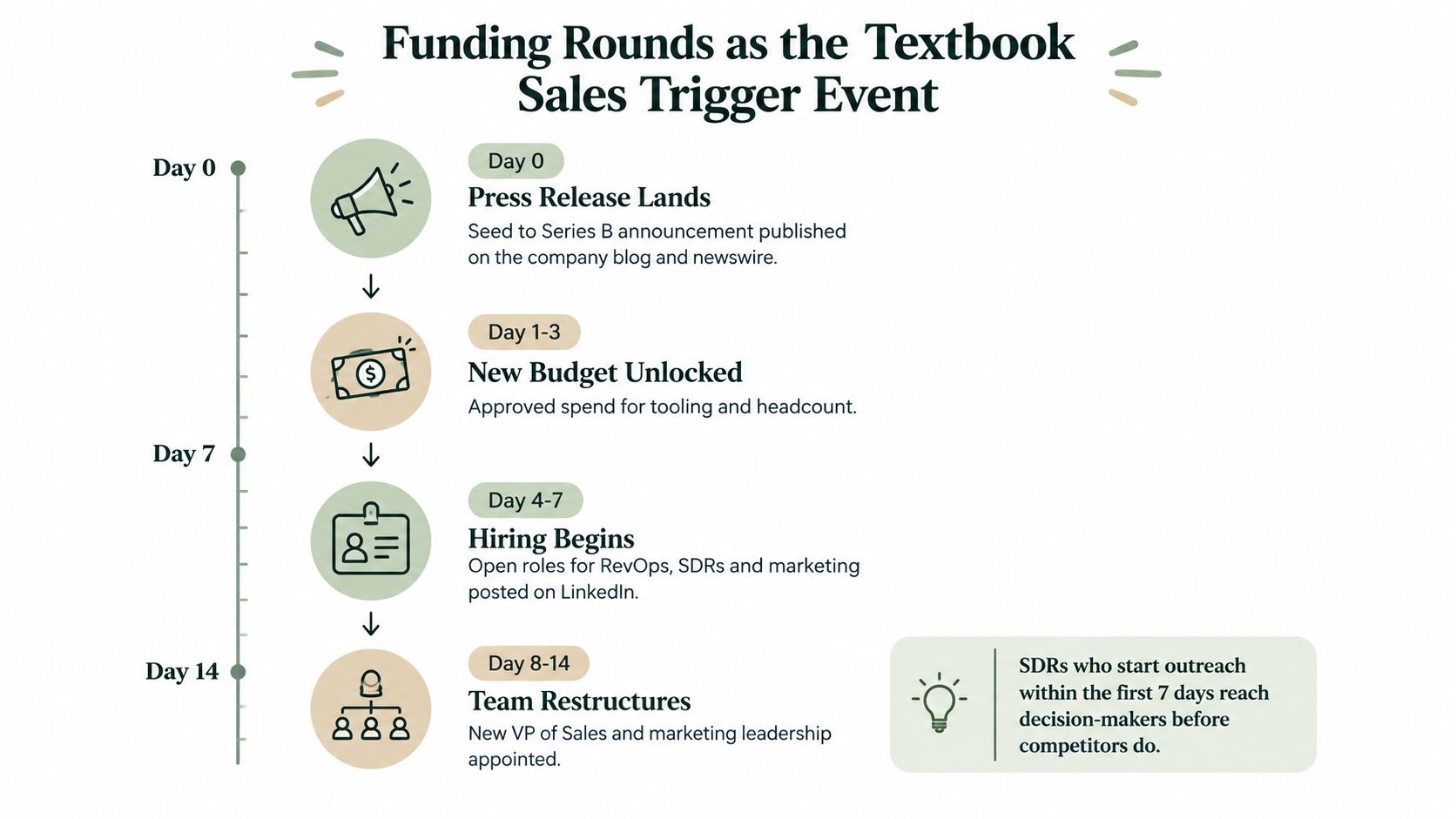
Take a startup moving from seed through Series B. At the moment the announcement lands, the company has made a public statement about its financial position and growth plan. The sales team shouldn't treat that announcement as a reason to blast every employee. It should treat it as a research task with a deadline.
On day zero, capture the original announcement and extract the round stage, amount, lead investor, date, and company details. On days one through three, look for corroborating evidence such as new hiring, revised leadership responsibilities, or expansion into a new market. The point isn't to build a perfect account dossier. It's to establish whether the raise creates a plausible use case for your offer.
Within the recommended 14-day post-announcement outreach window, contact selection should reflect company maturity. At seed, the founder may still own the buying decision. Around Series A, the head of sales or RevOps leader may have more direct responsibility for commercial systems. By Series B, departmental ownership is often more distributed, so the SDR should connect the funding context to the specific function being targeted.
A practical sequence can run for 21 days with five touches, as recommended in this guide to funding-round sales triggers. Use the first email for the event and the relevant business implication, then vary the follow-up angle instead of repeating the same pitch. A LinkedIn touch, a concise follow-up, and a final break-up message can support the sequence when those channels fit your team's process.
The timing matters because the signal decays. The same guide recommends starting within 14 days, while its broader discussion of trigger timing reports that response rates can drop by roughly 80% after 5 days. It also cites research that leads contacted within the first minute of a high-intent event were up to 391% more likely to convert than later contacts. Those figures come from industry sources and shouldn't be treated as universal benchmarks, but they capture the operational reality: waiting three weeks turns a current event into background context.
Funding context also changes the expected reply range. The cited guide reports 2 to 5 times higher reply rates for signal-triggered outreach than for cold sequences without signal context. The lift comes from relevance and timing, not from inserting “congratulations” into a template.
How to Identify and Prioritize Trigger Events That Matter
A trigger program needs a queue, not a firehose. Start with three tiers and make the thresholds explicit.
Tier 1 gets immediate attention
Use verified funding rounds and senior leadership changes when they fit the ICP. These events materially change budget, ownership, or priorities. A confirmed funding event should include a reliable source, announcement date, round information, and enough company detail to decide whether the account belongs in the active queue.
Tier 2 includes hiring surges, product launches, technology changes, and capacity expansion. These signals can be valuable, especially when they support a Tier 1 event, but they need more interpretation. A single job post rarely proves a buying initiative. A cluster of relevant roles alongside a recent raise is considerably stronger.
Tier 3 covers weak or indirect indicators such as traffic movement, broad social engagement, or unverified mentions. These may support research, but they shouldn't automatically create outbound tasks. Chasing every low-confidence signal consumes attention, increases personalization debt, and can put irrelevant accounts into sequences.
Score the event and the account together
A useful scoring matrix combines four dimensions:
Tier Event Type Recency Window ICP Fit Weight Verification Required 1 Verified funding or senior leadership change 30-90 days, act sooner Highest Source and contact verification 2 Hiring surge, launch, expansion, technology change 30-90 days High Event confirmation and role check 3 Traffic, broad engagement, indirect mention Use as research context Moderate or low Manual review before outreachThe 30-90 day recency filter and focus on events that change budget, priority, risk, or ownership are recommended in this buying-trigger playbook. In practice, funding deserves a shorter operating clock than a general account review because the announcement is visible to many vendors at once.
Score ICP fit before contact enrichment. There's no reason to pay for or spend time verifying contacts at an account that fails your market criteria. Once an account passes, verify the person, role, email, and phone status before routing it to an SDR.
For teams that want a funding-specific source, NowFunded's funding data blog offers context on tracking newly funded startups and turning announcements into structured workflows. The principle is simple: fewer verified events, processed quickly, beat broad monitoring without prioritization.
Polling vs Webhooks for Live Trigger Feeds
Polling asks a system to check for new events on a schedule. It's straightforward to implement, easy to reason about, and useful when the SDR team only needs a daily queue. A scheduled API request can also support backfills, reconciliation, and recovery after an integration outage.
The weakness is latency. A source may publish an announcement shortly after the last check, leaving the account invisible until the next scheduled run. More frequent polling improves freshness but increases requests, duplicate handling, and infrastructure load. It also creates a process that repeatedly asks whether anything changed, even when nothing did.
Webhooks reverse that model. The source sends an authenticated HTTP request when a verified event becomes available. That reduces the delay between event confirmation and downstream processing, but it introduces operational responsibilities. Your endpoint needs authentication, idempotency, retries, logging, schema validation, and a dead-letter path for failed deliveries.
Choose based on the response you promise
Delivery model Best fit Strength Trade-off Polling Daily SDR queues and historical backfills Simple scheduling and recovery Slower detection and repeated requests Webhooks Same-day routing and agent workflows Low-latency event delivery More integration and failure handling Hybrid Live response plus data reconciliation Combines speed with completeness Requires two operating pathsUse polling when the team reviews accounts once a day or when you're backfilling missed events. Use webhooks when the playbook depends on same-day action, especially for funding events whose useful window can close quickly. A webhook shouldn't launch outreach by itself. It should start a controlled pipeline that validates the payload, enriches the account, scores the event, and waits for required fields before creating a task.
For AI-driven workflows, an MCP endpoint can make structured event data available to an agent, while a REST API supports deterministic application calls. The delivery choice should follow the SLA for first touch, not the novelty of the integration.
From Signal to Pipeline and the Traps to Avoid
A production workflow should make every handoff explicit.
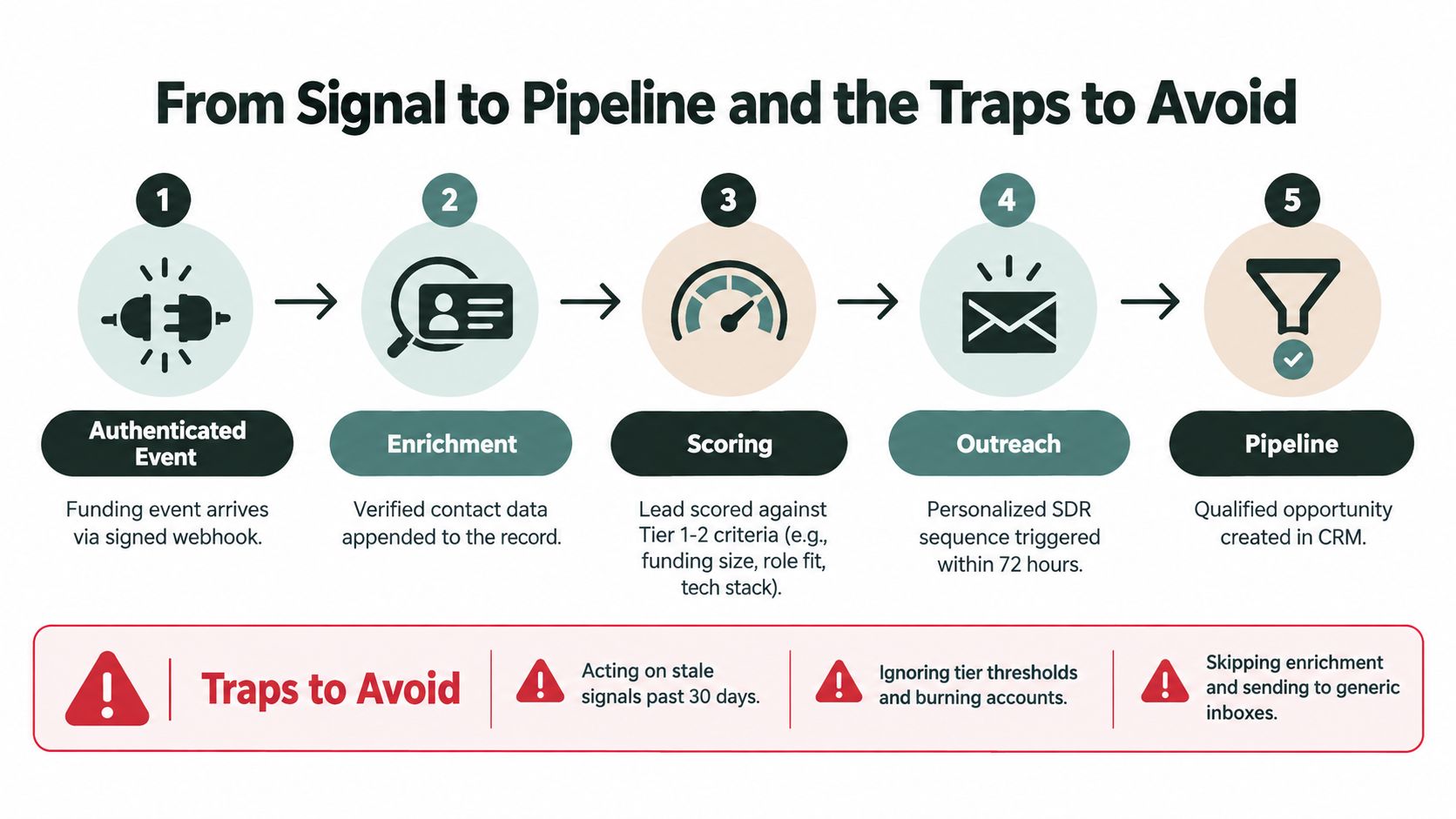
- Authenticate the event. Accept a signed webhook payload, validate the schema, record the event ID, and reject malformed or duplicate deliveries.
- Enrich the account. Append the company website, funding stage, amount, investor context, location, and relevant leadership contacts. Keep verification status visible in the record.
- Score the opportunity. Apply Tier 1 or Tier 2 rules using event type, recency, ICP fit, role relevance, and contact confidence.
- Route the sequence. Send founder-level accounts to one branch, commercial leadership to another, and hold records without verified contacts for enrichment rather than forcing them into a generic queue.
- Create ownership in the CRM. Assign an SDR, preserve the original event source, attach the event date, and start the approved cadence only after enrichment completes.
A 21-day cadence can be attached to the trigger record, but the CRM should also store why the account entered the sequence. That context helps the SDR write a message that reflects the event instead of copying a generic funding template.
Production failures usually happen between systems
The common breakdowns are operational:
- Alerts without ownership: Someone receives the notification, but no workflow creates an accountable task.
- Routing without verification: Unconfirmed contacts enter sequences and create bounces or irrelevant outreach.
- Premature sequencing: The email fires before enrichment finishes, so personalization fields are blank or wrong.
- Stale payloads: A delayed event is treated as new because the workflow ignores announcement dates.
- Duplicate processing: Retries create multiple accounts, tasks, or sequences for the same round.
- Context-free messaging: The SDR sees the trigger but doesn't use it in the email.
- Signal overload: The team monitors every possible event and spends its time on low-confidence records.
Build feedback into the system. Track which event categories create replies, which roles respond, how long verification takes, and where records fail. Then adjust scoring weights and routing rules from observed outcomes rather than adding more triggers by default.
The operating thesis: A small set of high-confidence, state-changing events, verified and routed within hours, will beat a large feed of unfiltered intent.
NowFunded provides a live, verified feed of newly funded startups, with structured event data, verified founder and leadership contacts, and delivery through MCP, REST API, webhooks, CSV export, or a dashboard. If you're building a funding-trigger workflow, visit NowFunded to evaluate the feed and connect it to your outbound stack.