10 Sales Outreach Tools for Smarter Prospecting

The most popular advice about sales outreach tools is also the least useful: pick one platform and make it your entire outbound system. No single product is equally strong at discovering timely prospects, enriching contacts, orchestrating multichannel outreach, protecting inbox placement, and turning activity into reliable reporting.
The better question is, which bottleneck is slowing your workflow? This comparison follows four jobs: finding the right trigger, enriching the people behind it, executing sequences, and maintaining deliverability. It evaluates each platform by ideal user, workflow fit, setup effort, pricing approach, strengths, and limitations, rather than treating every feature checkbox as equivalent.
NowFunded belongs at the trigger and data-enrichment layer for teams targeting newly funded startups. It identifies confirmed early-stage funding events and can supply verified founder and leadership contacts. The engagement platforms below handle the subsequent outreach motion, from cadences and calls to CRM activity and reporting.
That distinction matters because sales engagement has moved from basic email automation toward systems combining email, phone, social steps, sequencing, analytics, and workflow automation. Salesforce's overview of sales engagement platforms describes the broader shift from sending more messages to measuring outcomes such as replies, booked meetings, conversion rates, and pipeline velocity. The list starts with the tool that can create a timely prospecting trigger, then moves through enterprise, CRM-native, multichannel, email-first, and operationally focused options.
Table of Contents
- 1. NowFunded
- 2. Outreach
- 3. Salesloft
- 4. Apollo.io
- 5. HubSpot Sales Hub
- 6. Lemlist
- 7. Instantly
- 8. Reply.io
- 9. Mixmax
- 10. Groove by Clari
- Top 10 Sales Outreach Tools, Feature Comparison
- Build the Stack Around the Motion
1. NowFunded
NowFunded is most useful before a sales sequence exists. It provides a live, machine-readable feed of newly funded startups from pre-seed through Series B, combining funding metadata with on-demand contact enrichment for founders and relevant leaders.
Each funding event can include the company, round, amount, lead investors, headquarters, headcount, industry tag, website, and LinkedIn profile. Teams can receive updates through MCP, REST API, webhooks, CSV export, or a dashboard, which makes the product suitable for an SDR, an automation workflow, or an AI research agent.
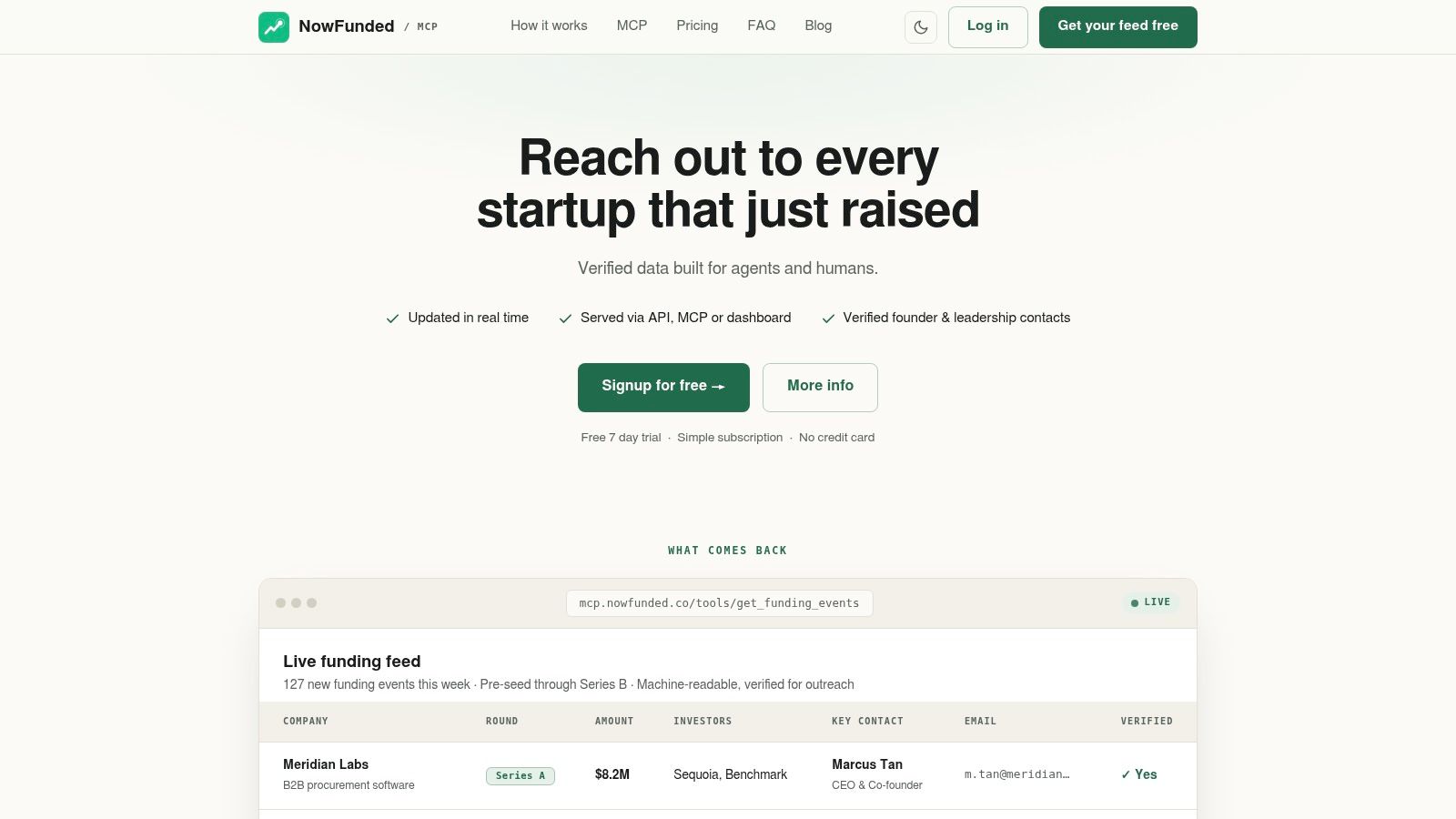
Best fit for trigger-based prospecting
The important design choice is separating free funding-event queries from contact retrieval. You can filter by round, industry, location, or other structured fields before pulling a person's details. Contact enrichment is usage-based, with verified work emails priced at $0.10 per email and phone numbers at $0.25 per phone number, with no subscription or minimum spend, according to the supplied product brief.
That model supports a more disciplined workflow than buying a large undifferentiated contact file. You can wait for a relevant funding event, narrow the account set, then request founder or leadership contacts only when they fit the campaign.
- Trigger freshness: Confirmed rounds are added to the feed when verified, supporting timely outreach.
- Contact quality: Verification status is explicit, and charges apply only when verification succeeds.
- Automation readiness: Typed JSON schemas and MCP support reduce the need for scraper maintenance.
- Delivery flexibility: Webhooks support push workflows, while MCP and REST support on-demand queries.
The trade-off is focus. NowFunded is designed for early-stage funding activity, not late-stage or IPO-era coverage. Phone availability can vary, and unfiltered bulk enrichment can increase usage costs.
Practical rule: Filter the funding event first, enrich second, and send only after the contact and domain checks pass.
NowFunded works best as a complementary data-trigger layer, not as a replacement for Outreach, Salesloft, HubSpot, or another execution platform. Teams building an automated prospecting workflow can connect a funding webhook to their CRM, enrichment step, and sequence tool, while human operators can use the dashboard or CSV export. The publisher also provides outbound workflow resources for teams turning fresh funding signals into prospecting motions.
2. Outreach
Outreach fits organizations that need controlled execution across a large sales team. Its role begins after account selection: it coordinates sequences, rep tasks, manager oversight, CRM synchronization, and AI-assisted follow-up. Teams should therefore evaluate it as an execution layer, not as a prospect database or trigger source.
A typical workflow combines email, calls, and task steps. Buyer sentiment, A/B testing, sequence analytics, reply handling, and AI-assisted copy support provide feedback within the cadence itself. That combination is useful for global SDR and AE teams whose sales operations group needs consistent account coverage and comparable performance data.
The product's strongest distinction is governance. Administrators can define workflows, set permissions, standardize sequence use, and connect activity with CRM records. Managers gain a clearer view of execution and outcomes than they would from a lightweight email sender.
The trade-off is implementation effort. CRM field mapping, sequence rules, reporting definitions, and user training can make the rollout substantial. Quote-based pricing also limits cost visibility before a sales conversation, so procurement should define users, integrations, and reporting requirements early.
- Enterprise control: Administrative features support standardized execution across teams.
- CRM alignment: Integrations keep activity and pipeline records connected.
- Sequence intelligence: Testing and reporting help separate activity levels from business outcomes.
- AI assistance: Reply and follow-up features extend the cadence workflow instead of requiring a separate writing tool.
Outreach is a poor first purchase for a small team that mainly needs contacts and a quick self-serve launch. It also does not solve data freshness or deliverability by itself. NowFunded's startup funding feed can provide a timely account trigger, while Outreach handles the controlled follow-up sequence. Teams can also review funding-triggered outbound workflow guidance when connecting those stages.
The buying decision is operational: accept the setup and procurement burden when governance, CRM alignment, and manager measurement matter. If the bottleneck is newly funded account discovery or contact validation, add a data-focused layer rather than expecting the sequence platform to cover the entire outbound workflow.
3. Salesloft
Salesloft is most useful when outbound execution is already a managed team process. Its center of gravity is cadences, manager coaching, and pipeline execution, rather than prospect discovery or contact enrichment. That distinction makes it a complement to a data source, not a complete outbound stack.
Its cadences can combine email, calls, and social steps. Conversation intelligence and analytics give managers evidence for reviewing interactions, spotting patterns, and coaching representatives. Salesforce and Microsoft integrations also fit organizations that need activity records connected to established revenue processes.
Built for managed execution
Salesloft's advantage appears after a team has defined its motion. Managers can inspect whether representatives complete the intended cadence activities, then use conversation context to assess how those actions relate to outcomes. The platform therefore fits structured mid-market and enterprise teams more closely than an individual operator seeking a fast campaign launcher.
The operating cost extends beyond subscription selection. Public pricing is not listed, so buyers must work through a quote process. Teams may also need separate providers for prospect triggers, contact enrichment, or verification. That adds implementation work, but it can produce a clearer division of responsibility across the outbound workflow.
A practical stack might use a funding or hiring event to trigger account selection, an enrichment provider to validate contacts, Salesloft to run the sequence, and CRM reporting to evaluate pipeline movement. Deliverability remains a separate operating concern. A polished cadence cannot compensate for stale or poorly matched contacts.
- Cadence maturity: Repeatable sequencing supports consistent team execution.
- Coaching visibility: Conversation and outcome context helps managers review rep performance.
- CRM integration: Salesforce and Microsoft connections support established operating models.
- Data dependency: Prospect discovery and contact quality may require another system.
Industry benchmarks supplied in the brief report an average reply rate of 3.43%, with top performers exceeding 10%, and attribute a substantial role to list quality and deliverability. The G2 sales engagement category is more useful as a category reference than as evidence that Salesloft itself produces a specific result.
Choose Salesloft when coaching, governance, and manager visibility justify enterprise implementation. Pair it with dedicated trigger and enrichment tools when outreach depends on time-sensitive events such as new funding.
4. Apollo.io
Apollo.io brings prospect discovery, contact data, enrichment, and engagement into one self-serve workspace. For smaller teams, that design can reduce the need to connect a database, enrichment service, and sequencing platform before outreach begins.
Its workflow covers email sequences, calls, and LinkedIn tasks. Reps can research an account, review available company details, select contacts, and start follow-up without switching systems. AI features support research, drafting, and prioritization, while published pricing tiers provide a clearer entry path than an enterprise platform that requires a sales-led buying process.
A practical starting point, not a complete data-control layer
Apollo's main advantage is workflow compression. A startup with limited operations support can move from account selection to sequence enrollment in one environment. That speed matters when the team needs to test an outbound motion before investing in a larger stack.
Contact availability does not equal contact verification. Teams sending at higher volume should test bounce rates and usable contact quality, then decide whether Apollo needs to work alongside a separate verifier or deliverability tool. Inbox placement, suppression rules, and domain health remain operating responsibilities rather than automatic outcomes of having a sequence builder.
The product fits a broad prospecting motion especially well:
- Combined workspace: Research, list building, and outreach stay connected.
- Self-serve access: Published tiers can reduce early procurement friction.
- Multiple channels: Email, calls, and LinkedIn tasks support more than email follow-up.
- Data-quality check: Buyers should validate contacts against their own bounce and conversion requirements.
Apollo can complement NowFunded in a trigger-led workflow. NowFunded supplies the funding trigger and verified founder or leadership enrichment. Apollo can then broaden account discovery or run sequences when the team wants a general-purpose workspace for execution.
The choice depends on signal precision versus workflow breadth. Apollo suits teams whose ICP supports ongoing database prospecting. A newly confirmed raise may offer a stronger starting condition when timing drives the campaign, with Apollo handling the subsequent research and sequence execution. Teams should therefore assess it as one layer in the outbound stack, not assume that one interface removes the need for trigger data, verification, or deliverability controls.
5. HubSpot Sales Hub
HubSpot Sales Hub fits teams that treat the CRM as the operating system for outbound, rather than adding a separate engagement platform. Sequences connect with contact records, deals, meeting links, quotes, CPQ, reporting, and AI-supported sales processes.
That connection changes the buying decision. HubSpot supports email sequences, tasks, templates, meeting scheduling, and integrations with LinkedIn Sales Navigator and other messaging channels. Published tiered pricing makes the purchase path more visible than quote-only enterprise platforms, but the selected tier and add-ons determine which workflows a team can run.
Choose it when pipeline context matters more than outbound specialization
A rep can enroll a contact in a sequence while keeping prior activity, ownership, and deal status in the same record. Managers therefore spend less time reconciling engagement data with pipeline updates. The benefit is operational consistency, especially for teams already using HubSpot as their system of record.
The trade-off is scope. HubSpot is not primarily a deliverability operations platform, and advanced execution depends on plan level. Advanced Sequences require Sales Hub Professional or higher, while add-ons and higher tiers can raise the total cost. Teams should map required steps, permissions, reporting, and sending controls before selecting an entry plan.
HubSpot's fit is strongest when adoption and data continuity outweigh the need for specialized outbound infrastructure. It supports a connected workflow across:
- CRM execution: Sequence activity, contact history, ownership, and pipeline status remain together.
- Revenue operations: Meetings, quotes, CPQ, and reporting sit beside prospecting activity.
- Rep adoption: Teams already working in HubSpot face less process change.
- Plan control: Advanced sales execution may require a higher tier or additional purchases.
For trigger-led startup prospecting, NowFunded can identify a funding event and provide structured company data to HubSpot. HubSpot can then qualify the account, assign ownership, enroll prospects, and report on outcomes. Before sending, the team still needs to verify domains and contacts and define appropriate sending practices. This division keeps funding intelligence outside the CRM while giving sales managers one place to manage execution and measurement.
6. Lemlist
Lemlist fits outbound teams that prioritize message-level personalization and quick campaign setup. It brings email, LinkedIn, and calls into one workflow, with visual personalization, landing-page elements, contact verification, Lemwarm warm-up, and AI-assisted automation.
Its main advantage is execution speed. SDRs can assemble a sequence, add personalized images or landing pages, configure channel steps, and start testing without the administrative overhead of a larger enterprise platform. Reporting focuses on campaign activity and outbound results, rather than broad revenue governance.
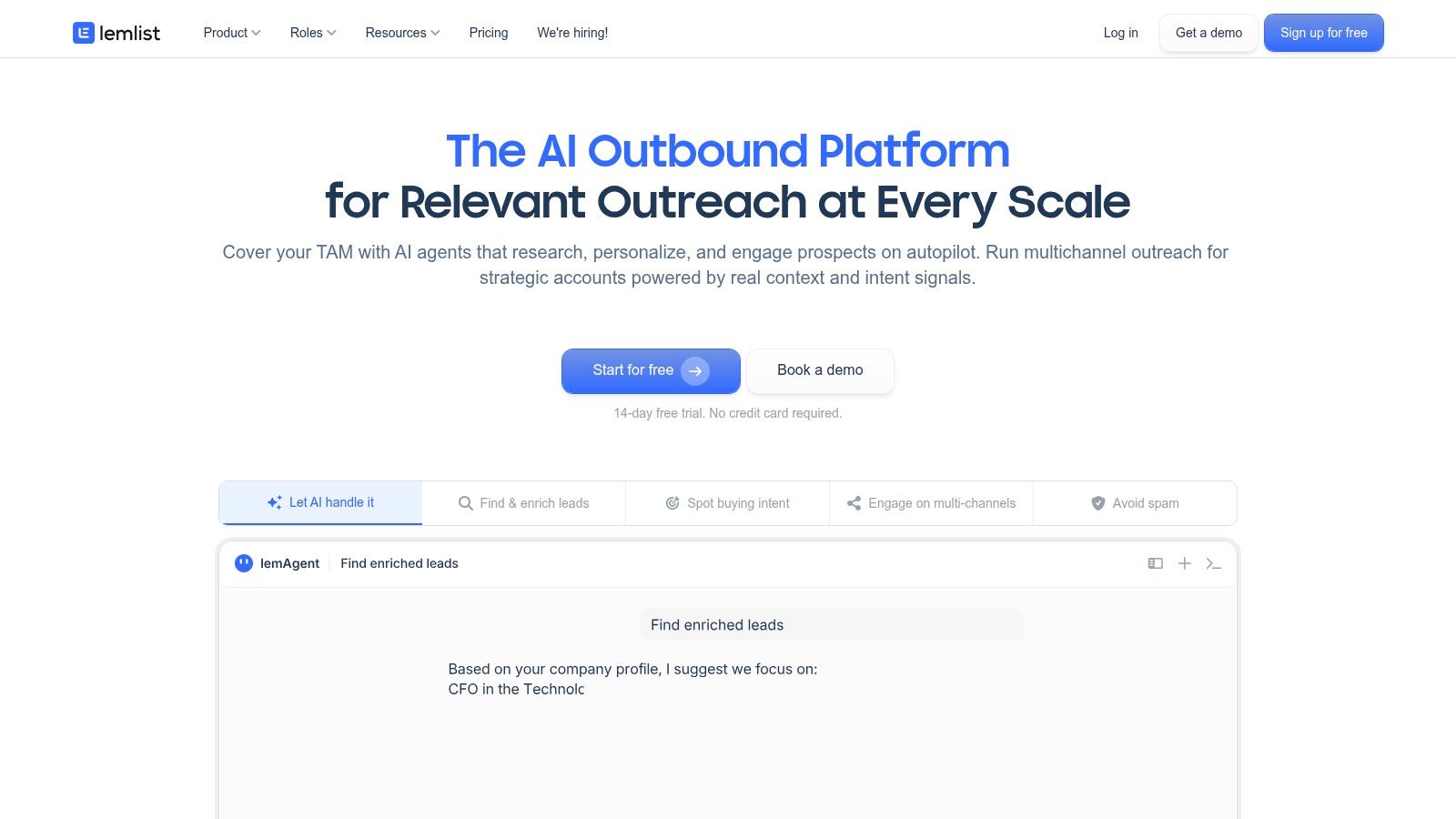
Personalization works only after targeting
Lemlist's clearest differentiator is its creative layer. A custom image or landing page can make an email more relevant, but it cannot correct an unsuitable prospect, inaccurate role data, or poor timing. Teams should therefore treat Lemlist as the sequencing and personalization layer, then connect it to a dependable trigger and enrichment workflow, such as the startup funding research from NowFunded.
Campaign economics also require a full cost review. Enrichment, verification, and AI functions may draw on credits or add-ons, so usage can affect total spend as volume rises. Buyers should model the complete prospecting workflow rather than compare only base seat prices.
- Fast deployment: Campaigns and multichannel steps can be configured quickly.
- Creative flexibility: Images and landing pages add context beyond text templates.
- Channel coordination: Email, LinkedIn, and calls can run from one workspace.
- Usage exposure: Verification, enrichment, and AI credits can change campaign economics.
Deliverability still depends on list quality and sending controls. A supplied benchmark recommends keeping bounce rate under 3%, spam complaints under 0.3%, and inbox placement above 90% for strong programs, as documented in the sales engagement category guidance. These are operating targets, not guarantees provided by Lemlist.
Choose Lemlist when a small outbound team needs fast deployment and distinctive personalization. Provide verified, well-filtered prospects, monitor sending performance, and use NowFunded when a campaign is triggered by a verified startup raise. This division keeps signal generation separate from message execution, making the stack easier to evaluate and refine.
7. Instantly
Instantly fits a specific layer of the outbound workflow: operating cold email across multiple inboxes with limited administrative overhead. Its core capabilities include inbox management, account rotation, warm-up, deliverability controls, AI sequence writing, and an AI reply agent. Agencies and independent operators can manage several sending accounts from one workspace, which reduces coordination work as campaigns expand.
That focus makes Instantly a complement to prospecting and CRM systems rather than a replacement for them. Teams that need email execution can usually set up campaigns faster than they would in an enterprise sales execution platform. The trade-off appears when managers need detailed CRM governance, coaching workflows, or coordinated phone and social activity.
A practical evaluation should start with the sending model. Instantly can organize inboxes and distribute activity across accounts, but it cannot correct weak targeting, incomplete verification, poor domain configuration, or low-quality messaging. Those controls belong earlier in the workflow, while Instantly handles the mechanics of sending and responding.
The benchmark context reinforces that distinction. SoPro's cold outreach statistics roundup reports an average cold email response rate of 5.1%, with most campaigns between 1% and 5%, and says about 20% of cold emails are flagged as spam. It also associates personalized outreach with stronger responses and positive ROI for many sales teams. The practical implication is straightforward: personalization and deliverability safeguards must operate together.
- Inbox operations: Rotation and warm-up support multi-inbox email programs.
- Deployment speed: Agencies can launch campaigns without extensive enterprise administration.
- AI assistance: Drafting and reply handling reduce repetitive execution work.
- Workflow boundary: Phone, LinkedIn, and broader CRM governance sit outside its main strength.
Instantly can pair with NowFunded when that trigger layer provides filtered newly funded accounts and verified contacts. Separating account selection from email infrastructure makes diagnosis clearer. If performance declines, the team can test whether stale data, weak copy, or inbox placement is responsible instead of treating the entire stack as one system.
8. Reply.io
Reply.io fits growing teams that need email, LinkedIn, SMS, and calling within one outbound workflow. Its AI SDR assistant supports prospect research, personalization, drafting, and reply handling. Templates, analytics, and collaboration tools then turn individual outreach into a process the team can repeat.
Its main advantage is coordination across channels. Reps can place different touchpoints in one cadence rather than managing separate campaigns for email, social, and calls. The benefit depends on execution, however. A sequence may automate one action, create a task for another, or require the rep to switch into a separate application.
Test the handoffs, not just the channel list
Before rollout, trace a prospect from enrollment through every scheduled action. Confirm which steps run automatically, which require human completion, and how LinkedIn or calling activity is recorded. This test reveals whether Reply.io reduces coordination work or merely collects it in one interface.
The per-seat model also changes the cost calculation for agencies and larger teams. Budget for users and add-ons, then account for contact data, verification, and separate sending infrastructure if the program requires them. A wide channel mix can increase coverage while also increasing operational overhead.
Reply.io is a reasonable fit when channel coverage matters more than the governance depth associated with Outreach or Salesloft. It can complement a data or trigger tool by handling sequence execution, while deliverability and prospect selection remain separate workflow responsibilities.
A focused pilot provides the clearest evaluation. Start with one buyer segment and one cadence. Track completed actions, replies, bounces, and rep time, then add channel complexity only after reps execute the initial workflow consistently. That approach tests whether multichannel capability produces completed activity, rather than assuming that placing channels in one sequence will improve results.
9. Mixmax
Mixmax fits teams that already work in Gmail or Google Workspace and want to add outreach without replacing their daily tools. Its extension and web dashboard support sequences, tracking, templates, polls, surveys, and scheduling links. Outlook and Salesforce options extend that workflow beyond one inbox.
The product's main advantage is workflow proximity. Reps can write, schedule, and follow up where they already spend time, reducing the gap between sending an email and recording the next action. Published per-user tiers and trials give smaller teams a practical way to test adoption before committing to a heavier sales engagement platform.
A focused execution layer for inbox-led outreach
Mixmax works best after prospect selection and enrichment are already handled. It can run a focused email motion, but it is not a trigger feed, enrichment database, or full deliverability operations layer. Teams targeting newly funded startups could use NowFunded to identify and enrich accounts, then send relevant follow-up through Mixmax.
That division of labor clarifies the buying decision. Mixmax supports fast execution and human-managed follow-up, while data quality, sending infrastructure, and broader governance remain separate responsibilities. A Salesforce-first enterprise may prefer a platform with deeper native alignment. A Gmail-centric team may value Mixmax because reps do not have to adopt a separate operating environment.
- Inbox-native workflow: Reps can create and manage outreach close to Gmail.
- Quick adoption: The extension and dashboard limit training overhead.
- Practical engagement tools: Tracking, polls, templates, and scheduling support follow-up.
- Governance ceiling: Complex routing, administration, and cross-channel analysis may require a specialized platform.
The fit is strongest for founders, small SDR teams, and recruiters that prioritize relevance and speed over elaborate branching. Before rollout, test how sequences, replies, tasks, and CRM records are handled in the team's actual workflow. That check shows whether Mixmax reduces administrative work or adds another layer around the inbox.
A global revenue organization with extensive coaching, governance, and cross-channel reporting needs will likely outgrow it. For smaller teams, however, Mixmax can serve as the execution layer in a complementary outbound stack rather than pretending to replace every system around it.
10. Groove by Clari
Groove by Clari fits the outbound stack at the execution and governance layer. It is built for companies that already run Salesforce and use Clari's broader revenue workflow, with activity capture, inbox-based work, cadences, email and call tasks, meeting scheduling, and AI assistance in the same operating environment.
The main advantage is record consistency. Reps can work from the inbox while activity synchronizes with Salesforce, reducing the chance that outreach history sits outside the CRM. That connection supports account ownership, forecasting, and pipeline inspection when managers need a dependable view of rep activity.
Groove is therefore a poor substitute for prospect discovery or enrichment. It assumes the organization has already identified accounts and contacts, then provides a controlled way to execute and record outreach. Quote-based pricing and an enterprise-oriented rollout can make the buying process disproportionate for smaller teams.
Its value also depends on the surrounding architecture. Without Salesforce and Clari already in the workflow, buyers should compare the administrative gains with lighter tools that are faster to deploy and easier to operate independently.
- Salesforce alignment: Native synchronization limits duplicate entry and record drift.
- Inbox execution: Reps can manage cadences, calls, and meetings close to email.
- Revenue context: Clari integration places sales activity within a broader operating model.
- Enterprise commitment: Quote-based deployment may not suit small or independent teams.
A complementary setup can send timely account triggers from NowFunded to Groove, while Salesforce remains the system of record for prospecting activity. This division separates external funding intelligence from internal ownership, activity capture, and reporting, which is useful for teams targeting early-stage companies.
The trade-off is specialization. Choose Groove when Salesforce governance and complete activity history matter more than self-serve launch speed. Choose a lighter execution tool when the immediate requirement is relevant outreach with limited administrative overhead. Before adopting it, map triggers, enrichment, sequence execution, replies, and reporting across the existing stack. That exercise shows whether Groove closes a governance gap or duplicates capabilities already in place.
Top 10 Sales Outreach Tools, Feature Comparison
Product Core features Target audience / Best for Unique selling points Pricing & billing NowFunded (Recommended) Real‑time verified funding feed (pre‑seed→Series B); on‑demand contact enrichment; MCP/REST/webhook/CSV; typed JSON Sales/BD teams, VC scouts, AI agents, growth ops Agent‑native real‑time feed; verified deliverable contacts (charged only on success); webhook push; no scraper maintenance Funding queries free; emails $0.10 / phone $0.25 per verified pull; usage‑based, no subscription Outreach Enterprise sales engagement: multichannel sequences, analytics, AI follow‑ups, governance Large SDR/AE teams, enterprises needing governance Deep CRM integrations; mature reporting and admin controls Quote‑based enterprise pricing Salesloft Cadence automation, conversation intelligence, coaching, CRM integrations Mid‑market to enterprise sales teams Proven cadence + analytics; strong manager coaching Quote‑based (sales process required) Apollo.io (Engage) Large B2B contact database + sequences, enrichment, AI prospecting SMB → mid‑market teams wanting discovery + outreach All‑in‑one discovery + outreach; transparent published tiers Published pricing tiers; may need verifier at scale HubSpot Sales Hub (Sequences) Native CRM + email sequences, pipeline, CPQ, integrations Teams wanting unified CRM + outreach and revenue workflows Unified CRM reduces sync issues; native pipeline/CPQ Tiered pricing (Starter/Pro/Enterprise); advanced features need Pro+ Lemlist Personalization (email/LinkedIn), warm‑up, verification, automation SDRs and personalization‑focused outbound teams Visual personalization toolkit; easy onboarding Seat pricing + credit‑based add‑ons (enrichment/verification) Instantly High‑deliverability cold email, inbox rotation, AI agents Agencies and high‑volume senders Multiple inboxes per plan; fast deployment; value at scale High‑volume plans; credits/add‑ons for enrichment Reply.io Multichannel cadences (email/LinkedIn/SMS/calls), AI SDR, templates Growing sales teams needing broad channel coverage Broad channel coverage at single price; SDR playbooks Per‑seat licensing; tiered plans Mixmax Gmail/Workspace‑native sequences, tracking, scheduling Gmail‑centric small teams & fast adopters Fast to adopt; lightweight reporting; Chrome/Gmail native Per‑user published tiers; easy trials Groove by Clari Salesforce‑native cadences, activity capture, inbox workflows Salesforce‑centric enterprises Deep Salesforce sync; inbox‑embedded workflows; Clari integration Quote‑based enterprise pricingBuild the Stack Around the Motion
There isn't a universal winner among sales outreach tools because outbound teams don't share one bottleneck. A company selling into newly funded startups may need a real-time trigger and verified founder contacts before it needs cadence analytics. A global SDR organization may have the opposite priority, with governance, coaching, CRM controls, and reporting carrying more weight than prospect discovery.
Use NowFunded for trigger-based startup prospecting and verified enrichment. Its role is to identify newly confirmed early-stage funding events, structure the company context, and provide verified leadership contacts on demand. The engagement layer can then be selected separately, based on the channels and controls the team needs.
Choose Outreach or Salesloft when managers need enterprise governance, coaching workflows, and detailed execution visibility. These platforms are stronger operating environments for established sales organizations than lightweight email senders, but they shouldn't be expected to solve every data or deliverability problem automatically.
Choose HubSpot or Groove when the CRM is the center of the business. HubSpot suits teams that want CRM, pipeline, quotes, and sequences in one broad system. Groove is more appropriate when Salesforce-native activity capture and Clari alignment are central requirements.
For faster deployment and narrower motions, consider Apollo.io, Lemlist, Instantly, Reply.io, or Mixmax according to the workflow:
- Apollo.io fits teams that want prospecting and outreach together.
- Lemlist fits teams that prioritize creative personalization and approachable multichannel setup.
- Instantly fits email-first operators that care about inbox and sending operations.
- Reply.io fits growing teams that want several channels in one cadence framework.
- Mixmax fits Gmail-centric teams that value quick adoption and lightweight execution.
Deliverability deserves its own buying decision. The supplied market summary reports that 87% of sales development teams use a sales engagement platform, while about 90% of sales organizations consider one critical to success, and estimates category growth from $7.4 billion in 2022 to nearly $30 billion by 2032. Those figures from Snov.io's sales outreach tools summary suggest that sequencing itself is becoming standard. Differentiation now comes from data freshness, targeting precision, workflow automation, and inbox health.
A reliable implementation sequence is straightforward:
- Define the target signal: Decide whether the campaign starts with new funding, a role change, an account attribute, or another verifiable event.
- Filter before enriching: Narrow accounts and roles before paying for contact retrieval.
- Verify contacts: Confirm deliverability and remove invalid or unsuitable records.
- Launch a small sequence: Start with one audience, one message angle, and a limited channel path.
- Monitor deliverability and replies: Watch bounces, spam complaints, inbox placement, replies, and booked meetings.
- Expand only after reliability is proven: Add volume, users, or channels once the workflow works consistently.
The best stack is the one that makes each job accountable. Let the trigger system find the right moment, the enrichment layer identify the right person, the engagement platform coordinate action, and the reporting layer show whether the motion creates qualified pipeline.
NowFunded gives outbound teams a live feed of newly funded startups, structured funding metadata, and verified founder and leadership contacts through MCP, REST API, webhooks, CSV, or a dashboard. Use it to create a cleaner trigger and enrichment layer before launching sequences in the sales outreach tool that fits your team. Visit NowFunded to start building a more timely, deliverability-conscious prospecting workflow.