10 Sales Intelligence Tools for Smarter Prospecting

The best sales intelligence tool isn't the one with the biggest database. It's the one that captures the signal your team can act on before that signal loses value. A real-time funding event serves a different purpose from a verified phone number, firmographic enrichment, buyer intent, a mutual connection, website activity, or a workflow that combines several sources.
That distinction matters because sales intelligence has moved into mainstream revenue operations infrastructure. Market estimates for 2026 range from USD 4.52 billion to USD 5.37 billion, with projections reaching roughly USD 9.15 billion to USD 12.45 billion by 2031 through 2034, according to Fortune Business Insights' sales intelligence market analysis. Yet adoption still fails when data arrives too late, lacks verification, or doesn't fit the CRM process. One implementation source attributes 40% to 60% of sales intelligence failures to technical integration issues, while another reports that 4 in 5 sellers identify inaccurate data and poor integration as obstacles. See the implementation troubleshooting research for that distinction.
This comparison evaluates signal freshness, contact quality, coverage, delivery method, integration effort, pricing model, and workflow fit. The goal isn't to crown one universal winner. It's to identify the tool that best matches the event that starts outreach, with particular attention to NowFunded when newly confirmed startup funding is the trigger.
Table of Contents
- 1. NowFunded
- 2. ZoomInfo Sales
- 3. Apollo.io
- 4. Cognism
- 5. LinkedIn Sales Navigator
- 6. Crunchbase
- 7. Clearbit by HubSpot
- 8. 6sense Sales Intelligence
- 9. Dealfront
- 10. Clay
- Top 10 Sales Intelligence Tools Comparison
- Build the Smallest Stack That Covers the Gap
1. NowFunded
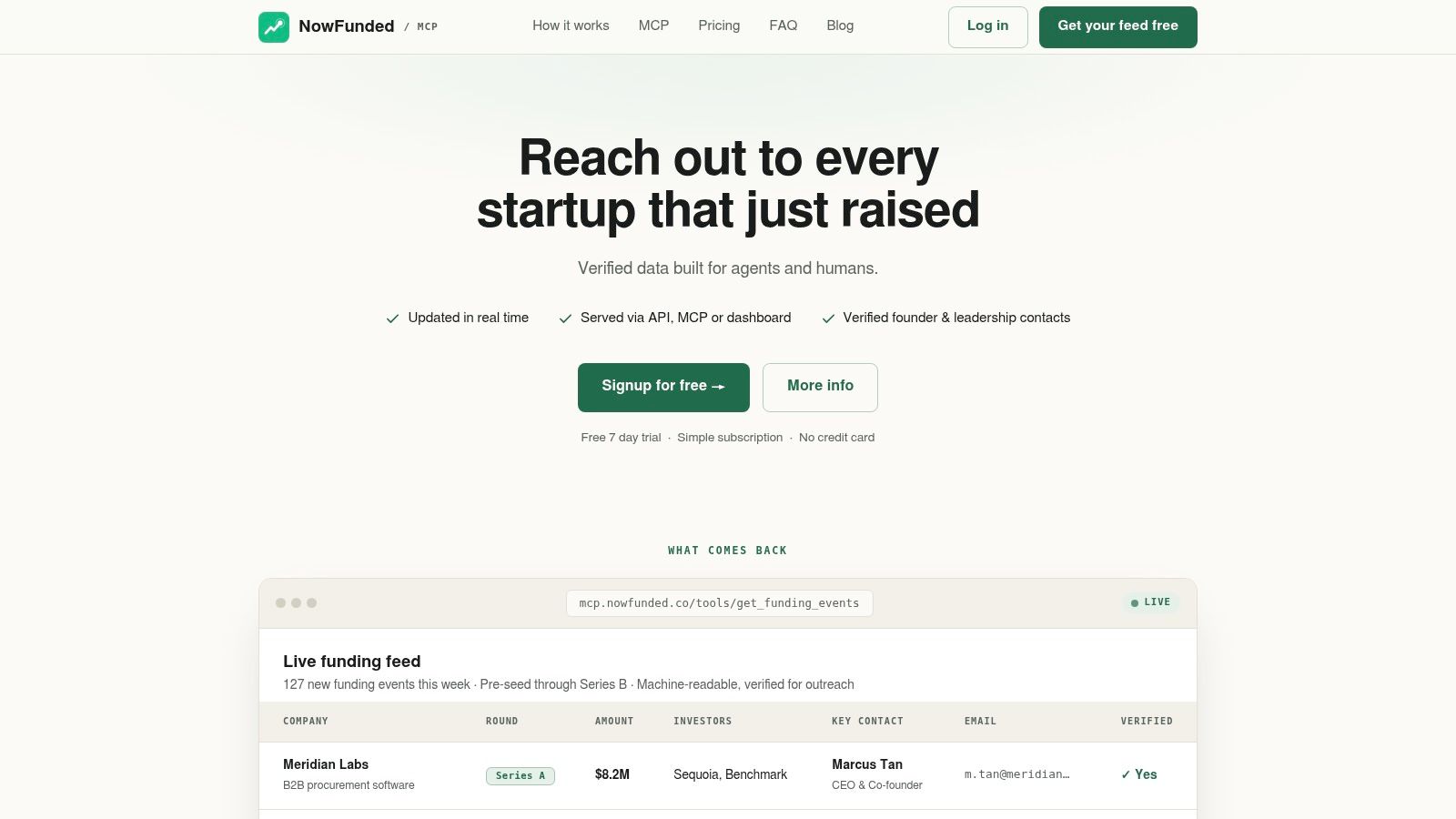
NowFunded is built around a narrow but commercially useful signal: newly confirmed startup funding. It tracks early-stage rounds from pre-seed through Series B and pairs funding-event records with on-demand, verified founder and leadership contacts. That makes it different from a general-purpose database. The workflow begins with a timing event, then moves directly toward a relevant person.
The feed includes the company name, round, amount raised, lead investors, headquarters, headcount, industry, website, and LinkedIn profile in typed JSON schemas. Teams can receive records through native MCP support, REST API, webhooks, CSV export, or a dashboard. The platform says it tracked 100+ new startups weekly, including 127 reported events in a recent week, and maintains a 10,000+ record historic database covering 12 months. Those figures come from the product information supplied for this comparison.
Why the signal is useful
Funding creates a clear reason to revisit an account. A newly funded startup may be hiring, expanding its infrastructure, revisiting vendors, or formalizing processes that were previously handled informally. The signal doesn't prove buying intent, but it gives an SDR a defensible timing hypothesis and a specific business context for outreach.
NowFunded adds 2 to 5 founder or leadership contacts where available, with explicit verification status for emails and phone numbers. Contact pulls are usage-based, with funding-event queries free and verified contacts priced at $0.10 per email and $0.25 per phone number, as stated in the product brief. Charges apply only when verification succeeds.
Practical rule: Use funding to decide when an account deserves attention, then use verified role-level contacts to decide who should receive the message.
Webhook delivery is particularly important for automation teams. Confirmed rounds can be pushed by HTTP POST instead of collected through polling loops, while MCP support makes the data accessible to agent workflows. The trade-off is focus. NowFunded is strongest for early-stage funding activity, not broad later-stage account coverage, and per-contact billing needs monitoring when outreach volume grows. Visit NowFunded for the live feed and integration options.
2. ZoomInfo Sales
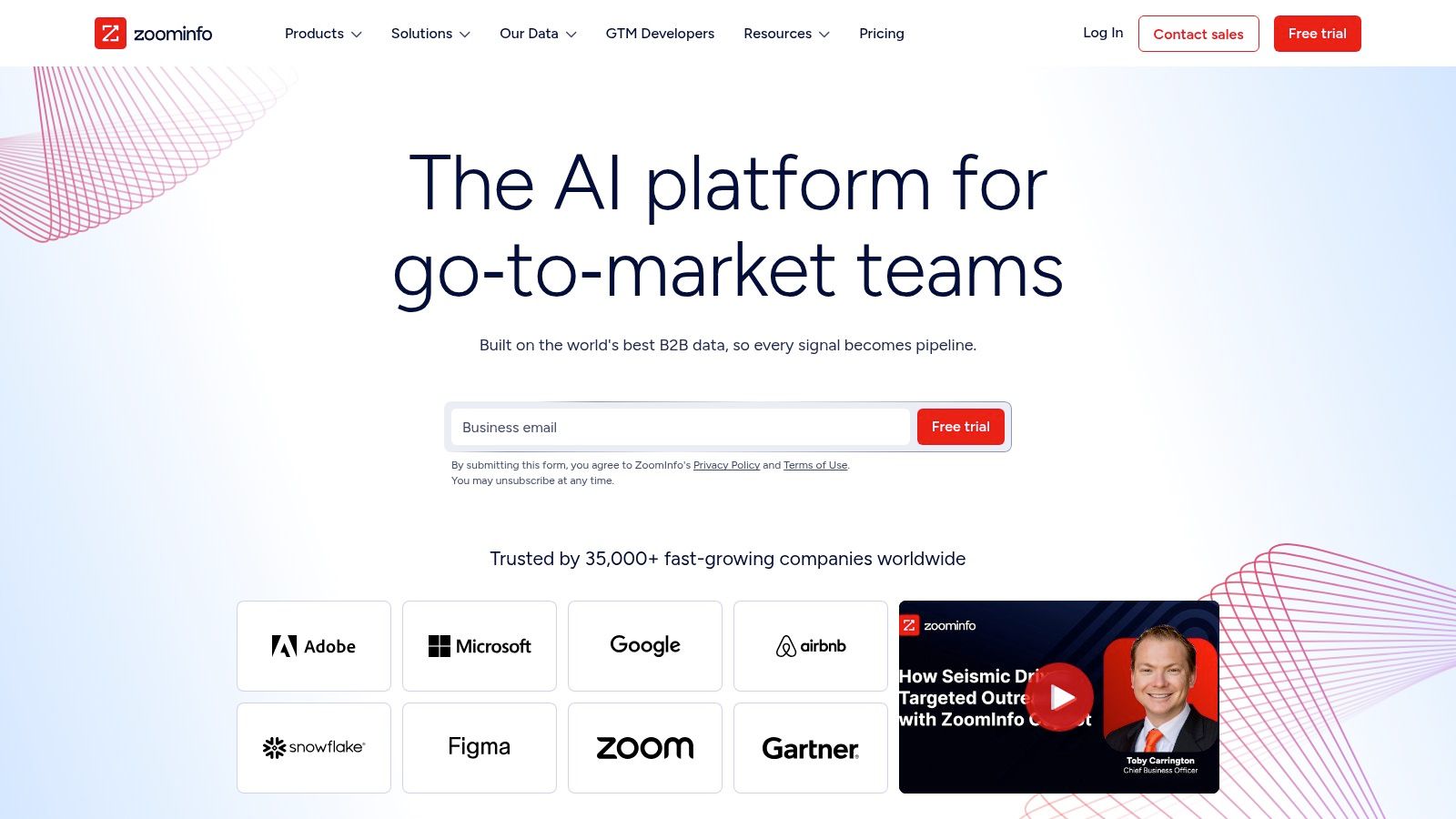
ZoomInfo Sales is the broad coverage option for teams that want company data, contact data, intent, technographics, and seller execution in one enterprise environment. Its distinctive signal isn't a single trigger. It's the combination of account context and prioritization across a large B2B data graph.
The platform's Copilot is designed to summarize accounts, surface talking points, prioritize targets, and recommend next actions. That can reduce the amount of manual research an SDR performs before a call, particularly when the account has several subsidiaries, stakeholders, or technology indicators to interpret.
Workflow fit and trade-offs
ZoomInfo connects with major systems such as Salesforce, HubSpot, Microsoft Copilot, and Dynamics. Browser and mobile experiences also support sellers outside the CRM. For a revenue organization with established governance, routing rules, and account ownership, that depth can make it a practical execution layer rather than just a contact database.
The cost structure is a material consideration. Pricing is quote-based and may involve annual or multi-year commitments and add-on costs, so buyers need to define which modules and data rights are required before comparing proposals. Smaller teams may pay for breadth they don't yet have the process discipline to use.
ZoomInfo is best when the need is broad account intelligence at scale, not a specialized event feed. A team already using a separate funding source or website-intent product should check whether those signals duplicate existing coverage before adding more modules. Explore ZoomInfo Sales and Copilot for the current platform configuration.
3. Apollo.io
Apollo.io is designed for teams that want to move from prospect discovery to outreach without assembling several separate systems. Its strongest signal is contact and account availability inside an engagement workflow. Search, enrichment, sequences, dialing, analytics, a browser extension, and API access sit close together.
That bundling suits SMB and mid-market teams where an SDR needs to identify a role, add the record to a sequence, and track activity without waiting for a complex operations build. The platform also supports waterfall-style enrichment, allowing teams to look for missing information through additional sources rather than relying on one record.
The operational advantage
Apollo's self-serve onboarding and published tiers make it easier to pilot than quote-led enterprise platforms. Its API supports enrichment and record operations, but teams need to understand the credit model before automating heavily. Different searches, exports, enrichments, or engagement actions may consume credits differently, so a workflow should be tested with representative records.
The main trade-off is that bundled convenience can conceal data gaps. Some roles or regions may still need supplementation, especially when the campaign depends on a narrow executive profile or a market where contact coverage is uneven. Apollo can provide the execution layer, while a specialized trigger source defines which accounts deserve priority.
For teams comparing NowFunded's funding intelligence with a general prospecting system, the distinction is straightforward. NowFunded answers, “Which startups just raised?” Apollo answers, “Which people can we contact, and how should we run the sequence?” See Apollo.io for its current prospecting and engagement workflow.
4. Cognism
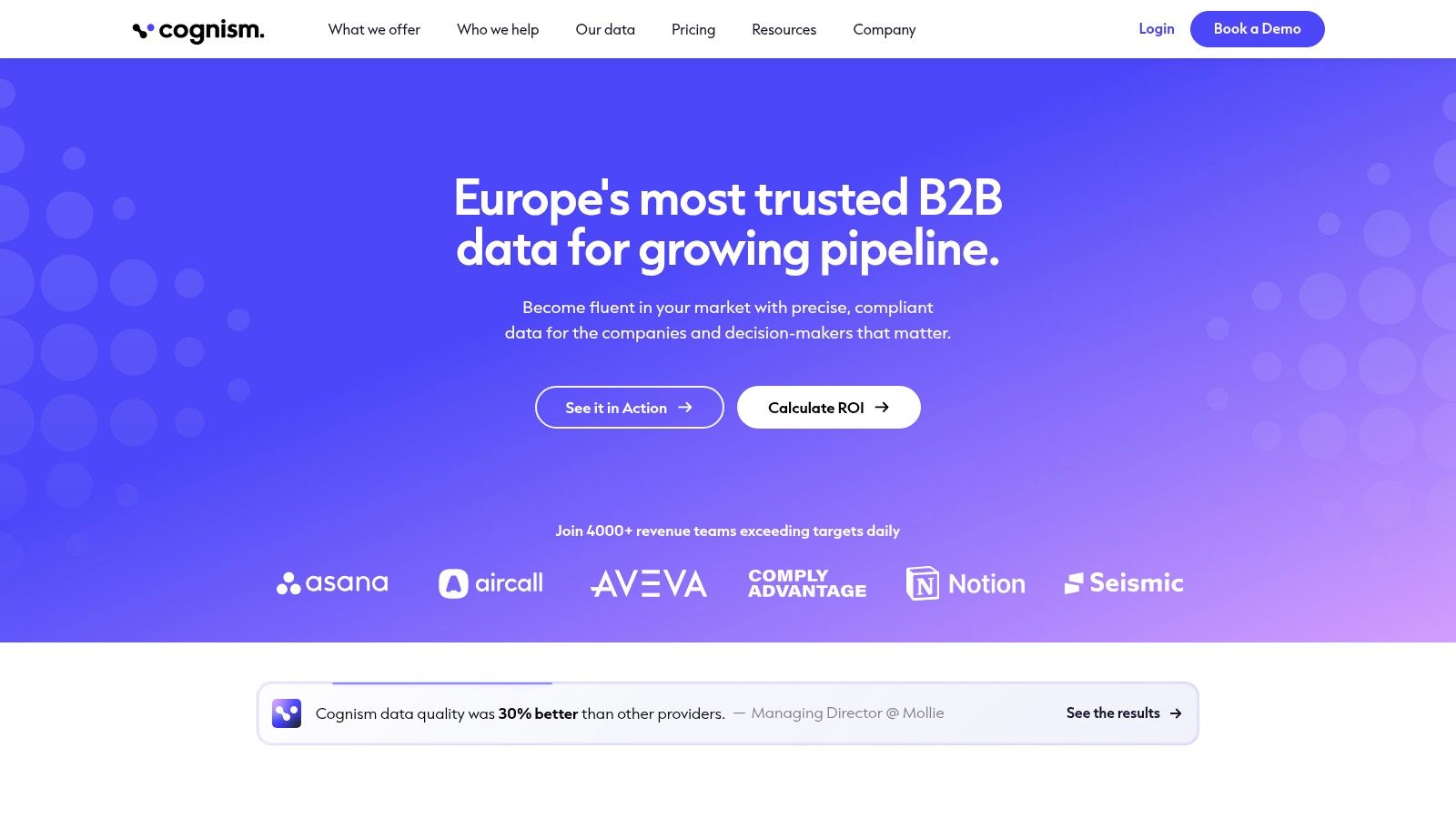
Cognism's strongest signal is compliance-conscious contact intelligence, particularly for teams selling into the UK and Europe. The platform emphasizes verified mobile numbers and emails, a GDPR-forward operating posture, and controls associated with DNC, GDPR, and TCPA requirements.
Its “Diamond Data” positioning puts phone quality at the center of the product experience. That matters for SDR teams whose workflow depends on calling rather than relying mainly on email. Cognism also supports enrichment and connections to common CRM and sales engagement platforms, so contact records can move into an existing operating process.
Where it fits best
Cognism is a practical candidate for regulated industries or revenue teams that need a clear governance conversation before enabling outbound access. Strong EMEA coverage can reduce the need to improvise regional data practices, although buyers should still validate coverage for their exact industries, countries, and personas.
The trade-off is commercial visibility. Pricing isn't publicly listed and is quote-based, which makes an apples-to-apples comparison harder until the team has documented its expected users, markets, contact types, and integration requirements. US mobile coverage may also need a secondary provider for certain segments.
The important distinction is between verified contact quality and trigger freshness. Cognism can support compliant outreach once a target exists. It isn't primarily a funding-event feed, so a startup-focused team may need another source to determine which accounts have just entered a relevant buying window. Review Cognism alongside your compliance and regional coverage requirements.
5. LinkedIn Sales Navigator
LinkedIn Sales Navigator is strongest when the signal is identity, role movement, and network context. Its advanced lead and account search helps SDRs map companies and buying committees, while saved lists and alerts keep changes visible after the initial search.
The product's advantage comes from being close to professional identity data. Sellers can validate employment changes, examine current roles, identify mutual connections, and understand how a prospect relates to the wider account. That context is difficult to reproduce with a static contact export.
Why social context changes outreach
A mutual connection can affect the path into an account, even when it doesn't guarantee a response. Job changes can also create a reason to revisit an old relationship or identify a newly appointed decision-maker. For account-based prospecting, those signals may be more useful than another generic firmographic field.
Sales Navigator doesn't provide verified personal email or phone data, so teams commonly pair it with enrichment or contact-verification software. Seat costs can also become significant as more SDRs, account executives, recruiters, or researchers need access.
A funding feed and Sales Navigator can work together without duplicating each other. Funding establishes timing, then Sales Navigator maps the founder, leadership team, and relevant connections. The NowFunded research library can provide additional context for teams designing startup-focused workflows. Explore LinkedIn Sales Navigator for the current search, alert, and relationship features.
6. Crunchbase
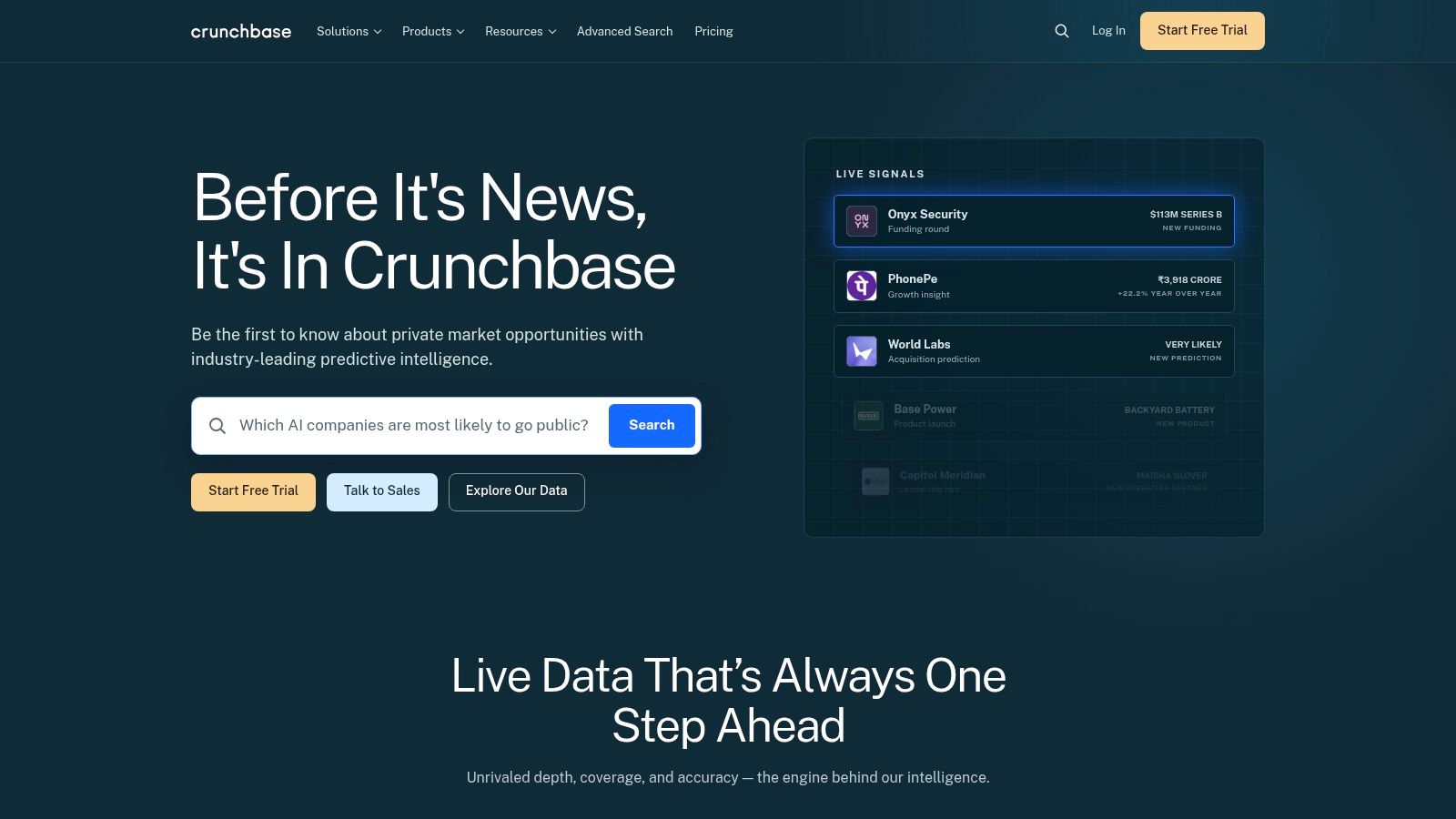
Crunchbase is a company-centric option for funding discovery, investor context, and startup account research. Its interface supports list building, saved searches, alerts, CSV export, and company investigation. That makes it useful for SDRs and analysts who need to shortlist organizations before searching for individual contacts.
The platform connects funding information with leadership, firmographics, and growth-oriented company insights. AI-assisted search can help users move from a broad market question toward a more defined set of accounts, while API options support programmatic workflows for teams with technical resources.
Company discovery is not contact readiness
Crunchbase's strength is identifying and understanding the company. Person-level contact data is more limited, so a team generally needs an enrichment provider or another contact source before launching direct outreach. That separation is not a weakness if the workflow acknowledges it. It becomes a problem when users assume a company record is already an outbound-ready lead.
Individual seats can make Crunchbase relatively easy to pilot, while trial restrictions around exports or contacts should be checked before a team designs a process around them. The product is a strong fit for startup ecosystems, founder-led selling, venture research, and market mapping.
For a team comparing NowFunded's startup funding feed with Crunchbase, the key question is freshness and purpose. NowFunded is oriented toward newly confirmed rounds and verified leadership contacts. Crunchbase is useful for broader company discovery, funding history, investors, and shortlist construction. Visit Crunchbase to assess which company-level workflows your team needs.
7. Clearbit by HubSpot
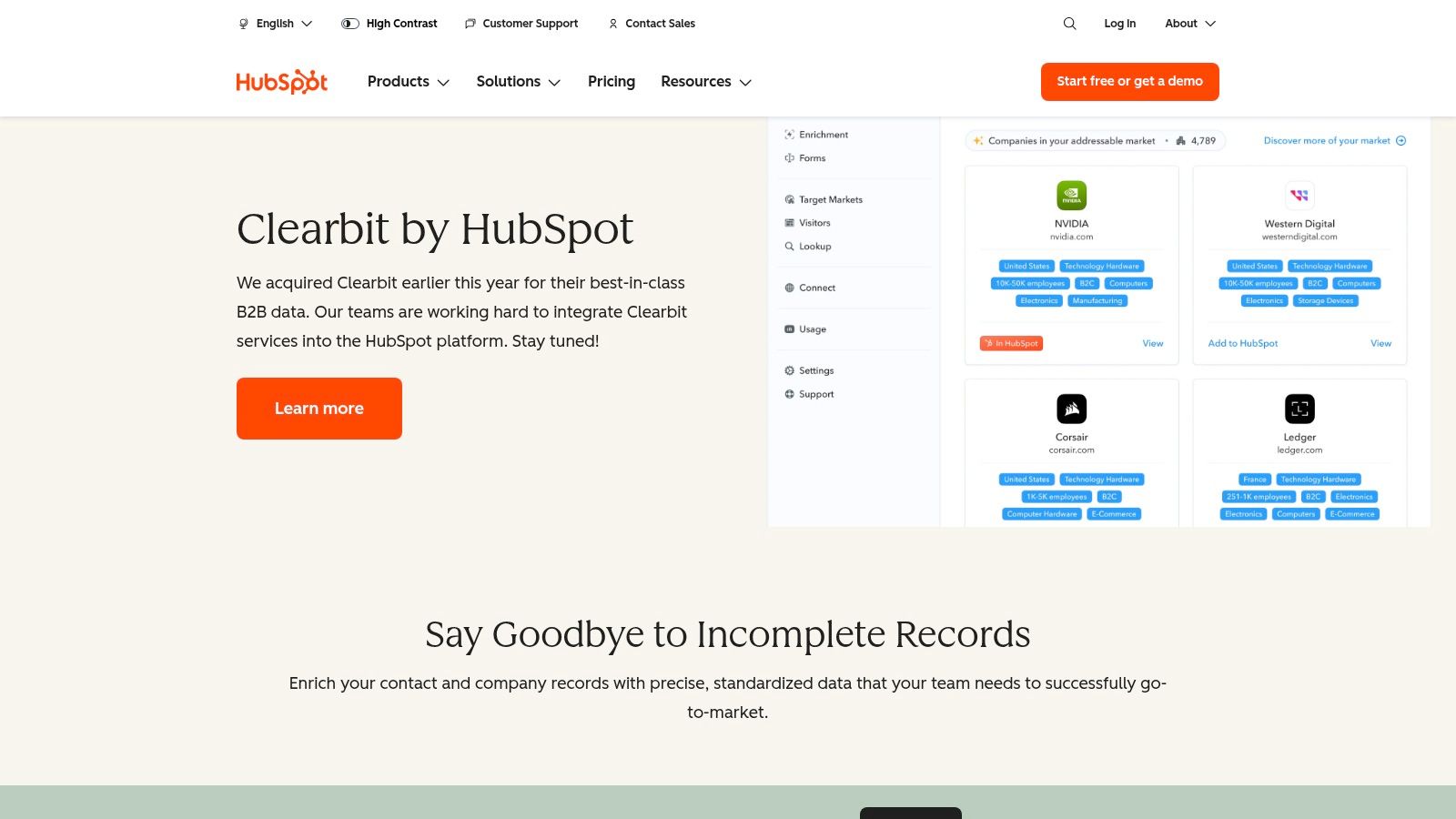
Clearbit, now integrated into HubSpot, is best understood as firmographic enrichment and website visitor intelligence inside a HubSpot-centered workflow. It can enrich company and role information across forms, CRM records, and marketing operations, helping teams route, score, segment, and personalize without adding as many external connectors.
The visitor function changes the starting point. Instead of beginning with a purchased prospect list, a team can identify companies interacting with its website and use that activity to inform follow-up. The signal is useful for marketing and sales teams that already have traffic but lack sufficient account context.
Integration fit comes first
HubSpot standardization is the deciding factor. Teams already using HubSpot can reduce connector work and keep enrichment close to forms, lists, routing, and CRM operations. Teams using Salesforce or another CRM may find the product less attractive because its strongest advantage depends on the surrounding HubSpot environment.
Clearbit's current usage and credit arrangements need confirmation with HubSpot, and standalone Clearbit pricing pages are no longer maintained. That makes it important to model expected enrichment volume and visitor workflows before assuming the product is a simple fixed-cost add-on.
Clearbit doesn't replace a funding trigger, a verified phone provider, or a dedicated intent platform. It handles who visited and what the company looks like, especially within HubSpot. Review Clearbit by HubSpot with the CRM architecture, not as an isolated database.
8. 6sense Sales Intelligence
6sense focuses on account intent, buying-stage prediction, and orchestration. Its Sales Intelligence module combines first-party and third-party intent with fit scoring and seller workflows, making it a natural fit for account-based marketing and complex deals involving several stakeholders.
Predictive models, 6QA scoring, Sales Copilot, website visitor identification, technographics, alerts, and account hierarchy mapping work together to prioritize accounts. The value isn't seeing that an account exists. It's creating an operating view of which accounts appear active, how they fit, and what a seller should do next.
Strong signals require operating discipline
6sense makes the most sense when a revenue team has defined account ownership, agreed qualification rules, and the ability to coordinate marketing and sales actions. Without those processes, more alerts can become another stream of unassigned work. The platform's broad integrations and single-license structure can support a mature operating model, but they don't create that model automatically.
Pricing is quote-based and geared toward teams prepared for ABM orchestration. The free plan has been discontinued, so testing requires a conversation with the vendor. That matters for smaller teams that want to validate intent quality before committing to a larger program.
Use 6sense when in-market account behavior is the core question. Use a funding tool when the question is whether a startup has just received new capital. Those signals can complement each other, but they shouldn't be treated as interchangeable. See 6sense Sales Intelligence for the platform's current capabilities.

9. Dealfront
Dealfront combines Leadfeeder's website visitor identification with Echobot's company, contact, and trigger capabilities. Its clearest signal is website activity connected to account discovery, particularly for European go-to-market teams that need a GDPR-conscious approach.
The platform can de-anonymize company-level site visitors, sync accounts with a CRM, segment prospects, and use real-time trigger events and filters for prioritization. Its modules, including Target, Leadfeeder, and Promote, address different parts of the pipeline process under one brand.
The website is the trigger
Dealfront works best when a company's website activity is a meaningful indicator of interest. A sales team can identify an account that has visited, examine its fit, and decide whether the activity justifies outreach. That is a different motion from a funding alert, where the trigger happens outside the vendor's website.
EU coverage and compliance posture are important advantages for teams operating in EMEA. North American data depth for particular roles may still require a secondary provider, so buyers should test representative accounts rather than rely on general coverage statements.
Pricing emphasizes product structure rather than fixed public seat prices, so expect a quote-based evaluation. Dealfront is most useful when anonymous account activity is the missing signal. It can complement a funding feed by revealing whether a newly funded company has also reached your site, but adding both tools only makes sense if the team has a rule for combining those signals. Visit Dealfront for the current product configuration.
10. Clay
Clay is less a conventional database than a workflow orchestration layer for multi-source enrichment. Its best signal is the one a revenue operations or automation team designs by combining several inputs. Column-by-column waterfall lookups can query different providers, while Claygent, HTTP blocks, scheduled workflows, and CRM pipes turn research into repeatable processes.
That flexibility is useful for unusual ICPs. A team might start with a company list, add firmographics, search for a role, verify contact details through another provider, ask an AI research step to summarize the account, and then send the finished record into a CRM. Clay can use marketplace credits or user-supplied vendor API keys, giving technical teams more control over the source mix.
Flexibility creates responsibility
Clay doesn't eliminate data-quality decisions. The team still has to define source priority, fallback logic, duplicate handling, field mapping, verification rules, and failure states. A poorly designed waterfall can increase cost without producing a materially better record.
The pricing model uses Actions and Data Credits, so operators need to monitor both meters. Clay is also not plug-and-play in the same way as a single prospecting database. Its value rises with workflow sophistication, API familiarity, and a clear reason to combine sources.
A sensible architecture might use a funding event as the first trigger, a contact provider for role discovery, LinkedIn for identity validation, and Clay for enrichment, routing, and CRM synchronization. That approach avoids buying several overlapping databases when the need is controlled orchestration. Explore Clay for programmable enrichment and automation.
Top 10 Sales Intelligence Tools Comparison
Product Coverage & data quality Delivery & integrations Best for Price & key USP NowFunded Early-stage (pre-seed–Series B); 100+ startups/week; 10k+ 12‑month history; verified founder & leadership contacts Native MCP, REST API, webhooks (push), CSV, web dashboard; typed JSON for agents Sales, recruiting, research teams needing instant, agent-friendly funding signals Query funding free; verified contacts billed on successful pull ($0.10/email, $0.25/phone); real-time, curated feed ZoomInfo Sales (incl. Copilot) Broad B2B graph with intent & technographics; enterprise depth Deep CRM integrations (SF/HubSpot/MS), browser & mobile apps, API Enterprise GTM teams seeking consolidated data + execution Quote-based annual pricing; strong governance and AI Copilot for seller workflows Apollo.io Large B2B database with enrichment and engagement features API, native sequences/dialer, Chrome extension, analytics SMB / mid-market teams wanting data + native engagement Self-serve plans; credits model; good value bundling of data + engagement Cognism GDPR-forward global data with strong EU/UK and mobile focus; verified numbers Enrichment + CRM/engagement integrations; compliance tooling Regulated industries and teams selling into EMEA Quote pricing; compliance controls (DNC/GDPR/TCPA) and verified mobile focus LinkedIn Sales Navigator Best-in-class identity & role accuracy from LinkedIn profiles Saved lists, alerts, CRM integrations, relationship context ABM, social selling, and relationship-driven outreach Seat-based pricing; excellent profile accuracy but no verified personal emails/phones Crunchbase Company- and funding-centric coverage with investor & growth signals Web UI, saved searches/alerts, CSV export, API Startup discovery, analysts, SDRs and VC/PE research Affordable seats for pilots; strong funding coverage but limited person-level contacts Clearbit (by HubSpot) Firmographic enrichment and visitor intelligence optimized for HubSpot Native HubSpot integration, batch enrichment, credits model Teams standardized on HubSpot needing embedded enrichment Credits/usage model; tight HubSpot experience and reduced connector work 6sense Sales Intelligence Account intent, predictive scoring and buying-stage signals Visitor ID, technographics, integrations, Sales Copilot ABM and complex, multi-stakeholder deals at scale Quote-based pricing; mature intent/prediction capabilities for prioritization Dealfront (Leadfeeder + Echobot) Website visitor de-anonymization + company/contact triggers; strong EU posture CRM sync, 33+ real-time triggers, 100+ filters, multiple modules EU-focused GTM teams using site intent to drive pipeline Quote-based; combines website intent with enrichment for EU strategies Clay Orchestrated enrichment across 100+ sources; waterfall lookups for coverage Workflow builder, HTTP blocks, AI research (Claygent), CRM sync, vendor keys Ops and automation teams building bespoke enrichment pipelines Actions + Data Credits billing; highly customizable multi-source enrichmentBuild the Smallest Stack That Covers the Gap
The right selection process starts with the event that begins outreach. If the trigger is a newly confirmed startup raise, NowFunded is more directly aligned than a broad database. If the trigger is a target account's website activity, Dealfront or Clearbit may be more relevant. If the team needs to know whether an account is actively researching a category, 6sense addresses a different problem. If the immediate need is a person's current role and a path through the network, LinkedIn Sales Navigator is the more natural starting point.
This distinction prevents a common buying mistake: paying for several tools that all claim to provide “intent” while none delivers the exact signal the workflow requires. Funding is not the same as category research. A job change is not the same as a verified phone number. A website visit is not proof of purchase readiness. Teams should define how each signal changes an action in the CRM before purchasing access.
A practical evaluation should test a representative set of accounts, contacts, regions, and delivery paths.
- Coverage: Confirm that the platform reaches the industries, company stages, geographies, and roles your SDRs target.
- Freshness: Ask how quickly new events, job changes, visitor activity, and contact updates become available.
- Verification: Separate a profile match from a deliverable email or phone number, and confirm how failed verification is handled.
- Delivery method: Compare dashboard use with API, webhook, MCP, CSV, browser, and native CRM delivery.
- CRM compatibility: Test field mapping, duplicate prevention, ownership rules, enrichment updates, and activity synchronization.
- Usage controls: Model credits, actions, contact pulls, export limits, add-ons, and quote-based commitments before scaling.
- Compliance: Review regional requirements, suppression handling, DNC processes, and governance responsibilities.
- Maintenance effort: Estimate who will manage integrations, source fallbacks, schemas, monitoring, and data-quality exceptions.
The cheapest stack is not the one with the fewest subscriptions. It's the one that removes duplicate coverage and leaves the fewest manual steps between a signal and a useful sales action.
Complementary tools usually make more sense than overlapping databases. A funding signal can define timing. A prospecting platform can identify the account and relevant roles. A verification or enrichment workflow can prepare records for outreach. LinkedIn can add network context, while a CRM or orchestration layer can enforce routing and follow-up rules.
The market's growth reinforces why this architecture matters. A major historical estimate placed sales intelligence at USD 2.95 billion in 2022 and projected USD 6.68 billion by 2030, while later estimates place the category higher, according to Mordor Intelligence's market overview. The category is expanding, but expansion doesn't make every tool necessary. It makes disciplined tool selection more important.
Freshness will also matter more as AI becomes the first interface for research. Gartner's projection that 95% of seller research workflows will begin with AI by 2027, compared with less than 20% in 2024, is cited in the 2025 buyer's guide to sales intelligence platforms. Agents need structured, current, clearly defined fields. They also need delivery systems that fit the moment of execution, not merely a large static database.
Start with one measurable workflow. Define the trigger, enrich only the records that meet the rule, route them to an owner, and inspect the resulting data quality before adding seats or sources. That process will tell you whether the bottleneck is discovery, contact verification, intent interpretation, website activity, or orchestration.
NowFunded provides a live feed of newly funded startups from pre-seed through Series B, with structured funding data and on-demand verified founder and leadership contacts delivered through MCP, REST API, webhooks, CSV, or a dashboard. If funding is the timing signal your SDR or revenue team needs, visit NowFunded to explore the feed and build a fresher path from confirmed funding to relevant outreach.