REST API vs Webhook Guide for Real Time Workflows
A newly funded startup appears in your target market, and the useful window is measured in minutes. An SDR wants to reach the founders before every competing sequence targets the same announcement. A recruiter wants to identify the hiring signal while the team is still assembling. An AI agent needs structured facts it can trust, not a stale spreadsheet or an unverified snippet.
That's where the REST API vs webhook decision becomes practical. REST APIs let your system ask for data when it needs it. Webhooks let another system notify you when an event occurs. The choice affects freshness, request volume, failure recovery, security, and the amount of infrastructure your team must operate.
The right answer usually isn't one technology replacing the other. A webhook can announce that a funding round has been verified, while a REST request retrieves the complete record, checks historical context, or recovers from an outage. This guide explains how both models work, where each one performs well, and why event notification plus retrieval is often the durable architecture for funding-triggered workflows.
Table of Contents
- Introduction Why Timing Decides Between REST APIs and Webhooks
- How REST APIs and Webhooks Work Under the Hood
- Head to Head Comparison Across Latency Scalability and Cost
- Reliability Security and Failure Modes You Must Plan For
- The Hybrid Pattern: Push Notifies, Pull Retrieves
- When to Use Each Approach by Real World Use Case
- Implementing NowFunded MCP REST and Webhooks in Your Workflow
Introduction Why Timing Decides Between REST APIs and Webhooks
Suppose your outbound workflow watches early-stage companies. A new funding event is verified, but your process only checks the data source periodically. By the time the next request runs, the signal may no longer feel timely. The data can still be accurate, yet the workflow has lost part of its practical value because the sales or recruiting action arrived late.
A webhook handles that moment differently. The provider sends an HTTP POST to your endpoint when the event occurs, allowing your workflow to enqueue the event, enrich it, and route it to a CRM, recruiting system, Slack, or an AI agent. REST polling takes the opposite approach. Your client makes repeated requests and decides when to look again.
Neither model is automatically safer or cheaper. Polling gives your team control over request timing, retries, and recovery. Push delivery reduces needless checking, but it introduces a publicly reachable endpoint, acknowledgement requirements, retry behavior, deduplication, and schema-change concerns.
The decision behind the keyword
The practical question isn't “Should we use REST or webhooks?” It's closer to this:
- How quickly must the workflow react?
- Can the consumer operate a reliable receiving endpoint?
- Does the workflow need historical retrieval, filtering, or replay?
- What happens when the destination is unavailable?
- Can the consumer safely process the same event more than once?
For a live funding feed, push is valuable when a confirmed round should trigger immediate outreach or research. Pull remains valuable when an analyst needs a historical lookback, an agent needs a filtered query, or an operator must reconstruct what happened after an incident.
By the end, you'll be able to choose polling, webhooks, or both based on timing and failure tolerance rather than fashion. You'll also have a practical model for connecting funding alerts to enrichment, automation, and agent workflows without treating notification as a substitute for data retrieval.
How REST APIs and Webhooks Work Under the Hood
REST is an architectural style formally defined by Roy Fielding in his 2000 doctoral dissertation. Its constraints include client-server separation, statelessness, cacheability, a layered system, a uniform interface, and code-on-demand. In practice, most APIs described as REST implement the first five and omit HATEOAS, as discussed in this overview of Fielding's REST constraints.
A REST interaction starts with the client. Your application sends a request, often asking for records, applying filters, or submitting a change. The server responds, and the client decides what to do next. For a funding feed, a polling worker might ask whether any new verified rounds exist, receive either new records or an empty result, then repeat the request according to its schedule.
A webhook reverses the initiation. You register an endpoint with the provider, and the provider sends an HTTP POST when a configured event occurs. Your system receives the notification, acknowledges receipt, and normally processes the work asynchronously through a queue or background worker.
A funding event in two flows
With polling, the flow looks like this:
- Your worker sends a REST request.
- The provider returns matching funding records.
- Your system compares event identifiers with its stored state.
- The worker waits and asks again.
With a webhook, the flow is different:
- A funding round is verified.
- The provider sends an event payload to your endpoint.
- Your endpoint validates the request and records the event.
- A worker retrieves additional details and starts downstream actions.
The webhook isn't necessarily the full record. It may contain an event identifier, company reference, event type, and selected fields. A follow-up REST request can then retrieve the authoritative record, enrich it, or confirm that the event meets your workflow's criteria.
That distinction matters because webhooks and REST APIs are complementary control models. REST is request driven and useful for querying. Webhooks are event driven and useful for notification. A webhook doesn't remove the need for an API when you need search, filtering, historical access, updates, or recovery.
Head to Head Comparison Across Latency Scalability and Cost
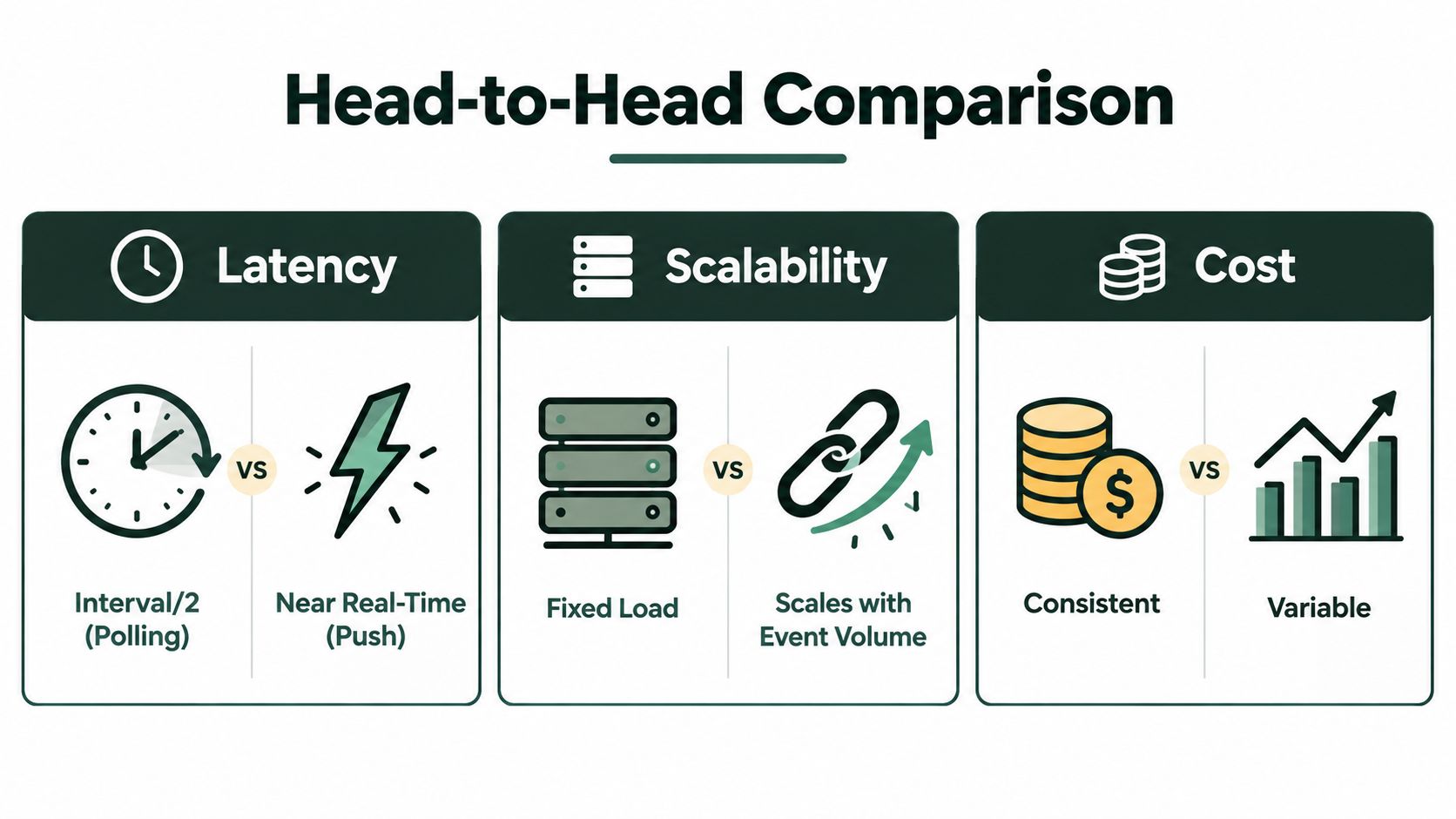
The choice becomes clearer when a funding alert must reach a workflow quickly. Polling makes your system ask for changes on a schedule. A webhook lets the provider notify your endpoint, while REST retrieves the details needed to act. For NowFunded funding alerts, that distinction determines whether you accept delayed discovery, maintain continuous push delivery, or combine both.
Polling adds delay because a client can check just before an event arrives and then wait for the next interval. The technical comparison of webhook delivery and polling describes the average delay as approximately half the polling interval. A 60-second poll therefore averages about 30 seconds of staleness, while a 5-second poll averages about 2.5 seconds.
Shorter intervals increase request volume. The same comparison notes that a 60-second schedule can produce about 14.4 million requests per day, compared with about 172.8 million at 5-second polling. Polling remains predictable, but freshness consumes quota, bandwidth, and rate-limit capacity.
Webhooks avoid repeated “anything new?” requests. Their load follows event activity instead of the checking loop. That suits sparse or irregular funding events, although bursts still require a queue and controlled downstream processing.
Criterion REST API Polling Webhook Push Latency Depends on the polling interval, with average delay near interval divided by two Event delivery can be near real time, subject to acknowledgement, retries, batching, and processing Request pattern Client repeatedly initiates requests Provider sends an HTTP POST after an event Scalability Request volume rises as polling becomes more frequent Delivery load follows event volume, with burst handling required Cost profile Uses API calls, bandwidth, quota, and rate-limit capacity Reduces polling traffic but requires endpoint and delivery infrastructure Failure control Client controls retries, scheduling, and recovery Consumer must handle retries, duplicates, outages, and acknowledgement Historical access Natural fit for searches, filters, lookbacks, and replays Usually requires a REST or other retrieval path Security surface Client authenticates outbound requests Consumer exposes a receiving endpoint and validates incoming requests Best fit On-demand queries, reconciliation, backfills, and analysis Time-sensitive notifications and event-triggered automationComplexity moves rather than disappears
Polling appears simpler because the client owns the loop. You can slow requests during an outage, pause a job, or rerun a query after correcting a bug. The operational cost rises when freshness requires frequent, distributed, quota-sensitive checks.
Webhook delivery removes that loop and introduces a delivery contract. The endpoint must acknowledge quickly, preserve the event, and pass expensive work to asynchronous processing. The consumer also needs handling for duplicate events, retries, out-of-order arrivals, and replay.
The 2023 State of Webhooks report found that 83% of the APIs studied offered a webhook service, while its 2024 update reported 85% across the top 100 APIs analyzed, as documented in the State of Webhooks report. Push delivery now commonly complements pull access. For a funding workflow, the practical design is often hybrid: use the webhook to learn that something changed, then use REST to retrieve, verify, reconcile, or backfill the authoritative record.
Reliability Security and Failure Modes You Must Plan For
A webhook's value depends on what happens after the event leaves the provider. If the receiver is slow, unavailable, or unable to process the payload, delivery speed alone does not protect the workflow.
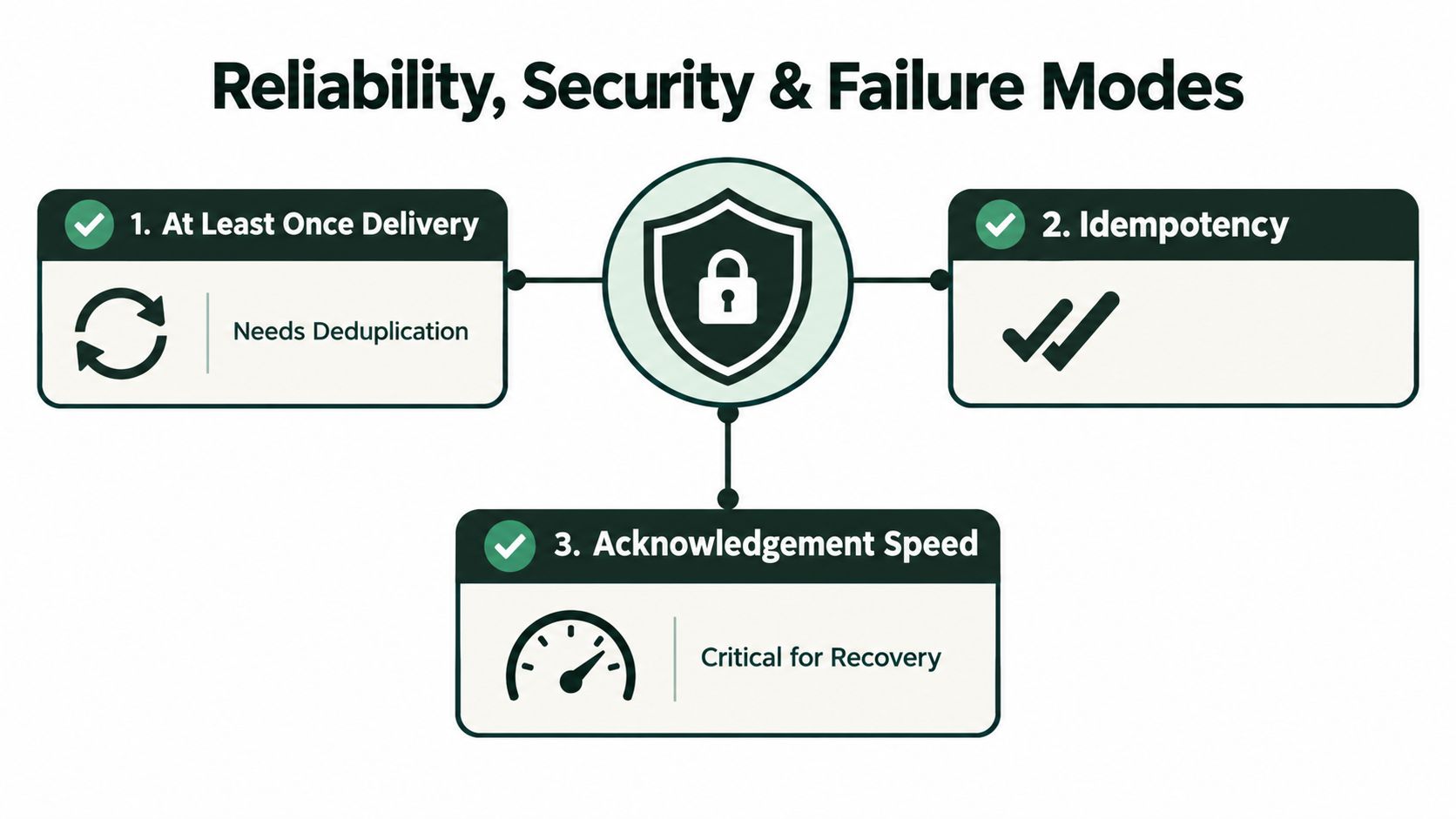
Webhook delivery is commonly at least once. Providers retry until they receive an acknowledgement, improving the chance that a business event is not lost while requiring the consumer to handle repeated deliveries. The guide to webhook guarantees and retry strategies describes idempotency as a required control for at-least-once delivery.
Build for duplicate delivery
Persist a stable event identifier before starting an irreversible action. If that identifier is already marked processing or processed, acknowledge the delivery without sending another email, creating another CRM record, or launching another enrichment request.
A dependable consumer separates four responsibilities:
- Authentication: Validate the request through the provider's supported verification method.
- Persistence: Save the raw event or a durable reference before expensive work begins.
- Acknowledgement: Return success promptly after the event is safely accepted.
- Processing: Let a worker handle enrichment, filtering, notifications, and retries.
The endpoint should not wait for an AI workflow, contact lookup, or CRM transaction before acknowledging. Long synchronous work increases timeout risk and may trigger a retry while the original event is still running.
Operational rule: Acknowledge after durable acceptance, not after the entire business workflow finishes.
Polling gives the client more control during an outage. A worker can back off, record failed requests, and retry. Recovery still requires a reliable cursor, timestamp boundary, or reconciliation query so the client can find records missed during downtime.
Latency has internal layers
“Near real time” describes a delivery model, not a guaranteed end-to-end result. A relay or internal worker may poll a queue, batch events, or wait for downstream capacity. A 200 ms relay polling interval can add a uniform 0 to 200 ms delay, raise median dispatch latency by about 100 ms, and push p99 latency close to the full interval plus batch time, according to the guide to webhook guarantees and retry strategies.
Security controls differ by direction. A polling client mainly protects outbound credentials and response handling. A webhook consumer must protect a publicly reachable endpoint, verify payload authenticity, reject malformed requests, limit abusive traffic, and keep sensitive data out of logs.
Schema versioning needs the same operational discipline. Store the received version or raw payload, validate expected fields, and treat unknown fields as nonfatal where possible. If a NowFunded funding event changes shape, a tolerant parser can preserve the event while a controlled deployment updates downstream mappings.
The Hybrid Pattern: Push Notifies, Pull Retrieves
Side-by-side comparison posts usually present REST and webhooks as an either/or decision. That model fails when an event needs more than a notification, such as retrieving authoritative details, applying rules, or recovering after delivery downtime.
For a NowFunded funding alert, the webhook can announce that a round was verified. A REST request can then fetch the complete company record, retrieve historical context, apply filters, or confirm fields before an agent acts. If the receiving endpoint was unavailable, the API supports backfill and reconciliation. Analysts reviewing broader history can still use on-demand retrieval without waiting for event delivery.
The practical distinction is simple: push notifies, pull retrieves.
A funding workflow can combine both paths:
- Receive the event. The webhook announces a newly verified round.
- Persist the reference. Store the event identifier and delivery metadata.
- Retrieve the record. Call the REST API for the authoritative, typed object.
- Apply business rules. Filter by stage, location, sector, role, or other supported fields.
- Enrich selectively. Request contact information only when the workflow needs it.
- Dispatch the action. Send the qualified record to a CRM, recruiting queue, research workspace, or agent.
- Reconcile later. Use historical retrieval to detect missed or incorrectly processed events.
The push payload can stay small and focused on notification. The retrieval call supplies typed JSON, enrichment, and deterministic filtering. Replay is easier because the system can fetch the current record again instead of reconstructing a business object from the delivery message.
Webhooks alone often lead teams to add retrieval for context and recovery. Polling alone may later need push when timing becomes important. Building both paths from the start reduces that retrofit, provided the consumer shares identifiers and processes events idempotently.
When to Use Each Approach by Real World Use Case
The right choice follows the action required after a signal arrives. A funding alert might need an immediate review, a scheduled research query, or both.
SDR outbound
Use a webhook when the objective is rapid reaction to a verified funding signal. The event can enter a queue, pass qualification rules, and create a review task before an SDR decides whether to contact the company. This removes repeated polling from the outbound system.
Keep REST retrieval available for account research. An SDR may need round details, investor context, company attributes, or a current record before writing a relevant message. Push starts the workflow, while pull supplies the context needed for a careful decision.
Recruiting triggers
Recruiting teams may monitor funding as a hiring signal, while still filtering out events that do not fit their hiring plan. A webhook can flag the round, then a REST query can apply role, geography, industry, or company-stage rules before a recruiter sees it.
A scheduled market review can use REST alone. The client requests matching companies on demand, without maintaining an always-on receiver or handling delivery retries.
Market intelligence
Dashboards, trend analysis, and historical comparisons favor REST. Analysts need filters, lookbacks, pagination, and repeatable queries to examine a market over time. A webhook can feed a new-events stream, but it should not be the only input for a dashboard that must reconstruct prior records or compare changing fields.
Indie automation with Zapier or Make
Webhooks fit lightweight triggers, such as sending a new event into a scenario that posts a notification or creates a task. REST becomes more useful when the automation must search, paginate, enrich, or retrieve records on a schedule.
A practical pattern is webhook first, API lookup second. The trigger stays responsive, while the lookup supplies the fields the automation needs. It also avoids making the delivery payload carry every possible attribute.
AI agent workflows
Agents need structured retrieval alongside timely triggers. A webhook can start an agent run, while REST or MCP provides typed JSON, constrained filtering, historical context, and a controlled grounding source. Treat the event as a prompt to investigate, not as permission to act without verification.
For a funding workflow, trigger the agent from the webhook, then ground its run in a typed REST or MCP lookup before any outreach action fires. The agent can inspect the verified record, apply business rules, and route only the qualifying result to a human or downstream system. See the NowFunded blog for related workflow examples and decide whether your process needs notification, retrieval, or both.
Implementing NowFunded MCP REST and Webhooks in Your Workflow
Start by defining the business event, not the transport. For a funding-triggered workflow, decide whether the system should poll for verified rounds, receive an HTTP POST when a round is verified, or use a webhook to trigger a REST or MCP retrieval.
A practical implementation looks like this:
- Create the receiver. Expose an endpoint that validates incoming requests and accepts the event reference.
- Acknowledge quickly. Persist the event and return success before enrichment or agent execution.
- Process asynchronously. Use a queue or worker to retrieve the full typed JSON record and apply deterministic filters.
- Deduplicate. Store event identifiers and make downstream actions idempotent.
- Reconcile. Run REST lookbacks when the endpoint was unavailable or when operators need history.
- Enrich deliberately. Request verified founder or leadership contacts only when the workflow requires them, since contact verification is handled separately from funding-event retrieval.
NowFunded provides a live, verified funding feed covering rounds from pre-seed through Series B, with access through MCP, REST API, webhooks, CSV export, and a dashboard, as described on its funding data platform. Its historical database supports lookbacks and trend analysis, while typed schemas suit filtering and agent workflows.
Human operators may prefer the dashboard or CSV export for review and one-off analysis. Automated systems should use the REST or MCP path for retrieval and webhooks for event initiation, then test duplicate delivery, delayed acknowledgements, endpoint outages, schema changes, and replay behavior before enabling production actions.
NowFunded gives sales, recruiting, research, and AI agent teams a verified funding feed with REST, MCP, webhook, CSV, and dashboard access. Use NowFunded to connect timely funding alerts with structured retrieval and build a workflow that can react quickly without giving up historical control.