Real Time Sales Data: A Guide for Modern Sales Teams
A newly funded company can become a qualified prospect before it appears in your next lead-list refresh. If a competitor sees the funding signal first, verifies the right decision-maker, and reaches out while the new budget is still being allocated, your carefully prepared sequence may arrive after the conversation has already moved on.
That's the practical meaning of real time sales data. It closes the gap between a commercial event and the action your team takes in response. The technology matters, but the business outcome matters more: faster routing, more relevant outreach, and less revenue lost to stale context.
Table of Contents
- The High Cost of Yesterday's Sales Data
- Understanding True Real-Time Data
- How Real-Time Data Reaches Your Team
- Putting Real-Time Data to Work
- A Practical Implementation Guide
- From Reaction to Prediction The Future of Sales
The High Cost of Yesterday's Sales Data
A sales development representative starts the morning with a familiar task, reviewing a lead list exported the previous day. The list contains companies that may have changed priorities overnight, but the CRM shows no new context. A prospect may have raised capital, hired a senior operator, launched a product, or changed its buying signals, yet the rep still sees yesterday's record.
That delay affects more than research quality. It changes who gets contacted first, what message they receive, and whether the outreach matches the company's current situation. Batch-updated lists can support territory planning and historical analysis, but they're poorly suited to events that create immediate buying relevance.
Practical rule: If a signal can change your next sales action, its usefulness declines while your team waits to receive it.
The problem is widespread. Recent survey data reports that 19% of company data is inaccessible, 54% of enterprises cannot access and use real-time data, and 60% report having “dark data” that's collected but never used, according to Salesforce's sales statistics. These figures describe an activation problem, not only a storage problem. Companies often have information, but their sales teams can't reach it in a usable form at the moment of decision.
Why batch lists fail in live prospecting
A daily CSV export creates a fixed snapshot. It might include the right company, but the workflow still depends on someone noticing the record, interpreting it, finding the relevant contact, and deciding what happens next. Each handoff adds friction.
A live feed changes the operating model:
- Signal detection: A verified event enters the system as it occurs.
- Qualification: Rules identify whether the company matches your market, territory, or account profile.
- Contact resolution: The workflow finds an appropriate leader or buyer.
- Action: The system routes the account, creates a task, or starts a carefully controlled sequence.
The advantage isn't that every message becomes valuable. It's that your team can evaluate the opportunity while the event still carries context. Speed without relevance is noise, but relevance delivered late is often missed opportunity.
Understanding True Real-Time Data
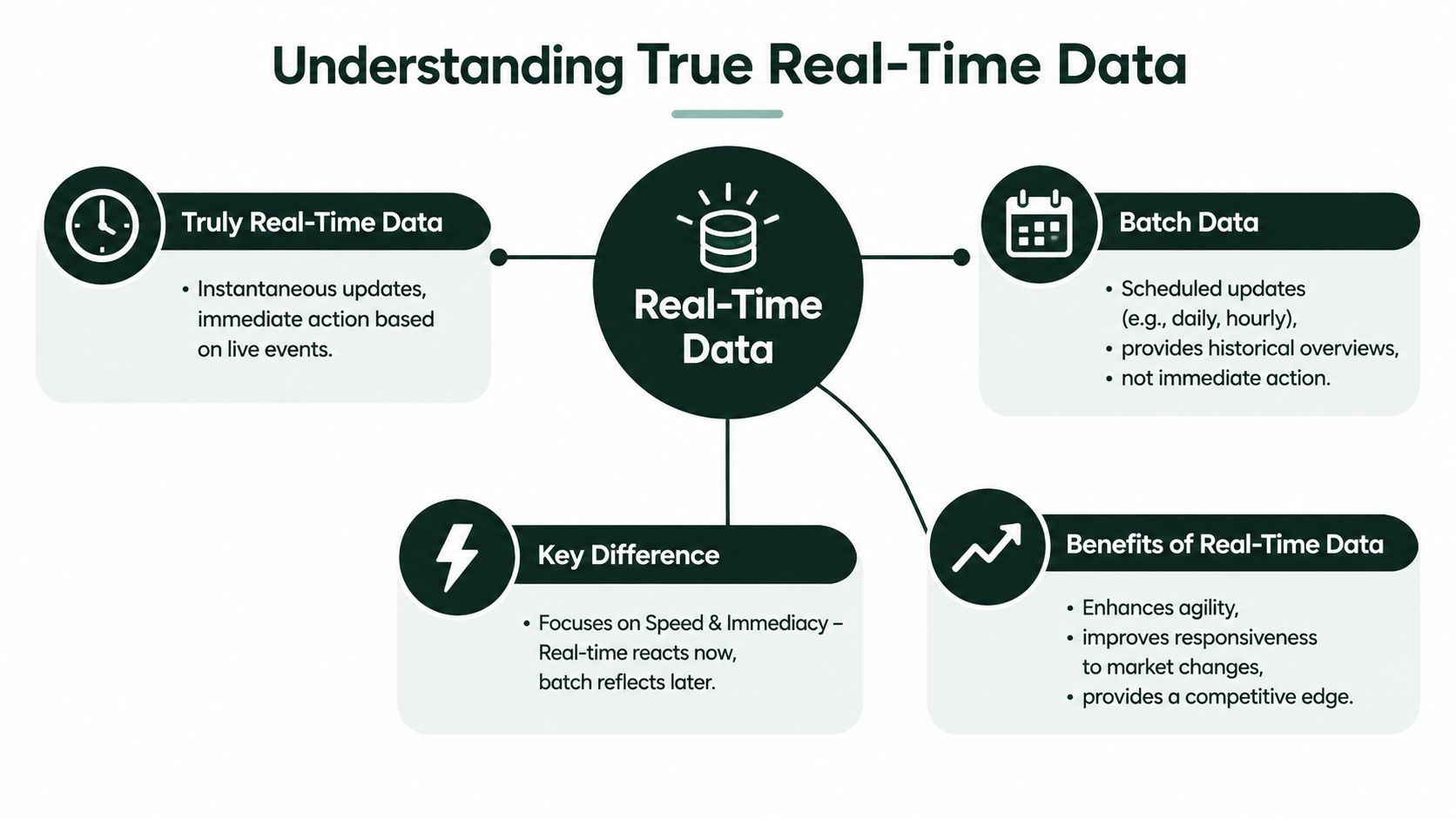
A file refreshed every hour may be newer than a file refreshed every day, but freshness alone doesn't make a system real time. The key distinction is whether your team waits for a scheduled retrieval or whether the system reacts when a meaningful event is produced.
A useful comparison is live sports coverage versus the next morning's box score. The box score is accurate and useful for review, but it can't help you respond to a play that already happened. A live broadcast gives viewers information as the game unfolds, which supports immediate interpretation and action.
The architectural difference
Traditional batch processing collects records, transforms them, and makes them available on a schedule. A low-latency batch process can reduce the waiting period, but it still depends on the next scheduled pull or refresh.
An event-driven system works differently. Sales, commerce, funding, website, and CRM events are emitted by source systems and consumed continuously. Decisioning logic can run when each event arrives instead of waiting for periodic polling, which reduces staleness and improves the responsiveness of automated workflows, as described in Aviso's overview of real-time streaming architecture for sales.
That architecture usually has several practical layers:
- Event production: A source system creates a structured event, such as a new opportunity, purchase, or verified funding round.
- Ingestion: A streaming endpoint, message broker, API, or webhook accepts the event.
- Processing: Rules validate, enrich, filter, and classify the record.
- Activation: A CRM, sales engagement platform, routing tool, or AI agent receives an actionable output.
Fresh data still needs context
A timestamp doesn't guarantee usefulness. Your system also needs consistent identifiers, defined fields, source provenance, and clear handling for updates or corrections. Without those controls, a real-time feed can distribute incomplete records faster than a batch system distributes them.
The right question isn't, “How often does this provider update?” Ask instead, “What event triggers delivery, how is the record verified, and what action can my team take immediately?”
How Real-Time Data Reaches Your Team
APIs and webhooks solve related problems, but they don't deliver information in the same way. An API is a pull mechanism. Your system sends a request and receives the records or results it asks for. A webhook is a push mechanism. The source system sends an HTTP request to your endpoint when a defined event occurs.
The mailbox analogy makes the difference clear. With an API, your system checks the mailbox when it chooses. With a webhook, the sender delivers a notification when the package is ready. Both methods can be valuable, but they support different operating patterns.
APIs give your team control
APIs work well when a rep, analyst, application, or agent needs information on demand. A sales intelligence interface might request companies that match a territory, retrieve details for a specific account, or enrich a record only after a user approves the action.
That control comes with responsibility. Your system must manage authentication, request timing, pagination, retries, rate limits, and duplicate handling. Polling too often creates unnecessary requests. Polling too slowly increases the time between an event and the action based on it.
APIs are especially useful for:
- On-demand research: Retrieve context when a rep is preparing for a call.
- Backfills: Import historical records into a CRM or warehouse.
- Interactive agents: Let an AI agent query structured information during a workflow.
- Selective enrichment: Pull contact data only after an account meets qualification rules.
Webhooks reduce the waiting loop
Webhooks suit workflows where a known event should trigger an immediate response. A provider can send a notification when a record is created, verified, or materially updated. Your application then validates the request, stores the payload, and passes it to the next step.
The trade-off is infrastructure complexity. Your endpoint needs to handle authentication, retries, duplicate events, malformed payloads, outages, and schema changes. It should acknowledge receipt quickly and process the business logic safely, rather than assuming every delivery will arrive once and in perfect order.
For live sales workflows, latency is a business variable. Practical production guidance commonly treats 200–500 ms p50 latency as a useful benchmark for APIs that support live decisioning, while 1–3 seconds can still count as live verification for single-record enrichment, according to Explorium's API latency guidance.
Delivery method Best fit Main trade-off API pull Research, backfills, selective enrichment Your system must request data and manage polling Webhook push Event alerts, routing, automated actions Your team must operate a reliable receiving endpoint Combined approach Immediate notification plus detailed lookup Requires clear rules for event and record synchronizationMost mature sales operations use both. A webhook starts the workflow, and an API retrieves the authoritative record or additional context before the CRM action is completed.
Putting Real-Time Data to Work
The value becomes visible when a signal changes a person's next action. Consider a sales development representative targeting early-stage technology companies. A funding announcement is more than a company attribute. It can indicate a new planning cycle, a changing hiring profile, or a fresh need for software and services.
The SDR's old workflow begins with a broad list and generic prioritization. The live workflow begins with a verified event, applies account-fit rules, identifies a relevant leader, and creates a task with a reason for contact. The message can reference the company's current transition without pretending to know more than the data supports.
The SDR
A webhook receives a new qualified event. The routing layer checks geography, industry, company stage, and account ownership. If the record passes those conditions, the CRM creates an opportunity task and the sales engagement platform prepares a sequence for human review.
The important control is approval. Instant delivery shouldn't mean instant, unchecked automation. The rep still needs to confirm the company, contact role, message relevance, and any suppression rules before outreach begins.
The sales manager
A manager can use live activity to spot concentration in a territory or a sudden change in account quality. Instead of waiting for a weekly review, the manager can inspect which accounts are generating signals and decide whether routing rules, ownership, or coaching priorities need adjustment.
That doesn't mean moving accounts constantly. Frequent reassignment can damage accountability. The better use is exception management, preserve the normal territory model and escalate only the events that justify intervention.
The RevOps leader
RevOps can combine event data with CRM history and engagement signals. A new event might increase an account's priority, but the model should also check whether the company already has an open opportunity, whether the account is in a restricted segment, and whether a rep recently contacted the same person.
A useful workflow separates detection, qualification, enrichment, and activation. That structure makes failures easier to diagnose and prevents every incoming event from becoming an expensive enrichment request or an unwanted sales task.
The data steward
Commercial truth matters as much as delivery speed. Shopware's discussion of trusted real-time commerce data highlights the risk of synchronized-looking information that remains inconsistent across pricing, availability, product, or inventory systems.
For sales teams, the equivalent risk is false confidence. A current record with an unclear source, stale contact details, or conflicting company identifiers can send a rep toward the wrong account. Fast data should move forward only after the workflow knows what has been verified and what remains uncertain.
A Practical Implementation Guide
Start with one sales decision, not a platform purchase. “We need real-time data” is too broad to guide architecture, provider selection, or adoption. “We need to route verified funding events to the correct SDR with enough context for a relevant first touch” gives the team a workflow it can test.
Define the event and the action
Write the workflow in plain language:
- Event: What changed?
- Eligibility: Which records matter?
- Verification: What must be confirmed?
- Destination: Which system receives the result?
- Owner: Who acts on it?
- Fallback: What happens when the record is incomplete?
This keeps the stream tied to a decision. A sales team does not need every event. It needs the subset that supports a defined action.
Evaluate the source
Review the provider's schema, update behavior, provenance, correction process, and delivery options. Confirm whether it supports APIs, webhooks, or both. Check how it handles new records, updates, deletions, duplicates, confidence, and verification status.
The U.S. Census Bureau's monthly retail trade time-series archive shows why cadence and historical continuity matter in market monitoring. The archive includes prior advance monthly reports beginning in October 1953, while related monthly retail sales and seasonal-factor time series run from 1992 to the present. A live feed becomes more useful when the team can interpret current events against a reliable historical record.
Choose the integration pattern
Use a webhook when an event should start a workflow. Use an API when a user or application needs information on demand. Many implementations combine both: the webhook carries an event identifier, and the API supplies the detailed, current record.
Keep the CRM schema small. Store the event timestamp, source, event type, account identifier, verification state, and useful context. Send long-form research to a linked workspace or enrichment layer rather than filling the contact record with fields nobody maintains.
Build safeguards before automation
A dependable workflow needs:
- Idempotency: The same event should not create duplicate accounts or tasks.
- Validation: Reject payloads without required identifiers or verification fields.
- Routing rules: Apply territory, segment, ownership, and suppression logic before assignment.
- Retry handling: Record failed deliveries and retry safely.
- Observability: Track delivery status, processing errors, latency, and downstream completion.
- Human review: Require approval for sensitive outreach or uncertain matches.
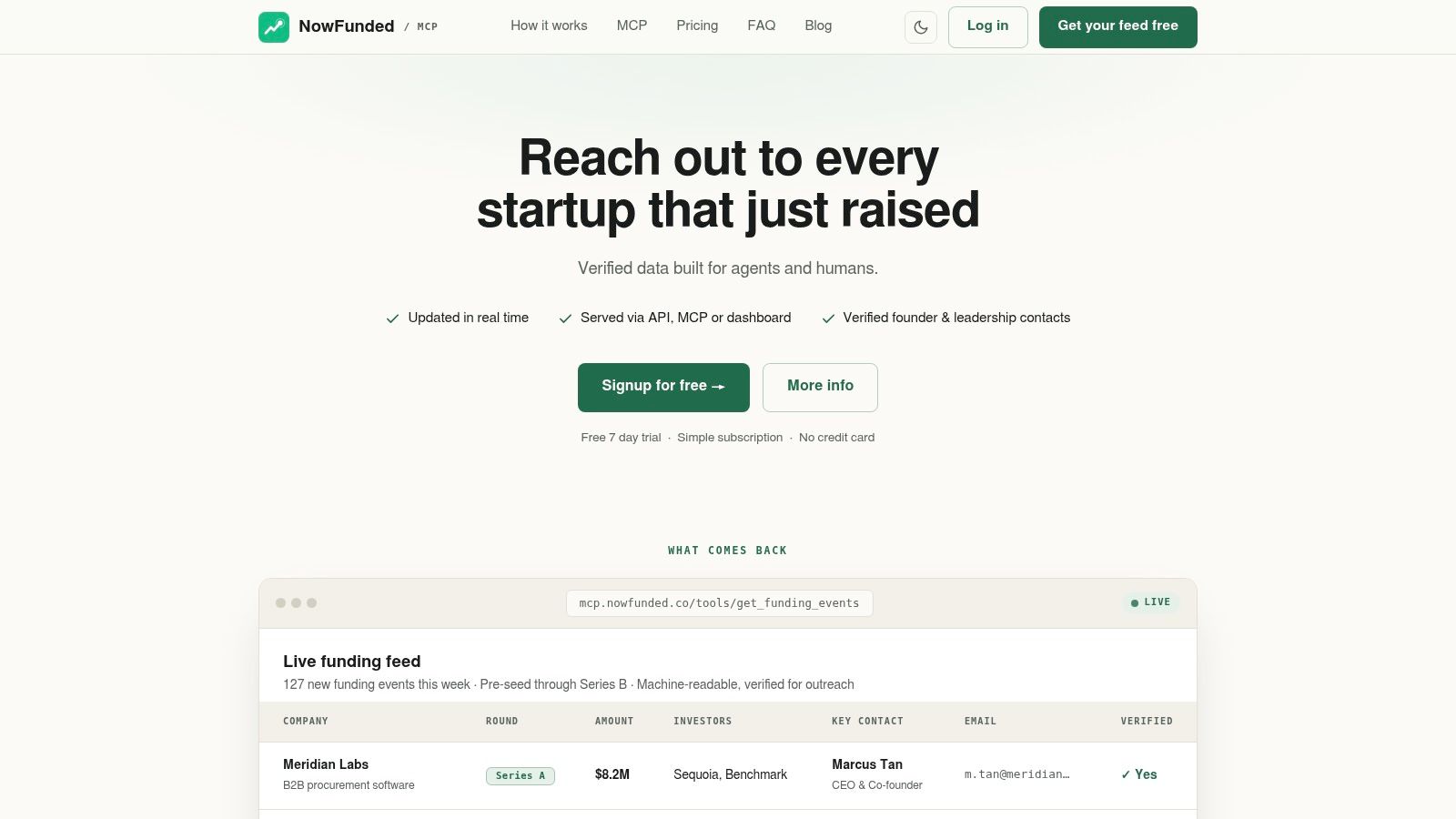
NowFunded is one example of a specialized source for this pattern. It provides a live, verified feed of newly funded startups, structured company and funding fields, verified founder and leadership contacts, and delivery through MCP, REST API, webhooks, CSV export, and a web dashboard. Teams can poll for records or receive HTTP POST notifications when a new funding round is verified through NowFunded.
Pilot with a narrow workflow
Choose one segment, one event type, one destination, and one owner. Test the complete path from source event to rep action, including duplicates, corrections, rejected records, and missing contacts. Then interview the users receiving the alerts. If the workflow creates noise, fix qualification and routing before increasing volume.
From Reaction to Prediction The Future of Sales
Real-time sales data changes the basic unit of work from a static list to a business event. Teams can ask which accounts changed, whether the change meets their qualification rules, and which action should follow.
That shift makes prospecting more proactive. A live signal can trigger routing, enrichment, or outreach while the event still matters. Over time, an event history can show which changes tend to precede opportunities, which contacts matter for a given account type, and when a rep should pause instead of sending another message.
AI agents raise the operating requirements. An agent working from stale, conflicting, or unverified records may produce fast actions with weak foundations. Connect it to structured events, defined schemas, verified contacts, and explicit workflow rules, and it has better inputs for research, prioritization, and next-action recommendations.
The commercial value comes from connecting verified events to accountable actions. A funding event might create an account, enrich the buying group, assign an owner, and start a review task. A pricing or hiring change might follow a different route. Those distinctions belong in the workflow, not in a generic alert stream.
Prediction develops from the same operating discipline. Once teams capture event timing, qualification outcomes, rep actions, and opportunity results, analysts can test which signals deserve attention and which create noise. The goal is a smaller set of trusted triggers that improve speed and relevance without flooding reps.
NowFunded provides sales and research teams with a live, verified feed of newly funded startups, structured funding records, verified leadership contacts, and delivery through MCP, REST API, webhooks, CSV export, or a dashboard. Visit NowFunded to connect fresh funding signals with prospecting, enrichment, and AI-agent workflows.