Outbound Sales Prospecting with Live Data

“Send more emails” is still the default answer to weak outbound performance. It's also usually the wrong diagnosis. When buyers receive more automated outreach, inbox filtering tightens, attention becomes scarcer, and a static list loses value as soon as someone exports it. Effective outbound sales prospecting now depends less on activity volume and more on whether a team can identify a credible buying signal, verify the right contact, and act while the signal is still relevant.
The operating model has changed from broad list building to precision prospecting. A funding event, leadership change, hiring push, product launch, or relevant market announcement can give a sales team a reason to reach out. But the signal only matters when it arrives quickly, carries enough context for a useful message, and connects to a deliverable person rather than a generic inbox.
Table of Contents
- Why Volume-Based Prospecting Is Failing
- Capturing Real-Time Funding Signals
- Enriching Targets With Verified Contacts
- Building Signal-Led Outreach Sequences
- Deploying AI Agents for First-Touch Research
- Measuring Funnel Health Beyond Reply Rates
Why Volume-Based Prospecting Is Failing
The old model assumes that more sends create more opportunities. That only works when list quality, deliverability, targeting, and timing remain constant. They don't. A larger send volume can multiply irrelevant touches just as easily as it multiplies useful conversations.
The latest outbound benchmarks show why precision matters. One 2026 dataset recorded 196,470 prospects contacted across 443,209 outbound calls, 146,832 delivered emails, and 142,800 LinkedIn tasks, producing 39,679 cumulative booked meetings. The average meeting conversion rate was 16.06%, and the average meeting held rate was 85.94%, with 3.36 touches per prospect across the motion. These figures describe a coordinated system, not a single-channel blast, as documented in the 2026 outbound benchmark.
Cold email performance also depends heavily on methodology. A 2026 benchmark reports an average reply rate of 3.43%, with elite campaigns reaching 10.7% or more, while another dataset recorded 5.8% across 16.5 million emails, down from 6.8% in 2023. The difference between those figures isn't a contradiction. It shows that list composition, campaign design, and measurement definitions change the result, as detailed in these cold email prospecting benchmarks.
Static lists decay before the first touch
A downloaded list freezes a company at a particular moment. People change roles, founders shift responsibilities, companies alter their priorities, and old addresses become undeliverable. Even when the company record remains accurate, a role-based contact may not be the person responsible for the problem you're trying to solve.
Generic intent data creates a similar problem. It can indicate that an account belongs to a broad category of interested companies, but it often lacks the timing and context needed for a relevant message. “This company may be researching software” is weaker than “this company just announced an event that creates a specific operational need.”
Practical rule: A signal should change who you contact, why you contact them, and what you ask for. If it changes none of those things, it isn't doing useful prospecting work.
Teams should therefore treat raw volume as an input, not a success metric. The better question is whether every additional touch is supported by a fresh reason to engage. Signal-based targeting can produce a reported 5% to 25% reply range, compared with about 3% for untargeted outreach, according to recent sales trend coverage on signal-based prospecting. That isn't a promise of performance. It is a useful explanation for why narrow, timely account sets deserve more attention than massive, undifferentiated lists.
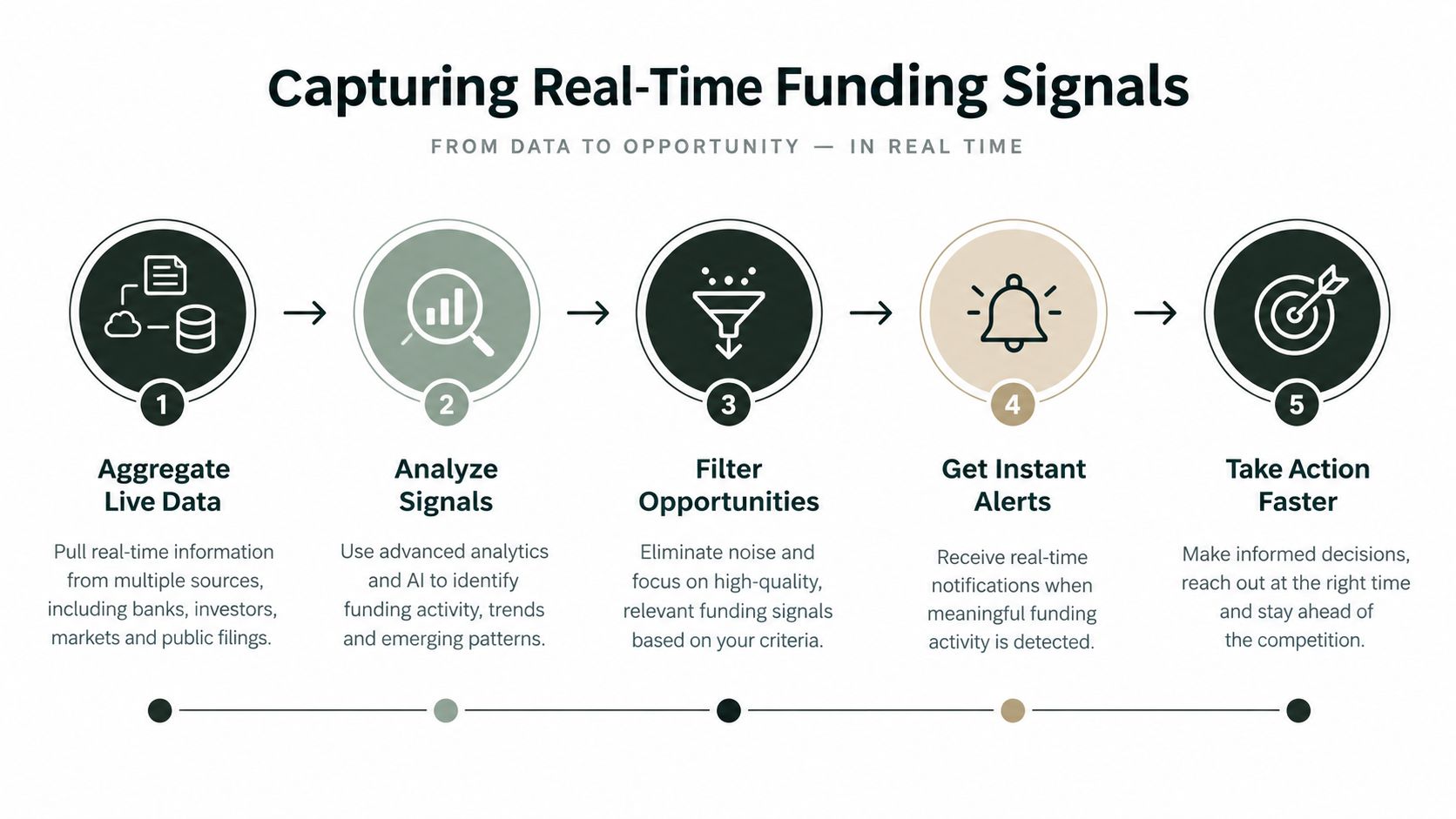
Capturing Real-Time Funding Signals
A newly funded startup often enters a period of change. Leadership may be planning hiring, expanding a product, entering a market, or replacing manual systems that no longer fit the business. A sales team can use that event as an opening, but only if the funding record arrives with enough detail and enough speed to support a responsible action.
The architecture doesn't need to be complicated. It needs to be dependable.
Start with a defined event schema
Before connecting a feed, decide what your workflow needs to receive. A useful funding-event record can include:
- Company identity: Name, website, LinkedIn profile, headquarters location, industry, and headcount.
- Round context: Funding stage, amount raised, lead investors, announcement date, and verification status.
- Routing fields: ICP segment, territory, account owner, priority, and the workflow that should receive the event.
- Audit fields: Source timestamp, last verification time, and the fields that changed since the previous record.
Typed JSON matters because agents and downstream systems need predictable fields. A free-text announcement forces every consumer to interpret the same information independently. A structured object lets a CRM, enrichment service, scoring model, and sequence tool use one consistent record.
Prefer push delivery over repeated checking
A polling loop asks your infrastructure to check repeatedly whether anything has changed. A webhook reverses that relationship. When a new funding event is verified, the data provider sends an HTTP POST to your endpoint, where your workflow can validate the payload, deduplicate the company, and route the record.
The receiving workflow should perform four checks before it creates a prospect:
- Validate the event. Confirm that the funding stage and verification state match the criteria for your campaign.
- Deduplicate the account. Match on the company domain rather than relying only on the company name.
- Apply business rules. Exclude existing customers, active opportunities, restricted industries, or accounts outside the territory.
- Create an action. Assign an owner, request contact enrichment, or send the record to an AI research agent.
The same feed can support both REST queries and webhook delivery. A REST API suits lookbacks, scheduled analysis, and manual account research. A webhook suits first-mover workflows where the team wants a new verified event to trigger enrichment and review without waiting for a batch refresh.
For teams tracking newly financed companies, live startup funding data can serve as one input to this architecture. The important design principle isn't the vendor. It's the handoff between an authenticated event, a machine-readable record, and a controlled next action.
Keep timing separate from message generation
A funding event should trigger research, not an automatic send by default. First confirm whether the company fits your ICP, identify the relevant business implication, and check whether the contact is appropriate. This small pause prevents a technically fast workflow from producing a contextually poor message.
Enriching Targets With Verified Contacts
A funding signal identifies an account. It doesn't identify the person who can evaluate a solution, approve a project, or redirect a budget. Contact enrichment is where many outbound programs lose the advantage they gained from timely account data.
The practical failure is familiar. A rep sees a newly funded company, finds an old founder address, sends a message, and receives a bounce or reaches a shared inbox. The team then labels the account unresponsive, even though the actual problem was contact quality.
Separate account qualification from contact verification
These are different decisions. Account qualification asks whether the company belongs in the campaign. Contact verification asks whether a specific person has a deliverable work email or phone number and whether that person holds a relevant role.
A well-structured workflow enriches only after the account passes basic filters. That prevents contact credits, verification effort, and rep attention from being spent on companies that don't fit the offer.
A useful order looks like this:
- Filter the account: Check stage, industry, location, company profile, and funding context.
- Select the role: Choose the founder, revenue leader, operations owner, hiring leader, or another person connected to the trigger.
- Request the contact: Pull the name, role, work email, phone number, and verification status.
- Record the evidence: Store when the contact was checked and whether verification succeeded.
- Route exceptions: Send uncertain matches to a human instead of forcing them into automation.
Usage-based enrichment changes the economic decision
Traditional data subscriptions encourage teams to buy access to broad databases, whether or not every record is useful. That model can make a large contact list feel inexpensive while hiding waste in stale records, unused seats, duplicate exports, and failed verification attempts.
Usage-based enrichment creates a different discipline. The team starts with a qualified funding event, requests the relevant contact, and pays for the result only when verification succeeds. The commercial model doesn't eliminate the need for data governance, but it aligns data spend more closely with an actual prospecting action.
This approach also supports leaner experimentation. A team can test a narrow funding segment, inspect deliverability and meeting quality, then expand the workflow if the account and contact criteria hold up. It doesn't have to provision an entire database before learning whether the signal is useful.
Build the handoff around explicit fields
MCP endpoints, REST APIs, and CSV exports can all work, but each creates different operational responsibilities. An API or MCP connection is useful when an agent needs to request contacts inside a controlled workflow. CSV can suit a human-reviewed batch, provided the export preserves verification status and doesn't become a new static list.
The CRM record should distinguish verified contact, unverified contact, generic inbox, and suppressed contact. That status gives sales operations a way to investigate bounce patterns and stop a sequence automatically when contact quality falls below its standard.
Building Signal-Led Outreach Sequences
A funding announcement isn't personalization by itself. Repeating the round details in an email can still sound automated if the message doesn't connect the event to a credible business priority. The signal should shape the hypothesis behind the outreach.
For example, a founder who has just raised may be considering growth plans, hiring, infrastructure, customer acquisition, or operational controls. Don't assume which one applies. Use the available event context to form a relevant hypothesis, then make it easy for the prospect to correct you.
Use the event as context, not as the pitch
A strong first email can follow this structure:
- Specific context: Mention the verified funding event and the relevant public detail.
- Business hypothesis: Explain the operational change that often follows this kind of event, without presenting it as a certainty.
- Relevant capability: Show how your solution addresses that narrow problem.
- Low-friction question: Ask whether the priority sits with the recipient, rather than demanding a meeting immediately.
An example might read:
Subject: Planning for the next growth phase
Hi [Name], I saw the announcement about [Company]’s new [round]. Teams at this stage often revisit [specific workflow] as they plan [relevant growth priority]. We help [role] handle [specific outcome]. Is that on your roadmap, or does another operational priority come first?
The message works because it gives the recipient room to disagree. It doesn't pretend that a funding event proves intent, and it doesn't force a generic product pitch onto a company just because it appeared in a feed.
Coordinate channels without repeating yourself
A multi-touch sequence should add context at each step. It shouldn't copy the same sentence into email, LinkedIn, and voicemail.
A practical 14-day cadence can look like this:
- Day 1, email: Reference the funding event and test one business hypothesis.
- Day 3, LinkedIn task: Review the company and role, then send a short connection note without pasting the full pitch.
- Day 5, call: Use the event as the reason for the call and ask whether the stated priority belongs to the prospect.
- Day 8, follow-up email: Add one useful observation, such as a workflow implication or a question about the company's next phase.
- Day 11, second call or social touch: Confirm relevance, leave a concise voicemail if appropriate, and avoid creating pressure.
- Day 14, close-the-loop email: State that you'll stop the sequence and invite the prospect to respond if the issue becomes timely.
This cadence reflects the benchmark expectation that prospecting is coordinated across channels and uses multiple touches, rather than treating a single cold email as the entire motion. For additional examples of funding-led workflows and startup research, teams can review the NowFunded blog.
Know when to stop
A sequence becomes noise when the salesperson has no new information, the contact has opted out, or the account has entered a different sales state. Suppression rules matter as much as follow-up rules. Stop outreach after a clear opt-out, an active opportunity, a customer conversion, or evidence that the contact is irrelevant.
Deploying AI Agents for First-Touch Research
AI agents are useful when they operate inside clear boundaries. They can inspect a structured funding record, gather approved context, identify missing fields, and draft a first-touch message. They shouldn't invent a company priority, infer a personal detail from weak evidence, or send outreach without a review policy.
The quality of the output depends on the quality of the inputs. An agent that receives a round stage, lead investor, company URL, industry, and verified role can produce a grounded draft. An agent that receives only a company name will fill gaps with plausible language, which is exactly how automated outreach becomes inaccurate while sounding confident.
Give the agent a narrow job
A practical agent workflow has four layers:
- Trigger intake: Accept only events that match the defined funding stages, territories, and ICP filters.
- Context retrieval: Read approved company pages, stored event fields, and permitted public material. Record the fields used.
- Draft generation: Produce a short message with one event reference, one qualified hypothesis, and one clear question.
- Human approval: Require a rep to approve the contact, factual context, and call to action before sending.
The agent should return structured output, not only prose. Useful fields include account_fit, contact_role, signal_summary, evidence_fields, message_draft, confidence, and review_required. Typed output makes it possible to stop a message when a critical field is missing.
Protect authenticity and deliverability
Automation can't compensate for poor contact data or weak sending practices. Teams need a suppression list, a clear opt-out process, approved claims, and a review path for ambiguous records. They also need to monitor whether a sequence is generating positive conversations or just increasing activity.
One recent outbound trend benchmark reports that 45% of outbound teams use AI agents for initial research, first-touch personalization, and follow-up cadence, while another source claims AI can handle 70% to 80% of the prospecting workflow. Those figures come from different methods and should be treated as directional rather than interchangeable. The broader lesson is that teams are assigning more research and drafting work to agents, while compliance and human oversight remain necessary, as discussed in the outbound sales trends benchmark.
Automation should make a rep more informed before the first touch. It shouldn't make an unverified assumption travel faster.
Measuring Funnel Health Beyond Reply Rates
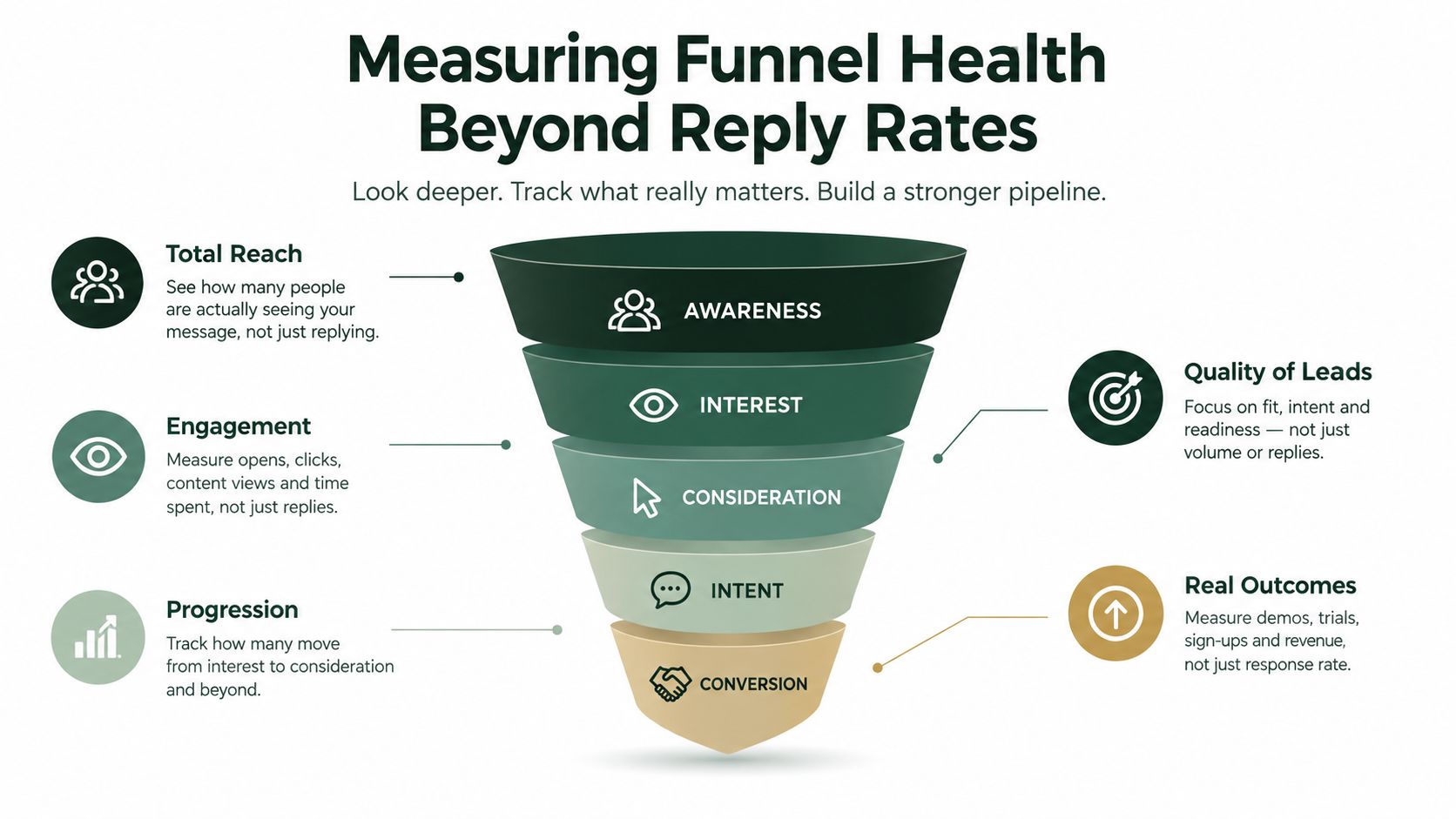
Reply rate is useful, but it can't tell you where the outbound motion is failing. A low reply rate may come from poor targeting, weak copy, bad deliverability, or an offer that doesn't match the account's current priority. A high reply rate may still produce poor pipeline if the responses aren't positive or the meetings aren't held.
Start with separate stages and stable definitions. Track the funnel from contact validity to delivery, reply, positive reply, live conversation, meeting booked, and meeting held. Keep cold outreach separate from warm leads, active opportunities, and existing customer conversations.
Use definitions that expose the leak
A useful dashboard should answer a different question at each stage:
Metric Definition What it diagnoses Deliverability Delivered messages divided by messages sent Contact quality, suppression, and sending health Reply rate Replies divided by emails sent Initial relevance and engagement Positive reply rate Positive replies divided by delivered messages Commercial relevance, not just curiosity Connect rate Live conversations divided by dials Phone data, timing, and call execution Meeting-booked rate Meetings booked divided by positive replies Qualification and call to action Meeting-held rate Meetings held divided by meetings booked Calendar quality and confirmation processOne benchmark framework cites example performance levels of 6% reply rate, 10% connect rate, and 40% meeting-booked rate, while other benchmark sources report substantially different cold-email results. The outbound prospecting KPI framework is useful because it defines the funnel terms rather than treating every response as equivalent.
Strict cold outreach can look even weaker when blended metrics are removed. One 2025 benchmark reports a 0.45% average reply rate across strict cold campaigns, with 0.50% in the first half of the dataset and 0.40% in the second half. It also reports 0.49% for firms with 11 to 50 employees, compared with 0.22% for enterprises with 10,000 or more employees, as described in the strict cold email response-rate analysis.
Diagnose the stage before changing the copy
High bounce rates point toward verification and list hygiene, not subject-line experimentation. Strong delivery with weak positive replies suggests a targeting or offer problem. Positive replies that rarely become booked meetings usually indicate friction in qualification, scheduling, or the call to action.
A booked meeting isn't the finish line. The 85.94% average meeting held rate in the 2026 outbound benchmark shows why held meetings deserve their own measure, rather than being merged with bookings. Teams should connect these stages back to the original signal, contact role, message hypothesis, and sequence version so they can refine the targeting criteria instead of relying on rep anecdotes.
Outbound sales prospecting becomes sustainable when every event produces a measurable learning loop. Capture the signal, verify the person, review the message, measure each conversion point, and suppress what fails. That process gives teams a way to increase precision without returning to the volume habits that created the problem.
NowFunded provides a live, verified feed of newly funded startups with structured funding records, verified founder and leadership contacts, and delivery through MCP, REST API, webhooks, CSV export, or a web dashboard. Use NowFunded to connect fresh funding signals to a controlled, signal-led outbound workflow and start building a more timely target list.