Outbound Sales Process: A 2026 Guide That Works
Most outbound teams don't have a cadence problem. They have a timing and data problem. They rewrite subject lines, add another follow-up, switch from email to LinkedIn, and then blame the sequence when the results stay flat. That work is often cosmetic. A polished message sent to a former employee, an unverified address, or an account long past its buying trigger still produces weak pipeline.
The average cold email reply rate reported across more than 20 million cold emails was 3.43%, which means roughly 96.57% of sends received no reply (Lemlist's 2026 cold email benchmark). That isn't an argument for sending more. It's an argument for deciding who deserves attention today, verifying the contact, and reaching out while the business event is still commercially relevant.
A durable outbound sales process treats funding announcements, executive hires, product launches, and other external events as routing signals. The sequence still matters, but the sequence is only as good as the account and moment it points at.
Table of Contents
- Why Most Outbound Sequences Underperform
- The Six Stages of an Outbound Sales Process
- SDR to AE Handoff Mechanics That Protect Pipeline
- Static Lists Versus Signal-Led Outreach
- Operationalizing Newly Funded Startup Signals
- Outbound KPIs That Actually Predict Revenue
- A 30-60-90 Day Plan for a Signal-Led Outbound Motion
Why Most Outbound Sequences Underperform
The popular advice says that underperforming outbound needs better copy and more touches. That advice is incomplete. Copy matters after the system has identified a reachable buyer with a current reason to engage.
Three failures appear repeatedly.
Stale account data quietly destroys relevance
Static lists decay as soon as they're exported. People change jobs, ownership moves between departments, companies alter their strategy, and old contact details become undeliverable. A persona filter such as “VP of Sales at a growing software company” describes a category, not a live sales opportunity.
Contact freshness should be treated as an operating requirement. Before an SDR writes a personalized opener, the team should verify the person's role, the company's current situation, and whether the proposed problem still exists. If the contact isn't verifiable, personalization is wasted effort.
Generic filters create crowded queues
A list can match every firmographic condition and still deserve no immediate attention. Static filters usually produce too many accounts with equal priority, so reps work the easiest names or follow an arbitrary order. Neither approach reflects buying conditions.
A signal-led queue ranks accounts by fit, event recency, contact confidence, and buyer availability. A recently funded company with a relevant leader in seat should outrank a similar company that hasn't changed for months. That distinction gives reps a reason to contact one account now and defer another.
Late triggers turn urgency into history
A funding round is useful because it can change priorities, budget, hiring plans, and executive attention. It loses value when the sales team learns about it long after the announcement and sends an automated message that sounds disconnected from the event.
A practical system catches the event, verifies it, enriches the account, and routes it to an owner without waiting for a quarterly list refresh. The same principle applies to a new executive hire, a product launch, an expansion announcement, or a relevant technology change.
Practical rule: Don't ask whether your sequence is clever enough until you've confirmed that the account is active, the contact is current, and the trigger is fresh.
The strongest outbound teams still use structured follow-up. Prospecting research indicates that booking a first meeting can take an average of 8 touches, while top performers can do it in about 5 (Klenty's outbound sales process research). But those touches should be applied to prioritized accounts, not sprayed across a stale database.
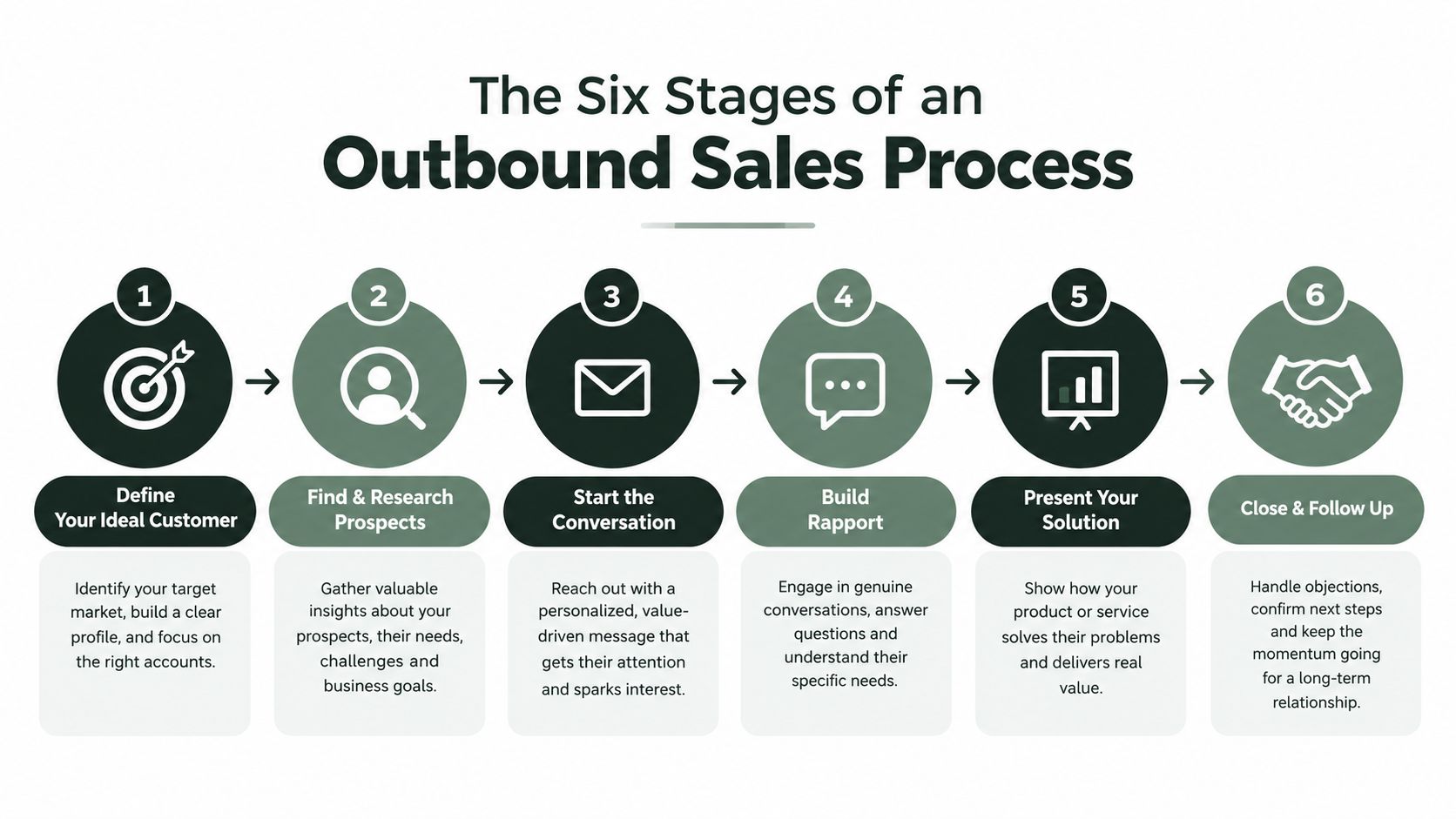
The Six Stages of an Outbound Sales Process
A working outbound sales process has six stages. Each stage needs a clear owner, a defined input, and an output that the next stage can trust. If one stage produces vague or unreliable data, downstream activity becomes expensive noise.
1. Define the ICP
The ideal customer profile should combine firmographic fit with buying context. Document the industries, business models, company characteristics, technologies, and operating conditions where your offer solves a costly problem.
The output is a ranked account universe, not a vague persona document. Marketing, sales operations, and sales leadership should agree on inclusion and exclusion rules before anyone builds a list.
2. Build and verify the account list
List building is a data operation, not an exercise in collecting names. Source the account, map relevant roles, verify contact details, and record the date of the latest validation.
The output should identify the people who can own the problem, influence the decision, or introduce the buyer. A list with fewer verified contacts is more useful than a large export filled with generic inboxes and outdated titles.
3. Detect and rank signals
Signal detection determines why now. Capture events such as a funding announcement, a leadership change, a product launch, or a meaningful hiring push. Then rank each account using the signal's recency, the account's ICP fit, and the confidence of the contact data.
This stage owns prioritization. It shouldn't just pass every event to an SDR. It should decide which accounts deserve a highly researched opener, which can receive a lighter workflow, and which should remain out of sequence.
4. Execute coordinated outreach
Email, phone, and LinkedIn should operate as one motion. The first message should establish relevance, while later touches add a useful observation, a direct question, or a different channel.
Cadence is a control system, not a substitute for judgment. Reps should pause or reroute contacts when a reply, job change, unsubscribe, or new account event changes the context.
5. Qualify the conversation
A booked meeting isn't automatically a qualified meeting. The SDR needs to establish that the prospect has a relevant problem, a plausible reason to act, access to the buying process, and a next step worth an AE's time.
The output is a meeting with documented evidence. Qualification should be visible in the CRM before the meeting begins, not reconstructed afterward from memory.
6. Create pipeline and complete the handoff
The AE receives the trigger, account context, contact role, pain expressed, qualification evidence, stakeholders involved, and agreed next step. The opportunity record should make it easy to understand what happened and what needs to happen next.
This stage owns pipeline hygiene. If the AE can't see the commercial narrative, the SDR has transferred an appointment rather than an opportunity.
SDR to AE Handoff Mechanics That Protect Pipeline
The SDR to AE handoff fails when “qualified” means something different to every rep. One SDR books a meeting because a prospect accepted a calendar invitation. Another waits for a confirmed business problem. The AE discovers the difference only after the meeting starts.
A protected handoff uses three mechanics.
Write the qualification contract first
Choose a qualification framework that fits the motion. BANT can work for a straightforward transactional offer. MEDDIC may fit a complex enterprise sale. Neither framework helps if the team treats the acronym as a form rather than a decision standard.
Define the minimum evidence required before booking. That can include:
- Business problem: What operational or commercial issue did the prospect describe?
- Business context: Why is the issue relevant now?
- Buyer role: What does this person own, influence, or know?
- Decision path: Who else needs to participate?
- Next step: What outcome does the prospect expect from the meeting?
The SDR should capture evidence in the prospect's words where possible. The AE needs context, not a row of completed fields.
Turn CRM notes into a deal brief
A useful brief reads like a short deal narrative. It should include the trigger event, the reason for outreach, the prospect's response, the problem discussed, likely stakeholders, objections, and the agreed meeting objective.
Avoid copying the same generic template into every record. A deal brief that says “interested in learning more” gives the AE no preparation advantage. A brief that says the company recently changed direction, the contact owns the relevant function, and the prospect wants to compare approaches gives the AE a starting point.
Grade meetings and coach quickly
The AE should record whether the meeting met the agreed standard, what evidence was missing, and whether the account should remain in active pursuit. Fast feedback prevents SDRs from repeating the same weak qualification pattern across a whole territory.
Use a small rubric with clear outcomes such as qualified, misaligned, premature, duplicate, or no-show. Review the patterns in one-on-ones and team coaching. The feedback loop should improve targeting, questions, and routing, not merely score individual reps.
Mechanic Without Structured Handoff With Structured Handoff Qualification Meeting acceptance becomes the definition of quality The SDR documents problem, timing, role, and next step CRM record Notes list activity without commercial context The deal brief explains the trigger and buying situation AE preparation The AE starts discovery from scratch The AE enters with a clear hypothesis and objective Feedback Quality issues surface late or not at all The AE grades the meeting and feeds coaching Pipeline hygiene Weak meetings remain open as false progress Records are routed, disqualified, or advanced consistentlyThe handoff is not an administrative moment. It's the point where outbound activity either becomes qualified pipeline or gets exposed as activity without buyer evidence.
Static Lists Versus Signal-Led Outreach
Static list outreach starts with a fit filter and asks the rep to create urgency. Signal-led outreach starts with a verified event and asks the rep to explain why the event makes the conversation relevant.
Newly funded startups show the difference clearly. A static workflow might pull every company that matches an industry and size range, then send the same campaign over an extended period. A signal-led workflow waits for a verified funding event, checks whether the company fits the ICP, identifies the relevant decision maker, and routes the account while the funding news still reflects an active business priority.
The benchmark gap supports this distinction. Generic cold outreach averages 3.43% reply rate, while the cited 2026 analysis reports 5% to 25% reply rates for signal-based targeting, compared with roughly 3% for untargeted outreach (CallLogic's analysis of outbound changes). These figures are directional benchmarks, not a promise. They show why prioritization deserves more attention than another copy revision.
Dimension Static List Outreach Signal-Led Outreach Starting point ICP filter and stored contact record Verified external event plus ICP fit Timing Scheduled according to list ownership Routed according to event recency Research burden Reps research every account manually The trigger provides an initial context Contact strategy Persona match may be the main criterion Role fit and current availability both matter Best use Broad category coverage and sustained awareness Time-sensitive offers tied to an active change Main risk Stale data and repetitive messaging Weak verification or overreaction to noisy eventsStatic lists still have a role. They provide account coverage and help teams build awareness in markets where useful triggers are rare. But teams targeting newly funded companies should use the trigger as the entry point, not as an afterthought. NowFunded's funding research resources can support that kind of event-led account discovery.
Operationalizing Newly Funded Startup Signals
A funding feed becomes useful only when it changes what a rep does. An alert sitting in a dashboard isn't an outbound system. The workflow needs filters, verification gates, routing rules, and CRM logging.
Define which funding events qualify
Start by specifying the events your team can act on. Useful filters include:
- Round type: Decide which funding stages match your offer and sales motion.
- Geography: Route only companies in supported markets or service regions.
- Industry: Exclude sectors where the problem or compliance model doesn't fit.
- Company profile: Apply your preferred business model, team structure, and maturity criteria.
- Buyer role: Determine whether the founder, a functional leader, or an operations owner is the first contact.
Not every funded company deserves a custom message. High-fit, recent events should receive deeper research. Lower-fit matches can be held for later review or excluded automatically.
Rank the queue before assigning work
Prioritization should combine event recency, round context, ICP fit, and buyer confidence. A fresh event with no verified decision maker isn't ready for a high-confidence touch. A slightly older event with a current, relevant leader and strong fit may be more actionable.
Set explicit routing rules. For example, one queue can send high-fit accounts to an SDR for same-day research, another can place medium-fit accounts into a lighter sequence, and a third can require manual review before any contact.
Verify before personalizing
The verification gate protects both relevance and sender reputation. Confirm that the round is real, the company record is not duplicated, the relevant leader still holds the role, and the contact method is deliverable. Cross-check the funding source and record the verification status in the CRM.
Don't build a personalized opening around an unconfirmed announcement. A wrong funding reference signals carelessness before the sales conversation has started.
Route the message into a short, event-specific motion
The first touch should connect the event to a business implication. A funding announcement may indicate new hiring pressure, expansion plans, operational complexity, or a need to establish systems. The rep should make one defensible hypothesis and ask a simple question.
Use a short sequence with clear variation between touches. The opener can reference the funding event. A follow-up can address the operational consequence. A later phone or LinkedIn touch can test whether the issue belongs with another stakeholder. Stop when the context changes, the contact opts out, or the account no longer fits.
Connect the feed to the operating stack
The minimum architecture includes a funding-event source, enrichment, deduplication, contact verification, sequencing, and CRM activity logging. A webhook can push a verified event into a routing workflow. An API or MCP connection can let an internal agent retrieve structured records on demand. CSV export can support controlled operations when automation isn't available.
NowFunded provides a live, verified feed of newly funded startups, structured founder and leadership contacts, and delivery through MCP, REST API, webhooks, CSV export, or a web dashboard. Teams can use that type of source as the event layer, then keep qualification and message judgment with the SDR.
Outbound KPIs That Actually Predict Revenue
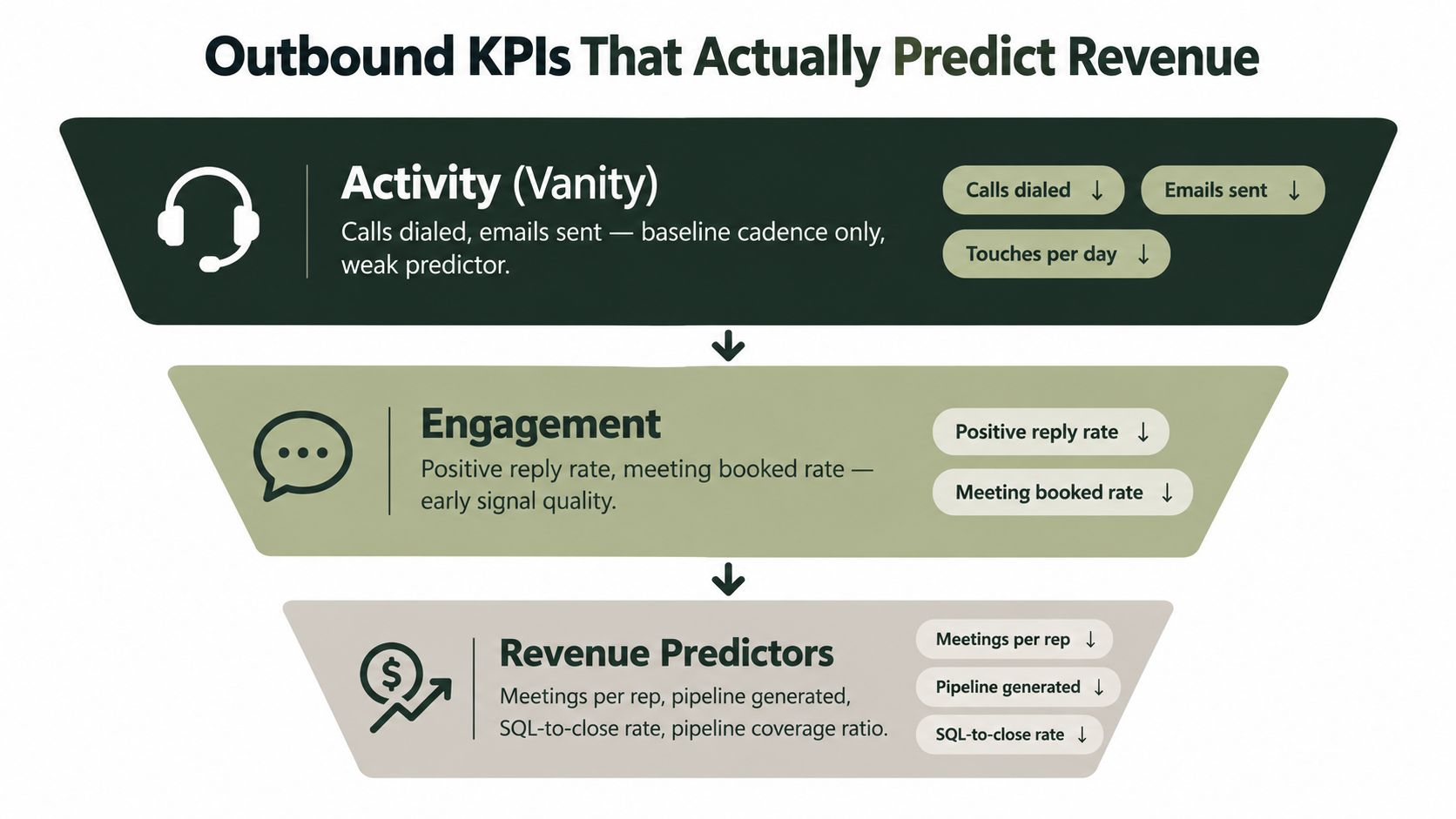
Calls dialed and emails sent are capacity metrics. They tell a manager whether work occurred, but they don't prove that the work targeted the right accounts or created commercial interest.
A useful dashboard connects each metric to a stage and a diagnostic question. Managers should be able to look at a weak result and identify whether the problem is data, timing, messaging, qualification, or handoff.
Measure activity only as a baseline
Activity counts help identify execution gaps. If reps aren't making the assigned touches, the manager has a coaching or capacity issue. Once a reasonable operating baseline exists, increasing volume without improving targeting usually creates more noise.
The outbound benchmark cited by Klenty describes roughly 50 to 100 emails or 50 to 80 dials per SDR per day, alongside 10 to 20 meetings per month and 15% to 30% outbound win rates in healthier motions (Klenty's outbound sales process benchmark). Treat these as contextual benchmarks, not quotas to copy blindly. Segment, deal complexity, territory, and signal quality change what productive activity looks like.
Track engagement by source and domain
Reply rate becomes more useful when segmented by signal source, account segment, domain, persona, and sequence. A blended average can hide a deliverability problem in one segment or a strong trigger that deserves more investment.
Ask:
- Reply rate by signal: Which external events produce meaningful conversations?
- Positive reply rate: Are replies expressing interest, or merely correcting the premise?
- Meeting rate from positive replies: Does the SDR convert interest into a relevant meeting?
- Domain-level performance: Are certain sending domains or segments underperforming?
The 3.43% average reply rate cited earlier is a market reference, not a universal target. Compare your performance with your own historical cohorts and investigate changes in data freshness, event age, and contact verification before rewriting copy.
Follow the pipeline outcomes
The most valuable measures sit closer to revenue:
- Qualified meeting to opportunity: Do accepted meetings create real sales opportunities?
- Opportunity creation by signal: Which triggers produce pipeline, not just replies?
- Pipeline generated per SDR: Does each rep create commercially viable pipeline?
- Pipeline by source: Which feed, segment, or event type deserves continued investment?
- Touch count per meeting: How much effort does each signal category require?
A low reply rate with strong opportunity quality may justify refinement. A high reply rate with weak qualification may indicate that the message is attracting curiosity rather than buyers. The dashboard should make that difference visible.
Manager's test: If a metric rises, can you explain which account type, signal, message, and handoff caused the improvement? If you can't, the metric is probably too broad to manage.
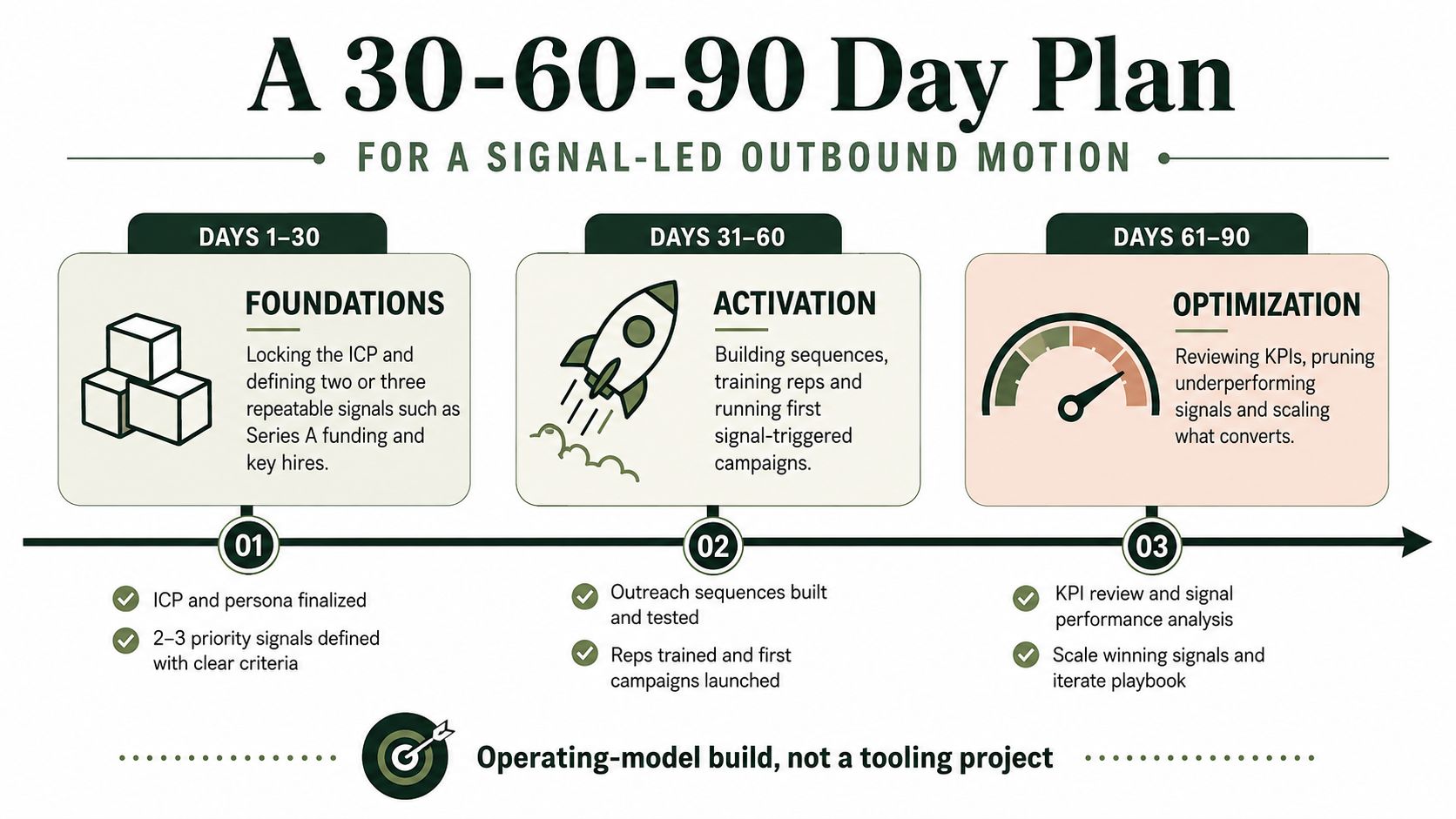
A 30-60-90 Day Plan for a Signal-Led Outbound Motion
Build the motion as an operating model, not a tooling project. New software won't repair an undefined ICP, an unverified list, or an AE team that rejects meetings without recording why.
Days 1 to 30 establish the foundations
Start with the accounts you already understand. Review wins, losses, stalled opportunities, and disqualified meetings. Identify the characteristics that consistently appear in good opportunities, then turn them into explicit ICP rules.
Choose two or three repeatable signals to begin with. Funding announcements and key executive hires are useful starting points because they can be observed externally and tied to clear account changes. Define what counts as a valid signal, how fresh it must be, who verifies it, and which role receives the alert.
Before launching volume, agree on the SDR to AE contract. Document qualification requirements, CRM fields, meeting outcomes, ownership rules, and the feedback deadline. Set baseline measures for replies, qualified meetings, opportunity creation, and pipeline by signal.
Days 31 to 60 activate the workflow
Connect the selected signal sources to enrichment and routing. Make contact verification a gate, not an optional cleanup task. Deduplicate accounts before they enter a sequence, and prevent multiple reps from pursuing the same event without an ownership rule.
Run controlled sequences that isolate the main variables. Compare event timing, channel order, offer framing, and contact role. Keep the message changes narrow enough that the team can identify what caused a result.
Ask reps to record signal quality after each meaningful conversation. A funding event may be accurate but commercially irrelevant to a particular offer. That feedback should return to sales operations and refine the routing rules.
Days 61 to 90 optimize what creates pipeline
Review performance by signal, account segment, contact role, and opportunity outcome. Keep the signals that produce qualified pipeline. Reduce attention on events that create activity without commercial progression.
Expand the library only after the initial signals operate reliably. Add product launches, market expansion, or relevant technology changes when the team can verify them and assign clear actions. Don't build a large signal catalog that reps can't interpret.
Document the playbook in the CRM and enable AEs to contribute prioritization insight. The AE often sees which event details correlate with a serious buying conversation, while the SDR sees the operational friction in sourcing and routing.
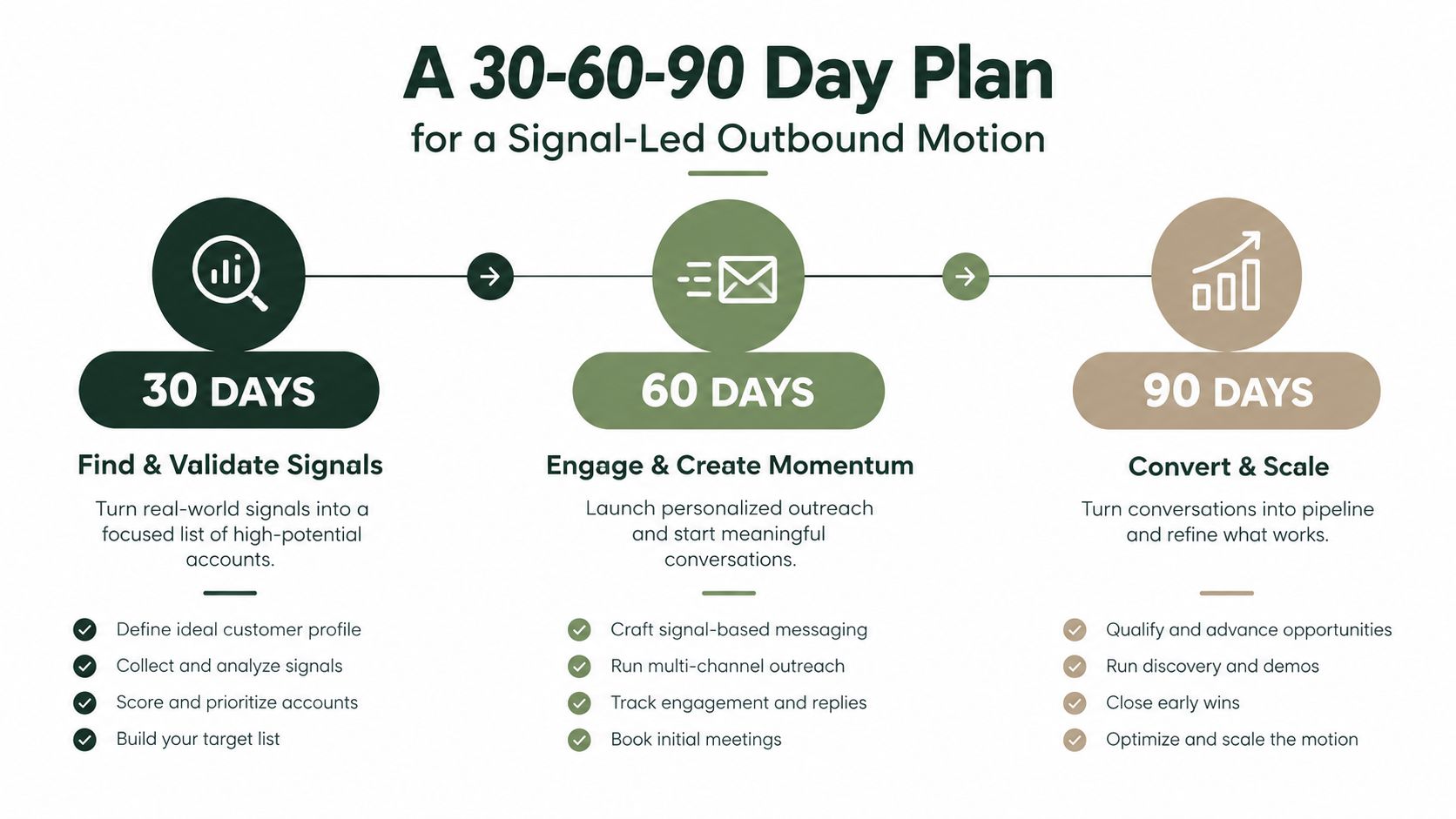
Use this implementation checklist:
- ICP: Write inclusion and exclusion rules that a system can apply.
- Signals: Select a small initial set with observable business meaning.
- Verification: Confirm the event, account, role, and contact method.
- Routing: Assign ownership and define the required response.
- Sequence: Match the offer and channel mix to the trigger.
- Handoff: Require a documented qualification brief before the AE meeting.
- Measurement: Report replies, qualified meetings, opportunities, and pipeline by signal.
- Iteration: Remove weak triggers before adding new ones.
Outbound becomes predictable when the team stops treating every prospect as equally urgent. Build the process around live events, verified contacts, explicit handoffs, and revenue-linked measurement, then let cadence support the system rather than carry it.
If your team needs a reliable way to identify newly funded startups and route verified founder or leadership contacts into an outbound workflow, visit NowFunded. Use the funding feed, API, MCP endpoint, webhook, CSV export, or dashboard to turn fresh funding events into timely, better-targeted sales outreach.