7 Sources for a Smarter List of Leads

A startup announces a fresh funding round on Tuesday morning. By Tuesday afternoon, its new budget is already being discussed across sales, hiring, infrastructure, and operations. If your team finds the company while the announcement is still recent, identifies the right decision-maker, verifies the contact details, and connects the outreach to the new initiative, you have a useful prospecting window. A generic directory entry won't give you that advantage.
A practical list of leads should connect a verified funding event to a relevant company, a decision-maker, a usable contact method, a timing signal, and a credible outreach hypothesis. That means comparing sources by workflow, not by database size alone. The seven options below serve different jobs, from live early-stage funding alerts and private-market research to contact enrichment and outbound execution. Evaluate them on freshness, coverage, contact verification, integrations, filtering, and cost control, then match the tool to the bottleneck your team has.
Table of Contents
- 1. NowFunded
- 2. Crunchbase
- 3. PitchBook
- 4. CB Insights
- 5. Dealroom
- 6. Tracxn
- 7. Apollo.io
- Top 7 Lead Providers Comparison
- Build the Funding-to-Conversation Workflow
1. NowFunded
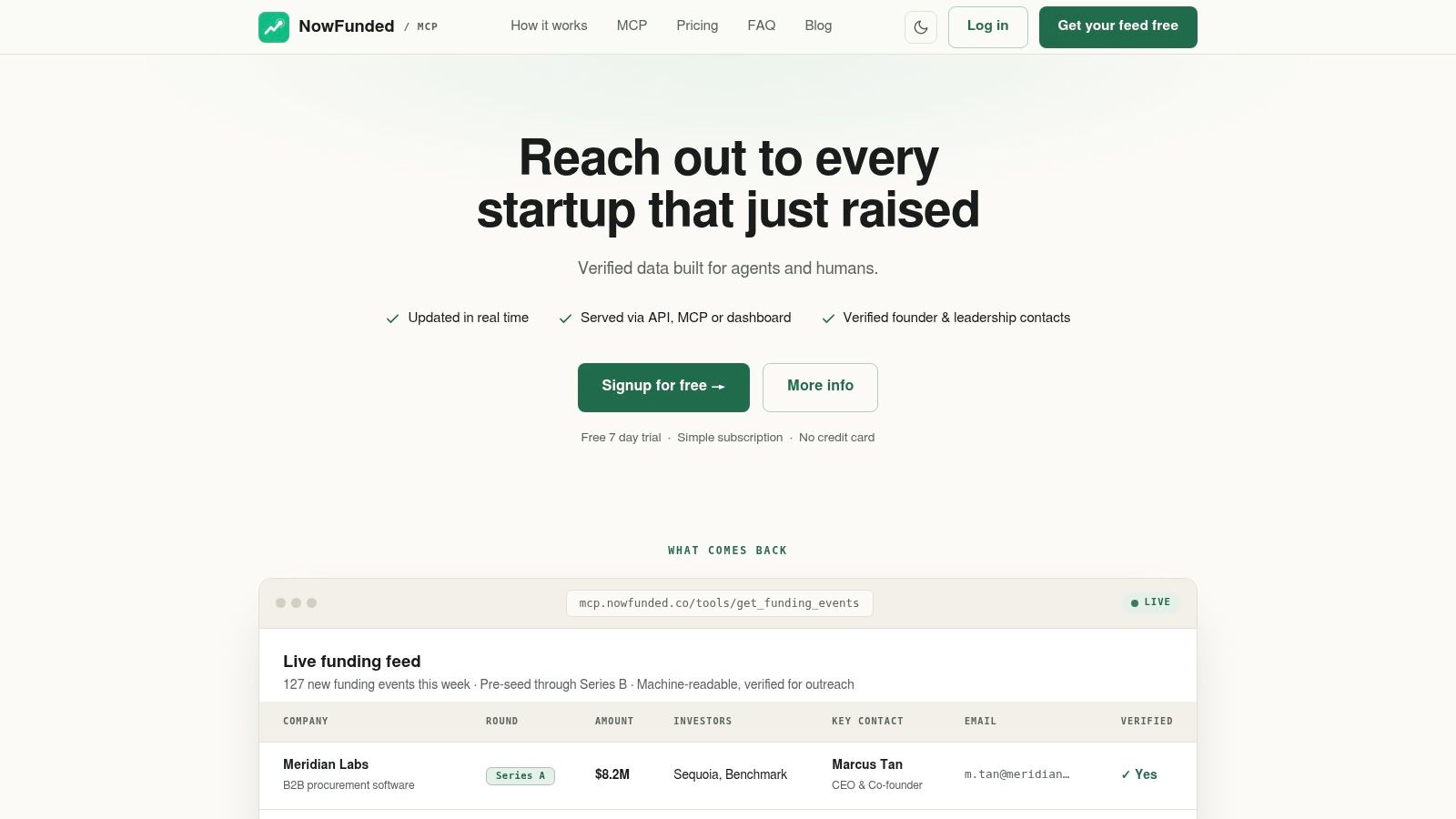
A newly funded startup can become a timely account only if the workflow moves from event detection to contact selection quickly. NowFunded is built for that sequence. It provides a live, verified feed of startups from pre-seed through Series B, with the company name, round, amount, lead investors, headquarters, headcount, industry, website, and LinkedIn details. New rounds appear within minutes of confirmation, making the platform suited to time-sensitive prospecting rather than occasional database updates.
Teams can receive the data through MCP, REST API, webhooks, CSV, and a web dashboard. Consistently typed JSON fields support deterministic filters by round, sector, location, and company attributes. A webhook can send an HTTP POST after an event is verified. The API and dashboard work better for on-demand research or smaller batches.
The contact workflow is the differentiator
The useful handoff happens after account selection. NowFunded enriches chosen companies with two to five founder and leadership contacts, including names, roles, work emails, and phone numbers. Contact pulls are deliverability-verified, and unverified contacts aren't billed. Sales teams can therefore select the person connected to the funded initiative instead of exporting every available contact.
Practical rule: Capture the funding event first, then enrich only the roles your message can credibly address.
Funding-event data is free to query. Contacts are charged per successful pull, currently $0.10 per email and $0.25 per phone number on the stated usage model. There is no subscription or minimum spend, but per-contact charges can accumulate in larger campaigns. Set role, sector, and funding-stage rules before enrichment, then send only verified records into the CRM or sequence.
NowFunded tracks 100+ new startups weekly and maintains a 10,000+ record historic database from the last 12 months, supporting lookbacks and trend analysis. Its coverage is narrower than a general private-market database, which makes it a focused choice when a recent early-stage round is the trigger. Start free without a credit card, or connect the live feed to an agent, CRM, or outbound workflow through NowFunded's funding data platform.
2. Crunchbase
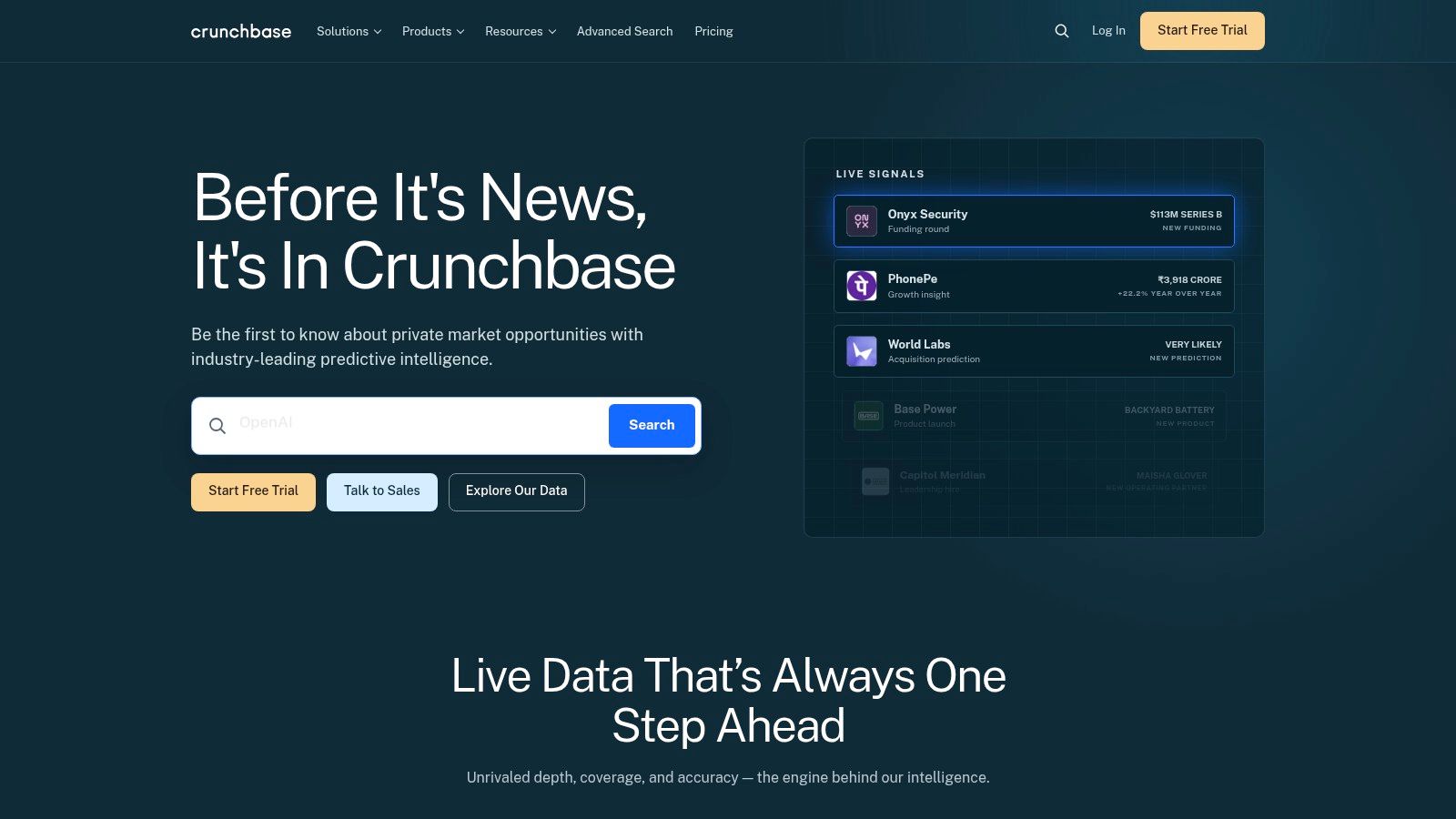
A sales operations manager can use Crunchbase to turn a broad market question into a monitored list of recently funded companies. Its private-company coverage includes funding rounds, investors, headcount, leadership changes, and related company activity. Filters for industry, geography, or funding stage help define the account set, while saved searches and alerts surface new records without rebuilding the query.
The practical advantage is fast setup. Researchers can review funding context, group companies into saved lists, and export selected records. Teams with technical resources can also connect the workflow through the REST API, although recurring exports and API access should be checked against the team's operating needs.
Where it fits in the workflow
Crunchbase is strongest at company discovery, funding context, and repeatable monitoring. It supports the first stages of a funding-to-conversation workflow, but it should not automatically serve as the final contact-verification layer. Contact records use confidence scoring, and verification status can change, so outbound teams should validate selected emails and phone numbers before adding them to a sequence.
Export limits also affect campaign design. Pro notes specify 2,000 rows per month for CSV export. Teams running larger recurring workflows should confirm current quotas and decide whether the API or a separate enrichment layer fits better. The trade-off is clear: Crunchbase can help identify and prioritize accounts, while another tool may handle contactability checks and delivery preparation.
A workable process is to save a search using funding recency and company-fit filters, review the financing event, identify the leadership roles relevant to the offer, and send only those records to verification or CRM enrichment. Teams that need a live early-stage funding-to-contact workflow can use NowFunded for verified founder outreach alongside Crunchbase, assigning each source a defined job instead of treating lead databases as interchangeable.
3. PitchBook
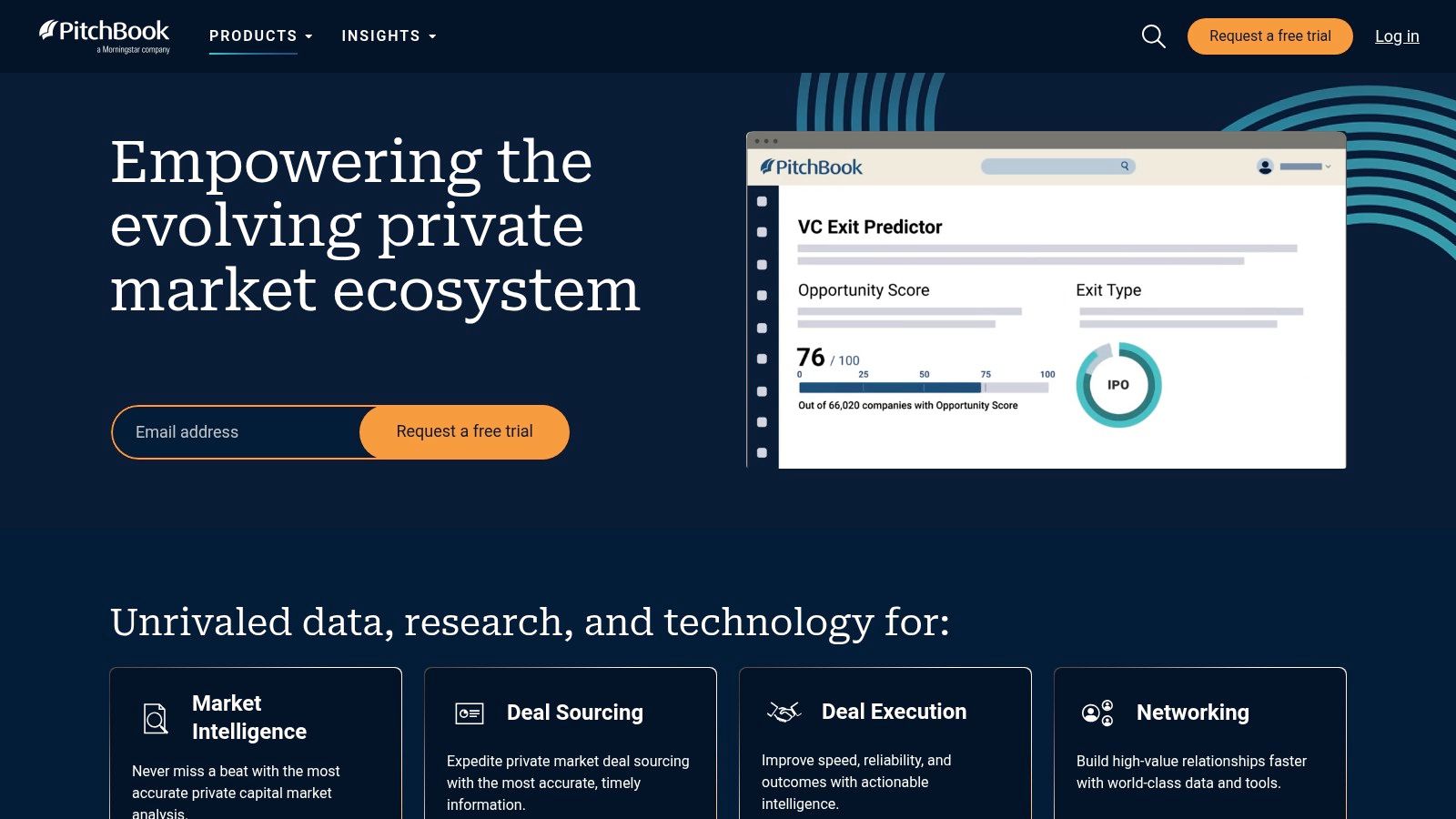
A company may match your sector filter yet offer little reason for a timely message. PitchBook adds private-capital context around the account, covering venture capital, private equity, M&A, valuations, funds, limited partners, ownership, companies, and people. Analysts can use that context to decide which accounts deserve outreach and what business event should shape the opening line.
Saved screens, lists, alerts, market maps, and subscriptions support recurring research. Enterprise teams can place private-market information inside internal systems through Direct Data, APIs, or data feeds. Desktop access and the Chrome extension suit browser-based investigation, while feeds support account-monitoring workflows.
Use it when context changes the message
PitchBook fits prospecting programs where deal structure, investor relationships, ownership, valuation context, or broader market mapping affect account selection. A service provider selling to venture-backed companies might segment prospects by investor type, then reference a relevant fund relationship in its introduction. A recruiting team could review financing context to rank companies before conducting a separate pass to identify and verify decision-makers.
The trade-off is procurement and workflow complexity. Pricing is not publicly listed and generally requires a sales conversation, so smaller teams should weigh deeper deal context against cost and implementation effort. PitchBook may be excessive when the requirement is to detect an early-stage funding event and obtain a verified founder contact.
Before building an agent or research pipeline, confirm which fields the selected delivery method exposes, how alerts arrive, and where contact verification occurs. Assign PitchBook to market and deal intelligence, then use a contact workflow to validate role, email, phone, and account fit before sequencing. NowFunded's research on funding-driven prospecting provides a useful reference when fresh funding events need to become timely founder outreach rather than remain research records.
4. CB Insights
CB Insights suits teams that build lead lists around a theme, market thesis, or strategic signal rather than a single funding filter. Its private-company datasets cover funding, M&A, IPO activity, cap tables, and company information, while thematic research and AI-derived scores help analysts frame why an account may matter. Key people and available contact details appear alongside company records, which reduces the distance between market research and prospect identification.
The platform's value shows up before the first email. A strategy team can map a category, identify companies receiving capital or showing relevant activity, and use the surrounding research to create a more specific account hypothesis. Instead of saying, “You raised money, can we talk?” the team can connect the outreach to a company type, market movement, or likely strategic priority.
Separate insight from contact readiness
CB Insights is particularly useful for thematic list-building, benchmarking, and strategic account selection. Its API and data-feed options can move signals into internal tools, but the contact workflow still needs explicit controls. A record that has a named person isn't automatically ready for a sequence. Validate the role, work domain, email status, phone status, and source recency as separate fields.
Enterprise controls and assurances around data use and model training may matter to larger organizations, especially where research data flows into internal AI systems. The main drawback is commercial rather than functional. Pricing isn't public, and access typically involves a demo and contract, which can make it difficult for a small outbound team to test casually.
Use CB Insights when the team needs a defensible reason to prioritize an account. Use a more focused funding feed when the team needs the fastest possible route from a confirmed early-stage round to verified founder or leadership contact details. That distinction prevents an expensive research platform from being judged on a workflow it wasn't built to own.
5. Dealroom
Dealroom suits teams researching global startups and technology ecosystems, particularly when Europe and international markets are part of the target. Its records connect funding rounds with growth, hiring, people, and other company signals, so analysts can build a list around more than one announcement. Exports support research workflows, while the REST API supports recurring programmatic queries.
Coverage is only useful when it leads to an actionable account record. Start with the target geography and company type, then filter for a recent funding event, relevant growth or hiring activity, and a clear fit with the ICP. Rank accounts before enriching contacts. This keeps research breadth from turning into unnecessary credit consumption.
Dealroom also offers an MCP-connected option on higher tiers. Teams building AI-assisted research can query the database through a native connection rather than rely on browser automation or manual copying. Define filters, map fields, deduplicate records, and require human review before an agent creates outreach or sends a message.
Watch the credit model
Dealroom publishes tiered plan information covering export credits, email credits, and MCP availability. That transparency helps buyers estimate costs, but finite credits can constrain teams that enrich every company instead of only qualified accounts. Confirm which exports, contact actions, API requests, and MCP operations consume credits before setting up a high-volume workflow.
A practical process is to identify funded companies in the target ecosystem, add growth or hiring signals, and review account fit first. Enrich the founder, commercial leader, or functional owner only after those checks pass. For confirmed early-stage events, NowFunded's funding intelligence workflow can provide a live funding signal while Dealroom supplies broader ecosystem context.
Dealroom fits teams that value geographic breadth, ecosystem context, and agent access. Choose another source when the requirement is limited to low-cost, verified contact pulls immediately after a funding round appears.
6. Tracxn
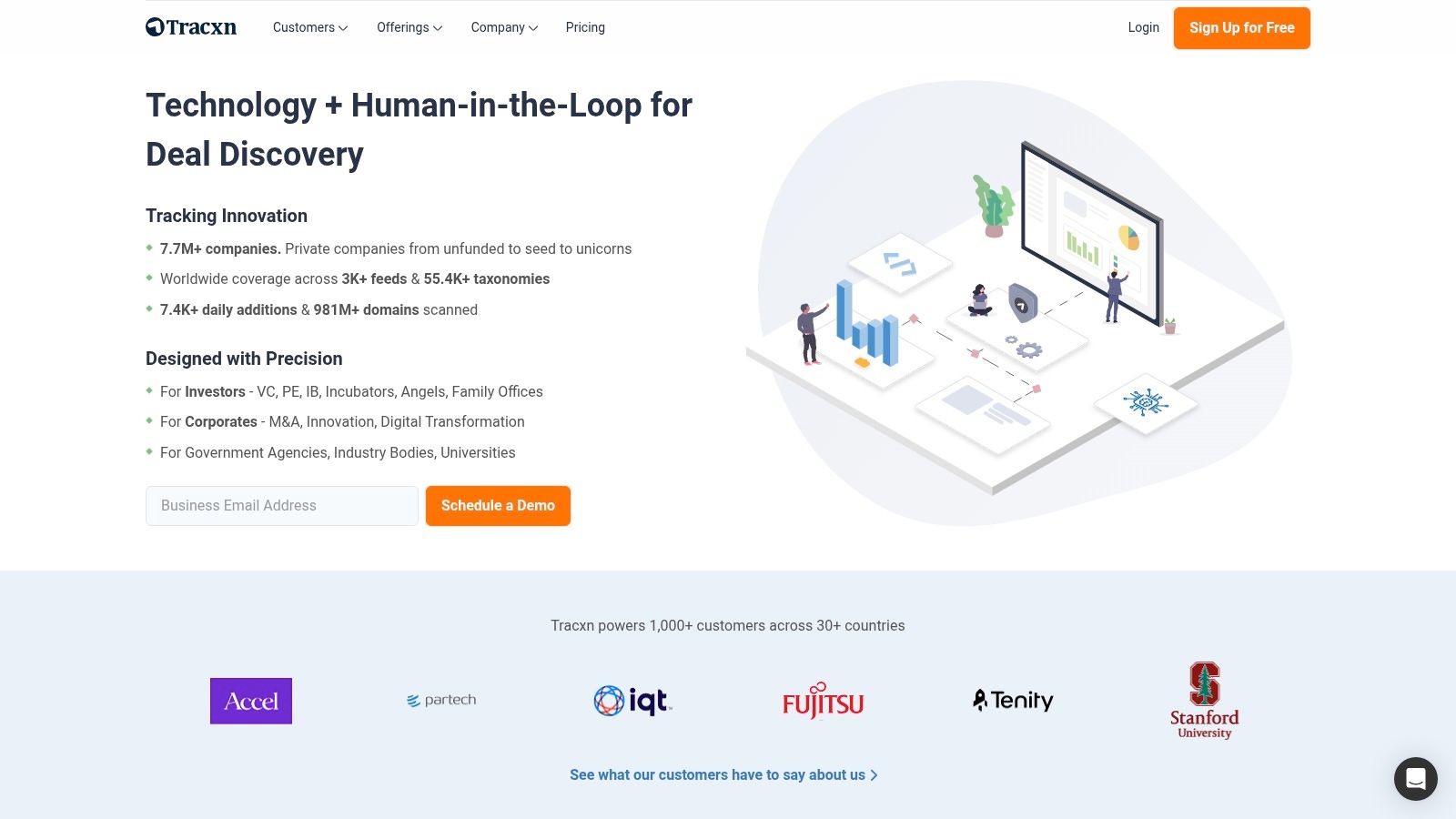
Tracxn is a pragmatic choice for teams that want broad structured coverage and several ways to put the data into an existing operating system. It tracks companies, funding rounds, acquisitions, news, and related private-market information across the company lifecycle. APIs support recurring workflows, while Snowflake delivery can fit organizations that already manage data in a warehouse.
The platform also offers browser extensions, Excel plugins, dashboards, and Tracxn Score. Those delivery paths make adoption easier for mixed teams. An analyst can work in a familiar spreadsheet, a sales operations team can use structured API data, and a research group can review dashboards before the account list reaches the CRM.
Build around the integration you already have
Tracxn is useful when the list needs to combine funding events, company metadata, acquisitions, and news into a recurring account process. A team could ingest new funding records, join them to an ICP table, remove existing customers, and route the remaining accounts to an enrichment step. That workflow is more reliable than repeatedly exporting a broad list and asking representatives to decide what matters.
The trade-off is usage and seat management. Pricing is tiered and can scale with usage and seats, so confirm export and API quotas before designing a high-volume process. Product documentation and help-center material can ease API onboarding, but implementation still requires clear ownership of deduplication, field normalization, contact verification, and suppression rules.
Tracxn is a sensible fit for organizations that value multiple integration paths and need coverage beyond a narrow early-stage feed. It may be more infrastructure than a small team needs if the campaign begins with one funding signal and a handful of leadership contacts. In that case, prioritize the source that minimizes the time between event detection and verified outreach.
7. Apollo.io
Apollo.io is the most outbound-oriented option in this comparison. It combines a large B2B contact database with enrichment and execution features such as sequences and a dialer. Company records can include funding information, so sales teams can filter for accounts connected to a recent funding event, identify contacts, and move directly into an outreach workflow.
That short path from selection to execution is Apollo's main advantage. A small SDR team doesn't need to assemble a separate sequencing system before testing a campaign. Tiered plans and credit-based usage also create a lower-friction entry point than many enterprise private-market platforms, although buyers should verify the current inclusions before committing because credit rules and plan details can change.
Treat contact accuracy as a process
Apollo is strongest when contact scale, outbound execution, and CRM-friendly workflows are the priority. It isn't automatically the best source for detecting the earliest funding event or understanding the full financing context. Use a funding-intelligence platform to define which companies deserve attention, then use Apollo when the team needs to find personas, enroll contacts, call, and manage follow-up in one place.
Contact accuracy can vary, so re-verification should remain part of the workflow. Check the work email, role, company domain, and phone status before sending. Also suppress generic addresses, former employees, duplicates, and contacts who don't match the initiative implied by the funding event.
A useful message might reference a new product launch, hiring push, or infrastructure project only when the account record supports that hypothesis. Funding alone is a timing signal, not proof of a specific purchase. Apollo helps execute the campaign, but the quality of the campaign still depends on the upstream filters and verification discipline.
Top 7 Lead Providers Comparison
Product Implementation complexity Resource requirements Expected outcomes Ideal use cases Key advantages NowFunded Low, MCP/REST/webhooks drop-in Minimal engineering; pay-per-verified-contact costs Live, verified early-stage funding feed with enriched contacts First-mover outreach, agent automation, recruiting Real-time typed JSON feed; deliverability-verified contacts; pay-as-you-go Crunchbase Low–Medium, REST API and UI Subscription (export quotas on Pro) Broad private-company tracking and alerts Rapid lead lists, alerts for newly funded startups Fast setup, well-documented API, widely adopted PitchBook High, enterprise integrations and workflows Enterprise contract and budget Deep deal, valuation, and participant intelligence Due diligence, valuation analysis, strategic sourcing Very deep global coverage; analyst research and market maps CB Insights High, platform + API embedding Enterprise contract; controls for data usage Thematic research and AI-derived market signals Strategic research, benchmarking, thematic monitoring Rich datasets with AI scores and enterprise assurances Dealroom Medium, API and MCP (higher tiers) Tiered subscription with export/email credits Global/European funding and ecosystem signals Ecosystem mapping, EU-focused list-building, agent queries MCP connectivity option; transparent credits; strong Europe coverage Tracxn Medium, APIs, Snowflake delivery, plugins Tiered pricing; confirm API/export quotas Broad lifecycle funding coverage with structured metadata Recurring programmatic lead lists and data pipelines Multiple delivery paths (API, Snowflake, Excel); clear docs Apollo.io Low, SaaS with enrichment and outreach tools Lower entry cost; credit-based plans; verification ops Large contact database ready for outbound campaigns High-volume outreach, enrichment, sequence automation Massive contact coverage + built-in outreach toolingBuild the Funding-to-Conversation Workflow
Choose the source according to the bottleneck, not the loudest feature list. NowFunded is the clearest fit when you need fresh early-stage funding events and verified founder or leadership contacts in one workflow. Crunchbase, Dealroom, and Tracxn are better suited to broader discovery and structured company research, while PitchBook and CB Insights add deeper private-market or thematic context. Apollo.io becomes the practical choice when contact scale, sequences, dialing, and outbound execution are central.
A reliable operating sequence looks like this:
- Define the funding filter: Set the target round range, industry, geography, company profile, and recency window before pulling records.
- Capture relevant events only: Exclude companies outside the ICP, duplicate announcements, existing customers, and events without enough context for a credible message.
- Enrich selected roles: Pull founders for founder-led outreach, or select the executive whose function matches the likely post-funding initiative.
- Verify contactability: Track email verification, phone verification, role accuracy, company domain, catch-all status, and source date as separate fields.
- Rank accounts: Combine company fit with funding recency, investor relevance, hiring or growth signals, and the strength of your outreach hypothesis.
- Launch a short message: Lead with the event and a specific business reason, not a generic product description.
- Measure the workflow: Track replies, meetings, bounces, suppressed records, and cost per verified contact.
For a founder-focused message, keep the connection direct:
Hi [First name], congratulations on [Company]'s new [round] with [lead investor]. Teams at this stage often revisit [relevant problem] as they put the new capital to work. We help [type of company] with [specific outcome]. Is [initiative] on your roadmap this quarter?
For a role-specific message, connect the person to a plausible responsibility without pretending to know the internal plan:
Hi [First name], I saw [Company]'s recent [round]. Since you lead [function], I thought [relevant initiative] might be timely as the team scales. We work with startups on [specific use case]. Would a short conversation be useful if that priority is active?
Your list isn't permanent. Lead-generation benchmarks show that nearly three quarters of respondents in one 2025 data-quality report said their lead data was inaccurate, outdated, or non-compliant, and more than 60% said poor data disrupted handoffs and sales productivity, as summarized by Demand Gen Report's coverage of the Integrate and Demand Metric findings. Track invalid, outdated, and non-compliant records separately, document the original source and verification status, suppress bounces, and refresh contacts when people change roles. A list that stays campaign-ready will outperform a larger export that decays.
NowFunded gives outbound teams a live, verified feed of early-stage funding events, structured company data, and on-demand founder and leadership contacts through MCP, REST API, webhooks, CSV, or its dashboard. Use it to turn a newly confirmed raise into a filtered, verified list of leads without scraping or paying for unsuccessful contact pulls. Visit NowFunded to explore the live feed and connect your funding-to-conversation workflow.