Levels of Funding for Startups: A Strategic Guide
In 2025, U.S.-based companies captured roughly $274 billion of the $425 billion global venture total. Startup funding ranges from small pre-seed rounds of about $500,000 to $1.5 million to median Series A and Series B deals of roughly $15 million and $45 million, but the right amount depends on the milestones that capital must finance.
That concentration changes how founders should think about the levels of funding for startups. A round label tells you what investors called the financing. It doesn't tell you whether the company has enough customer evidence, runway, or operating discipline to justify the next one.
I've seen founders make the same mistake at every stage: they start with a target amount, then work backward to find a story for it. The stronger approach runs in the opposite direction. Define the next operational milestone, identify the evidence investors will require, calculate the capital needed to reach it, and raise against that plan.
Table of Contents
- The Modern Startup Funding Environment
- Pre-Seed and Seed Funding Dynamics
- Series A Versus Series B Capital Regimes
- Why Stage Labels No Longer Predict Capital Needs
- Tracking Funding Rounds in Real Time
- Using Funding Data for Sales and Recruiting
The Modern Startup Funding Environment
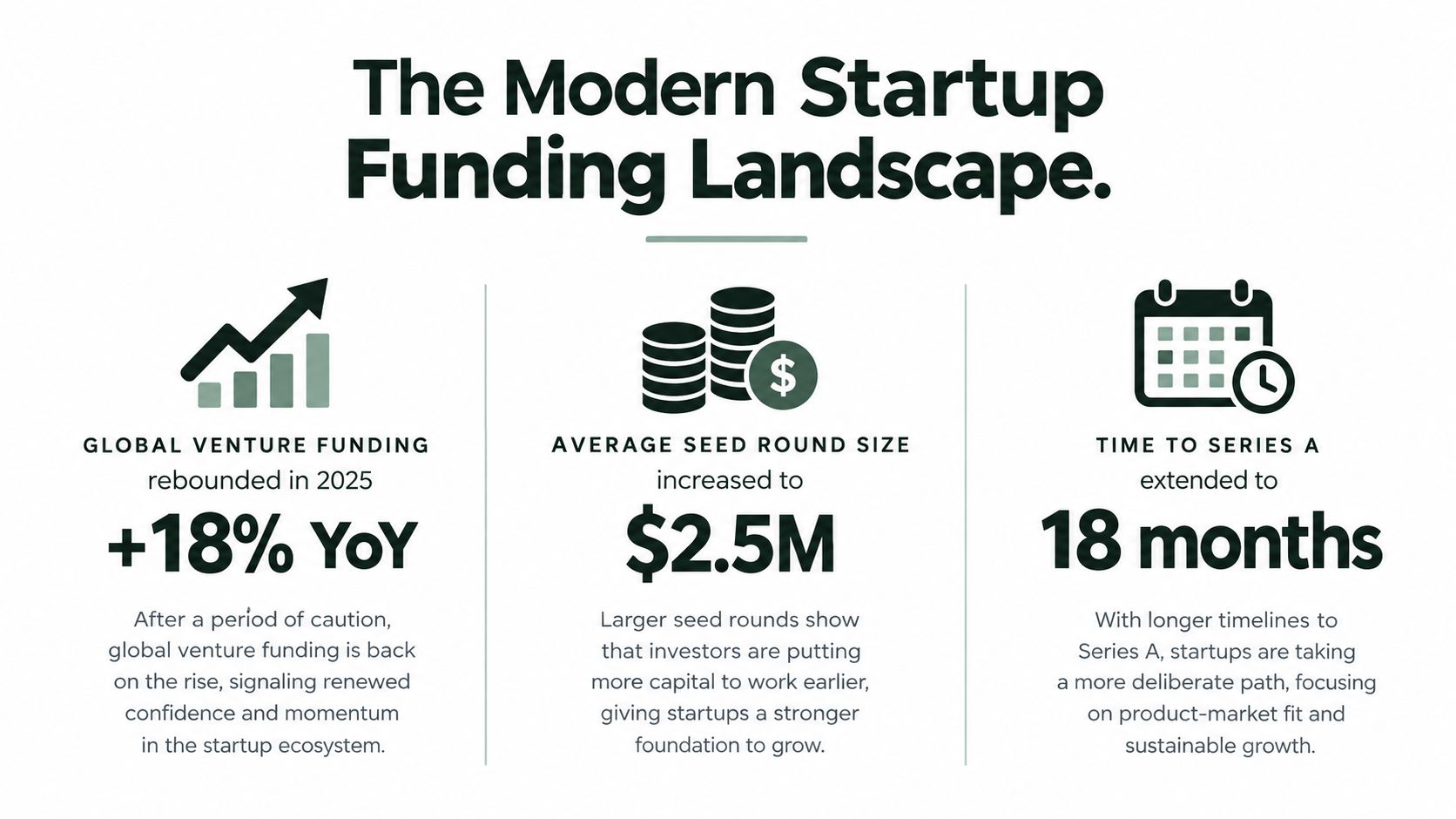
Global venture funding reached about $425 billion in 2025, up from approximately $328 billion in 2024, and supported more than 24,000 private companies, according to Crunchbase's 2025 venture funding analysis. The recovery looks broad, but access remains concentrated. Roughly $274 billion went to U.S.-based companies, about 64% of the global total.
That creates a useful distinction for founders and revenue teams. A larger worldwide pool does not mean every company can raise on the same terms. Geography, investor availability, product maturity, and the quality of operating evidence still shape the conversation. For an SDR, a funding announcement may signal new budget. For an analyst, the same announcement requires context before it becomes a reliable buying or hiring indicator.
Why labels create false confidence
Two companies can both be called “seed stage” while needing very different amounts of capital. One may have a working prototype, a small group of early users, and no repeatable acquisition channel. The other may have paying customers, improving retention, and a sales process the founders can explain. The label stays the same, but the evidence, hiring plan, and use of funds change.
The funding cycle adds another layer. Global venture funding peaked at about $702 billion in 2021, fell to around $328 billion in 2024, and rebounded in 2025, as documented in Crunchbase's comparison of 2025 and 2021 funding. In Q1 2025, global funding reached about $113 billion, while early-stage investment was about $24 billion, its lowest level in at least five quarters.
Practical rule: Treat the stage label as a filing category, not a complete diagnosis of the business.
Ask what the capital must prove. Founders should connect the round to an operational milestone, such as validating demand, improving retention, or establishing a repeatable sales motion. Commercial teams should ask what changed after closing: headcount, territory coverage, product scope, or purchasing authority.
The NowFunded blog can help SDRs and analysts follow funding activity. Its practical value increases when teams connect each round with the company's product, geography, hiring plans, and evidence quality. That turns a funding event from a headline into a useful operating signal.
Pre-Seed and Seed Funding Dynamics
Pre-seed and seed capital fund different jobs on the startup ladder. Pre-seed funding usually supports team formation, an MVP, and early validation. Seed funding turns that initial proof into a product and operating model that can be tested repeatedly.
Typical pre-seed raises sit around $500,000 to $1.5 million, with common pre-money valuations of $5 million to $10 million and dilution of roughly 10% to 20%, according to Pitchwise's funding-stage benchmarks. These figures describe market patterns, not guaranteed terms. At this stage, investors are mainly assessing whether the team can complete meaningful milestones, rather than relying on established revenue efficiency.
What pre-seed investors are buying
A pre-seed investor is testing whether the founders can turn an idea into credible evidence. The operating plan may include:
- Team formation: Recruit the technical or commercial skills required to build the first version.
- Prototype delivery: Produce something users can test instead of presenting only a concept.
- Initial adoption: Find early users and observe whether the product addresses a real problem.
- Problem-solution fit: Record repeated signals that the product meets a meaningful need.
A request to “grow” is too broad for this stage. A stronger funding case ties each expense to a testable outcome, such as completing the prototype, onboarding initial users, or identifying the customer segment with the clearest need.
How seed changes the burden of proof
Seed capital should fund the experiments and operating work needed to attract institutional interest. Industry guidance commonly cites 12 to 18 months of runway, but that period only helps when the burn rate matches the company's learning agenda.
A seed company may spend on product development, customer discovery, initial sales hiring, or measurement infrastructure. It should avoid adopting the cost structure of a scaled commercial organization before it knows which customers retain, which channel converts, and whether the product can support a healthy margin.
The seed test: Capital should purchase evidence, not just activity.
Bridge rounds and extensions often appear when a company has made progress but has not yet produced the traction metrics required for a larger institutional round. A smaller financing can extend the path to proof, much like adding fuel for the final leg of a test flight. The risk is raising reactively after spending has outpaced learning. Founders then return to investors without the signals that could improve pricing and negotiating power.
Series A Versus Series B Capital Regimes
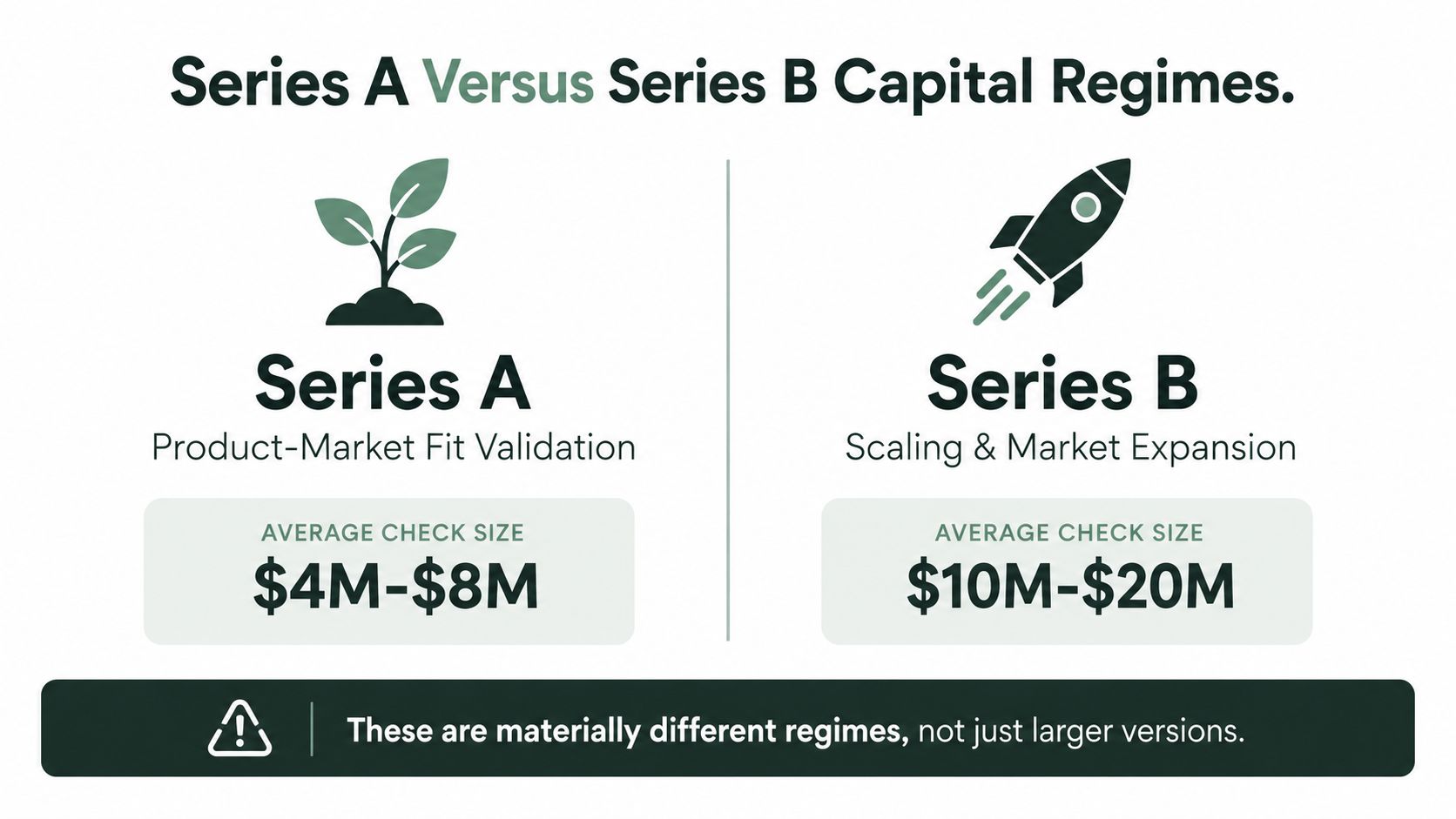
Series A and Series B represent different operating regimes, not interchangeable levels of funding for startups. The practical difference is simple: Series A capital proves that a focused commercial model can repeat, while Series B capital expands that model across more customers, markets, or products.
Recent U.S. market data places the median Series A deal around $15 million and the median Series B deal around $45 million. Other 2026 benchmark datasets place typical Series A rounds around $10 million to $20 million and Series B rounds around $20 million to $60 million, as summarized by Axis Intelligence's startup funding statistics.
Series A proves the model can repeat
At Series A, investors look beyond a promising product. They want evidence of product-market fit, a defined customer profile, and early proof that the company can acquire and retain customers through a repeatable process. A founder should be able to explain which segment buys, why customers stay, and how the sales motion works without treating every deal as a custom experiment.
Benchmark guidance commonly cites around $1 million to $3 million in annual recurring revenue for Series A. Dilution often falls near 18% to 25% (Axis Intelligence). Revenue quality still matters more than a headline total. Strong bookings paired with weak retention or poor gross margins may indicate that the business is not ready to scale.
Series A funding usually supports a controlled expansion of activities that already show evidence of working:
- Product development that removes adoption barriers.
- Sales and marketing hiring around a defined customer segment.
- Customer success processes that protect retention.
- Reporting systems that make unit economics visible.
For example, a company may use the round to add account executives only after it knows which segment converts and how long customers take to recover acquisition costs. Hiring ahead of those answers turns funding into overhead rather than evidence-building.
Series B funds efficient expansion
Series B investors expect the company to have moved beyond basic validation. The business should show proven growth efficiency, stronger revenue quality, and a credible plan for entering markets or segments that can support larger operations.
Benchmark guidance commonly places Series B around $5 million to $10 million or more in ARR, with dilution often near 15% to 22% (Axis Intelligence). The additional capital may fund international expansion, a larger sales organization, new product lines, or infrastructure that can handle significantly more demand.
Measure Series A Series B Typical benchmark range $10M to $20M $20M to $60M Median U.S. deal About $15M About $45M Core investor question Can the model repeat? Can efficient growth scale? Common ARR benchmark $1M to $3M $5M to $10M or more Typical dilution guidance 18% to 25% 15% to 22%The operating test changes in the boardroom. A Series A plan might show that a focused sales motion works with a defined customer group. A Series B plan must show that the motion can expand without gross margin deterioration, uncontrolled payback periods, or organizational confusion. That distinction helps SDRs and analysts interpret a funding event by the work it enables, rather than by the round label alone.
Why Stage Labels No Longer Predict Capital Needs
A stage label can hide more than it reveals. In Q1 2026, seed led named-stage deal counts with 360 deals, while late-stage funding captured most North American dollars, according to Fundraise Insider's Q1 2026 funding analysis. That split means deal frequency and capital availability are telling different stories.
AI-heavy rounds make the problem sharper. A large round can pull an average upward even when most companies at the same nominal stage are raising materially less. The label “Series B” therefore doesn't tell a sales team whether a company is adding enterprise sellers, building compute capacity, entering a new geography, or extending runway.

The ladder is becoming less linear
One dataset recorded under 4,000 early-stage fundraising deals in Q1 2026, compared with over 5,000 a year earlier, while late-stage and AI-native companies lifted average deal sizes, according to USA Today's report on Q1 2026 startup funding. The result is a market where fewer early companies may be competing for attention while a smaller group absorbs a large share of capital.
That makes “What stage are you?” a weak first question. Better questions focus on operating evidence:
- Revenue quality: Is revenue recurring, retained, and concentrated in a defensible customer profile?
- Retention: Do customers continue using and paying for the product?
- Capital efficiency: Does additional spending create proportionate commercial progress?
- Milestone distance: What specific proof is missing before the next round becomes credible?
- Funding purpose: Will the capital build product capability, validate demand, or scale a proven motion?
A company with revenue may still need a seed extension if retention is immature. An AI startup may raise a large round before its commercial model looks conventional. Another founder may stay private longer because existing capital supports the next milestone without forcing a premature pricing event.
The better diagnostic: Ask what the company has proven, what remains uncertain, and what the proposed capital will change.
This operating view also improves market research. Analysts can group companies by evidence quality and funding purpose rather than treating every company with the same round label as a comparable prospect.
Tracking Funding Rounds in Real Time
Funding data creates value when it reaches a team before an operating decision is made. A verified round may indicate new hiring capacity, a go-to-market budget, product expansion, or greater openness to vendors and recruiting partners. An old or unverified record cannot support timely action.
Start with the event, then add the context needed to interpret it. Capture the company, round type, amount, investors, headquarters, industry, headcount, announcement timing, and relevant leadership contacts. These fields connect the financing to practical questions, such as who may now have budget, which function may be expanding, and whether the event fits a broader sector pattern.
A practical operating workflow
First, filter by stage and use case. An SDR selling enterprise software might prioritize Series A and Series B companies showing signs of commercial hiring. A recruiter may focus on recently funded technical teams. An analyst may track every round in a sector to measure concentration and movement.
Second, verify the event. Announcements can show inconsistent company names, amounts, or investor lists. Separate a confirmed financing from a rumor, duplicate record, or older round that has resurfaced.
Third, enrich the company record. Round data identifies an event, not a buyer. Add founders, revenue leaders, hiring managers, or other relevant decision-makers. Check that their contact details are deliverable before outreach begins.
Fourth, trigger the appropriate action. A webhook can send a verified event into a CRM or workflow. REST API access, CSV export, and MCP endpoints support different technical setups, including analyst workbenches and AI agents.
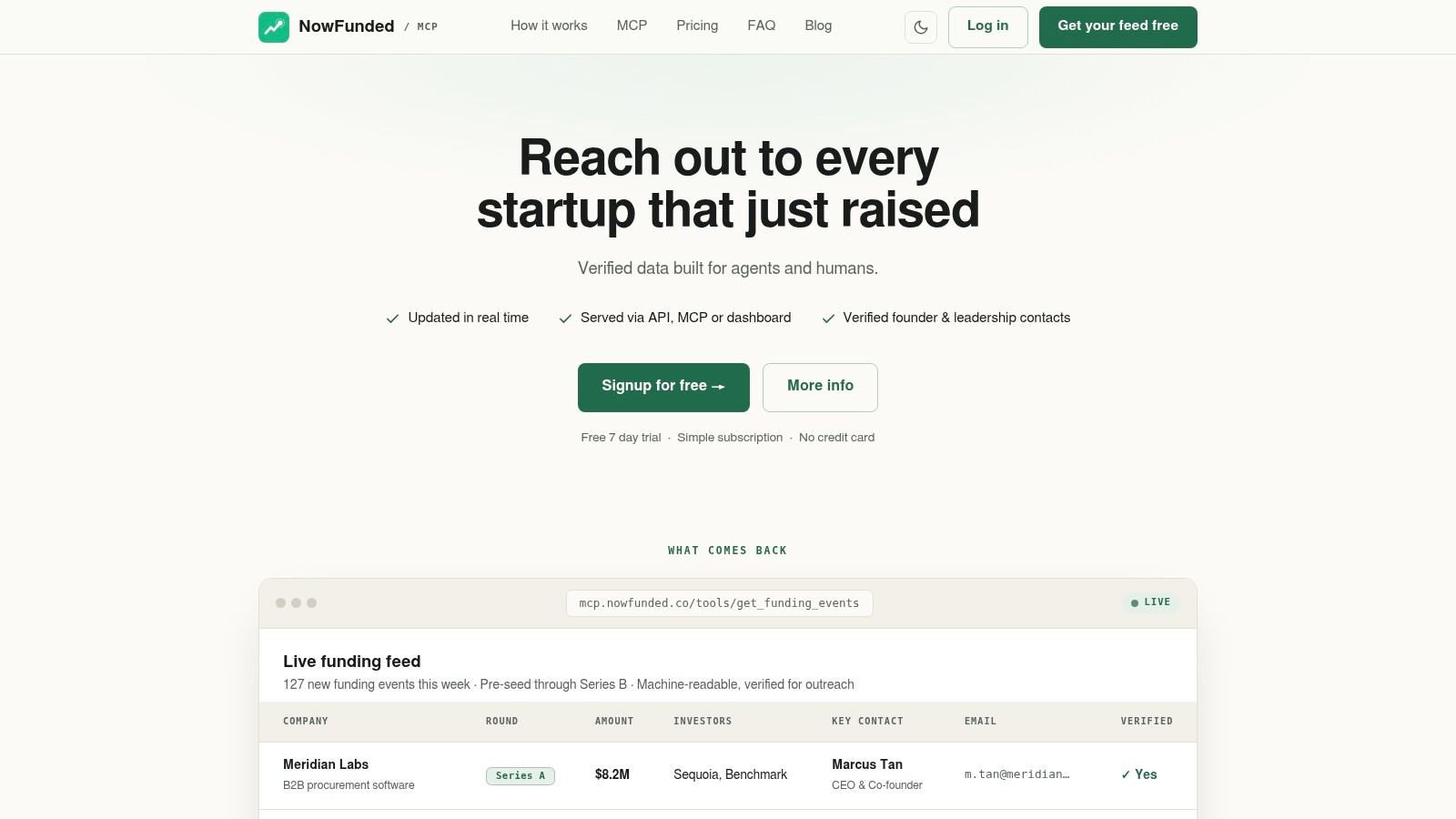
NowFunded provides a live, verified feed of newly funded startups from pre-seed through Series B. Confirmed rounds are added within minutes, with structured fields for company details, round information, investors, headcount, industry, and location. Teams can access startup funding data and integrations through MCP, REST API, webhooks, CSV export, and a web dashboard.
Turn timing into a repeatable motion
The goal is to connect the funding event to a plausible business change. A fresh pre-seed round may support product hiring and customer validation. A Series B event may fund sales expansion, recruiting, market entry, or operational infrastructure.
That connection makes outreach more relevant and gives analysts a consistent way to compare funding velocity, investor participation, sector activity, and geographic concentration without relying on disconnected spreadsheets.
Using Funding Data for Sales and Recruiting
The commercial value of funding data appears when teams combine timing, stage, and contact accuracy. A newly funded startup has a reason to revisit priorities, but the reason differs by level.
An SDR should treat the round as a trigger, not as a complete pitch. A recruiter should connect the financing to likely hiring pressure. An analyst should use the event to update a market view and identify similar companies. Each team needs a different next action from the same record.
Match outreach to the company's operating phase
For a pre-seed company, a relevant conversation may concern product tooling, technical hiring, or research support. The founders may not yet have a mature sales organization or a budget for broad commercial expansion.
A Series A company is more likely to be formalizing acquisition, customer success, and reporting. Its leadership team may care about repeatable pipeline, retention visibility, and hiring for functions that previously sat with the founders.
At Series B, the questions become more expansive. Is the company entering a new market? Adding sales capacity? Building a larger leadership layer? Recruiting teams should look for the functions required by that expansion, while SDRs should identify the executives accountable for turning the financing into growth.
Build a signal stack instead of a lead list
Use funding information as one layer in a broader prioritization model:
- Event freshness: Recent, verified rounds deserve attention before older records.
- Stage fit: Compare the company's round with the buyer profile for your offer.
- Investor context: Lead and participating investors can reveal the company's intended growth direction.
- Leadership access: Route outreach to a founder or relevant executive, not a generic inbox.
- Operating evidence: Use headcount, industry, location, and hiring activity to test whether the event matches your hypothesis.
Verified contacts matter because a funding event without a reachable decision-maker still leaves the team guessing. NowFunded's contact enrichment includes founder and leadership roles, deliverable work emails and phone numbers, and verification status. Its historian database supports lookbacks and trend analysis across 10,000+ records from the last 12 months, while the service tracks 100+ new startups weekly, according to the publisher's product information.
The strongest teams don't ask, “Which startups raised money?” They ask, “Which recent funding events create a credible reason to speak with this specific leader today?” That shift turns a static database into a timing system.
NowFunded gives SDRs, recruiters, analysts, and AI-agent teams structured funding events, verified leadership contacts, and delivery through MCP, REST API, webhooks, CSV, or a dashboard. Use the live feed to connect each funding level with the operational signal behind it, then visit NowFunded to build a more timely startup intelligence workflow.