Lead or Prospect: Key Differences and Qualification Tips

You've got a spreadsheet full of “qualified” accounts, but the first outreach queue still feels impossible. One row belongs to a recently funded founder with a clear business trigger. Another matches your ideal customer profile perfectly, yet contains only a generic inbox and an unverified phone number. Your team has a quota meeting soon, and the CRM is asking for a label when what you really need is a decision: who deserves a personalized message today?
That's why the lead or prospect debate matters. The useful distinction isn't vocabulary. It's contactability, intent, and routing priority. A record with weaker theoretical fit but a verified decision-maker can be more valuable than a highly qualified record nobody can reliably reach.
Table of Contents
- Why the Lead vs Prospect Question Matters for Outbound Teams
- Defining Lead and Prospect Side by Side
- Where MQL and SQL Fit in the Lifecycle
- How Sales and Recruiting Teams Read the Same Record
- When a Qualified Prospect Is a Worse Target Than an Unqualified Lead
- Speed, Signals, and Verified Contact as the Real Qualifiers
- Applying This to Newly Funded Startups and Next Steps
Why the Lead vs Prospect Question Matters for Outbound Teams
A sales development representative looking at a mixed list has three practical options for every record:
- Work it now, because the account has a relevant trigger and a reachable contact.
- Enrich or recycle it, because the fit looks promising but the data isn't ready.
- Drop it from the active queue, because neither intent nor contactability justifies more effort.
Calling every row a “lead” hides those choices. Calling every ICP match a “prospect” creates false confidence. The label starts doing the work that evidence should do.
Lead generation has always followed changes in how buyers and sellers exchange information. A widely cited history traces its lineage from Roman-era word-of-mouth selling through the printing press, telephone directories, telemarketing, websites, email, and social media, as described in this history of lead generation. Each shift made it cheaper to reach more people, but it also created larger volumes of contacts that needed sorting.
The routing problem behind the definition
An early-stage outbound team often over-researches attractive but unreachable accounts. Someone spends time reading company pages, checking technology choices, and writing a personalized angle, only to discover that the only available address is info@company.com. Meanwhile, a newly funded operator with a verified direct email sits untouched because the list treats both records as equivalent.
That's pipeline leakage. The team has mistaken account fit for sales readiness.
A better operating question is:
Can this contact receive a relevant message, from the right person, while the signal is still fresh?
The answer doesn't need to be perfect. It does need to be documented. A lead can have excellent firmographic fit and still belong in enrichment. A prospect can have incomplete buying evidence and still deserve a first touch if a strong event and verified contact information make the outreach timely.
Speed changes the economics of a list
Response handling exposes the cost of weak routing. In an audit of 2,241 companies, only 37% responded to a web test lead within an hour, while 16% responded within one to 24 hours, 24% took more than a day, and 23% never responded, according to response-time lead-generation benchmarks. The lesson for outbound teams is straightforward: qualification that happens after a long delay is less useful than a good-enough decision made while the buyer's attention is active.
Use a live source such as NowFunded's startup research resource to identify relevant funding events, then separate the resulting records by verified contact status. Your CRM should tell the SDR what to do next, not merely what category a contact appears to occupy.
Defining Lead and Prospect Side by Side
A lead is a record that may fit your target market but hasn't earned active sales attention. It might come from an inbound form, a purchased list, a social interaction, a funding announcement, or an account-research project. The record can be useful without being ready.
A prospect is a lead that has enough evidence to justify direct, personalized outreach. That evidence normally combines fit with at least one of two conditions: a meaningful intent signal or reliable access to the relevant decision-maker. In a strong operation, contactability is not a nice-to-have field. It's part of qualification.
Dimension Lead Prospect Intent level No confirmed buying motion, or only a weak signal A relevant event, engagement, business need, or other reason to contact now Contactability Contact details may be missing, generic, or unverified A named person has a verified, usable channel Lifecycle stage Early research, capture, enrichment, or nurture Active sales development and personalized outreach Routing ownership Usually marketing, research, or data operations Usually SDR, AE, or a shared sales-development process Next action Validate, segment, educate, or wait for a trigger Contact, qualify, and record the responseCore distinction: A lead is a possible account or contact. A prospect is a possible account or contact that has earned a place in the working queue.
Fit isn't the same as readiness
Teams often qualify at the company level and assume the person-level record is ready. That shortcut fails when the company matches the ICP but the named contact has left, the email is generic, or the role has no influence over the problem you solve.
A prospect therefore needs more than an attractive company profile. The record should answer practical questions:
- Who is the person? The name and current role should be clear.
- Why now? The account should have a trigger, engagement, or observable business change.
- Can the team reach them? The email, phone, or social route should be verified or otherwise reliable.
- What should the first message say? The trigger should support a specific opening rather than a generic introduction.
Marketing-owned lead lists and sales-owned prospect lists are different operational artifacts. Marketing can reasonably retain broad records for segmentation and nurture. Sales needs a narrower queue that protects research time and rewards timely action.
Labels should control work, not decorate the CRM
Many teams use “lead” for every early-stage record and “prospect” for every account an SDR has touched. That's acceptable only if the transition has a documented threshold. Without one, different representatives apply different standards, and managers can't diagnose whether pipeline is leaking through poor data, weak messaging, or slow follow-up.
My recommendation is simple. Keep the broad lead pool, but require intent, fit, and reachable ownership before a record enters the active prospect queue. A reply can strengthen the classification, but it shouldn't be the only route to prospect status. A newly announced funding round plus a verified founder contact may justify outreach before any reply exists.
Where MQL and SQL Fit in the Lifecycle
MQL and SQL are useful only when they describe evidence, not when they inflate the number of records handed to sales.
A marketing-qualified lead, or MQL, has crossed a marketing-defined threshold. That threshold should include firmographic fit and a measurable sign of interest or business change. A pricing-page visit, repeat engagement with relevant content, or a verified funding event can contribute to the decision. None of those signals proves that the person wants a sales call.
A sales-qualified lead, or SQL, has passed a human sales review. An SDR or AE has checked the record, assessed the likely problem and buying context, identified the relevant stakeholder, and confirmed that a usable contact route exists. Budget, authority, need, and timing may still be incomplete, but the team has enough evidence to begin a serious qualification conversation.
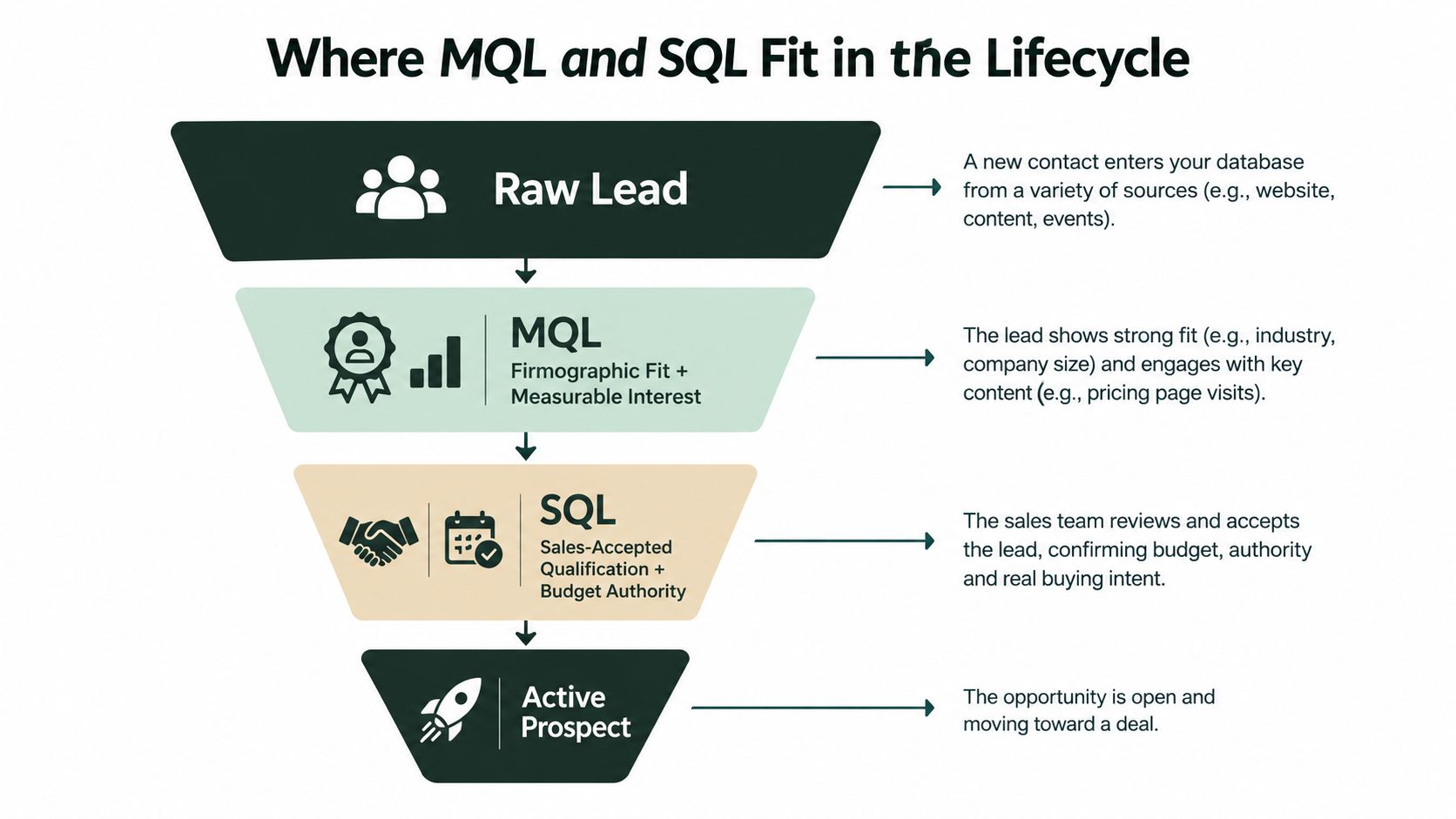
Use evidence thresholds at each handoff
A practical lifecycle looks like this:
- Raw lead: The record enters the database because the company or person may be relevant.
- MQL: The record matches the target profile and shows a meaningful signal beyond passive existence.
- SQL: Sales reviews the record, validates the likely use case and stakeholder, and confirms a reachable channel.
- Active prospect: The record receives a customized sequence, call plan, or direct conversation.
The mistake is allowing a scoring model to graduate a lead automatically. A model can recognize a page visit or an account attribute. It can't guarantee that the contact still works at the company, owns the problem, or can receive your email.
Separate intent from noise
Not every activity deserves the same weight. A single broad content download may indicate curiosity, research, or accidental form completion. A repeat visit to a relevant product page paired with a current hiring push or funding event gives the SDR a more useful reason to act.
Create a short evidence note beside every MQL:
- Fit: Why does this company belong in the target segment?
- Signal: What changed or what did the contact do?
- Person: Which role should sales approach?
- Access: How was the email, phone number, or profile verified?
- Action: What specific message or call angle follows?
An SQL should include the same evidence plus a sales owner and a next step. Don't let “high score” substitute for a named contact. If the data is incomplete, route the record to enrichment instead of pretending the handoff is complete.
How Sales and Recruiting Teams Read the Same Record
A newly funded founder can look like two different opportunities depending on who opens the record.
For a B2B SaaS sales team, a funding announcement signals that the company may be entering a new operating phase. The SDR checks whether the sector, company profile, and leadership role fit the ICP, then looks for a direct route to the founder or the executive who owns finance, operations, people, or technology. The opening message should connect the funding event to a specific operational pressure, such as payroll complexity, payment workflows, or vendor consolidation.
For a technical recruiter, the same announcement points somewhere else. New capital can support team expansion, a platform rebuild, or the hiring of senior engineers. The recruiter searches for the founder, CTO, or head of engineering and leads with the company's growth direction and a relevant candidate conversation.
Dimension Sales team (B2B SaaS) Recruiting team Primary signal Funding, operational change, new leadership, or a business problem Funding, hiring activity, engineering expansion, or a new technical leader Target contact Founder, finance leader, operations leader, or functional owner Founder, CTO, VP Engineering, or hiring manager First message Connects the event to a business workflow or cost of inaction Connects the event to team growth and a candidate or hiring need Qualification question Does the company have a problem the product can solve now? Does the company have an active role, hiring plan, or talent bottleneck? Conversion event Relevant reply, discovery conversation, or sales meeting Hiring intake, candidate introduction, or recruiting engagementThe same signal needs different copy
A sales SDR might write:
Your recent funding gives the team room to scale. I'm reaching out because companies at that stage often need a cleaner way to manage vendor payments as new departments come online.
A recruiter would use a different first sentence:
Your new funding appears to support the next phase of technical growth. I'm speaking with senior platform engineers who may fit the kind of team you're building.
These messages don't compete for the same outcome, even though they begin with the same public fact. The record becomes valuable only after the team connects the event to the right function and person.
Shared lists create routing collisions
If sales and recruiting use one undifferentiated list, both teams may contact the same founder with unrelated messages. The first team to verify the direct contact and establish relevance often gets the reply, while the second may look like noise.
Assign ownership by use case and persona, not just by account. A funding record can create a sales route, a recruiting route, or both. The CRM should store those routes separately, with distinct messaging, owners, suppression rules, and outcomes. That approach protects the founder from duplicate outreach and gives managers a clearer view of which signal produced which conversation.
When a Qualified Prospect Is a Worse Target Than an Unqualified Lead
Consider two records entering the same outbound queue.
Record A is a strong-fit prospect at a mid-market SaaS company. The account matches the ICP, the likely buyer role is known, and the business problem appears relevant. But the only email is a generic inbox, and the phone number hasn't been verified.
Record B belongs to a smaller company that's a weaker fit. The contact is the head of operations, the work email is verified, and the person's LinkedIn profile confirms the role. Record B has less theoretical account value, but the SDR can send a relevant message to a real person.
Axis Record A: qualified prospect Record B: unqualified lead Fit Strong ICP match Partial or weaker match Intent Relevant problem is plausible, but not confirmed May have a less obvious need Contactability Generic or unverified route Verified direct email and role confirmation Time to reply Delayed by enrichment or uncertain delivery Ready for immediate personalized outreach Queue decision Enrich before active sequencing Work now, then qualify through conversationThe standard definition would favor Record A. The operating decision should often favor Record B.
Why contactability changes the ranking
A message sent to a generic inbox may never reach the person who owns the problem. An unverified phone number can turn a good account into a wasted call block. Even accurate company research doesn't compensate for a failed delivery route.
Contact-data quality has a measurable effect on prospecting economics. Independent enrichment benchmarks and practitioner tests report verified work-email accuracy ranging from 72% to 91%, while waterfall enrichment can improve accuracy by about 35% versus single-source tools and increase record coverage from roughly 50% to 70% up to approximately 80% to 95%, as reported in contact-data enrichment benchmarks. Those figures vary by provider and dataset, but the operational point is consistent: verification changes how much of the queue is usable.
Use a contactability tie-breaker
Score every record on four axes:
- Fit: Does the account and person match the target?
- Intent: Is there a credible reason to contact them now?
- Contactability: Can the team deliver a relevant message to the right person?
- Time to reply: Can the record be worked before the signal becomes stale?
Don't treat the axes as a rigid mathematical formula. Use them to settle queue disputes. When two records are close on fit, contactability decides which one enters the working queue today. Record A still deserves attention, but its next action is enrichment. Record B deserves a first touch and a qualification attempt.
This rule also exposes the hidden cost of fit-only qualification. Teams spend research hours polishing records that cannot be reached, then complain that outbound conversion is weak. The problem isn't always the offer or the sequence. Sometimes the queue contains too many prospects that were never operationally contactable.
Speed, Signals, and Verified Contact as the Real Qualifiers
The useful classification isn't lead versus prospect. It's the combination of response speed, signal strength, and verified direct contact.
These three variables answer the questions managers actually care about:
- Why should we contact this account?
- Why should we contact it now?
- Can we reach the person who can respond?
A record that answers only the first question belongs in research. A record that answers all three belongs in the working queue.
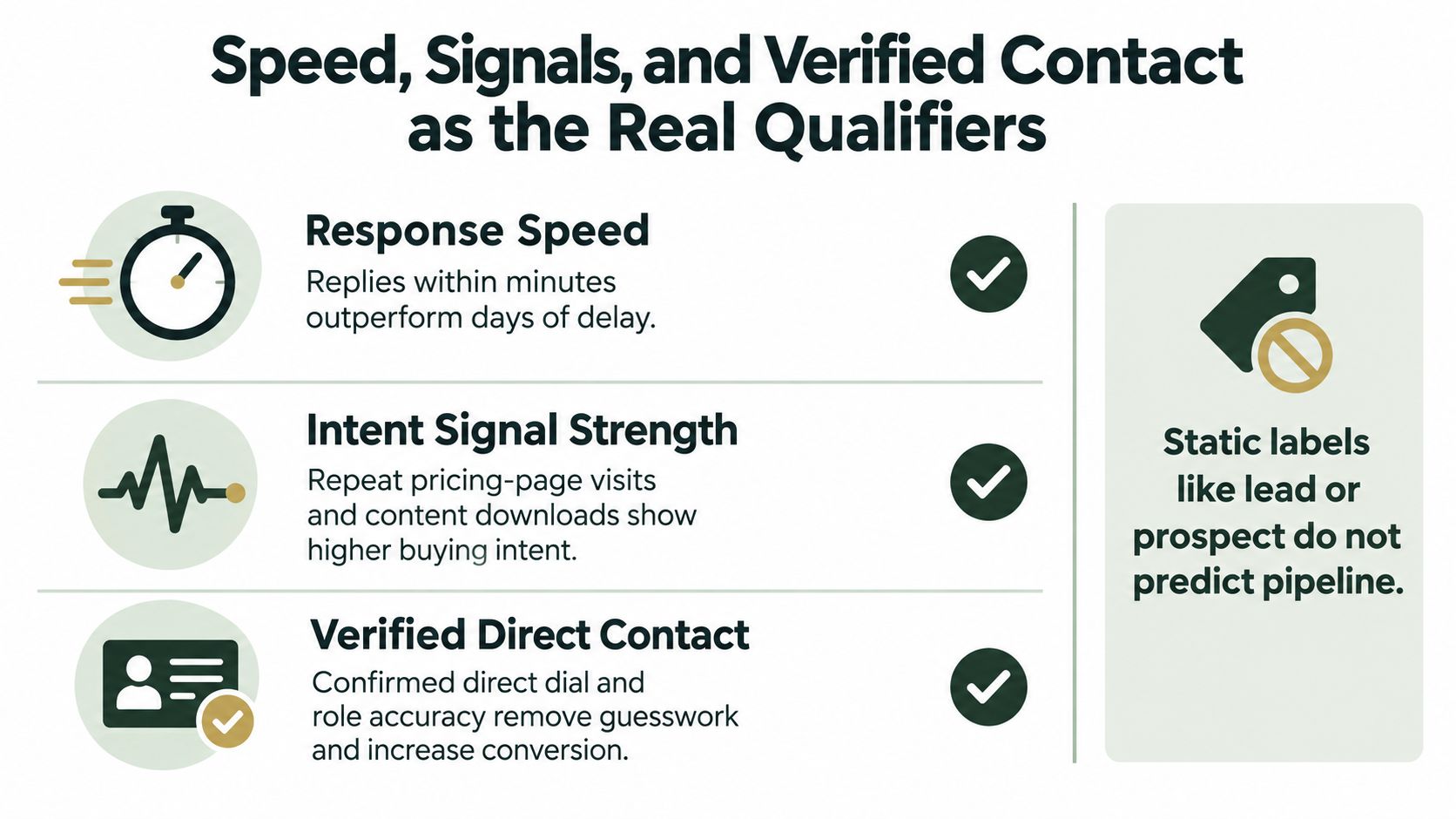
Build a signal stack instead of relying on one event
For startup-focused outbound, combine several observable signals:
- Funding event: Record the announcement, round type, lead investor, and event freshness.
- Hiring movement: Look for new roles, leadership additions, or expansion in a relevant function.
- Technology change: Check for a new platform, workflow, integration, or infrastructure direction.
- Public context: Use a founder post, interview, podcast appearance, or company announcement to understand priorities.
- Verified ownership: Confirm the named decision-maker's role and deliverable contact route.
A funding event alone can establish timing without proving product need. A hiring surge alone can indicate growth without identifying who owns the budget. Together, the signals help the SDR choose a better persona and write a sharper first sentence.
Sales-development coverage describes a broader shift toward signal-based targeting, with AI handling research and drafting while human sellers focus on verified facts and conversation quality, according to the 2026 state of sales development from Tenbound. That division of labor is sensible, but only if the system passes verified evidence to the seller rather than producing polished guesses.
Use a simple daily work rule
A record gets worked today when it has:
- A fresh, relevant business event.
- A verified direct email or another confirmed route.
- At least one second signal that supports the outreach angle, such as hiring activity, a leadership change, a public statement, or relevant engagement.
If one of those elements is missing, move the record to enrichment or nurture. Don't discard it automatically. The point is to stop incomplete data from consuming the same attention as a ready-to-contact account.
This rule down-ranks the attractive but unreachable prospect and raises the priority of the messier lead that can receive a thoughtful message. It also shortens the gap between MQL and SQL because sales reviews the evidence in the same workflow instead of waiting for a separate cleanup project.
Speed is part of qualification
The response-time audit cited earlier found that most test leads didn't receive a response within an hour. That makes prompt routing a competitive operating advantage, especially when a public event gives several teams a reason to reach out.
Channel fit matters too. Surveys cited in the same lead-generation benchmark report that 71% of buyers who accept meetings with salespeople want to hear from representatives during the early research stage, while 80% of B2B buyers prefer email as the sales-representative contact channel. The figures support a practical choice: reach out early, use the channel buyers prefer, and ensure the address belongs to the person you're addressing.
Label hygiene follows data. It doesn't create data. Fix the evidence first, then update the stage.
Applying This to Newly Funded Startups and Next Steps
A newly funded startup shouldn't remain in a generic lead bucket after the event creates a clear business reason to engage. The same applies when the company begins hiring aggressively or appoints a new executive who may change vendors, systems, or operating priorities.
Use this decision checklist before routing the record:
- Round announced: Is there a verified funding event rather than an old or unconfirmed mention?
- Capital context: What round information and investor context help explain the likely business priority?
- Sector fit: Does the company still match the segment your team serves?
- Deliverable contact: Has the founder or relevant leader's email or phone number been verified?
- Decision-maker identified: Is the selected person connected to the workflow your product addresses?
A record that passes the checklist should become a sales-ready prospect. A record with the event but no verified contact should enter enrichment. An ICP-fit account with no current trigger should remain in standard nurture instead of taking priority over a fresher opportunity.
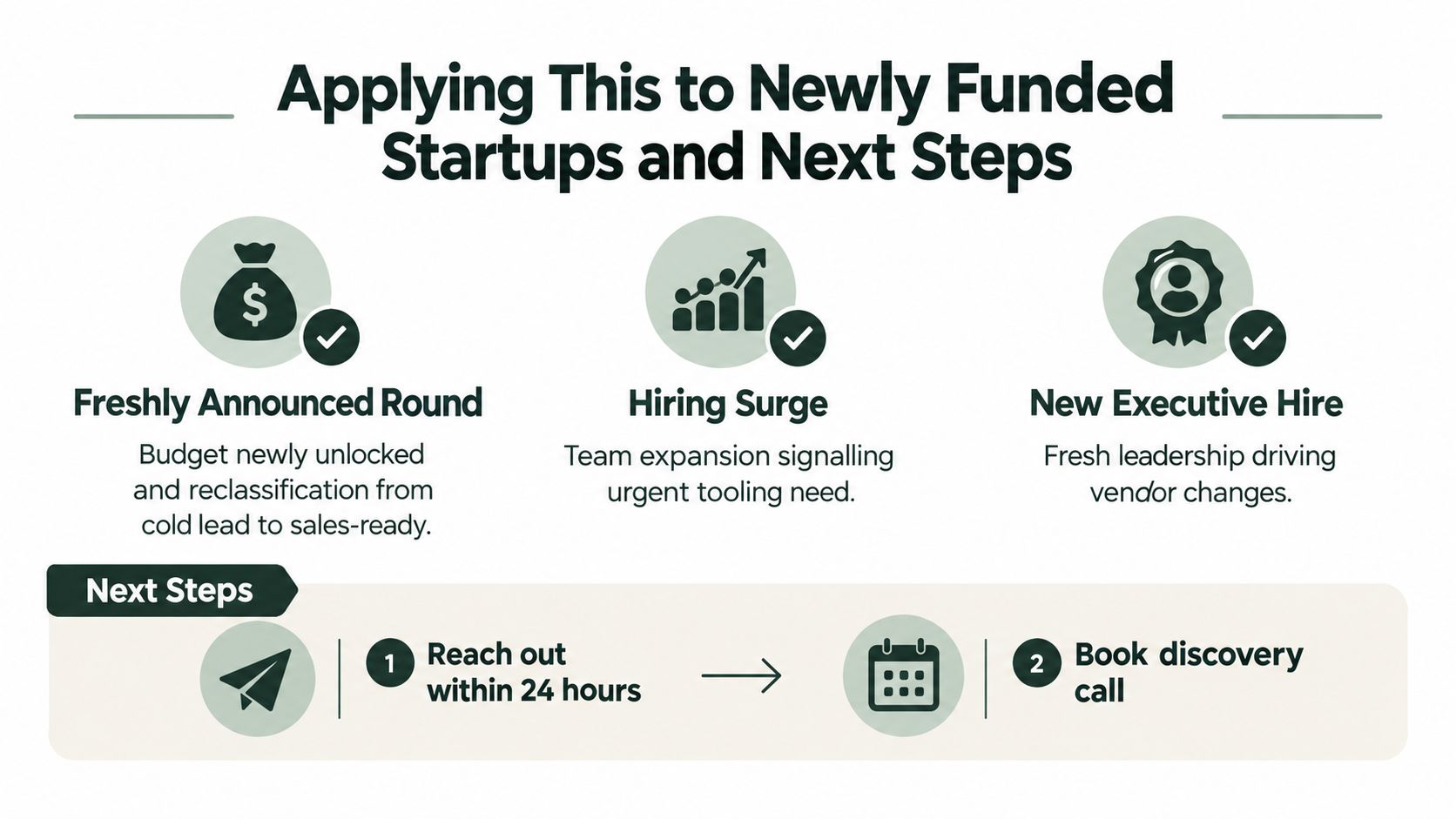
Add live signals without rebuilding the CRM
You don't need a new lifecycle model to apply this approach. Add a few fields to the existing lead or account record:
- Trigger type and event date
- Signal source and verification status
- Target persona
- Contact verification status
- Routing outcome
- Next action and owner
Then connect the fields to simple workflow rules:
- Funded record plus verified email: Route to the AE or the SDR responsible for the segment, with a message angle matched to the record.
- Funded record plus unverified contact: Route to an SDR or data-operations queue for enrichment before outreach.
- ICP-fit record without a current trigger: Keep it in nurture and define the event that would promote it.
- Recruiting signal: Route separately to talent acquisition so sales and recruiting don't duplicate outreach.
A live funding feed can supply company details such as the round, investors, location, industry, website, and leadership context. A verified-contact layer can then attach names, roles, deliverable work emails, and phone numbers with explicit verification status. The live startup funding feed can be connected through an MCP endpoint, REST API, webhook, CSV export, or web dashboard, which lets teams choose between agent workflows, push notifications, and manual review.
Make the first message event-specific
Don't write, “I saw your company is growing.” That sentence could apply to almost any startup.
Write what the event lets you know, then connect it to a relevant operational question. For a finance leader, the message might address payment controls or vendor management. For a people leader, it might address payroll or hiring operations. For a technical leader, it might address infrastructure, security, or developer workflow.
The objective isn't to prove that the company needs your product. It's to show that you understand why the record entered the queue and give the right person a reason to answer. Once the contact responds, the prospect label becomes less important than the conversation evidence.
Use a live funding signal to identify newly relevant accounts, then verify the decision-maker before assigning sales ownership. NowFunded provides structured funding events and verified founder and leadership contacts for teams that want to turn fresh startup activity into actionable prospecting workflows.