The Lead Generation Process for Outbound Teams in 2026

Your SDR opens the CRM on Monday, exports a “fresh” prospect list, and starts building a sequence. By Wednesday, the most promising accounts are already talking to competitors because they raised funding two days earlier and your team never saw the event. The contacts may still be accurate, but the buying moment has passed.
That failure is common because teams treat the lead generation process as a list-building exercise. They optimize for records, campaign volume, and content output while ignoring whether the underlying data is current, verified, and connected to a trigger. A better system behaves like a real-time data pipeline, moving a verified signal from detection to human follow-up without unnecessary handoffs.
Table of Contents
- Why Most Lead Generation Processes Break Before They Begin
- The Six Stages of a Modern Lead Generation Process
- Sourcing and Enriching Leads from Real-Time Funding Signals
- Building a Lead Scoring Model That Prioritizes Timing
- Outreach Sequences That Match Lead Response Speed
- Measuring the Right Metrics Across the Funnel
- Rethinking Lead Generation as a Signal Pipeline
Why Most Lead Generation Processes Break Before They Begin
The first problem usually isn't copy. It's timing.
A static database can tell you which companies fit an industry, size, or technology profile. It usually can't tell you which company has just received new capital, hired a growth leader, changed its priorities, or become more likely to buy your category. That gap creates a familiar scene: an SDR researches a long list, personalizes several messages, and launches a sequence after the account's most valuable trigger has already become old news.
The cost of that delay is structural. Across 2024 to 2026 summaries, only 27% of marketing-generated leads are ever contacted by sales, while 79% never convert to sales, with poor nurturing and follow-up failures identified as major reasons in the lead generation statistics benchmark from CIENCE. The same benchmark reports an average B2B cost per lead of about $198, with sector variation including $31 in e-commerce and $370 in healthcare. Buying more records doesn't solve a process that fails to contact or nurture the records it already has.
The three failures that appear in most audits
- Stale firmographic data: Headcount, leadership, technology, and company status change. A record can be technically complete and still be operationally obsolete.
- No trigger layer: The CRM receives contacts in batches rather than events. Reps see a queue, not a reason to act now.
- Demographic-first scoring: Models reward company size or industry fit while giving too little weight to recency. A perfect-fit account with no current need outranks a smaller account that just received funding.
The resulting workflow looks efficient in a dashboard. It isn't efficient for a buyer who has just created a budget, appointed a leader, or announced a growth plan. The team spends time enriching yesterday's priorities while today's opportunities move elsewhere.
Practical rule: A lead isn't ready for outreach merely because the record is complete. It's ready when the data is verified and the timing gives the message a reason to exist.
That's why the modern lead generation process should be designed as a pipeline: capture the signal, verify it, enrich the account, score it by fit and timing, route it immediately, and enforce follow-up. Real-time funding signals are especially useful because they create a clear business event and often reveal where new spending, hiring, infrastructure, or vendor evaluation may begin.
The Six Stages of a Modern Lead Generation Process
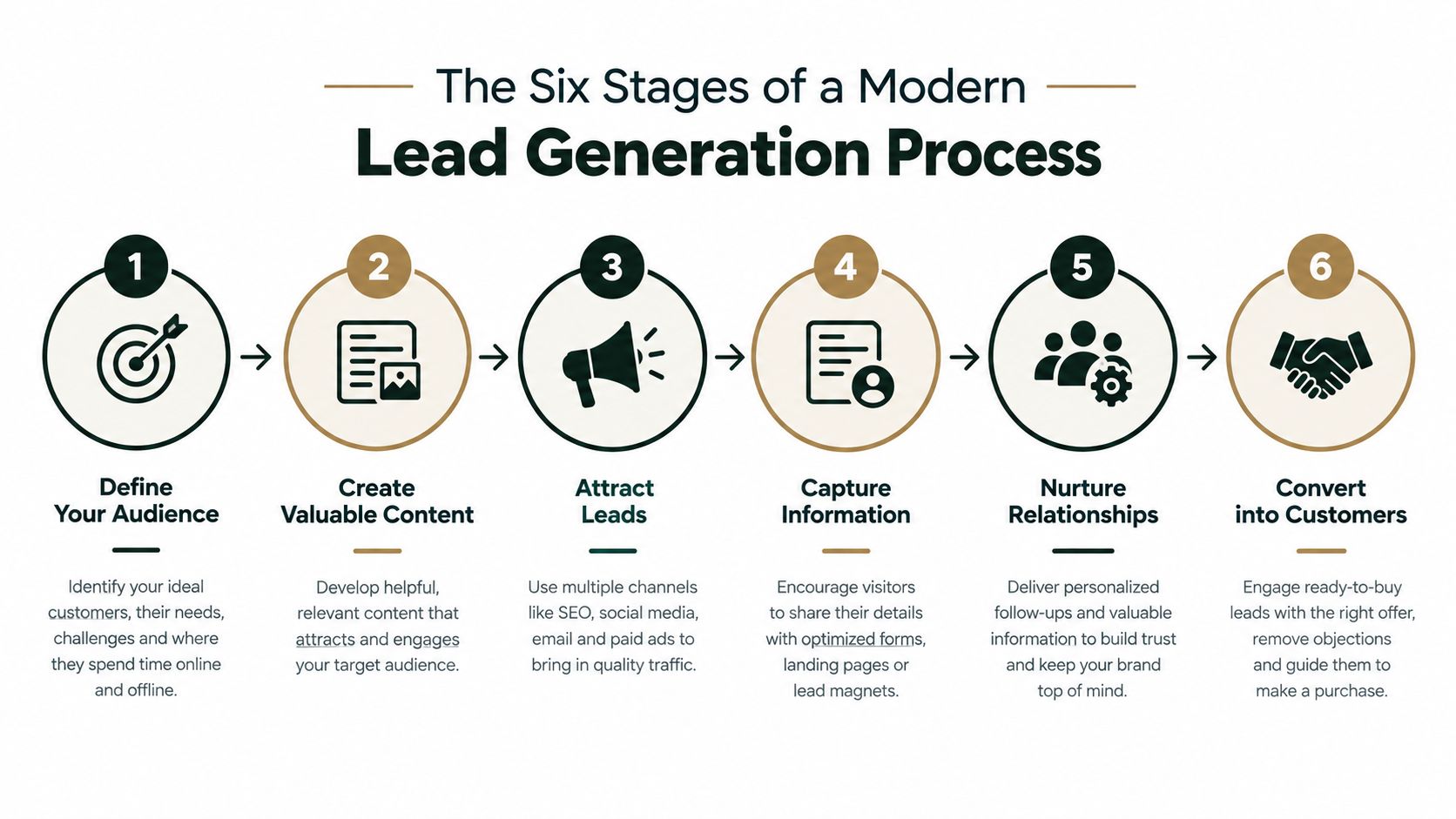
A useful operating model has six stages: Signal Capture, Verification, Enrichment, Scoring, Outreach, and Follow-Up. Each stage should produce a defined artifact, have a clear owner, and expose a metric that tells you whether the handoff is healthy.
Capture and verification
Signal Capture watches for an event instead of waiting for a list refresh. The artifact is a raw event record, owned by revenue operations or the data team. Measure signal-to-record latency, because an event that reaches the CRM days after discovery has already lost much of its practical value.
Verification checks that the event is real and that the associated company and contact data can support outreach. The artifact is a verified account-contact pair. Data operations owns this step, and the key health metric is the verification or match rate. Sending unverified emails pushes the problem into deliverability, where the SDR may not know whether a poor result came from weak messaging or bad data.
Enrichment and scoring
Enrichment adds the fields the rep needs to make the first message relevant. That may include leadership role, seniority, email pattern, phone availability, technology stack, location, funding stage, and investors. The artifact is an outreach-ready record, owned jointly by data operations and sales development. Watch for missing critical fields, not just whether a record has been enriched.
Scoring converts raw context into a priority. The artifact is a ranked queue with positive and negative reasons, owned by revenue operations with sales feedback. A useful model balances fit, current funding context, and intent. The B2B funnel benchmark from Little Bird Marketing reports website visitor-to-lead conversion typically falls in the 2% to 5% range, while average B2B lead-to-customer conversion is about 0.94%, or roughly 1 in 106 leads. Those figures make stage-level qualification more important than raw capture volume.
Outreach and follow-up
Outreach turns the ranked record into a coordinated action. The artifact is a personalized task or sequence, owned by the SDR or account executive. Measure time from verified signal to first touch, channel execution, and early reply quality. A sequence that fires from a general queue rather than from the trigger will often arrive after the account has received several similar messages.
Follow-Up manages the response path, including replies, objections, no-response branches, and nurture decisions. The artifact is a dispositioned conversation or next-step task, owned by sales. A service-level agreement should define who acts, how quickly, and what happens when the assigned rep is unavailable.
The pipeline works only when each stage passes structured data forward. Re-keying company names, copying contacts between systems, and manually rebuilding context introduce avoidable delay. Connect the event source, enrichment service, scoring logic, CRM, and inbox so the next owner receives both the record and the reason for its priority.
Sourcing and Enriching Leads from Real-Time Funding Signals
Treat sourcing as an event pipeline, not a list-purchase decision. The starting point is a funding signal, such as a verified announcement, regulatory filing, or cap-table change. The system should receive that event through a push mechanism, preserve the original evidence and event metadata, and create a candidate account without waiting for a spreadsheet refresh.
Build the pipeline around the trigger
A practical sequence looks like this:
- Receive the event: Capture the company, funding stage, amount if available, lead investors, event timestamp, headquarters, industry, website, and company profile identifiers.
- Resolve the account: Match the event to an existing CRM account or create a new one using stable company identifiers and domain data.
- Enrich the people: Find founders and relevant leaders, then add role, seniority, deliverable work email, phone availability, and verification status.
- Preserve provenance: Store where the event came from, when it was verified, and which fields were confirmed.
- Route the record: Send the completed object to scoring, then create the appropriate CRM task or sequence.
MCP-based connectors, REST APIs, and webhooks can make this flow usable by both automation agents and human operators. A structured payload might contain an event object, an account object, a contacts array, and a verification object. The exact field names matter less than consistency. Downstream systems should be able to filter on funding stage, identify the relevant decision-maker, and distinguish verified contact data from an unconfirmed guess.
For teams evaluating a live funding feed, NowFunded is one example of a source designed around structured event delivery, contact resolution, and machine-readable workflows. The operational principle is broader than any vendor: the trigger should arrive with enough context to support a decision, not merely with a company name.
Compare sources before connecting them
Source Type Typical Latency Coverage Verification Method Public announcements Variable Visible events and companies Cross-check announcement details and company identity Regulatory filings Dependent on filing availability Events that enter the relevant filing system Match filing entity, date, and transaction details Curated funding feed Near real time when supported Defined coverage by stage and market Provider validation plus field-level status Purchased database Batch-dependent Broad historical account coverage Periodic record checks and email verificationAsk three questions before adopting a source. How quickly does it deliver a confirmed event? Which companies and funding stages does it cover? Which contact fields are verified, and how is that status represented? If the source can't answer those questions clearly, your enrichment and scoring layers will inherit uncertainty.
Building a Lead Scoring Model That Prioritizes Timing
Most scoring models are good at describing an account and weak at deciding whether a rep should act today. A company's industry, headcount, and technology stack matter, but they don't carry the same urgency as a verified event that happened recently.
Build the model in layers. Start with firmographic fit, including industry, company profile, technology, geography, and the role you can reach. Add funding context, such as stage, investor relevance, and the likely business priorities associated with the raise. Then add intent signals, including hiring for growth or sales roles, meaningful product-page activity, pricing-page revisits, or a direct request.
Use recency as a first-class input
A recency rule prevents old events from dominating current opportunities. A recent Series A should outrank an older, larger round when the newer event better reflects the account's present operating phase. The model doesn't need to pretend that a funding event guarantees demand. It needs to make the event visible, explainable, and weighted against contradictory evidence.
Use positive and negative signals together:
- Positive signals: Recent verified funding, strong ICP fit, relevant leadership, matching technology, and current hiring or engagement.
- Negative signals: Competitor status, existing legal review, active nurture, unreachable contacts, incompatible industry, or a prior disqualification.
- Human override: Allow an SDR or account executive to record why a score was changed, then review those overrides during calibration.
The scoring output should show reasons, not just a number. A rep needs to know that an account ranked highly because of a recent funding event, a matching stack, and a reachable finance leader. That context turns personalization into a short research task rather than a blank-page exercise.
Signal Category Example Signal Weight Decay Rule Firmographic fit Target industry and operating profile High Remains stable until account data changes Funding event Verified recent round High Reduce priority as the event ages Investor context Relevant lead investor or portfolio pattern Medium Review as account strategy changes Intent Growth hiring or pricing-page activity Medium to high Decays quickly without another signal Contact quality Verified role and deliverable channel Gate Remove from active outreach if verification fails Suppression Competitor, legal review, or active nurture Negative Reassess only after a status changeKeep the model explainable. A complicated score that sales doesn't trust will be bypassed, while a transparent model can improve through feedback from actual conversations.
Outreach Sequences That Match Lead Response Speed
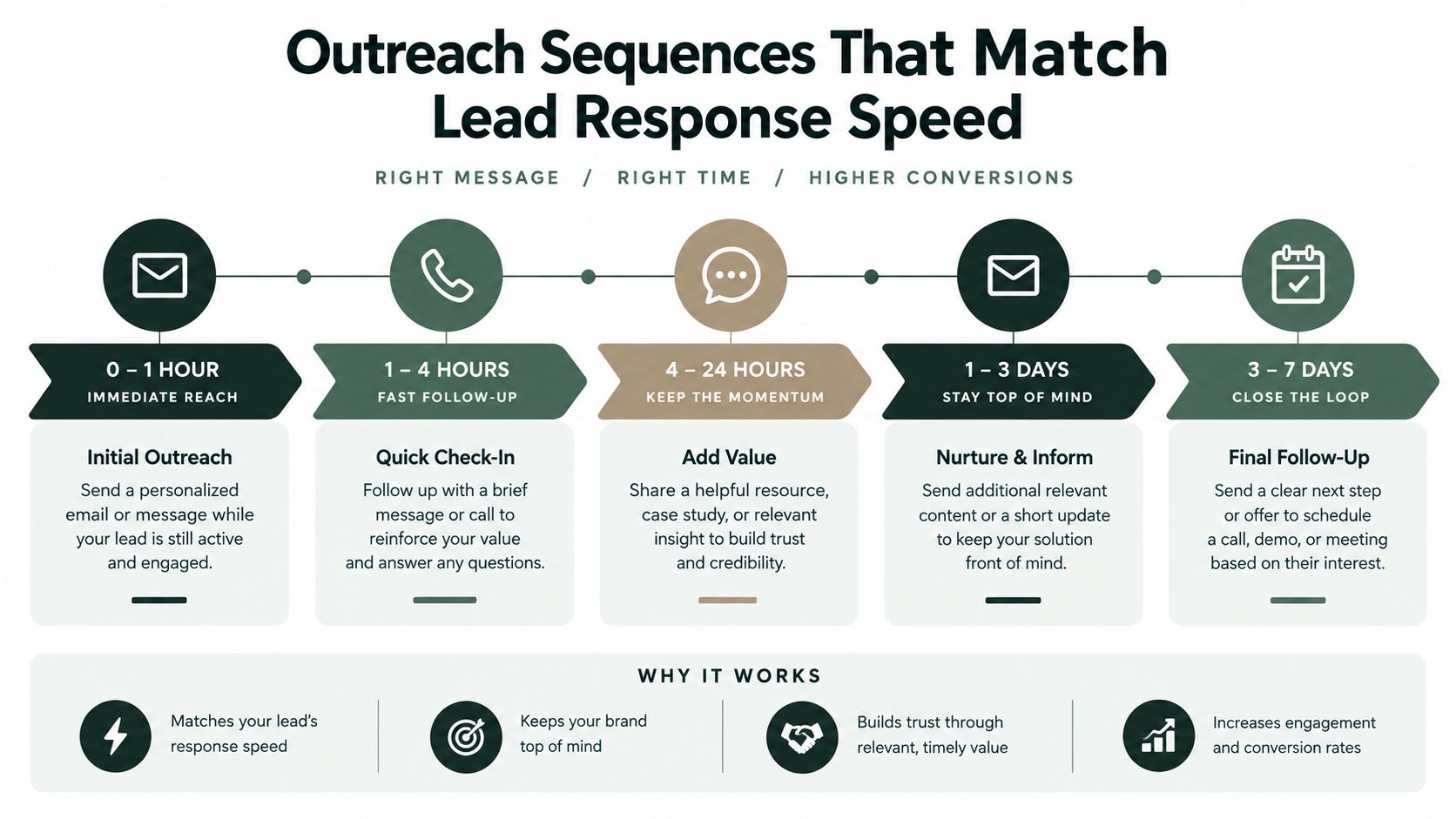
Speed-to-lead is a routing problem before it's a copy problem. The benchmark from Foundry CRO on B2B lead generation reports that the average company takes 47 hours to respond to a new lead, while only 7% respond within 5 minutes. It also reports that leads contacted within 1 minute show a 391% higher qualification rate, and 78% of buyers choose the first responder.
Those figures support a simple operating decision: reserve the fastest response path for verified, high-intent signals. Don't make every low-fit record trigger an urgent sales alert. Do make sure an A-tier account can reach the right rep without waiting in an unowned queue.
A practical first-response sequence
For a high-priority funding signal, a three-channel sequence can begin within the first response window:
- Email: Reference the verified funding event and connect it to a specific operational priority. Avoid congratulatory filler if it doesn't lead to a useful observation.
- LinkedIn: Send a brief connection request from a credible profile, with context that matches the email rather than repeating it.
- Phone or voicemail: Use the verified role and company context to leave a concise reason for the call.
SLA rules should determine the next branch. If there's no engagement after the initial period, route a peer-level nudge or a different angle. If there's no reply after the next business interval, replace the generic pitch with a message tied to the company's known technology, hiring direction, or likely post-funding workflow.
Compress cadence when the signal is hot
A-tier leads deserve a compressed sequence because the trigger is time-sensitive. B-tier accounts can use a slower cadence that allows for more research and lower operational urgency. The important distinction isn't the number of touches. It's whether the cadence reflects how quickly the reason for contacting the account can lose relevance.
Webhook delivery removes the manual step that often consumes the first part of the response window. The CRM can receive the event, invoke enrichment, assign the owner, and create the first task while the signal is still current. That workflow also makes accountability visible. Managers can inspect whether the delay happened in detection, verification, routing, or rep execution.
Measuring the Right Metrics Across the Funnel
Pipeline coverage and SQL counts describe accumulated outcomes. They don't tell an outbound leader whether the current signal pipeline is becoming slower, dirtier, or less persuasive. The useful dashboard connects each handoff to an observable operating metric.
Review speed and data quality every day
Track signal-to-contact time, verification success, enrichment match rate, and the share of high-priority records receiving an owner. These measures expose operational friction before it appears as a weak pipeline month. A record that never reaches a rep is not a messaging failure, and a reply that never enters the CRM is not a scoring success.
The Digital Applied benchmark on lead generation and marketing data reports that 75% of B2B teams say at least 10% of their lead data is inaccurate, outdated, or non-compliant, while 60% say poor data disrupts lead handoffs. The same source identifies a median Visitor-to-Lead conversion of 1.8%, Lead-to-MQL conversion of 28.0%, and MQL-to-SAL conversion of 47.1%. Those checkpoints show why the middle of the funnel deserves as much attention as acquisition.
Separate leading indicators from lagging outcomes
Metric Stage Type Review Cadence Signal-to-contact time Capture to outreach Leading Daily Verification and enrichment match rate Verification and enrichment Leading Daily Early reply rate Outreach Leading Weekly Tier-A meeting or opportunity conversion Scoring to sales Leading Weekly Lead-to-customer conversion Full funnel Lagging Monthly Customer acquisition cost Full funnel economics Lagging Monthly Source-level revenue contribution Sourcing and attribution Lagging MonthlyA weekly review should ask where the largest drop occurs, which source produces qualified conversations, and whether the scoring model predicted the accounts sales wanted. Monthly calibration should remove signals that create noise, strengthen signals that precede useful conversations, and feed sales dispositions back into sourcing.
Don't treat total leads, isolated open rates, or MQL volume as proof of progress. They can rise while verified contacts fall, response time expands, and downstream conversion weakens. The dashboard should make that contradiction hard to hide.
Rethinking Lead Generation as a Signal Pipeline
The volume-first playbook assumes that more names create more opportunities. In practice, a large list can multiply research, verification, routing, and follow-up work without improving the moments that make outreach relevant.
The Email Vendor Selection lead generation benchmark reports that 87% of B2B marketers said they successfully used content marketing to generate leads, and 76% said they achieved their lead-generation goals through content marketing. Email remains the leading B2B channel in the cited summaries, and LinkedIn is repeatedly identified as the strongest social platform for high-authority leads. Content and channels still matter, but they shouldn't distract operators from the data path that determines whether a rep reaches a buyer while the trigger is fresh.
A signal-first process asks a different question: can the team detect, verify, enrich, rank, and contact the right person before another vendor does? That model favors fewer records with clear provenance over a huge export with uncertain freshness. It also makes the trade-off explicit. Broad lists offer reach, while verified event-driven records offer context and urgency.
Metric Volume-First (10K list) Signal-First (400 leads) Primary advantage Broad account coverage Clear reason and timing for contact Main risk Stale data and diluted rep attention Narrower source coverage Workflow demand Heavy manual sorting and research Strong integration and routing discipline Best use Market mapping and account discovery Triggered outbound and priority plays Management focus List size and activity Verification, latency, and conversation qualityThe operational counter-thesis is simple: don't ask your SDRs to manufacture urgency from old data. Give them a verified event, a reachable decision-maker, a concise reason to engage, and a workflow that starts immediately. The process becomes easier to improve because every failure has a location: detection, verification, enrichment, scoring, routing, or follow-up.
Teams that want to operationalize that approach can review NowFunded's funding intelligence resources and assess whether live event delivery, structured records, and verified contacts fit their outbound stack.
NowFunded provides a live, verified feed of newly funded startups, with structured company data, leadership contacts, MCP, REST API, webhook, CSV, and dashboard delivery options. Visit NowFunded to connect funding signals to your enrichment, scoring, and outreach workflow before the opportunity goes cold.