10 Lead Generation Examples Using Startup Funding Data
A newly verified funding event can be a stronger buying signal than a broad startup list, but timing alone doesn't create a qualified lead. The event must become a matched account, the right decision-maker, and a message that reflects what the company is likely doing next. That conversion matters because the average B2B website visitor-to-lead conversion rate is 2.6%, while cold B2B email reply rates generally range from 1% to 5%, according to B2B lead-generation benchmark data.
The following lead generation examples treat funding as an operational trigger rather than a reason to send generic congratulations. Each workflow uses a different combination of timing, segmentation, enrichment, routing, and outreach. NowFunded provides the underlying live feed, structured funding fields, verified founder and leadership contacts, webhooks, REST API access, MCP support, CSV export, and historic records for building these systems.
For every example, assess six points: the trigger, the qualification logic, the contact strategy, the sequence, the trade-offs, and the next action. That framework helps sales development teams, recruiters, researchers, and AI-agent builders decide which workflow fits their bottleneck instead of copying whichever tactic looks most familiar.
Table of Contents
- 1. Real-Time Webhook-Based Lead Capture
- 2. Verified Contact Enrichment for Founder and Leadership Targeting
- 3. API-Driven Programmatic Lead Scoring and Filtering
- 4. Multi-Channel Outreach Sequences Triggered by Funding Events
- 5. Investor-Based Lead Clustering and Account Mapping
- 6. Vertical and Industry-Specific Outbound Campaigns
- 7. Geographic and Regional Lead Expansion Campaigns
- 8. Headcount-Based Hiring and Partnership Outreach
- 9. AI Agent and Automation Workflow Integration for Continuous Lead Generation
- 10. Competitive Displacement, Win-Back, and Data-Driven Content Marketing
- 10 Lead Generation Examples Comparison
- Turn the Strongest Example Into a Repeatable System
1. Real-Time Webhook-Based Lead Capture
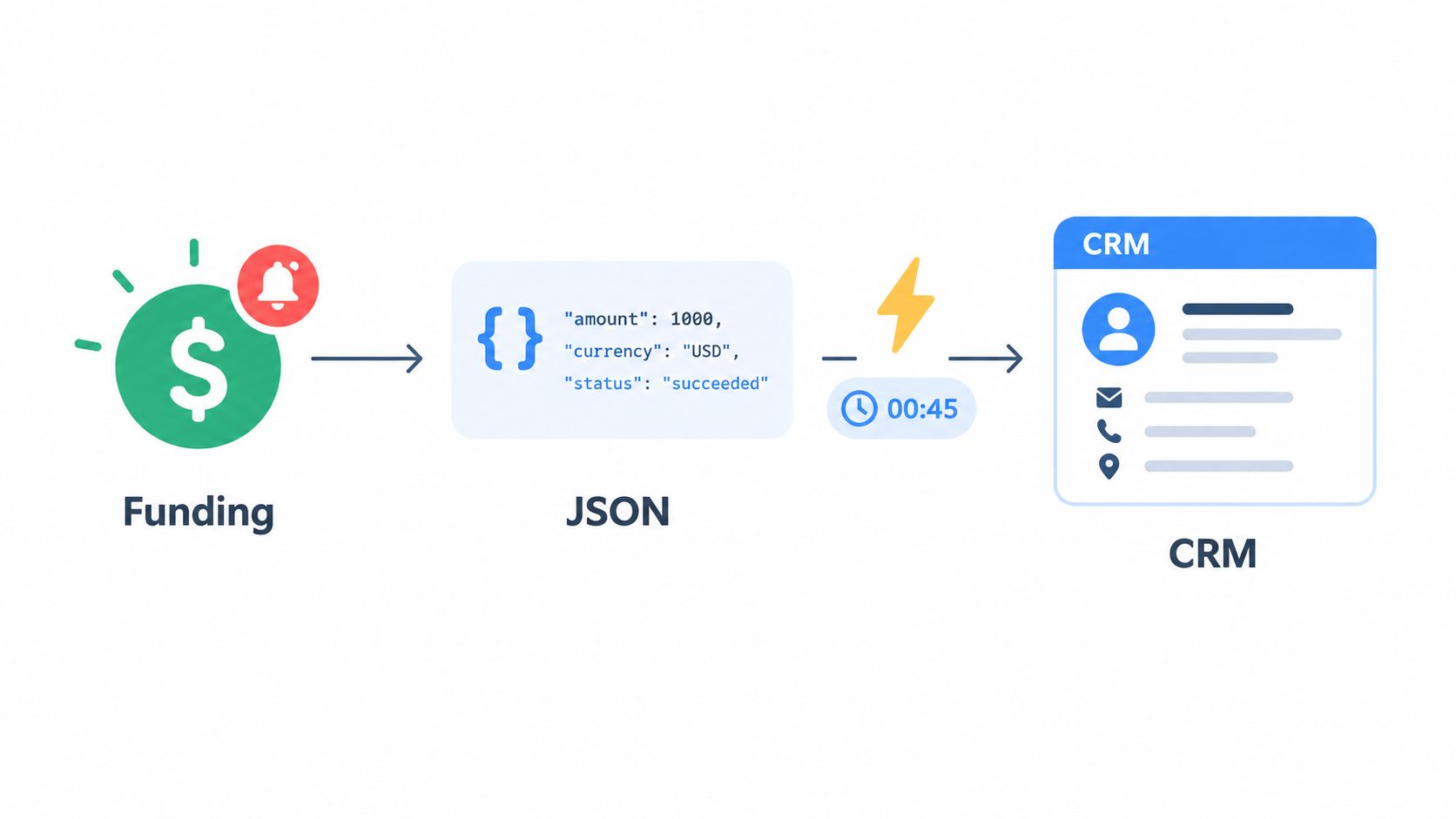
A webhook turns a verified funding event into an immediate operating instruction. When NowFunded sends an HTTP POST containing structured startup data, a sales team can create or update the account in its CRM, apply qualification rules, and route the record to an SDR without waiting for a manual list review.
A practical workflow starts with a narrow trigger, such as a newly verified Series A or later round in a target industry. The webhook payload can then populate company name, round, amount raised, lead investors, headquarters, headcount, industry, website, and LinkedIn profile. From there, the CRM can assign ownership, create a task, and request verified contact enrichment only when the account passes the initial filter.
This design is useful beyond sales. A recruiting team might alert consultants when a funded startup matches a hiring profile. An AI agent might receive the event, check account rules, retrieve a founder contact, and prepare a first-touch message.
Build reliability into the trigger
Webhook speed creates no value if the system duplicates records or drops failed deliveries. Use an idempotency key so retries don't create multiple accounts, and route failed deliveries to a dead-letter queue for review. Filtering at the webhook layer also reduces noise and keeps downstream systems focused on high-intent events.
Practical rule: Treat every funding notification as an event to process, not as permission to contact everyone connected to it.
Track delivery latency, processing time, duplicate rate, and routing failures. The next action should be a CRM task tied to the funding event, not an unstructured alert in a shared channel.
2. Verified Contact Enrichment for Founder and Leadership Targeting
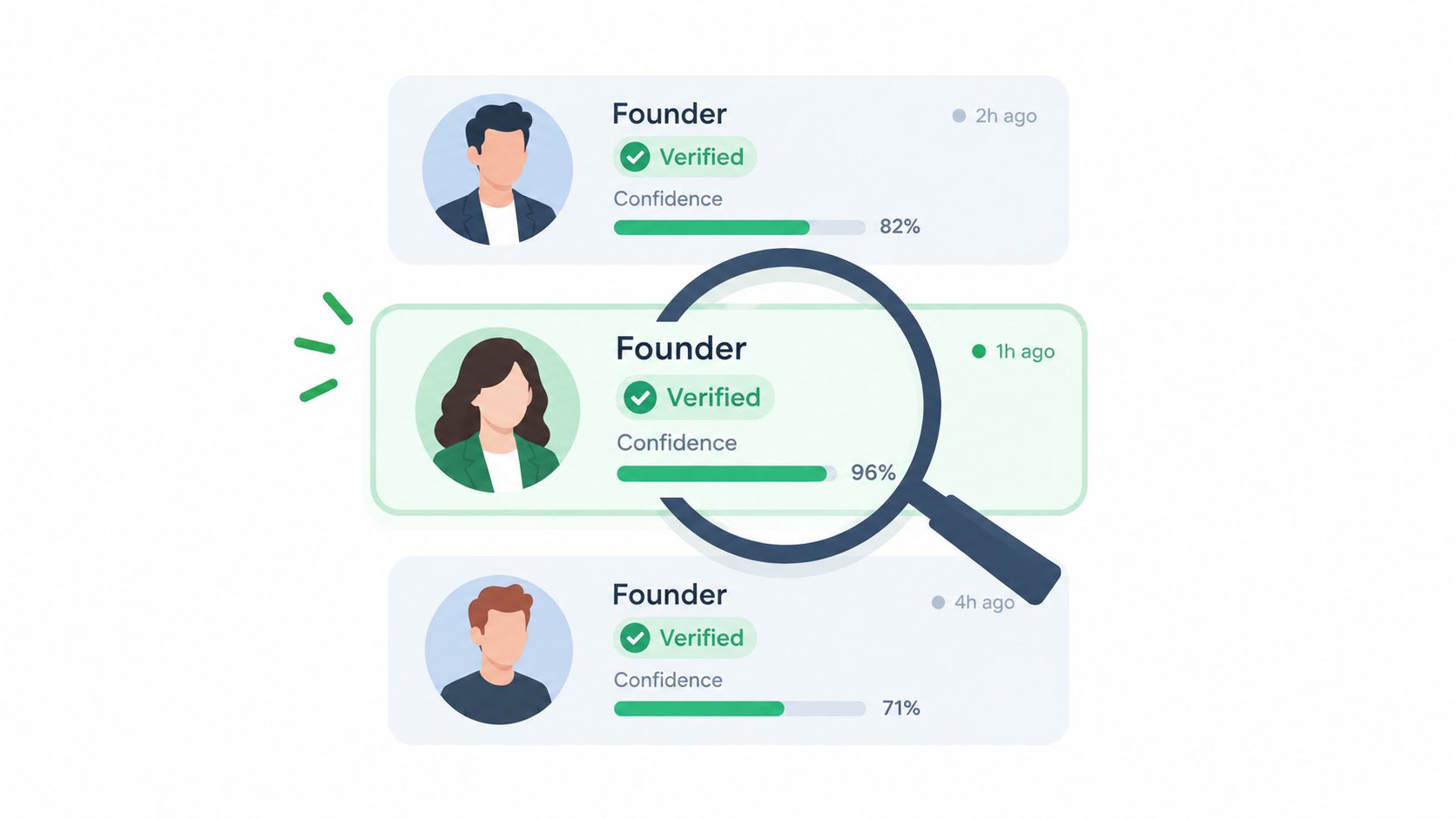
A funding record identifies an account. Verified contact enrichment turns that event into a reachable, qualified lead by connecting the company to founders and leaders who can approve a purchase, partnership, or recruiting conversation. Useful fields include role-level names, deliverable work emails, phone numbers, and explicit verification status.
For a recruiting firm targeting early-stage engineering teams, the workflow can filter for a recently funded startup with a technical hiring profile, then identify the CTO or VP of Engineering instead of sending a message to info@company.com. A finance software provider can target the CFO, while a partnership team may prioritize the founder. The funding event supplies timing, and the role filter supplies relevance.
Define the target roles before pulling contacts. This limits enrichment to people connected to the campaign and keeps contact costs tied to a qualification rule. Store verification status and its timestamp in the CRM, then recheck stale records before reuse. The result is a cleaner handoff from funded account to person-level outreach.
Make the message role-specific
A verified address does not create relevance by itself. Combine the contact record with LinkedIn research, the funding round, the company's product category, and visible hiring or expansion signals. A founder may care about strategic capacity after a raise. An engineering leader may respond to recruiting infrastructure or technical scaling. These distinctions determine both the opening message and the proposed next step.
Use phone and email as coordinated channels while respecting consent, unsubscribe requests, and do-not-contact rules. Test subject lines and opening messages by role, not only by company segment. Teams seeking practical research workflows and startup-market context can consult the NowFunded blog, provided the link is not repeated elsewhere in the article.
The next action should be a short, role-specific message with one relevant reason for contact and one clear response path.
3. API-Driven Programmatic Lead Scoring and Filtering
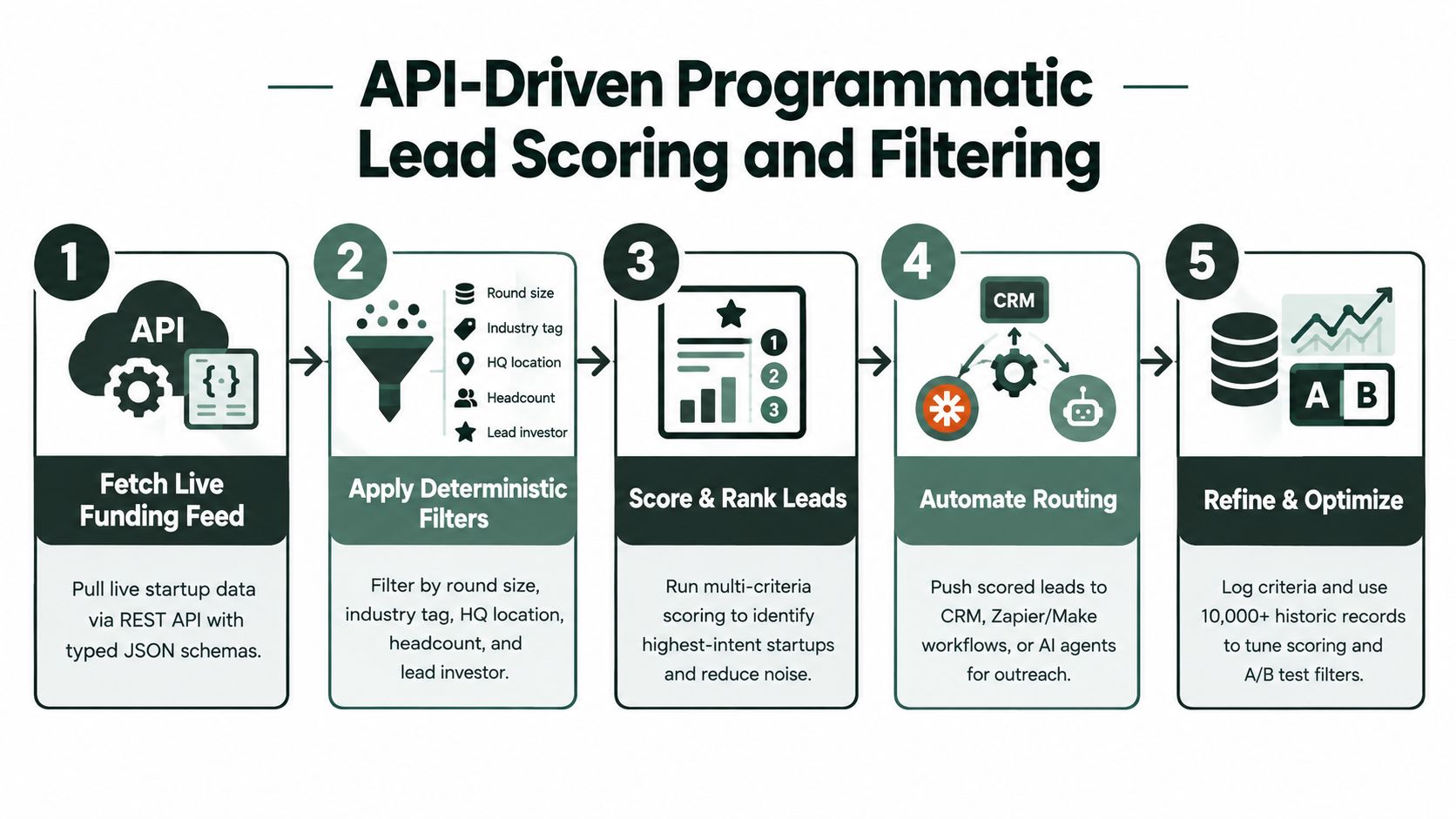
An API lets operations teams define what “qualified” means in software. Instead of downloading a broad funding list and asking reps to sort it manually, a workflow can query live events, apply deterministic rules, and return only companies that fit the campaign.
A sales operations manager might query for newly funded startups in a selected vertical, at a chosen round stage, with a defined headcount range and relevant investors. A recruiting team could use headcount and stage to identify companies likely to be building a larger team. An AI agent could rank results using a scoring function that combines industry, location, investor profile, funding stage, and CRM history.
Start broad enough to learn. Overly narrow filters can hide useful accounts before the team understands which signals correlate with qualified conversations. Log the criteria applied to every record, then compare outcomes by segment so the scoring model improves through win and loss data.
Use historical records as a calibration layer
NowFunded's historic database contains 10,000+ records from the last 12 months, which can support lookbacks and pattern analysis. A team might compare its highest-value customers against historical funding stage, industry, investor, location, or headcount fields before setting production rules.
Technical controls matter too. Cache repeated queries, use exponential backoff for temporary failures, and monitor rate limits. Keep live retrieval separate from enrichment so the system doesn't pull contact data for accounts that fail qualification.
The best next action is a ranked queue with an explanation for each score. Reps should be able to see why an account was selected, not just that an algorithm selected it.
4. Multi-Channel Outreach Sequences Triggered by Funding Events
Funding can justify a coordinated sequence, but it shouldn't justify a high-volume barrage. A useful workflow sends a relevant first message after verification, then gives the prospect time to respond before adding another channel.
A sales sequence might begin with an email referencing the round and the company's growth context. The following touch could use a verified phone number, followed by a LinkedIn interaction and a useful resource tied to the startup's likely priorities. A recruiting sequence could address the founder first, then contact the technical leader with a separate message about hiring execution.
The sequence should preserve one narrative across channels. If the email discusses scaling finance operations, the phone call shouldn't switch abruptly to an unrelated product pitch. Each touch should add context, answer a likely objection, or offer a lower-friction next step.
Balance speed with restraint
Cold outbound reply rates typically cluster around 1% to 3% for average campaigns, while highly targeted campaigns can reach roughly 8% to 12% or higher, and strong campaigns book meetings from about 0.5% to 2% of total contacts reached, according to cold outbound benchmark guidance. Those figures make relevance, list quality, and message discipline more important than just adding touches.
Space contacts across a sensible interval, monitor channel-level replies, and stop the sequence when a prospect responds or opts out. Build the workflow with NowFunded's live startup funding data so the trigger remains tied to a verified event rather than a stale spreadsheet.
5. Investor-Based Lead Clustering and Account Mapping
The lead investor can act as a useful clustering field. Startups backed by the same firm may share sector exposure, operating expectations, hiring patterns, or access to a common founder network. That doesn't make them identical, but it gives an account-based campaign a more intelligent starting point than company size alone.
A sales team could identify SaaS startups in a target funding stage backed by a particular venture firm, then build a coordinated campaign around a problem common to that portfolio. A recruiting firm might map engineering-heavy companies across several investor portfolios and approach them with a portfolio-aware hiring partnership. A market intelligence team could use investor clusters to observe emerging sectors and compare follow-on activity.
Investor data works best when combined with industry, location, headcount, and funding stage. A portfolio list without those filters can become too broad to personalize. Research the investor's thesis and portfolio composition, then create separate messaging tracks for different investor archetypes.
Turn clusters into account maps
Map the investor, portfolio company, founder, relevant leadership contacts, and any existing relationship in the CRM. Track multiple funding rounds so the team can distinguish a new announcement from a company with sustained backing. That distinction can change the message from immediate post-raise support to longer-term expansion planning.
Measure conversion by investor-backed cohort, but don't treat the investor as proof of fit. The next action should be a small account list with a shared hypothesis, a role-specific contact plan, and a message that explains why the cohort was selected.
6. Vertical and Industry-Specific Outbound Campaigns
Industry tagging becomes valuable when it changes the message, not merely the filter. A healthcare data vendor approaching newly funded healthtech companies should address data governance and sector-specific operating constraints. A recruiting platform targeting fintech startups might focus on compliance hiring, specialist talent, and the execution pressure that accompanies growth.
The funding event supplies timing. The vertical supplies relevance. Together, they let a team write an opening that reflects the company's market instead of repeating a generic “congratulations on your raise” template.
Build a reusable vertical evidence base
Create a research library for each priority sector. Include common workflows, competitive pressures, terminology, relevant events, and questions buyers ask before adopting a solution. Store these references in the campaign system so reps and AI agents can use the same approved context.
A vertical campaign should still qualify accounts by stage, headcount, location, and role. A newly funded company in the right industry may not have the operational maturity or use case the offer requires. Use the industry tag as a relevance layer, not as the entire scoring model.
The funding event creates urgency. Industry context earns attention.
Test one vertical message against another, then inspect reply quality, meetings, objections, and disqualification reasons. A high reply count with poor fit isn't a successful lead-generation workflow. The next action should be a message designed for one vertical and one decision-maker, supported by a clear reason that the timing matters.
7. Geographic and Regional Lead Expansion Campaigns
A funding feed can help a company enter a region with a defined account universe. For example, a US fintech vendor expanding into Europe could filter newly funded companies headquartered in London, Berlin, or Amsterdam, then adapt its outreach to local market conditions and business hours.
The workflow starts with geography, but it shouldn't end there. Add industry, funding stage, investor, headcount, and relevant leadership role. A startup in Singapore may need a different expansion message from one in a European hub, even when both sit in the same broad vertical.
Localize operations, not just copy
Research regional venture ecosystems, accelerators, investors, associations, and events. Those details can inform partnerships, social proof, and account mapping. Schedule messages using the recipient's local time, and assign regional ownership in the CRM so follow-up doesn't cross time zones unnecessarily.
Language and compliance also require care. Use locally appropriate wording, respect regional contact rules, and make opt-out handling visible. A regional campaign that sends identical messages everywhere can create friction instead of relevance.
For example, a recruiting firm entering a new market might select recently funded startups in a local hub, enrich founders and technical leaders, then offer a region-specific hiring conversation. A sales team might build a similar flow around local implementation support or market-entry expertise.
Measure conversion by region and segment, not only by total campaign output. The next action is a small regional cohort with localized copy, timezone-aware routing, and one clearly defined expansion hypothesis.
8. Headcount-Based Hiring and Partnership Outreach
Headcount gives funding data an operational dimension. A recently funded startup with a small team may need recruiting infrastructure, finance support, or foundational systems. A larger startup may be replacing lightweight tools, formalizing processes, or coordinating a wider hiring program.
A recruiting platform could combine a funding event with a headcount range and recent job postings to identify companies with confirmed hiring intent. An employee-experience vendor might target a more established team, while an infrastructure provider could approach a smaller startup before it commits to a long-term architecture.
The key is to avoid treating headcount as a standalone proxy for need. Combine it with round stage, funding recency, role distribution, and visible hiring activity. A company with a particular headcount may be stable, shrinking, or hiring selectively.
Use headcount as a routing condition
Set thresholds inside the automation workflow, then route each band to a different playbook. The message should reflect maturity. A small team may value speed and low implementation overhead. A larger team may care more about governance, integration, and repeatability.
Track headcount changes over time when historic records support the comparison. Growth velocity can help prioritize accounts, but the sales or recruiting team should still verify the current situation before contacting anyone.
A useful next action is a two-step qualification check: confirm the funding event, then confirm hiring or operational intent through company pages, job listings, or relevant leadership research. Only then should the team pull the contact and begin outreach.
9. AI Agent and Automation Workflow Integration for Continuous Lead Generation
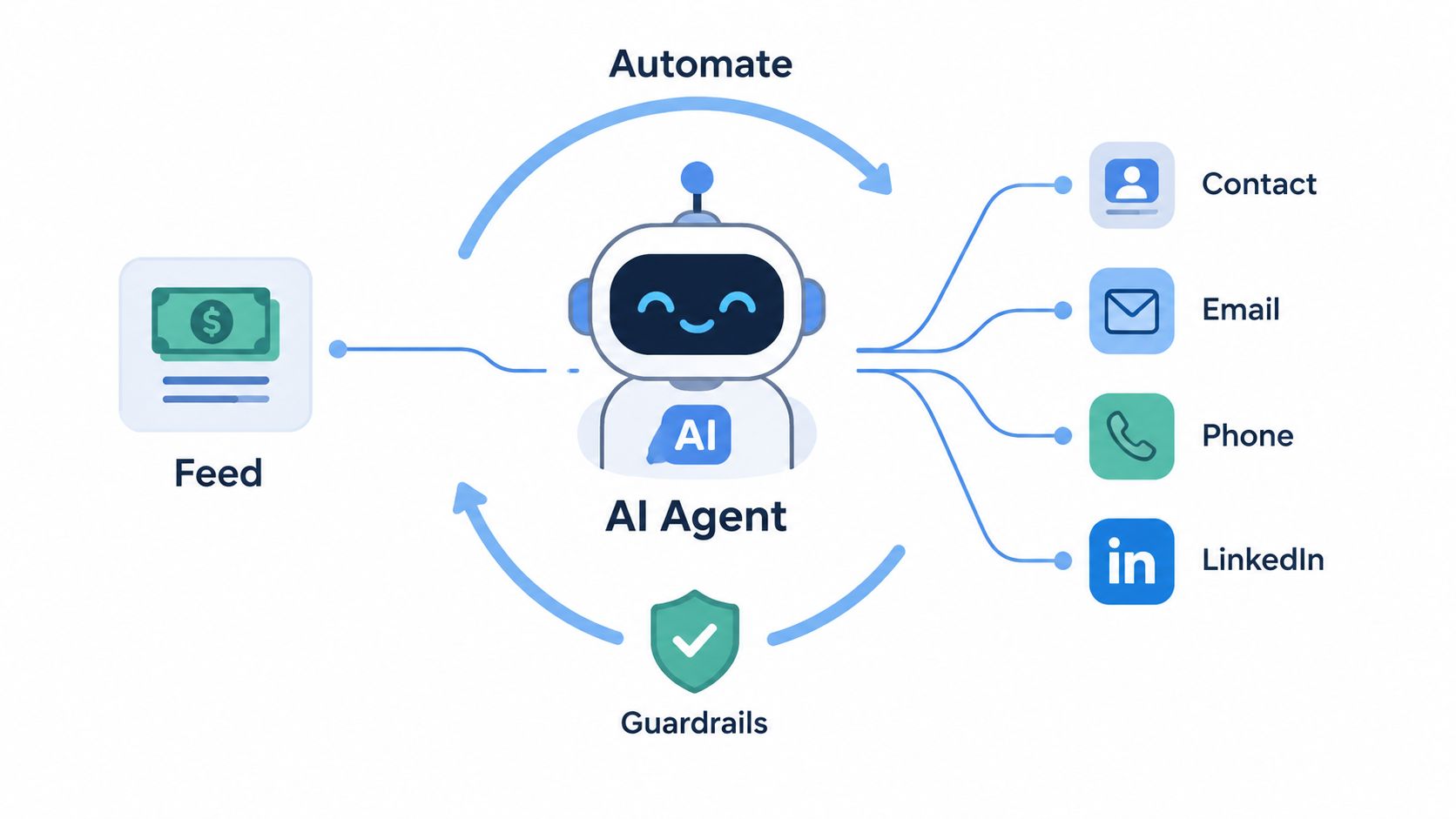
AI agents can connect funding discovery, qualification, research, message drafting, and routing into one workflow. A narrowly scoped agent might fetch newly funded B2B SaaS companies, apply a defined score, retrieve a verified founder contact, draft an email, and place the record in a human approval queue.
A recruiting agent could monitor a selected funding stage, identify companies with engineering hiring signals, enrich the CTO contact, and schedule a recruiter review. A marketing workflow could use the same feed to invite matched founders to a relevant report, webinar, or research conversation.
The useful distinction is between automation and autonomy. Automation executes known rules. Autonomy introduces judgment, which needs controls. Keep the first deployment narrow, with one vertical, one use case, and one approved sequence.
Add approval and audit controls
Require message preview before sending, filter by approved domains, check do-not-contact records, and use verified contact data exclusively. Log the source event, applied filters, enrichment result, generated message, and final action. Monitor bounces, replies, unsubscribe requests, and human overrides.
An agent shouldn't invent funding context or infer a business problem that the record doesn't support. Structured JSON fields from NowFunded give the workflow grounded inputs, while the operator remains responsible for the campaign's claims and compliance.
Test the agent on a sample cohort before production. The next action is a human-reviewed queue, not an unrestricted multi-channel launch.
10. Competitive Displacement, Win-Back, and Data-Driven Content Marketing
Funding events can create qualified leads for both defensive sales and demand generation, but the workflow differs by intent. When a competitor raises capital, analysts can identify customers exposed to that competitor, combine the event with CRM data, and route accounts to retention or migration outreach.
Funding alone does not establish risk. Customer usage, renewal timing, unresolved support issues, product gaps, and prior win-loss notes provide the qualification layer. Segment accounts by exposure and urgency, then match each group with an approved message and owner. This turns a verified funding event into a targeted win-back opportunity rather than a broad competitor campaign.
The same event data can support content-led acquisition. A B2B SaaS company might publish analysis of startup funding patterns, create hiring guides for specific verticals, interview founders, or host a webinar on operational changes after a raise. Each asset should connect a funding signal to a decision the audience needs to make, giving prospects a relevant reason to engage.
Separate the defensive and editorial tracks
Win-back campaigns need battle cards, approved differentiators, and practical migration or integration support where appropriate. Content campaigns need a stated methodology, verified funding records, and insights that remain useful without a sales conversation.
Use first-party capture selectively. Keep a short insight open, while placing a detailed benchmark report or webinar registration behind a clear exchange. Distribute through founder communities and LinkedIn, then enrich engaged accounts, score their fit, and route qualified responses into a measured nurture path.
The implementation choice is straightforward: select one competitive risk or editorial theme, define the account criteria, and connect engagement to qualification. NowFunded funding records supply the event trigger, while CRM context and verified contacts determine whether the next action is retention outreach, win-back, or content nurture.
10 Lead Generation Examples Comparison
Strategy Implementation complexity Resource requirements Expected outcomes Ideal use cases Key advantages Real-Time Webhook-Based Lead Capture Moderate, webhook endpoint, retry & idempotency Low–moderate engineering, monitoring, CRM integration Sub-minute lead delivery, faster outreach response SDRs and AI agents needing instant prospecting Fastest contact, lower polling costs, verified payloads Verified Contact Enrichment for Founder & Leadership Targeting Low, API integration to retrieve contacts Pay-per-verified-contact budget, integration & periodic reverify Higher open/response rates, lower bounce and wasted sends Outbound sales, recruiters, personalized campaigns Verified role-level contacts, pay-for-success billing, improved deliverability API-Driven Programmatic Lead Scoring and Filtering Moderate–high, API, scoring logic, scripting Dev/analytics resources, historic data, caching Clean, high-fit lead lists, reproducible scoring and audits Sales ops, marketing ops, AI agent developers Deterministic filters, auditability, scalable rule-based routing Multi-Channel Outreach Sequences Triggered by Funding Events Moderate, orchestration across channels and CRM Automation platform, content, SDR/phone resources Higher engagement via coordinated touches, faster feedback loops High-velocity SDR campaigns, recruiting sequences Multi-channel lift, synchronized timing, personalized sequences Investor-Based Lead Clustering and Account Mapping Low–moderate, grouping and portfolio mapping Research into investor theses, analytics tooling Cohort identification, ABM-ready account lists Enterprise ABM, partnership outreach, market intelligence Portfolio-based targeting, cohort insights, investor signals Vertical and Industry-Specific Outbound Campaigns Low–moderate, vertical tagging and messaging Industry research, vertical content and case studies Higher relevance and ROI within target sectors Vertical-focused sales/marketing teams Deep credibility, sector-specific value propositions Geographic and Regional Lead Expansion Campaigns Low, location filtering and localization Regional expertise, localized assets, timezone automation Localized engagement, regional partnerships, market entry support Regional expansion teams, localized sales operations Cultural relevance, regional targeting, timezone-optimized outreach Headcount-Based Hiring and Partnership Outreach Low, headcount filters combined with signals Data validation, recruiting research, messaging variants Targeted hiring and partnership leads aligned to maturity Recruiters, HR tech vendors, infrastructure providers Stage-aligned positioning, predicts hiring needs, simplifies targeting AI Agent and Automation Workflow Integration for Continuous Lead Generation High, MCP/LLM integration, guardrails, monitoring AI engineers, infrastructure, verification data, observability 24/7 autonomous lead gen, scalable outreach, reduced manual effort AI-first orgs, advanced sales ops, automation teams Continuous scaling, deterministic workflows, automated personalization Competitive Displacement, Win-Back & Data-Driven Content Marketing Moderate–high, competitor mapping plus content programs Content team, competitive intelligence, long-term analytics Inbound lead growth, account defense, thought leadership Enterprise sales, customer success, long-term marketers Defensive playbook, data-driven authority, long-term inbound funnelTurn the Strongest Example Into a Repeatable System
The strongest starting point isn't necessarily the most complex workflow. Choose the segment where your team already understands the buying motion, then connect one verified funding trigger to one CRM queue. A recruiting team might begin with newly funded startups showing engineering hiring intent. An SDR team might begin with a single vertical and funding stage. A research group might begin with investor or regional clustering.
Keep the first system deliberately narrow. Define the trigger, select the fields that matter, and enrich only the roles required for the campaign. If the first campaign targets founders, don't pull a full leadership map. If it targets technical hiring, prioritize the CTO or VP of Engineering. This reduces unnecessary data use and makes it easier to identify which part of the workflow creates value.
The next step is a concise sequence with a clear stop condition. Use one relevant funding fact, one reason the recipient may care, and one requested action. A webhook or API can create the task quickly, but a human should still be able to inspect the account, contact verification status, and message before outreach expands.
Timing matters because response speed affects qualification. Independent outbound data reports that responding within 5 minutes makes a lead about 21 times more likely to qualify, while responding within 1 hour makes it about 7 times more likely to qualify, according to large-sample outbound response data. That makes routing, alerts, ownership, and queue management part of lead generation, not merely sales administration.
Quality controls matter just as much. Only 27% of marketing-generated leads are contacted by sales, and 79% of marketing leads never convert to sales, according to the B2B lead-generation benchmark summary. Those figures explain why a large event feed can underperform if the team lacks contact ownership, nurture logic, and follow-up discipline.
Review each workflow against these questions:
- Trigger latency: How long passes between funding verification and CRM visibility?
- Qualification rate: What share of triggered accounts meets the campaign's fit rules?
- Contact verification: Was the selected person's role and deliverability status confirmed?
- Reply quality: Do responses indicate relevant interest, or are they mostly polite acknowledgments and objections?
- Bounce and unsubscribe handling: Does the system suppress bad addresses, opt-outs, and do-not-contact records immediately?
- Conversion by segment: Which combinations of industry, stage, location, investor, headcount, and role create qualified opportunities?
Finally, don't optimize for raw lead volume without checking handoff performance. One benchmark set reports that only 13% of marketing-qualified leads convert to sales-qualified opportunities in B2B SaaS, based on Salesforce's State of Sales 2024 findings across 5,500 sales professionals in 27 countries, as summarized in B2B lead-generation benchmark coverage. The strategic lesson is straightforward. A verified funding event becomes a qualified lead only when fit filters, verified contacts, relevant messaging, routing, safeguards, and measurement work as one system.
NowFunded provides a live, verified feed of newly funded startups from pre-seed through Series B, with structured company fields, verified founder and leadership contacts, MCP, REST API, webhook, CSV, and dashboard delivery. Use NowFunded to turn funding events into filtered, enriched, and actionable lead-generation workflows instead of relying on stale lists or manual research.