10 Lead Enrichment Tools for Better Outreach

The largest contact database isn't automatically the best lead enrichment tool. A broad record count can still leave your team with an unverified email, an outdated title, weak regional coverage, or a phone number that doesn't support the workflow you run day to day. The right choice depends on the moment you need the lead and the field that must be accurate.
This comparison evaluates deliverability, email and phone verification, enrichment depth, API and webhook support, implementation effort, pricing predictability, and operational fit. It includes platforms for CRM enrichment, developer-led workflows, European outreach, manual prospecting, and event-triggered campaigns. It also includes an adjacent data source, NowFunded, for teams that want verified leadership contacts connected to newly funded startups rather than a general-purpose database.
Lead data decays quickly. One industry analysis estimates that around 30% of B2B contact data becomes stale each year, while other estimates put the share of CRM records that become outdated, incomplete, or inaccurate within a year as high as 70%. The contact enrichment landscape analysis also cites 22% contact-data decay every six months, which makes refresh strategy as important as the initial lookup.
Table of Contents
- 1. NowFunded
- 2. Clearbit by HubSpot
- 3. ZoomInfo Enrich
- 4. Apollo.io
- 5. Cognism
- 6. Lusha
- 7. RocketReach
- 8. People Data Labs
- 9. FullContact Enrich
- 10. Dropcontact
- Top 10 Lead Enrichment Tools Comparison
- Choose the Workflow Before You Choose the Vendor
1. NowFunded
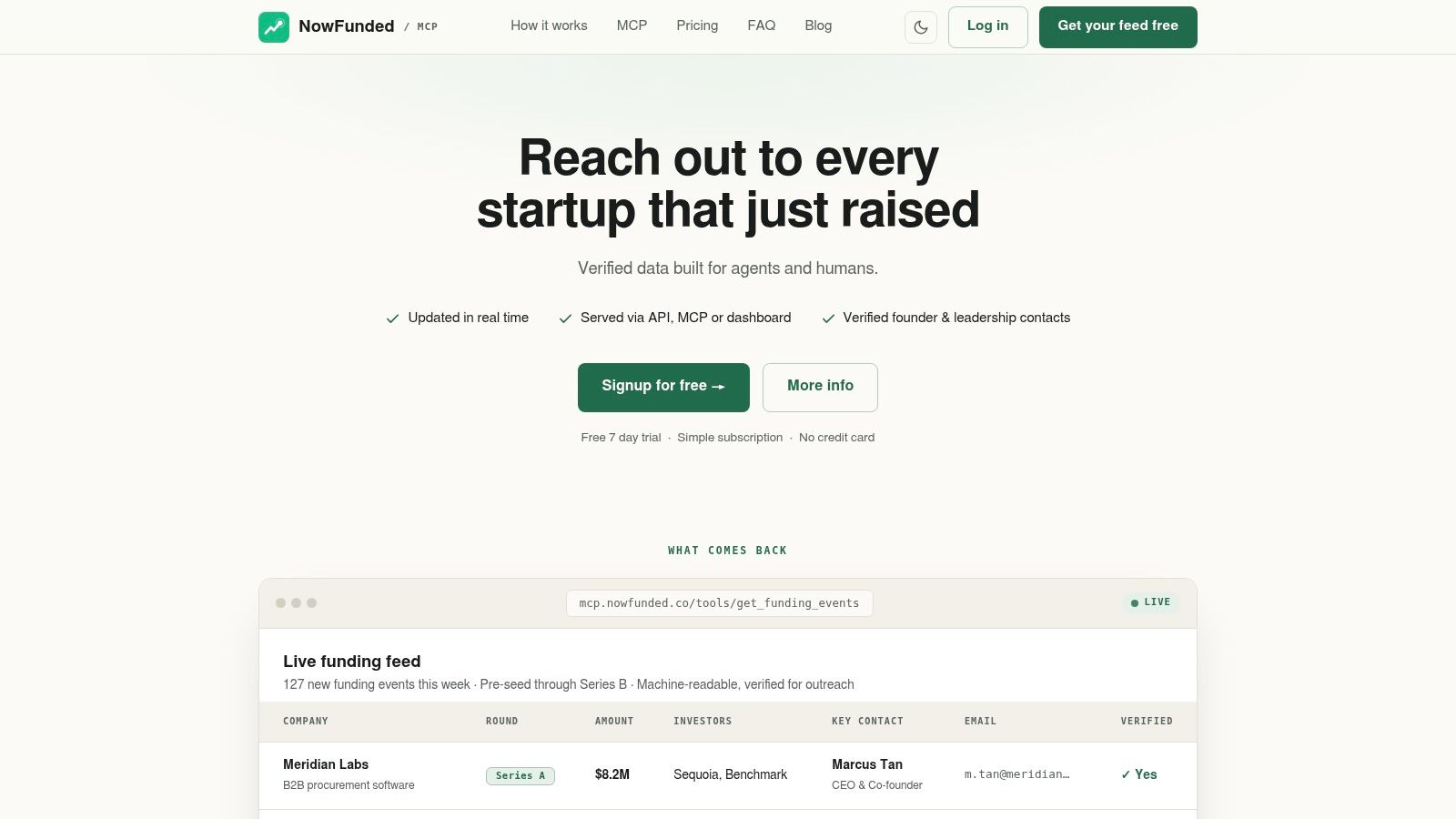
NowFunded fits teams that prioritize a timely trigger over a large static database. It tracks newly funded startups from pre-seed through Series B, then provides verified founder and leadership contacts after a confirmed funding event. That positions it as an event-driven prospecting source rather than a general-purpose enrichment suite.
Its records include the company, round, amount, lead investors, headquarters, headcount, industry tag, website, and LinkedIn profile. New entries appear within minutes. The service tracks 100+ new startups weekly and maintains a historic database of 10,000+ records from the last 12 months, according to the product information supplied for this comparison. Funding-event data is free to query, while contact pulls use a usage-based model.
Best use: Trigger outreach, recruiting, or research from a verified funding event, then enrich only the leadership records you intend to use.
Why the workflow stands out
NowFunded returns typed JSON through MCP, REST API, webhooks, CSV, or a dashboard. MCP support suits AI-agent developers who need consistent fields instead of loosely formatted research results. Webhooks let engineering teams receive new events without maintaining polling loops or scrapers.
The contact workflow puts verification first. Current stated rates are $0.10 per verified email and $0.25 per verified phone, with failed verifications not charged. The published usage model helps buyers compare expected contact volume with subscription and credit-based alternatives. For SDR and recruiting workflows, that makes the cost easier to tie to contacts that were used, although high-volume campaigns still require forecasting.
Trade-offs for operators
The focus on early-stage startups supports first-mover outreach but limits coverage. Teams targeting late-stage companies or public enterprises will need another source. Per-contact billing may become less predictable when a campaign requires many leadership contacts, even without a subscription or minimum spend for funding-event access.
SDRs gain timing and role relevance. Recruiters can monitor newly financed companies for hiring opportunities, while researchers and developers receive structured funding context for an agent or automation. The supplied information does not list public awards or third-party certifications, so buyers should test field quality against their own sample before expanding usage.
Explore NowFunded's funding and contact data
2. Clearbit by HubSpot
Clearbit is now most useful inside the HubSpot environment. HubSpot operates the product as a native enrichment layer, with company and contact updates, field mapping, overwrite controls, and batch workflows connected directly to the CRM. Teams already using HubSpot can avoid building a separate sync between their system of record and an enrichment vendor.
The platform supports 100+ attributes, according to the supplied product details. That breadth matters when marketing and revenue operations need more than an email address, such as company context, role information, or segmentation fields. Batch enrichment also gives administrators control over which CRM fields may be updated, reducing the risk that an automated process overwrites carefully maintained records.
The main advantage is implementation simplicity. HubSpot workflows, record creation, and enrichment live in one operational environment, so a marketing team can configure the process without asking engineering to maintain a separate integration.
Where the fit weakens
Clearbit is primarily HubSpot-native now, which makes it less attractive for teams operating across Salesforce, a custom CRM, or a warehouse-led architecture. Its standalone API position is more limited than the independent Clearbit product many older comparisons describe. Buyers should therefore assess the current HubSpot workflow rather than assume they're purchasing a portable enrichment API.
Pricing is credit and usage based inside HubSpot, with separate batch considerations. That can be convenient for an existing customer, but it makes cross-vendor comparisons harder. A RevOps owner should model the number of records enriched, the frequency of refreshes, and the fields required before treating the native integration as cheaper than an external provider.
Clearbit suits HubSpot-first inbound teams that value low implementation overhead. It's less suitable when regional coverage, multi-provider fallback, or engineering-controlled enrichment logic matters more than native CRM convenience.
3. ZoomInfo Enrich
ZoomInfo Enrich fits enterprise data programs that need company and contact enrichment across files, connectors, APIs, and established go-to-market systems. Teams can submit records through the Enrich API, bulk uploads, or match-based file workflows. That operating model suits recurring re-enrichment managed by data or RevOps teams more than occasional lookups by individual sales reps.
Its main advantage is workflow coverage. Data teams can process files, RevOps can connect systems, and sales teams can consume enriched records inside existing GTM tools. Data-health features support ongoing maintenance, which matters because outdated titles, companies, and contact details reduce the value of an otherwise accurate append.
Connectors and webhooks can synchronize records across a CRM and other revenue systems. They also create governance work. An organization needs owners for field mapping, overwrite rules, permissions, and monitoring, or automated updates can introduce inconsistency as well as reduce manual maintenance.
The enterprise cost of breadth
ZoomInfo uses quote-based pricing and may require substantial annual commitments. That makes it harder to compare with usage-based contact tools or self-serve credit plans, particularly when enrichment volume changes by campaign. Buyers should request a model based on record volume, refresh cadence, required fields, and user count instead of relying on database-size comparisons.
Documentation depth can vary, and some pages or portals require access. Engineering teams should test the API and file workflows with representative records. The test should cover match behavior, overwrite rules, failure responses, and export formats.
ZoomInfo makes sense when connector maturity, enterprise support, and broad firmographic coverage justify less transparent pricing. It is less suitable for a campaign that needs only verified emails or for a team that wants to pay strictly for successful contact verification.
Practical rule: Evaluate ZoomInfo by the fields your CRM can operationalize, not by the total volume of records available to your team.
For startup-focused campaigns, an event-based workflow may require fewer broad database commitments. Teams can compare that approach with NowFunded's live startup data before signing an enterprise contract.
4. Apollo.io
Apollo.io combines prospecting, enrichment, and outbound execution. That combination makes it a natural fit for SDR teams that don't want to assemble a separate contact database, enrichment layer, and sequencing workflow. CRM enrichment can run manually, in bulk, or on a schedule, while the platform also supports automatic updates such as job-change enrichment.
The API uses credits across enrichment, search, and insights. Apollo documents which endpoints consume credits, which is useful for engineering and RevOps teams forecasting usage. Administrative controls can limit how credits are spent, but the plan structure still requires attention because search, export, enrichment, and outbound activity may draw from different entitlements.
Apollo's practical strength is consolidation. An SDR manager can give reps a prospecting interface, enrichment workflows, and outbound tooling in one environment. That reduces the number of handoffs between tools and can shorten implementation for a sales-led team.
The data-quality question
Consolidation doesn't guarantee uniform coverage. Match quality and field depth can vary by region, segment, seniority, and role. A team that mainly needs business emails may find the platform sufficient, while a phone-heavy motion should test mobile availability separately rather than assume that an email match implies a usable direct dial.
Pricing can look attractive relative to enterprise incumbents, but the actual cost depends on how quickly the team consumes credits and how much outbound functionality it uses. Model both recurring seats and enrichment actions. Also test duplicate handling before enabling scheduled CRM enrichment.
Apollo is best for SDR teams that want enrichment next to prospecting and sequencing. It's not the ideal architecture for a data platform that needs independent provider routing, highly customized identity resolution, or complete control over every enrichment step.
For teams researching funding-led prospecting ideas, NowFunded's startup research resources provide a separate event signal that can sit before Apollo in the workflow.
5. Cognism
Cognism suits teams whose workflow depends on European phone coverage, compliance, and repeatable enrichment. It combines CRM enrichment, automated data hygiene, API access, bulk delivery, and a GDPR-first sourcing posture. Verified mobile coverage in the EU and UK gives calling teams a different value proposition from tools built mainly around email discovery.
Coverage still varies by market and field. Independent benchmark guidance places firmographic match and accuracy commonly in the 85% to 97% range, while email, phone, and job-title fields more often fall between 70% and 85%. The benchmark guidance from Explorium recommends assessing those field types separately instead of relying on one blended accuracy figure.
That distinction affects implementation. An SDR team may prioritize verified mobile numbers, while recruiting teams may need role and seniority accuracy. Data teams should test identity matching and refresh behavior before sending records into a CRM or warehouse.
Cognism is designed for RevOps teams managing ongoing data hygiene rather than occasional lookups. API and bulk delivery support custom pipelines, while CRM workflows provide a familiar interface for commercial users.
European coverage versus global completeness
The trade-off is pricing and geographic balance. Cognism uses quote-only pricing and generally sits above SMB-focused products. Teams targeting the United States extensively may need supplementary providers when priority accounts or roles show weaker coverage.
Recruiting, SDR, and data teams should test representative countries, job families, and seniority levels. Measure verified mobile availability separately from email availability, then review consent and compliance requirements with the relevant legal owner.
Cognism is strongest when calling, European outreach, and data governance drive the buying decision. It is less suitable for occasional self-serve enrichment or a single provider expected to cover every geography.
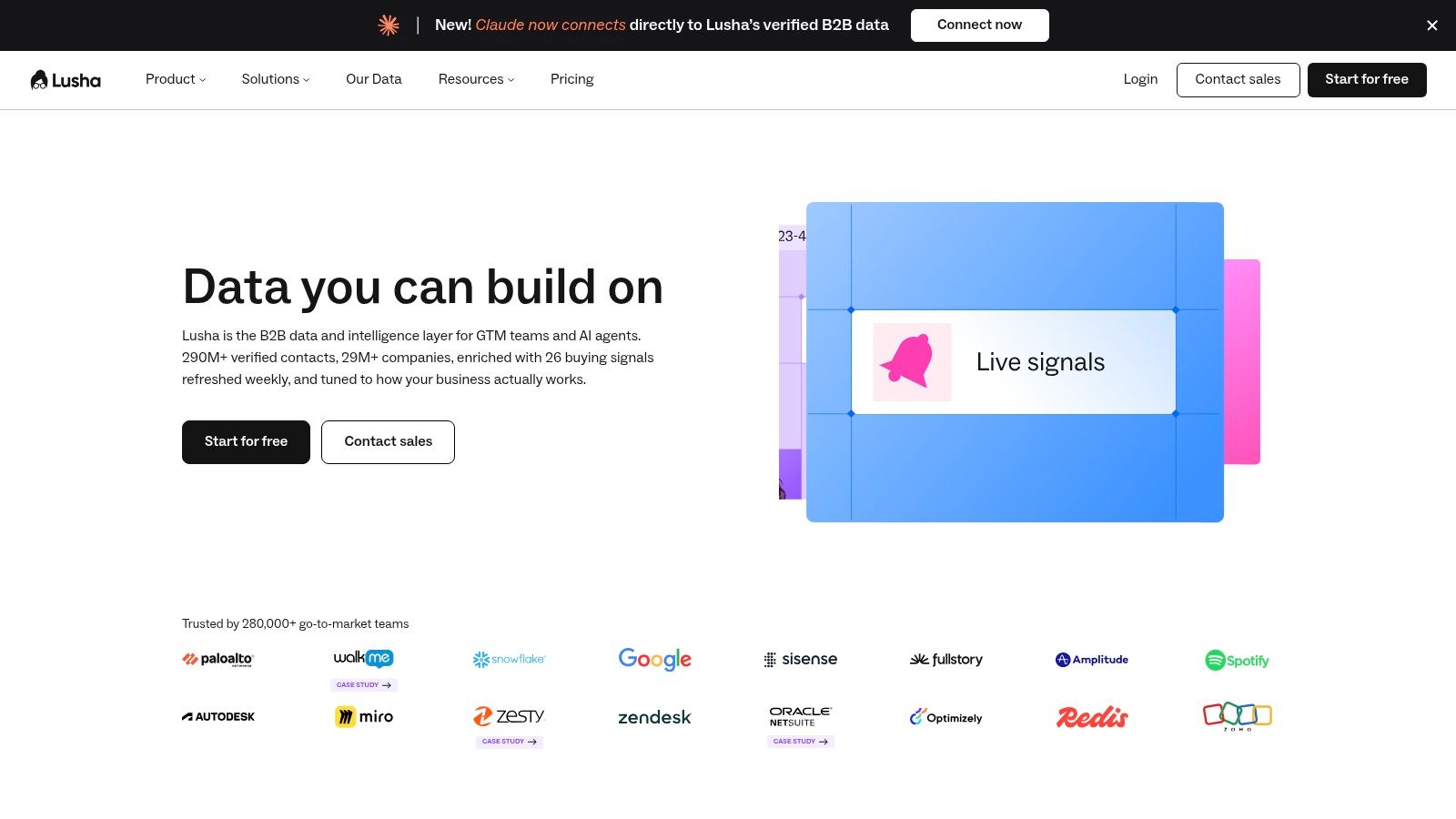
6. Lusha
Lusha favors quick access over complex data architecture. It combines contact and company enrichment with self-serve plans, a published credit structure, API access, and workflows that suit individual users or small teams. The product is especially practical when a rep is researching a prospect manually and needs to move a record into a CRM without a long implementation project.
Its plan structure includes Starter, Pro, and Premium tiers, with credit rollover options described in the supplied product details. That gives smaller teams more visibility than quote-only enterprise contracts, although a buyer still needs to understand how email and phone reveals consume credits. Phone reveals cost more credits than email reveals, so a calling motion can change the economics quickly.
A good manual layer, a limited control plane
Lusha works well when the workflow is simple. A rep identifies a person, requests available contact information, and pushes the record into a connected system. Documentation around billing, credits, and upgrades supports a faster start for teams without dedicated data engineering.
The limitation is scale governance. Teams with complex deduplication, field ownership, scheduled refreshes, or multi-provider fallback may outgrow the extension-led model. Coverage can also vary by region and segment, so buyers should test their actual markets instead of treating a published plan as evidence of universal data quality.
Lusha is a sensible fit for small outbound teams, individual SDRs, and manual LinkedIn-adjacent research. It's less compelling when the business needs event-driven ingestion, complex API orchestration, or verification measured at the field level across large volumes.
7. RocketReach
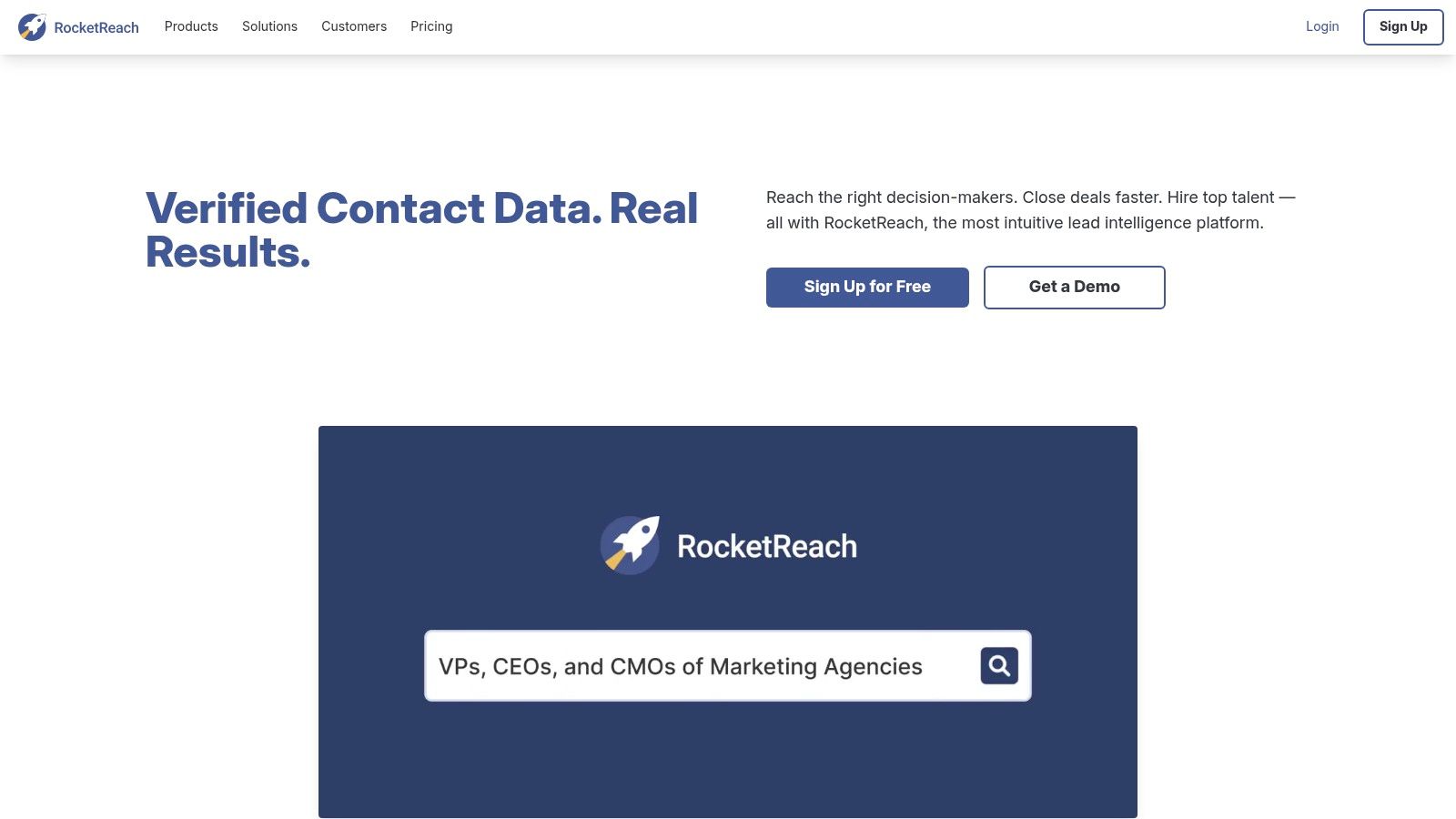
RocketReach fits workflows that need contact lookup without committing every record to one enrichment provider. It supports person and company search, bulk lookups, API access, a browser extension, and CRM integrations with Salesforce, Outreach, HubSpot, and Salesloft. A free tier lets teams test search quality and export requirements before forecasting paid usage.
Its main advantage is workflow flexibility. SDRs can research individual prospects through the extension, while data teams can run larger jobs through bulk or API access. That makes RocketReach a practical fallback when a primary vendor returns no email address or phone number. Engineering teams should still define where fallback data enters the pipeline and which source owns each field.
Why secondary-source use can make sense
A single provider rarely performs equally across every region, role, and industry. Independent guidance supports multi-source or waterfall enrichment because single-source APIs can produce materially weaker coverage than blended workflows. Results should be assessed separately for firmographic fields, email addresses, and phone numbers rather than reduced to one match-rate score. RocketReach therefore makes more sense as a controlled secondary source than as the default owner of every CRM field.
The economics depend on usage, not only on the availability of a free tier. Teams should confirm current allowances and plan terms before forecasting, then measure successful lookups by role, region, and channel. An email that cannot be verified has less operational value than a usable address, while a phone result may justify a different cost threshold for a calling team.
RocketReach suits budget-conscious teams and layered enrichment stacks. It may underperform specialized or higher-priced vendors in particular segments, so procurement should compare field-level outcomes, verification quality, integration effort, and fallback cost. The browser workflow favors manual prospecting, while API and bulk access support repeatable data operations.
8. People Data Labs
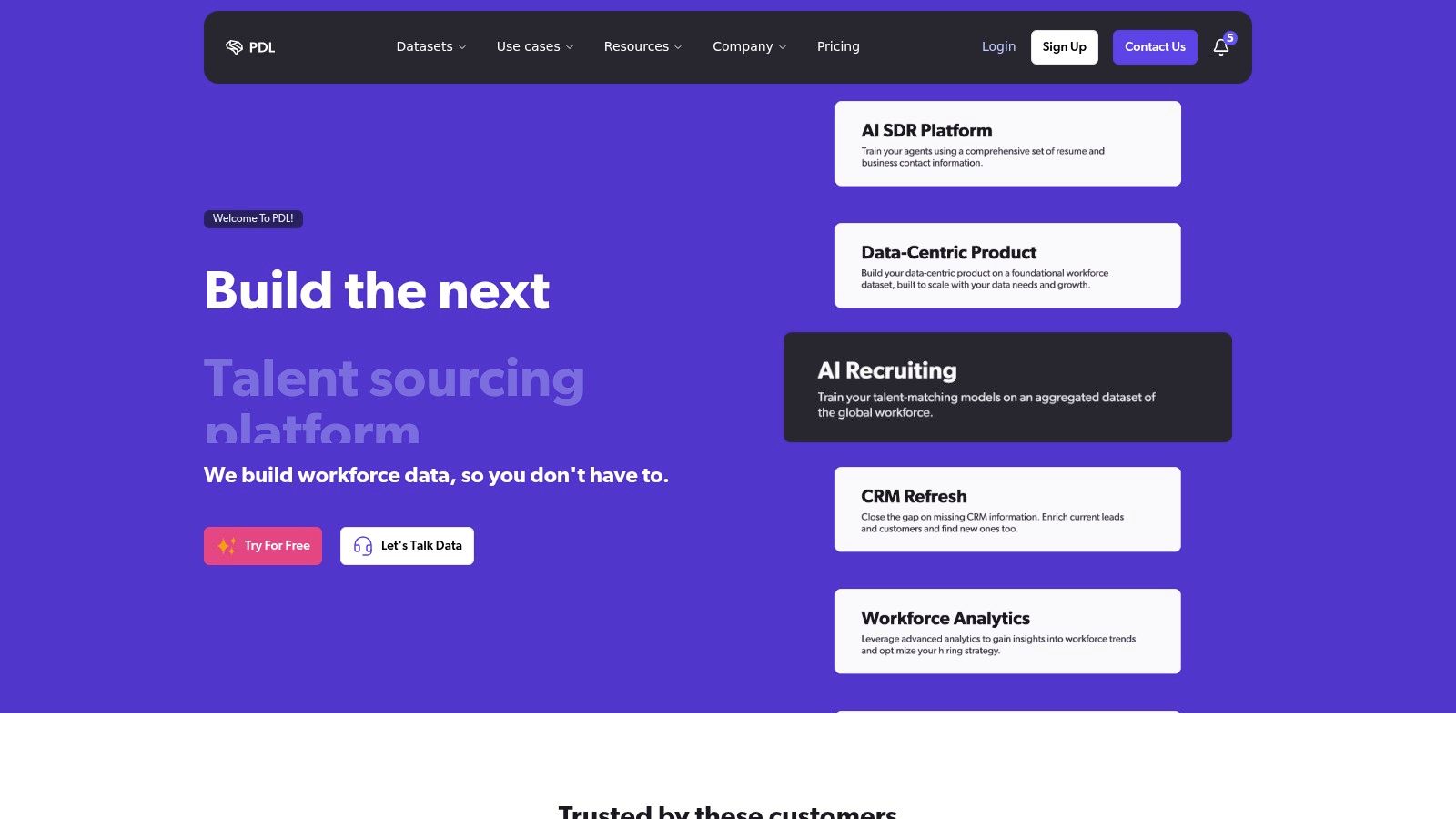
People Data Labs is designed for engineering and data teams that want enrichment inside their own applications. Its person and company APIs accept flexible inputs such as email, phone, name, social profile, or work information. The platform uses volume-based credits and exposes documentation around matching, field bundles, privacy, and compliance.
That developer-first orientation changes the buying question. Instead of asking whether a sales rep likes the interface, engineering teams need to ask how the API behaves when inputs are incomplete, how confidence and match responses are represented, and how the system handles retries, rate limits, and ambiguous identities. The integration becomes part of the company's data infrastructure.
Strong fit for custom pipelines
PDL is useful when a company wants to enrich records before they reach a CRM, warehouse, scoring service, or internal application. Engineers can tune matching logic and decide which fields belong in the company's canonical profile. This flexibility is valuable for recruiting platforms, marketplaces, and internal data products that need more control than a CRM plugin offers.
The cost is implementation time. Credit pricing depends on volume and selected fields, so teams need a forecast based on actual input quality and refresh behavior. A data engineer should also define how failed matches, partial matches, and stale records are stored, rather than treating every API response as equally usable.
PDL is best for API-driven enrichment and custom identity workflows. It's less suitable for an SDR team that needs an immediate prospecting interface or a marketing manager who wants no-code CRM updates.
9. FullContact Enrich
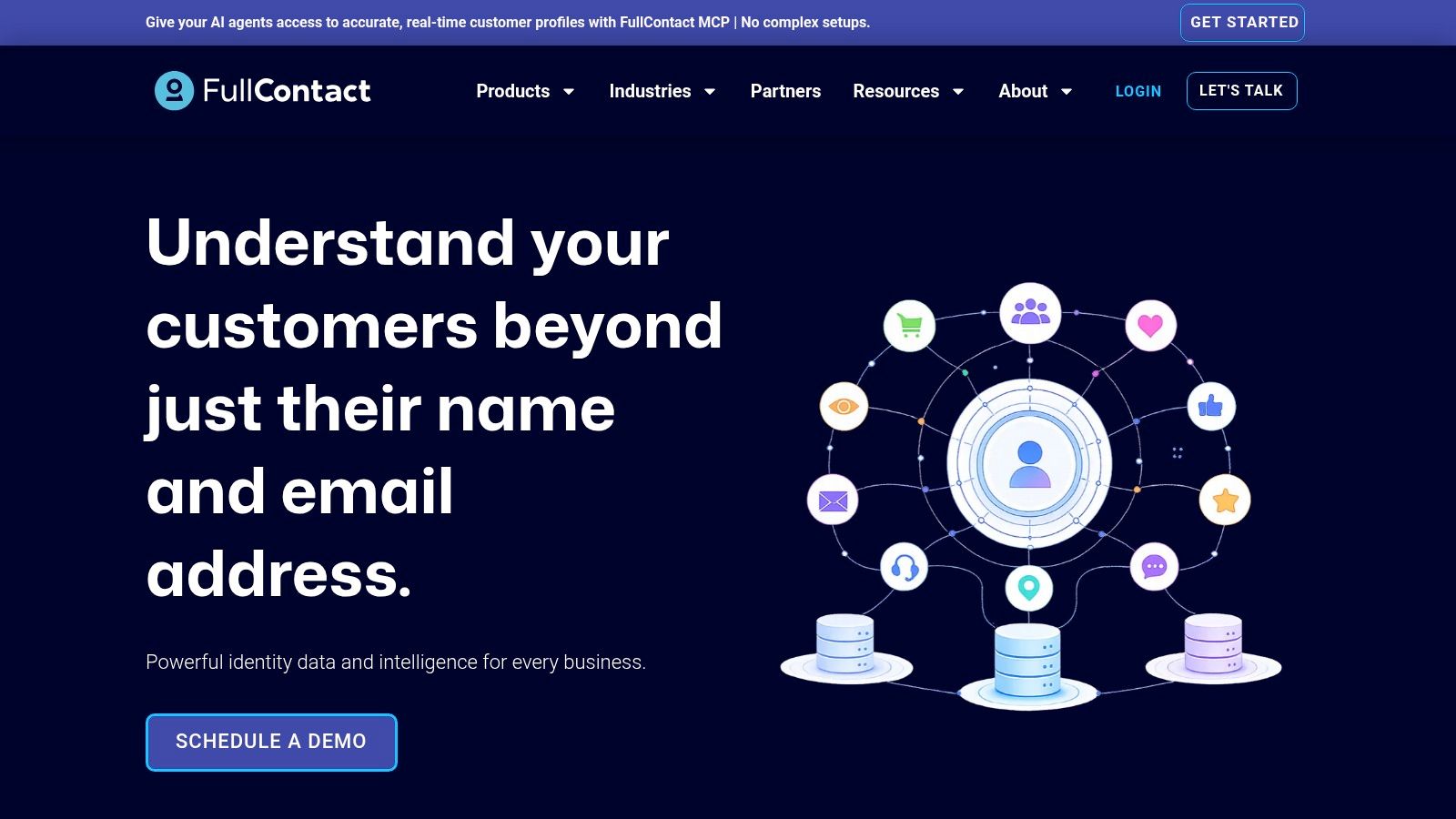
FullContact Enrich combines person and company enrichment with identity resolution. Its V3 APIs support multi-field requests, while official SDKs and client libraries for Go, Python, and Node help developers build the service into a larger data workflow. Postman collections and a developer-focused surface further position it as infrastructure rather than a rep-facing prospecting database.
The identity-resolution component is the differentiator. Many enrichment tools append fields to an existing record, but a data team may also need to determine whether records from different channels represent the same person or company. FullContact is more relevant when unification across customer, prospect, and other identity signals is part of the requirement.
Where engineering ownership matters
The API model gives developers control over request construction, response handling, and system integration. That's useful for organizations with an existing warehouse or customer-data platform, particularly when enrichment and resolution need to be coordinated rather than run as separate manual tasks.
There's no public self-serve pricing in the supplied product information, so buyers should expect a contract discussion. The implementation also requires engineering resources for monitoring, schema changes, error handling, and privacy governance. A team without that capacity may find a CRM-native tool easier to operate, even if FullContact offers more control.
FullContact is the right candidate for identity unification plus enrichment, not just for buying a list of emails. Evaluate it against deduplication quality, resolution behavior, supported identifiers, and the engineering burden of maintaining the integration.
10. Dropcontact
Dropcontact focuses on privacy-conscious email and contact enrichment for European workflows. It offers GDPR-oriented enrichment and email validation, CRM subscriptions, file-based processing, and batch workflows. Its no-data-resale positioning can appeal to teams that want a clearer privacy story around how contact information is sourced and handled.
The product is narrower than a full GTM suite. It focuses on identity fields, roles, and verified emails where available, rather than trying to cover every sales-intelligence signal. That can be a benefit for a team whose main requirement is to turn names and professional context into usable, validated email records without adopting a broad prospecting platform.
Simpler operations, narrower coverage
CRM and file workflows reduce setup effort for marketing and recruiting teams. A company can process a batch or connect enrichment to an existing CRM without building the kind of custom infrastructure required by an API-first provider. The privacy-centric approach also gives compliance stakeholders a concrete evaluation point, although every buyer should still review the provider's current terms and legal basis for its intended use.
Global breadth is the main limitation. Dropcontact may not match the coverage of multi-source waterfall tools, and it offers less depth beyond email and identity signals. Teams targeting multiple regions should test country by country, especially where phone coverage or technographic enrichment is essential.
Dropcontact is a good fit for GDPR-sensitive teams that prioritize email validation and uncomplicated CRM enrichment. It's less appropriate for sales organizations seeking intent data, extensive direct-dial coverage, or a broad outbound operating system.
Top 10 Lead Enrichment Tools Comparison
Provider Offering Coverage & Freshness Integrations & Delivery Contact Verification & Pricing Best for / USP NowFunded (recommended) Live, machine-first feed of newly funded startups + on‑demand founder/lead contacts Focused pre-seed → Series B; 100+ new startups/week; 10k+ records (12mo); rounds added within minutes MCP, REST API, webhooks (push), CSV, web dashboard; poll or instant POST Verified emails/phones billed only on successful verification ($0.10/email, $0.25/phone); funding data free; no min First-mover outreach, AI agents, SDRs, recruiters; MCP-native, verification-first, real-time Clearbit (by HubSpot) HubSpot-native company & contact enrichment (100+ attrs) Broad attribute coverage; cadence tied to HubSpot sync Native HubSpot sync, batch enrichment, field overwrite controls Credit/usage model inside HubSpot; pricing less transparent Teams embedded in HubSpot wanting minimal integration overhead ZoomInfo Enrich Enterprise-grade contact & company enrichment with data-health tooling Very broad firmographics; ongoing re-enrichment for data freshness API, connectors, bulk uploads, webhooks; managed support Quote-only pricing; often high annual minimums Large enterprises needing breadth, connectors and managed programs Apollo.io (Enrichment) Prospecting + enrichment + outbound tools Credit-based enrichment/search; widely adopted, variable match rates REST API, scheduled/bulk CRM enrichment, integrated outbound tools Credit model; plan entitlements can be complex SDR teams wanting integrated prospecting + enrichment Cognism GDPR-first B2B data with strong EU/UK phone coverage Strong EU/UK mobile/phone coverage; narrower U.S. depth API, bulk delivery, CRM enrichment, automated hygiene Quote-based pricing; typically higher for enterprise GDPR-sensitive teams prioritizing EU/UK phone coverage Lusha Self-serve contact/company enrichment with clear credit tiers Good SMB fit; regional coverage varies API, self-serve plans (Starter/Pro/Premium), quick setup Published credit pricing; phone reveals cost more credits Small teams wanting fast setup and transparent plans RocketReach Email & phone reveals with browser extension and bulk/API Budget-friendly; useful as primary or secondary source Bulk lookups, exports, API, CRM integrations, extension Tiered pricing (Free → Ultimate); check allowances Cost-conscious teams seeking an easy-to-try secondary source People Data Labs (PDL) Developer-first person/company enrichment APIs at scale Very large data footprint; volume-based credit pricing REST APIs designed for engineering integration; flexible inputs Transparent credit/field bundles; needs volume forecasting Engineering teams and API-driven workflows requiring scale FullContact Enrich (V3) Enrichment + identity resolution (Resolve) with SDKs Mature identity/unification capabilities; enterprise focus V3 APIs, official SDKs (Go/Python/Node), Postman collections Enterprise/quote pricing; requires engineering resources Data teams needing identity resolution + enrichment Dropcontact GDPR-compliant email/contact enrichment; no data resale Focused on Europe; validated emails and privacy-first sourcing CRM integrations, batch/file enrichment, email validation Subscription/batch pricing; privacy-centric approach GDPR-sensitive European teams wanting no-data-resale sourcingChoose the Workflow Before You Choose the Vendor
Start with the failure you need to prevent. If deliverability is the constraint, prioritize verified email and phone outputs, then measure bounce outcomes and field-level fill rates. A strong operating benchmark is more than 85% completeness for critical CRM fields, less than 2% email bounce rate, less than 20% annual data decay, and more than 80% enrichment match rate, according to operational guidance from ZoomInfo. Those are program benchmarks, not guarantees from any individual vendor.
If CRM simplicity matters most, choose a native workflow. Clearbit by HubSpot is the obvious candidate for a HubSpot-first organization, while Apollo can suit an SDR team that wants enrichment, prospecting, and outbound activity together. The convenience comes from fewer handoffs, but it can reduce portability and limit control over source precedence.
API-first platforms make more sense when engineering owns the workflow. People Data Labs and FullContact give data teams room to control matching, identity resolution, schemas, and downstream destinations. That flexibility carries an implementation cost, so include monitoring, retries, privacy reviews, and maintenance in the decision.
Regional coverage deserves its own test. Cognism and Dropcontact are relevant for European and GDPR-sensitive use cases, but “international” isn't a single quality category. Compare verified email, phone, title, and company fields by country and persona. Recent buying guidance also warns that some tools are strong in the United States and Canada but weaker internationally, and that buyers should check whether data is verified at query time or drawn from a static dataset. Clay's guide to lead enrichment tools frames freshness, geographic coverage, and verification process as separate selection criteria.
Compare the economic model, not just the list price
Subscription pricing buys access and capacity. Credit pricing ties spend to actions, but different fields can consume different credits. Quote-based contracts may include support and connectors, yet annual minimums can make them inefficient for low or irregular volume. Usage-based success charges, such as NowFunded's per-verified-contact model, are easier to connect to outcomes but can rise with campaign scale.
Model expected monthly lookups, required fields, refresh frequency, failure rates, seats, and minimum commitments. Don't compare a seat subscription with a per-success lookup until both are translated into the same workflow volume.
Run the same representative sample through every finalist. Measure verified email rate, verified phone rate, title accuracy, critical-field completeness, duplicate behavior, and the cost of usable records.
For refresh planning, fast-changing fields such as job title generally need more frequent attention than stable firmographic fields. The supplied operational guidance recommends 30-to-60-day refresh cadences for those fast-changing attributes and calls for tracking duplicates, field completion, and bounce outcomes as ongoing service-level measures. Treat those outputs as part of the enrichment program, not as a one-time vendor evaluation.
Choose NowFunded when the highest-value signal is a newly verified funding event and you want leadership contacts on demand. Its early-stage coverage, structured funding data, MCP, REST API, webhooks, CSV, and dashboard make it a particularly direct fit for first-mover SDR outreach, recruiting at newly financed startups, and agent workflows that need current, structured context. For every other use case, let the workflow, region, verification requirement, integration ownership, and expected lookup economics determine the vendor.
NowFunded provides a live feed of newly funded startups with structured funding facts and on-demand, verified founder and leadership contacts. If funding events are the trigger for your outreach, recruiting, or research workflow, visit NowFunded to evaluate its MCP, REST API, webhook, CSV, and dashboard delivery options.