Choosing an Email Verification Service That Actually Works

Your SDR team sends a carefully written sequence to a fresh list. Replies fall, hard bounces rise, and a post-send review shows that a large portion of the file contained catch-all, role-based, disposable, or stale addresses. The problem isn't only that one list was dirty. Email databases decay quickly, and verification has to operate as an ongoing deliverability control.
ZeroBounce reported in 2025 that email databases degrade by at least 28% per year, while its system detected 2.5 billion invalid email addresses and found that only 62% of verified addresses were valid and safe for sending. Those figures make one point clear: an email verification service shouldn't sit at the end of a quarterly cleanup process. It belongs in your forms, CRM imports, prospecting workflow, and pre-send checks. (ZeroBounce's deliverability benchmark coverage)
The right choice also isn't the vendor with the loudest accuracy claim. Independent testing of 15 verifiers against 3,000 real business emails produced overall accuracy scores ranging from 70.0% to 31.2%, with rankings changing by company-size segment and by how catch-all and unknown results were counted. (Hunter's benchmark discussion of email verifiers) Your buyer-side test should therefore focus on the addresses that create risk in your own database, not on a clean sample supplied by a vendor.
Table of Contents
- What an Email Verification Service Really Does
- How Verification Pipelines Work and Why Accuracy Claims Differ
- The Criteria That Actually Matter When Comparing Providers
- Profiles of the Top Email Verification Services
- Side-by-Side Comparison of Accuracy, Pricing, and Features
- Matching Services to Real-World Use Cases
- How to Pick and What to Do After You Choose
What an Email Verification Service Really Does
A lead enters your CRM, passes through enrichment, and reaches a campaign. The verification service decides whether that address should continue through the workflow, while separating clear delivery problems from signals that require a policy decision. It checks syntax, confirms the domain can receive mail, probes the mailbox where possible, and records risk that a simple valid-or-invalid label hides.
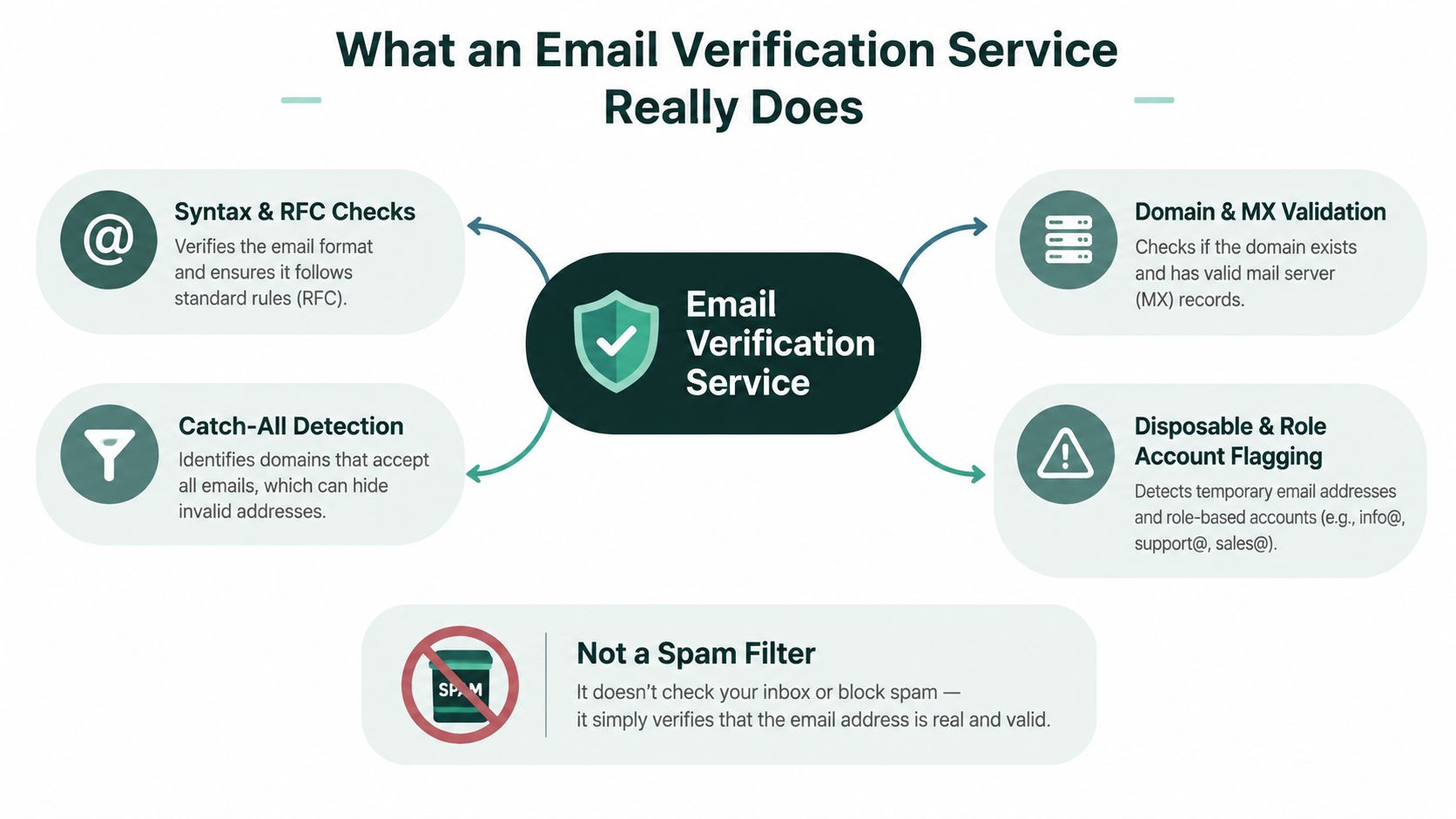
The checks behind the verdict
A typical service starts with syntax and RFC checks, then inspects DNS and MX records to confirm that the domain has a functioning mail destination. SMTP-level mailbox probing may distinguish a likely deliverable address from an undeliverable one. Greylisting, timeouts, filtering, and server policy can still block a definitive answer. The service therefore produces risk categories, not certainty. (A technical overview of how verification works)
A useful result set separates several outcomes:
- Valid: The address passes the provider's checks and is generally suitable for sending.
- Invalid: The syntax, domain, or mailbox presents a clear delivery problem.
- Catch-all: The domain accepts mail for addresses that may not represent real individual inboxes.
- Risky: A warning signal requires a sending-policy decision.
- Disposable: The mailbox appears connected to a temporary email provider.
- Role-based: The address belongs to a shared function such as sales, support, or information.
- Unknown: The service cannot reach a confident conclusion.
Those labels matter under current bulk-sender requirements, especially when AI-generated prospecting data adds plausible-looking addresses to lead files. A catch-all may accept mail while offering weak evidence that the named prospect exists. A role inbox may receive the message but lack individual ownership. A disposable address may pass a mailbox check yet undermine a lasting customer relationship.
For real lead data, rank providers by how they handle catch-all and unknown results. A verifier that marks every server acceptance as valid can make a clean dashboard while sending your team toward preventable bounces and low-quality prospects. Choose one that exposes ambiguous verdicts so you can suppress, review, or test them according to your risk tolerance.
Bulk cleaning versus continuous verification
Bulk verification still helps with a legacy CSV, a newsletter migration, a large outbound send, or CRM deduplication. It is a starting cleanup method, not a deliverability program.
Ongoing verification belongs inside the data flow. Use an API when a visitor submits a form, an ecommerce customer creates an account, or enrichment adds a lead. Run scheduled hygiene checks on active CRM segments, and verify imported records before they enter a sequencer.
Practical rule: Treat verification as a gate in the data flow, not as a broom you use after the floor is already dirty.
Verification has a firm limit. It assesses address-level risk, but it cannot guarantee inbox placement, engagement, permission, or message quality. A clean address can still reach spam if authentication, sender reputation, content, or sending patterns create problems.
How Verification Pipelines Work and Why Accuracy Claims Differ
Two vendors can report near-perfect accuracy and still disagree on the same B2B list. The gap usually reflects test scope, verdict definitions, and treatment of ambiguous mail servers, rather than a simple difference between a good tool and a bad one. For ongoing outbound under 2024 to 2025 bulk-sender rules, the practical question is how each provider handles catch-alls and uncertain results on real lead data.
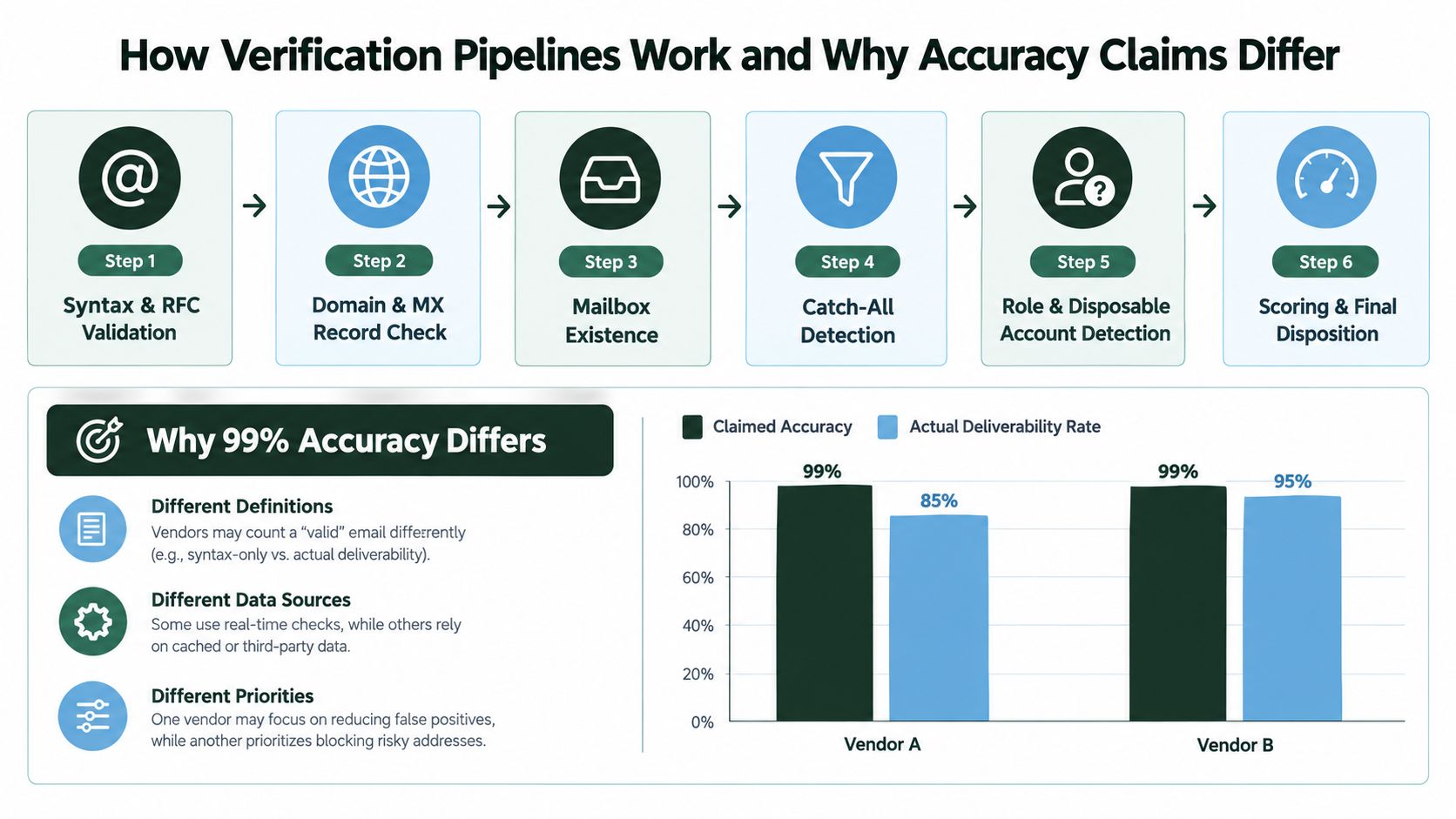
Five layers of a serious pipeline
Syntax validation catches malformed addresses, invalid characters, and obvious entry mistakes. It prevents waste, but it does not prove that a mailbox exists.
Domain and MX validation checks whether the domain is configured to receive email. A functioning domain can still contain a nonexistent user, so this layer is necessary but incomplete.
Mailbox existence checks use SMTP-level signals to infer whether a specific recipient exists. Greylisting, timeouts, rate limits, and anti-probing defenses can turn a technically plausible address into an uncertain result.
Catch-all detection tests whether a server accepts arbitrary recipients. Catch-all domains create the main ambiguity in B2B verification because server acceptance does not prove that the intended person owns the mailbox.
Risk scoring and disposition combines technical and behavioral signals. Stronger systems can flag disposable domains, role accounts, spam traps, typo-squatted domains, and other addresses that may be reachable yet harmful to sender reputation.
Why the headline number misleads
Some vendors calculate accuracy only against addresses with confirmed mailboxes, where an SMTP response confirms acceptance. That test can exclude catch-all domains, greylisting, and timeout-prone filters, even though those conditions appear in live lead data. A quoted 99.9% accuracy figure may therefore describe a narrow test rather than performance across your actual list. The technical limitations behind verification accuracy claims
The operational consequence is substantial. In 2023, Validity's worldwide benchmark found that roughly one in six legitimate marketing emails didn't reach the inbox, while average combined bounce rates for permission-based programs were about 1.5%, corresponding to approximately 98.5% deliverability as reported by ESPs. More recent 2024 to 2025 summaries put global inbox placement around 83.1%, or about 16.9% of legitimate messages failing to reach the intended inbox. Email deliverability benchmark coverage
Google and Yahoo's 2024 bulk-sender requirements set spam complaints below 0.3% and hard bounces below 5%. Microsoft 365's sender requirements use a tighter bounce threshold of below 2%. Coverage of bulk-email verification and sender requirements A verifier that hides uncertainty inside a binary valid bucket gives your sending team less control when mailbox providers apply pressure. Choose the provider that exposes catch-all and ambiguous verdicts, then set your own review and suppression rules.
The Criteria That Actually Matter When Comparing Providers
Don't score providers on a single accuracy percentage. Score them on how well they classify uncertainty, how easily they fit your workflow, and how much operational friction they create when you need to recheck data.
A practical weighted framework
Accuracy depth comes first, but define it properly. Ask how the service treats catch-alls, role accounts, disposable addresses, and unknown results. A provider that exposes confidence or risk levels gives you more control than one that forces every address into a pass-or-fail decision.
Speed and throughput decide whether the tool works in production. Signup forms need a fast API response, while outbound teams need predictable batch turnaround. Request performance data for your expected traffic instead of assuming that bulk capacity translates into real-time responsiveness.
Ambiguous-address handling deserves its own score. Look for deeper probes, retry logic, confidence scoring, and a clear distinction between catch-all, unknown, and risky. If a vendor labels difficult addresses as valid, your team inherits the risk without seeing it.
Pricing affects verification cadence. Compare per-email credits, subscriptions, rollover rules, expiration, and charges for rechecks or unknown outcomes. A low headline price can become expensive if routine hygiene discourages your team from checking records again.
Integrations and developer experience should match your stack. Check native connectors for HubSpot, Salesforce, Outreach, and Salesloft, then inspect API documentation, webhooks, SDKs, error handling, and bulk endpoints. A technically capable service that requires constant CSV movement will eventually be bypassed.
Compliance and data handling belong in the procurement decision. Ask about GDPR and CCPA posture, retention periods, deletion controls, list isolation, and whether uploaded records are used to train models. AI-generated lead volume makes governance more important, not less.
Criterion Why it matters Suggested weight Accuracy depth Separates clear deliverability from ambiguous and risky results Highest Catch-all and risk handling Protects decisions on difficult B2B addresses Highest API speed and throughput Keeps forms, enrichment, and outbound workflows moving High Pricing transparency Determines whether recurring verification is sustainable High Integrations Reduces manual exports and workflow failure points Medium Security and retention Controls privacy, compliance, and data exposure Medium Deliverability extras Adds context beyond address-level validity MediumRun a matched sample containing old CRM records, new form submissions, role accounts, corporate domains, and AI-generated candidates. Compare the size of each provider's valid, invalid, catch-all, risky, and unknown buckets. The provider that gives your team the clearest action path is more valuable than the provider with the most impressive landing-page claim.
Profiles of the Top Email Verification Services
No provider wins every workload. The shortlist below is useful because each service has a different center of gravity, and those differences matter when your list includes ambiguous corporate addresses.
ZeroBounce
ZeroBounce stands out for its broader scoring and data layer, including appended information and risk-oriented signals. It suits teams that want verification inside a wider hygiene program rather than a narrow mailbox check. The trade-off is greater product breadth and credit-based decision-making, which can be more than a small team needs. Choose it when enterprise operations need bulk workflows and layered scoring.
NeverBounce
NeverBounce is the practical choice for teams that want bulk cleaning and a real-time API without building a new data system around the verifier. Its appeal is operational simplicity and established workflow fit. It's less compelling when your central problem is extracting deeper meaning from catch-all and unknown results. Choose it when a dependable verification layer must attach cleanly to an existing ESP or CRM process.
Hunter
Hunter's verifier makes the most sense when your team already uses Hunter for prospect discovery. Its confidence score can connect an address to the quality of its underlying source, which is useful during sourcing. The compromise is that it isn't the strongest standalone option for every large-scale hygiene program. Choose it when verification and email finding need to live in one prospecting workflow.
Kickbox
Kickbox differentiates itself through a developer-friendly experience, deliverability orientation, and transparent quality framing. It works well when engineers need to embed real-time checks into a signup or application flow. Teams with catch-all-heavy B2B data should still test how its verdicts map to their policy. Choose it when implementation quality and clear operational feedback matter more than an expansive enrichment suite.
Bouncer
Bouncer appeals to privacy-conscious buyers, particularly those operating in Europe, because its positioning emphasizes European infrastructure and GDPR considerations. It offers a focused verification experience without requiring adoption of a broader sales platform. The trade-off is that buyers seeking extensive appended data or a full prospecting suite may need additional tools. Choose it when data handling and catch-all insight lead the procurement decision.
MillionVerifier
MillionVerifier attracts price-sensitive teams with an aggressive pay-per-valid approach. That model can make the economics easier to understand when your main goal is to remove unusable records before sending. Confirm how unknown and risky outcomes are treated before comparing it with credit-based competitors. Choose it when cost control matters and your team can manage the remaining ambiguity.
Snov.io
Snov.io bundles verification into a broader sales workflow that includes prospecting and outreach operations. That makes it convenient for lean teams that don't want to connect several specialized systems. The trade-off is reduced flexibility if you already have a mature CRM and sequencing stack. Choose it when one integrated sales workspace is more valuable than a best-of-breed verifier.
Emailable
Emailable takes a developer-first approach, with an API and framework integrations aimed at teams building verification into their own products or data pipelines. It can be a sensible starter option for smaller engineering teams. Before committing, test its handling of ambiguous business domains and confirm the pricing behavior for repeated checks. Choose it when clean implementation and an accessible entry point outweigh advanced enrichment.
Side-by-Side Comparison of Accuracy, Pricing, and Features
A useful comparison starts with a warning: vendor accuracy claims are not interchangeable. Test-set quality, pass definitions, catch-all policies, and treatment of unknown results can change the ranking. Use the table as a procurement checklist, then require a sample run on your own lead data before signing. That step matters even more under 2024-2025 bulk-sender rules, where repeated bounces and poor engagement can weaken ongoing deliverability. AI-generated address noise also makes ambiguous verdicts more common than a one-time list-cleaning exercise suggests.
The table below is a buyer's evaluation template, not a list of invented vendor measurements. If a provider does not publish a directly comparable figure or price in the verified material, request the result and the calculation method.
Provider Accuracy Claim Catch-All Handling Bulk Price per 1k Real-Time API Integrations Standout Feature ZeroBounce Request matched-sample results Ask for confidence and risk disposition Request current quote Available, confirm limits CRM, ESP, and workflow options vary by plan Scoring and appended data NeverBounce Request matched-sample results Confirm unknown and retry policy Request current quote Available, confirm throughput Established ESP and workflow connectivity Straightforward bulk and API operation Hunter Confidence tied to source quality Review confidence treatment Request current quote Available through its platform Strong fit with Hunter workflows Prospecting plus verification Kickbox Ask for test-set definition Confirm catch-all policy Request current quote Developer-oriented API Confirm native connectors Deliverability-focused implementation Bouncer Request segment-level results Review catch-all insight Request current quote Available, confirm limits Confirm CRM and ESP coverage European infrastructure and privacy posture MillionVerifier Request matched-sample results Confirm risky and unknown billing Request current quote Available, confirm limits Confirm stack compatibility Pay-per-valid positioning Snov.io Request platform-specific results Confirm how uncertainty is labeled Request current quote Integrated into sales workflows Broad sales-stack workflow Prospecting and outreach bundle Emailable Request matched-sample results Test ambiguous business domains Request current quote Developer-first API Framework integrations Accessible API implementationThe differences that decide the purchase
Rank providers by their handling of catch-alls and ambiguous outcomes, not by a single headline accuracy claim. Ask whether the service returns a dedicated catch-all label, places it in risky or unknown, retries later, or passes it as valid. Confirm whether unknown results consume credits and whether the API separates invalid, risky, unknown, and valid states. These details determine how safely your team can keep verifying new leads instead of repeatedly sending to uncertain addresses.
For real lead data, request segment-level results for corporate domains, personal inboxes, older records, and addresses created through automated or AI-assisted workflows. A verifier that identifies uncertainty clearly may support better deliverability decisions than one that produces a higher apparent pass rate by treating ambiguous records as valid.
Then inspect integration behavior. Webhooks, bulk endpoints, retry controls, and clear event states matter when your CRM or sending platform must suppress invalid records while holding risky ones for review. Finally, separate verification from inbox-placement testing. Some deliverability products bundle authentication monitoring, blacklist checks, or placement tests, but an address verifier alone cannot predict whether a message will reach Gmail, Outlook, or Yahoo.
Matching Services to Real-World Use Cases
The right verifier depends on the workflow, data quality, and action attached to each verdict. Under current bulk-sender requirements, ongoing list hygiene matters more than a single cleanup. Choose the provider that handles catch-alls and ambiguous results without inflating the valid count.
Outbound SDR teams
Outbound teams processing recurring prospect files need fast bulk checks, CRM synchronization, and suppression rules that sales operations can enforce. NeverBounce suits a straightforward bulk and API workflow. ZeroBounce fits better when the team needs scoring and broader hygiene signals. The trade-off is a simpler operating layer versus more information for routing uncertain leads.
Rank both by how they classify real corporate-domain results. A dedicated catch-all or unknown status is more useful than a forced valid result when an SDR sequence could damage sender reputation.
Marketing operations before a migration
A marketing operations manager cleaning a legacy newsletter list needs more than a CSV divided into valid and invalid addresses. ZeroBounce is the stronger choice when appended data and layered scoring support segmentation. The team still needs a separate inbox-placement and authentication review. Verification reduces address-level risk, while a deliverability audit examines the sending system and message placement.
Ecommerce signup flows
An ecommerce store needs a low-latency check during account creation and predictable cost per verification. Kickbox is a strong candidate for a developer-embedded flow because real-time implementation is central to its use case. Emailable suits a smaller engineering team seeking a focused API.
Test response latency, timeout behavior, failed requests, and the action triggered by an uncertain verdict before sending the integration live. A verifier that fails closed may protect campaigns but reject legitimate signups. One that fails open may preserve conversion while admitting more risky addresses.
Recruiting across corporate domains
Recruiting firms regularly encounter company domains that accept mail broadly, so a binary result is too blunt. Bouncer deserves attention when privacy posture and catch-all insight matter. Hunter fits recruiters already sourcing contacts there who want source-linked confidence.
Neither product removes the need for a review policy. A risky address may still be the best route to a candidate, but it should not enter an automated sequence without a deliberate decision.
AI-driven enrichment and lead generation
A developer building an AI agent needs structured API responses, predictable credit handling, and routing that preserves ambiguous outcomes. Emailable fits a developer-first build. Snov.io is more appropriate when the agent feeds a broader prospecting and outreach workflow. For teams sourcing contacts around newly funded startups, NowFunded provides a live funding feed and verified founder and leadership contacts through MCP, REST API, webhooks, CSV export, or a dashboard. A lead source and an email verifier solve different problems, so every enriched record still needs a verification gate.
AI-generated addresses increase the noise. An address can be syntactically correct and reachable while being disposable, role-based, typo-squatted, or unsuitable for outreach. Preserve the full verdict and confidence metadata. Do not reduce every result to a Boolean field.
How to Pick and What to Do After You Choose
Choose for ongoing deliverability, not a one-time list clean. Test each finalist against real lead data, including catch-alls, role accounts, disposable addresses, stale CRM records, and AI-generated candidates.
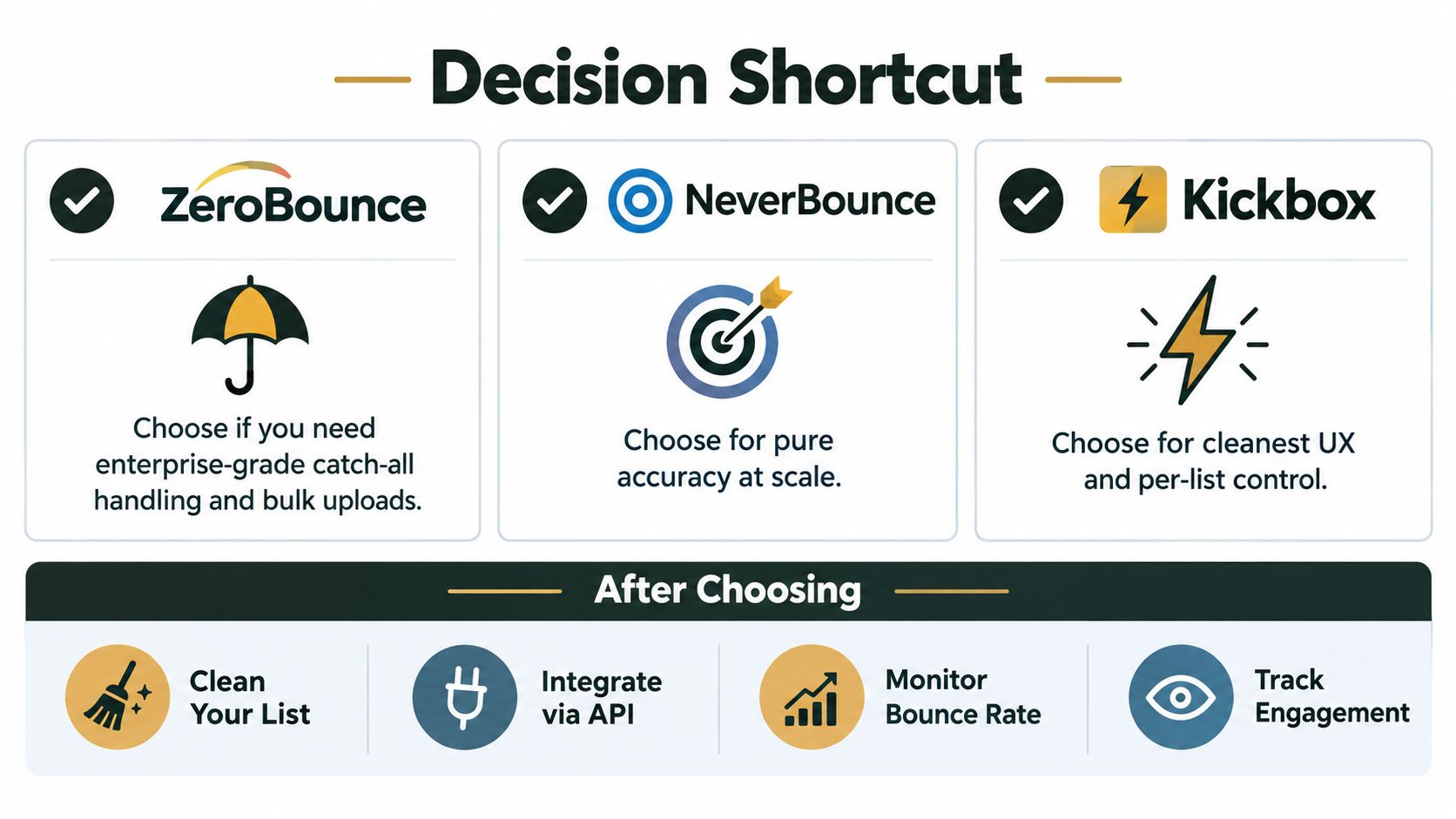
- Choose ZeroBounce for enterprise bulk workflows, scoring, and broader data signals.
- Choose NeverBounce for a focused verifier that connects cleanly to an established sending stack.
- Choose Kickbox when developer experience and real-time checks come first.
- Choose Hunter when discovery already runs there and source-linked confidence helps.
- Choose Bouncer when European infrastructure, privacy, and catch-all visibility matter.
- Choose Emailable for a budget-conscious, developer-oriented starting point.
Run one matched sample through two or three finalists. Compare valid results, then examine the size and usefulness of unknown, risky, and catch-all groups. Rank providers by the quality of their ambiguous verdicts. A verifier that labels every difficult address valid or invalid creates more operational risk than one that gives your team a clear review queue.
Build the operating process
Verify addresses at capture. Put a real-time API in front of forms, signups, CRM imports, and enrichment jobs. Send invalid addresses away from campaigns, hold ambiguous records for review, and preserve the original verdict so later systems cannot overwrite the evidence.
Recheck active lists on a rolling schedule. Database quality changes after acquisition, so one-time cleaning does not protect recurring outbound campaigns. Treat verification as a repeated control, especially when AI-generated records add syntactically correct but disposable, role-based, typo-squatted, or unsuitable addresses.
Monitor more than bounces. Track complaints, inbox placement across major mailbox providers, engagement, authentication, and domain reputation. Gmail and Yahoo require bulk senders to keep spam complaints below 0.3%, while Microsoft 365 uses a hard-bounce requirement below 2%. Set your verification policy to support the sending rules that apply to your traffic.
Verification removes avoidable address risk. It cannot rescue weak permission practices, poor content, missing authentication, or an unheated sending domain.
The right verifier gives your team a defensible action for difficult records. Do not buy a headline accuracy percentage. Buy a repeatable workflow that exposes uncertainty, keeps bad data out of sending systems, and makes re-verification easy.
If stale lead data slows outbound work, NowFunded provides structured funding events and verified founder and leadership contacts through MCP, REST API, webhooks, CSV export, or its dashboard. Use it as a fresher startup prospecting source, then verify every pulled contact before sending.