Difference Between Outside Sales and Inside Sales

Inside sales usually covers more prospects at lower cost, with inside teams often spending 40%–90% less on new customer acquisition than outside teams. Outside sales earns its place when a deal is complex, high-value, and dependent on face-to-face trust.
You're probably dealing with this choice in a less tidy form. Your team has a promising account, but nobody agrees on how much attention it deserves. One rep wants to run a sequence, qualify the opportunity, and book a video call. Another wants to travel, meet the leadership team, and build the relationship in person. Both may be right, but assigning the wrong motion wastes budget, delays the deal, and creates unnecessary friction between SDRs and account executives.
The difference between outside sales and inside sales isn't just whether a rep travels. It's a routing decision. You're matching the buyer's expectations, the deal's complexity, the account's potential value, and your team's available bandwidth to the way most likely to move the opportunity forward.
Table of Contents
- Inside the Pipeline - Why This Choice Shapes Your Outbound Team
- Defining Inside Sales and Outside Sales
- Roles, Workflows, and Daily Rhythms Compared
- Cost, Activity, and Performance Benchmarks That Matter
- Tooling, Data, and Outreach Infrastructure
- When to Choose Inside Sales, Outside Sales, or a Hybrid
- Hiring, Quotas, and Team Structure for Modern Outbound Teams
Inside the Pipeline - Why This Choice Shapes Your Outbound Team
A founder at a recently funded startup has just hired several senior employees and is evaluating a new operating platform. An inside sales team can identify the company from a verified funding signal, find the relevant leader, and begin a coordinated sequence of calls, emails, and social touches from a desk. The rep can qualify the account, run a remote demo, and bring in a specialist without asking anyone to book a flight.
An outside rep handles the same account differently. They research the company's operating model, arrange an executive meeting, and prepare for a conversation involving several stakeholders. Travel, scheduling, and preparation take more time, but the rep may uncover details that are difficult to surface in a short remote exchange. The account might justify that investment if the purchase carries material risk or requires deep organizational alignment.
Practical rule: Don't assign a field rep because an account looks prestigious. Assign one when in-person access can change the buying decision.
This distinction affects more than territory ownership. It changes the profile you hire, the tools you need, the activity you measure, and the way you set quotas. Inside reps need clean contact data, reliable sequences, strong call control, and tight CRM habits. Outside reps need territory judgment, executive presence, meeting preparation, and the autonomy to manage a longer path to revenue.
The economics also shape founder decisions. Widely cited sales benchmarks report an inside sales call at about $50, compared with roughly $308 for an outside sales call, while inside sales teams are associated with 40%–90% lower acquisition costs than outside teams, as summarized in sales acquisition and activity benchmarks. Those figures don't prove that remote selling always wins. They show why a field motion needs a stronger business case for every opportunity.
For startup-focused teams, stale data makes the routing decision worse. A rep can't build a useful account plan around an old leadership record or a generic inbox. Whether you operate through a live startup intelligence workflow or another verified data source, the team needs current company signals and relevant decision-maker information before choosing between volume and depth.
Defining Inside Sales and Outside Sales
Inside sales is a remote-first sales motion. Reps use email, phone, video meetings, social channels, CRM workflows, and digital demonstrations to engage buyers without routinely meeting them in person. The model is built for repeatability. A rep can move from research to outreach to qualification without losing time to travel or venue logistics.
Outside sales, also called field sales, is built around in-person engagement. Reps visit customer sites, attend relevant events, host workshops, and coordinate meetings with executives or operational stakeholders. Video calls can still support the process, but the motion depends more heavily on relationship depth, local context, and direct stakeholder alignment.
The distinction is about how the team creates buying confidence, not whether one role is more senior. Inside sales creates confidence through responsiveness, relevant messaging, product fluency, and consistent follow-up. Outside sales creates it through presence, observation, trust-building, and the ability to work through complicated decisions in the room.
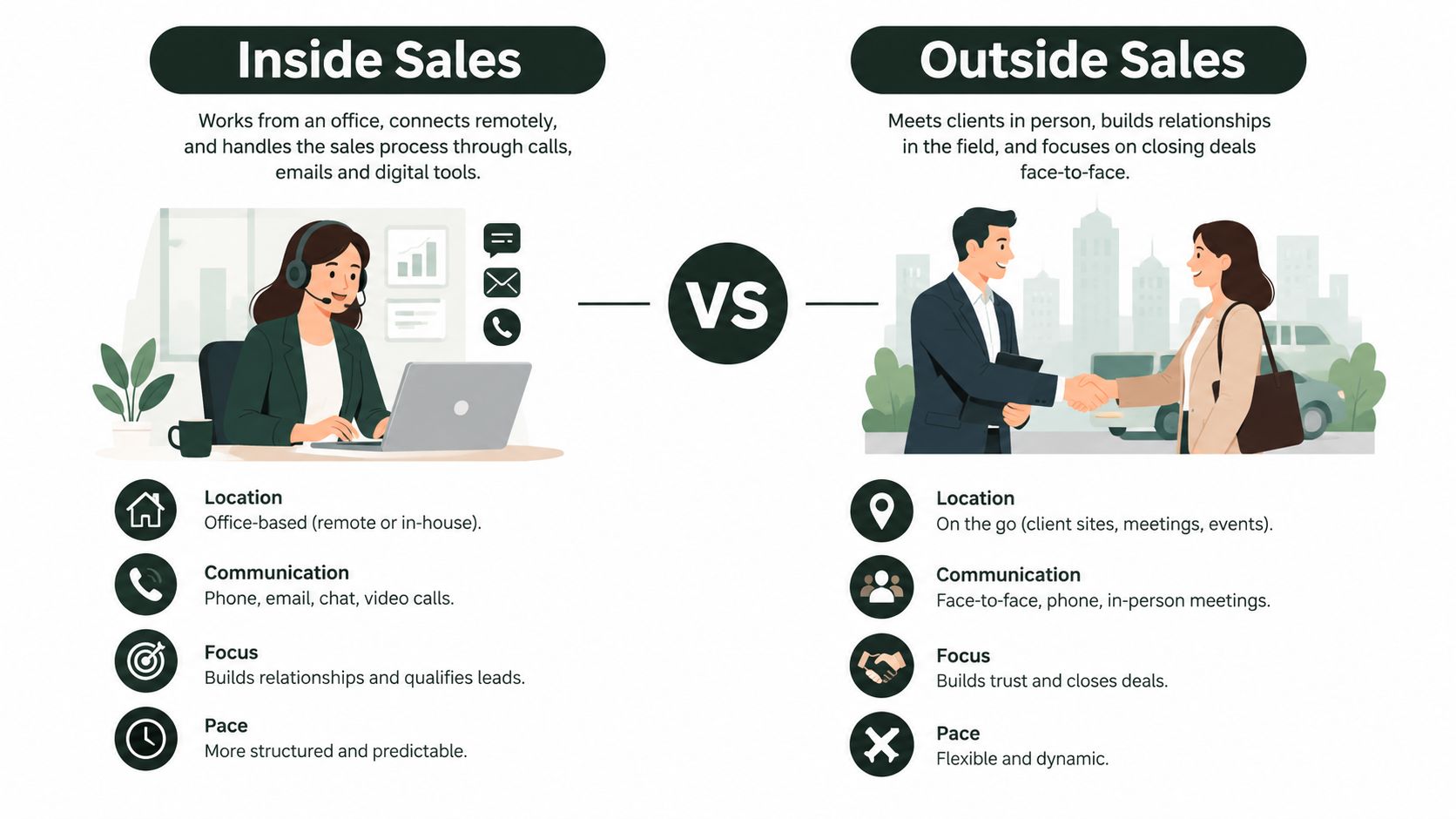
The operating differences
Dimension Inside sales Outside sales Primary setting Office or remote workspace Customer sites, events, and field territories Core advantage Coverage, speed, and repeatable activity Trust, discovery depth, and stakeholder alignment Typical interaction Calls, email, video demos, and digital follow-up Meetings, workshops, site visits, and executive conversations Best fit Standardized offers and shorter buying paths Complex offers and higher-risk buying decisions Main management challenge Maintaining data quality and meaningful activity Controlling travel cost, territory focus, and deal durationInside sales isn't telemarketing, and outside sales isn't a permanent roadshow. A skilled inside rep can run thoughtful discovery and close business remotely. A skilled outside rep may use digital communication for much of the process and reserve travel for the moments that matter.
Use the terms to describe the sales motion, then design the role around the buyer journey. If the buyer can understand value, validate fit, and secure internal approval remotely, inside sales is usually the cleaner route. If the buyer needs a site-specific assessment, repeated executive meetings, or a high level of personal trust, outside sales deserves consideration.
Roles, Workflows, and Daily Rhythms Compared
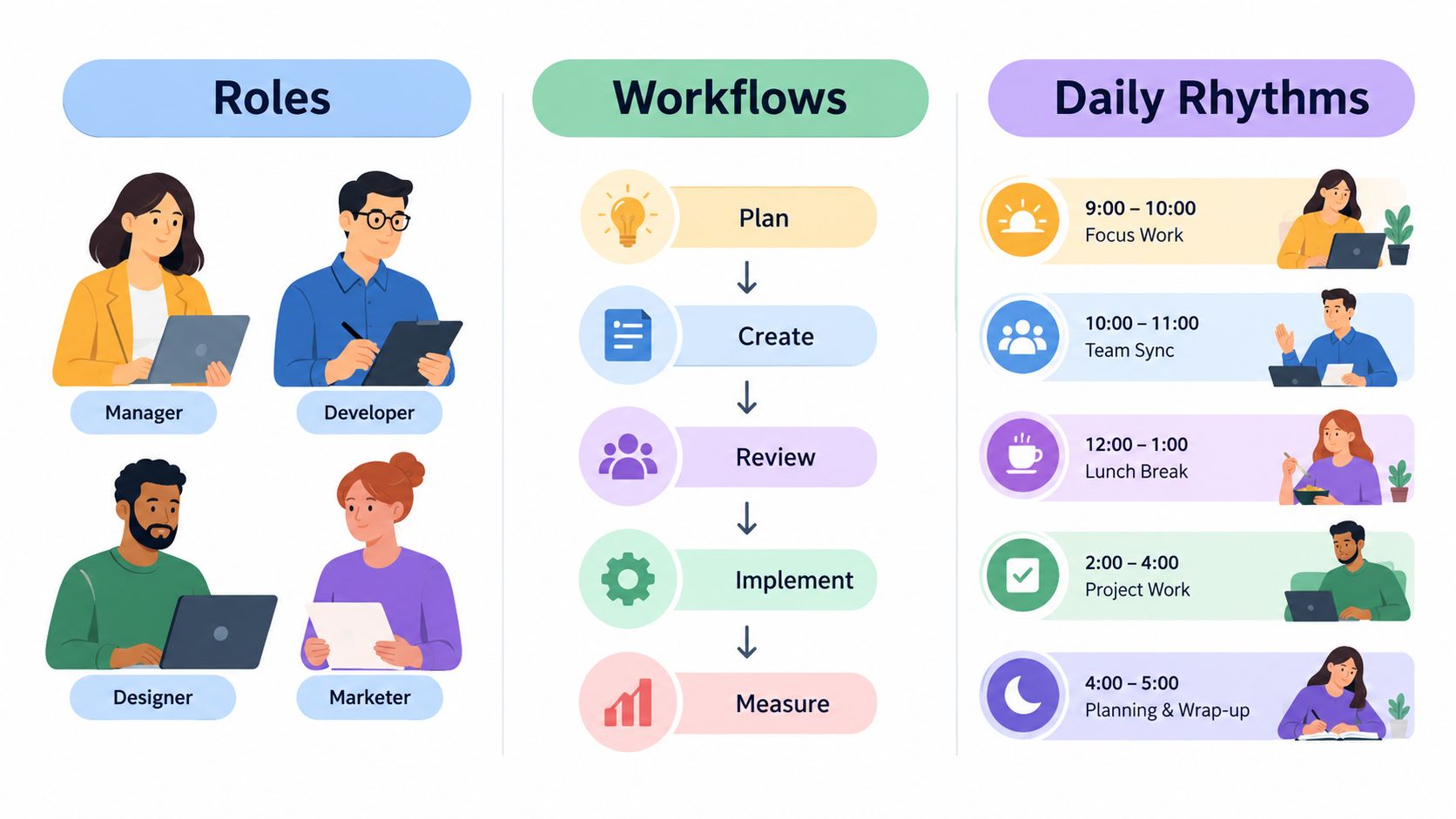
The difference becomes obvious when you compare a normal workday. An inside rep starts with account research, checks intent or company updates, works a prioritized queue, places calls, sends personalized follow-ups, runs discovery meetings, and records the outcome in the CRM. The rep's output depends on activity density, but quality still matters because a high-volume sequence aimed at the wrong contact only creates noise.
An outside rep starts by reviewing the territory and confirming meetings. They may drive to a customer site, conduct a discovery workshop, meet several stakeholders, return to the office, and write a detailed account update. Their day contains fewer direct selling moments, but each meeting can reveal operational context that changes the proposal or buying strategy.
Where the time goes
Inside sales compresses work into a repeatable loop:
- Research: Identify a relevant account, trigger, and contact.
- Engagement: Use calls, email, video, and social outreach.
- Qualification: Test urgency, fit, authority, and next steps.
- Progression: Run a demo or discovery process remotely.
- Handoff: Give the AE or specialist complete CRM context.
Outside sales uses a more deliberate loop:
- Planning: Group accounts by territory, value, and meeting priority.
- Preparation: Map stakeholders, business conditions, and meeting objectives.
- Engagement: Conduct in-person conversations, workshops, or site visits.
- Coordination: Align decision-makers and internal specialists.
- Follow-through: Manage proposals, commercial discussions, and next meetings.
The inside workflow usually wins when response speed and coverage determine results. The outside workflow earns its cost when the rep's presence improves access to stakeholders, clarifies the customer's environment, or reduces perceived risk.
The hidden cost of field activity
Travel isn't just a line item for flights and hotels. It includes route planning, meals, schedule changes, idle time, preparation between appointments, and the opportunity cost of unavailable selling hours. Outside sales also tends to require a longer ramp and a longer sales cycle, which means managers must fund the period before the rep has built enough territory knowledge and relationship capital.
The reverse problem appears in inside sales. A remote team can generate plenty of activity while producing weak pipeline if contact data, messaging, qualification, or coaching is poor. Managers should measure meaningful progression, not celebrate calls that never reach a relevant buyer.
The practical answer is straightforward. Use inside sales to create and qualify broad coverage. Use outside sales where a smaller number of carefully prepared interactions can open up a larger, more complicated opportunity. Don't let either team inherit accounts just because the CRM assignment happened to be convenient.
Cost, Activity, and Performance Benchmarks That Matter
Deal size and cycle length are the two benchmarks that most directly drive routing decisions. Inside sales fits repeatable opportunities with a lower cost per touch and a high volume of accounts. Outside sales earns its place when stakeholder access, technical discovery, or perceived risk makes direct involvement more valuable than remote coverage.
A published comparison places inside sales deal sizes around $5K–$50K, with sales cycles of approximately 2–8 weeks. It places outside sales opportunities around $50K–$500K or more, with cycles of roughly 90–180 days or longer, as outlined in B2B inside and outside sales benchmarks. Use these ranges as routing signals, not rigid rules. A smaller deal may involve complex approvals, while a large deal may still move efficiently through a remote process.
Inside versus outside sales benchmarks
Metric Inside sales Outside sales Acquisition cost Lower, because the rep can cover more accounts without field travel Higher, because travel, time, and field operating costs reduce selling capacity Daily prospecting pattern More cold calls, conversations, and message tests across a broad account set Fewer interactions, with more time allocated to meetings and account development Prospects engaged per day Higher account coverage through calls, email, and digital outreach Lower account coverage, with deeper preparation for each opportunity Calls or visits per day A high volume of calls and scheduled remote conversations A smaller number of in-person visits and stakeholder meetings Cost per interaction Lower for remote contact Higher for an in-person interaction Deal-size sweet spot About $5K–$50K About $50K–$500K or more Sales cycle About 2–8 weeks About 90–180 days or longerThe activity gap makes inside sales a strong growth motion for broad markets. A rep can work more accounts, test messaging quickly, and shift effort without rebuilding a territory plan. That advantage depends on clean inputs. Verified funding events, current leadership contacts, accurate role data, and structured enrichment prevent reps from spending high-volume outreach capacity on the wrong companies or people.
Outside sales needs a different scorecard. Count qualified pipeline created, stakeholder access gained, opportunity progression, win rate by segment, gross profit, and total cost to serve. A field rep who attends more meetings but cannot reach the economic buyer is generating activity, not performance. A remote rep who books meetings that repeatedly stall at executive approval has a routing problem, not just a coaching problem.
A higher close rate does not automatically produce better ROI. Calculate the value created per rep after travel, ramp time, meeting preparation, and other operating costs. Then compare that result with the contract value and margin the motion supports.
Your funnel should determine the handoff. Route broad early-stage coverage to inside reps when the offer is easy to explain, the buyer group is accessible, and the sales cycle is short. Add outside support when technical validation, executive alignment, site context, or risk reduction becomes the bottleneck. Use verified data and AI agent tools to identify those signals, enrich accounts, and flag the point where a remote opportunity needs field involvement. Do not assign accounts solely because the CRM makes the transfer convenient. Route them according to deal complexity, buyer expectations, and team bandwidth.
Tooling, Data, and Outreach Infrastructure
Inside and outside teams need the same commercial system, but they use it differently. Both require a CRM, accurate account records, activity history, forecasting discipline, and clear ownership. Inside sales adds sequencing, dialers, call recording, email deliverability controls, and fast enrichment. Outside sales needs mobile CRM access, territory planning, calendar coordination, route visibility, stakeholder mapping, and meeting preparation.
Data quality is especially important in inside sales because the model depends on repeated contact at scale. One stale email wastes a touch. A bad title sends the message to the wrong person. An outdated company record can send an entire sequence toward a business that no longer fits the target profile.
Build around verified signals
For startup prospecting, a funding event can serve as a useful trigger because it may indicate a change in hiring, priorities, or budget. The signal still needs context. A rep should know the company's sector, location, leadership structure, website, and relevant contact before writing the first message.
An AI agent can turn that workflow into a controlled process:
- Detect a verified company event.
- Enrich the account with structured firmographic fields.
- Select the relevant founder or functional leader.
- Check role and contact verification status.
- Draft outreach using the event and account context.
- Push the record into a CRM sequence for human review.
That setup is more reliable than asking an agent to browse disconnected pages and infer facts from stale snippets. Structured fields also make it easier to filter accounts, route them by deal complexity, and preserve the evidence behind a prospecting decision.
The infrastructure should support the motion rather than dictate it. A REST API or webhook can send new account signals into a workflow. An MCP endpoint can let an AI agent query approved data directly. A CSV export can support a smaller team that isn't ready to build integrations. The important question is whether the data arrives in a consistent, auditable format.
Independent summaries describe inside sales as engaging roughly 40–60 prospects per day and making about 50–80 calls per rep, while outside sales averages about 5 visits per day. They also place cost per interaction around $50 for inside sales and roughly $215–$400 for an in-person outside interaction, as documented in inside and outside sales activity comparisons. Those economics make stale data particularly expensive for a high-volume team, while field teams need accurate account information to avoid wasting a trip.
Don't build a scraping system just because a list is difficult to maintain. Use managed, verified feeds where possible, keep an audit trail for important signals, and require human approval before an AI agent sends sensitive outreach. Automation should remove research waste, not remove judgment.
When to Choose Inside Sales, Outside Sales, or a Hybrid
Choose the motion from the buying process backward. Start with the decision the customer must make, then identify the amount of trust, technical validation, stakeholder coordination, and personal access required to reach it.
Choose inside sales when speed is the constraint
Inside sales is the better default when:
- The offer is standardized and easy to demonstrate remotely.
- Buyers can evaluate value without a site visit.
- The target market is broad or geographically distributed.
- The team needs frequent testing of messaging and segments.
- The opportunity value doesn't justify repeated travel.
- A strong CRM and data workflow can support consistent follow-up.
This model is particularly effective for early qualification and repeatable mid-market motions. It lets managers add coverage without redesigning territories around every new hire. It also gives reps more opportunities to practice, review calls, and refine messaging during the workweek.
Choose outside sales when trust is the constraint
Outside sales makes sense when:
- The solution changes how the customer operates.
- Several executives or departments must reach agreement.
- The buyer expects an on-site assessment or workshop.
- Implementation risk is material.
- The account can support a high cost per opportunity.
- Relationship depth matters after the contract is signed.
A field visit should have a job. It might expose a workflow problem, bring a skeptical executive into the conversation, or help the rep understand a physical environment. If the visit is only a more expensive version of a video call, don't send the rep.
Use hybrid routing deliberately
Hybrid sales is not a compromise for teams that can't decide. It's a deliberate way to reserve expensive engagement for the moments where it adds value. An inside rep can identify the trigger, qualify the need, and run an initial demonstration. An outside rep can join when the opportunity requires executive alignment, technical workshops, or commercial negotiation.
Set the handoff rules before the pipeline fills:
- Define the trigger: Use deal complexity, stakeholder count, buyer request, or implementation risk.
- Preserve ownership: Decide whether the inside rep stays involved or becomes a supporting partner.
- Standardize the handoff: Require account context, pain points, stakeholders, objections, and agreed next steps.
- Measure the route: Compare conversion and total cost by motion, not by rep anecdotes.
- Re-route quickly: Move opportunities back to a remote motion when travel no longer adds value.
Outside sales still deserves a place in a digital-first market, but not as a status symbol. A recent comparison notes that some sources claim field teams close 30.2% better or achieve around 40% close rates, while other summaries emphasize that inside teams can reach more prospects at lower cost. The inconsistency is exactly why you should segment your own data instead of copying a headline from the inside versus outside sales analysis.
Hiring, Quotas, and Team Structure for Modern Outbound Teams
Hire for the motion your revenue model requires. Inside reps need disciplined research, concise communication, coachability, and comfort with CRM workflows. Outside reps need account judgment, executive presence, autonomy, and the ability to manage complex conversations without constant supervision.
Do not hire a field rep and measure them like a high-volume SDR. Do not hire an inside rep to rescue a territory with no routing rules. The hidden cost is predictable: poor role design creates weak pipeline, confused ownership, and expensive activity that never becomes revenue.
Ramp planning also differs. Inside reps typically reach productivity faster, while field reps need more time to learn accounts, territories, stakeholders, and deal processes. The sales ramp and cycle comparisons place inside sales ramp time around 3–4 months, compared with approximately 6–9 months for field reps. Set quotas against that learning curve and the pipeline volume each role can realistically manage.
Keep account ownership clean. If an inside rep sources and qualifies an opportunity, the outside rep should receive the account context, qualification notes, stakeholders, objections, and a defined role. Compensation should follow revenue progression, while rewarding the behaviors that make each motion work, such as qualified meetings, accepted opportunities, closed revenue, or expansion.
Use verified data and structured feeds for both recruiting and prospecting. Reps should decide whom to contact and why, not repair brittle lists. A practical structure starts with broad inside coverage, adds senior field capacity for strategic complexity, and reviews routing against pipeline economics. Use startup sales and hiring resources to support hiring and territory planning, without confusing higher activity with better revenue.
NowFunded provides a live, verified feed of newly funded startups, structured company data, and on-demand founder and leadership contacts for sales, recruiting, research, and AI agent workflows. Its MCP endpoint, REST API, webhooks, CSV export, and dashboard can route fresh opportunities into the right inside, outside, or hybrid motion. Visit NowFunded to build a more accurate outbound pipeline.