7 Best Sales Intelligence Tools for 2026

The right signal matters more than the biggest database.
A lot of advice about the best sales intelligence tools still treats database size as the main buying criterion. That's outdated. A giant directory is useful only if it helps a team notice a meaningful change, verify the right person to contact, and move that signal into an actual workflow before the moment passes.
That distinction matters even more now because sales intelligence is no longer a niche category. Independent market forecasts place the segment at roughly USD 4.5 billion to USD 5.0 billion in 2025 to 2026, with projections of about USD 9.0 billion to USD 12.5 billion by 2031 to 2035, according to Mordor Intelligence's sales intelligence market analysis. In other words, teams aren't deciding whether to use sales intelligence. They're deciding which kind of intelligence belongs in their stack.
This roundup compares seven platforms by the signal-to-action workflow: how quickly each tool detects a buying or funding signal, how well it verifies the relevant contact, and how easily it moves that signal into CRM, outbound, or AI-agent workflows. Some are built for broad enterprise coverage. Some are built for relationship selling. One is built for the exact moment a startup becomes newly reachable.
Table of Contents
- 1. NowFunded
- 2. ZoomInfo
- 3. Apollo
- 4. LinkedIn Sales Navigator
- 5. 6sense
- 6. Cognism
- 7. Crunchbase Pro
- Top 7 Sales Intelligence Tools, Feature Comparison
- Match the Platform to the Signal You Can Act On
1. NowFunded
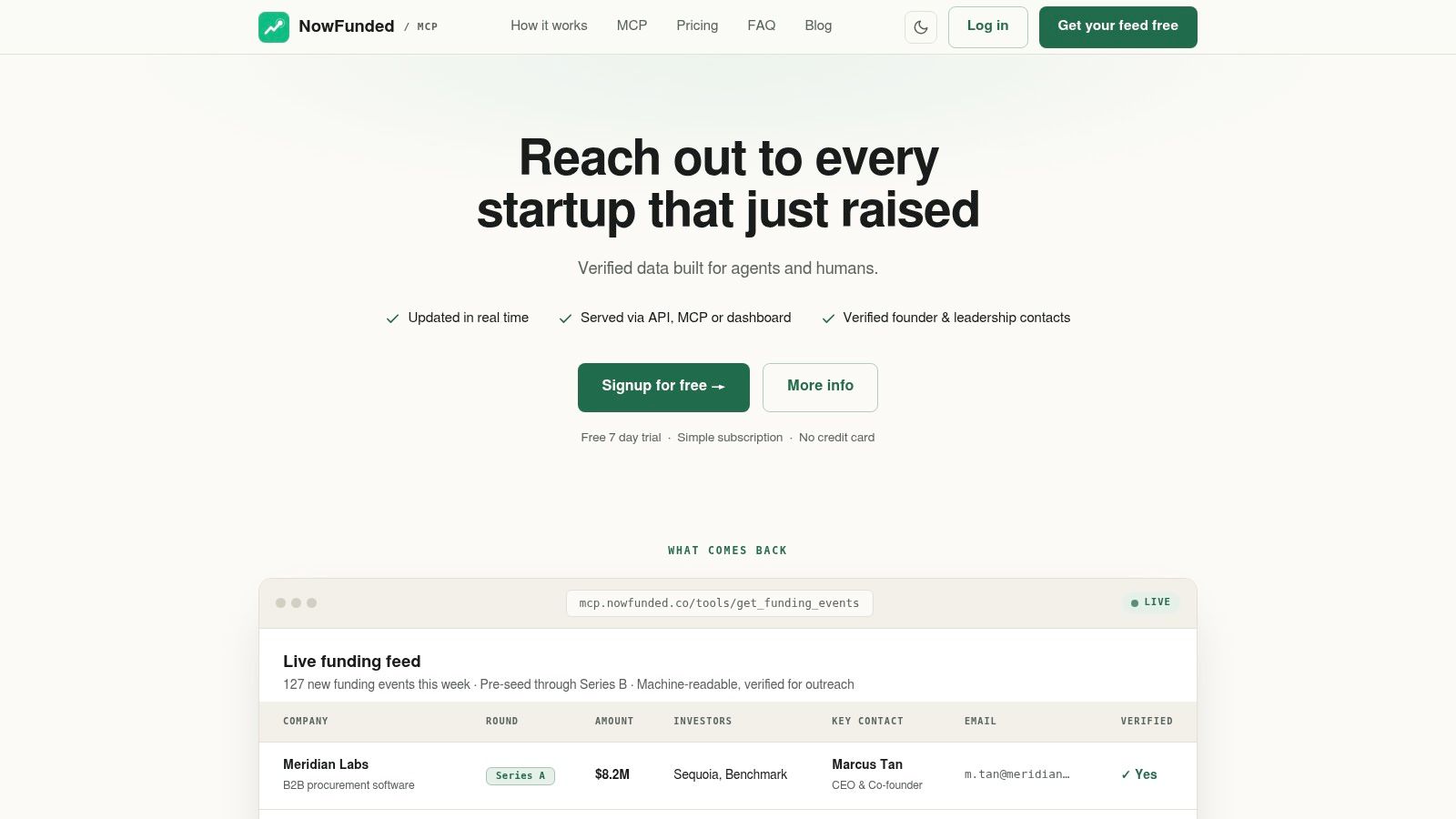
Bigger databases often lose to faster triggers. NowFunded stands out because it is built around a single event a team can act on immediately: a startup closes a funding round, the event is verified, and the relevant founder or leadership contact is available for outreach.
That focus changes the signal-to-action workflow. Broad sales intelligence platforms usually start with account discovery, then ask reps or ops teams to layer on timing and contact validation. NowFunded starts with timing. The company record matters because a fresh funding event often signals new budget, hiring urgency, vendor evaluation, or founder openness to new tools.
Where NowFunded is strongest
NowFunded is best understood as an event-driven funding intelligence product rather than a general prospecting database. It tracks newly funded startups from pre-seed through Series B and pairs each funding record with structured round details plus verified founder and leadership contacts. For teams that sell to early-stage companies, that usually matters more than having the widest company universe.
The more important distinction is delivery. NowFunded supports an MCP endpoint, REST API, webhooks, CSV exports, and a web dashboard. That means the signal can move in different ways depending on the workflow. A sales team can review rounds in the dashboard, an ops team can push records into CRM through exports or API calls, and a developer can send verified funding events straight into an AI prospecting agent through webhooks or MCP.
That reduces lag.
If your workflow starts with "something changed at this company today," push-based delivery is often more useful than a larger but more static dataset.
How the signal-to-action path compares
NowFunded detects a narrow signal, but it is a high-intent one. A verified funding round is easier to operationalize than a broad list of startup accounts because the trigger already answers the timing question. The next step is contact verification, and that is where the product stays disciplined. Instead of presenting a large pool of possible contacts with mixed confidence, it emphasizes a smaller set of founder and leadership records with explicit verification status.
That design has practical consequences. Reps spend less time deciding whether a company is newly relevant. RevOps teams spend less time building filtering logic to isolate fresh opportunities. Developers also have less transformation work before a funding event becomes an alert, enrichment job, outbound sequence, or agent task.
Pricing and workflow fit
The pricing model follows the same logic. Funding-event queries are free, while verified contacts are charged only when verification succeeds, at stated per-contact rates and without a subscription or minimum spend. That structure fits teams that want to pay for actionability instead of paying first for broad access they may not use often.
This is a good fit for three groups in particular: startup-focused sales teams, recruiters targeting newly funded companies, and builders creating event-driven outbound systems. All three care less about territory-wide account coverage and more about whether a credible signal can reach a person or system fast enough to trigger outreach.
Trade-offs
NowFunded is specialized by design. It is not the right anchor tool for later-stage private markets, enterprise account planning, deep org charts, or company coverage across large public and private segments. Teams that need technographics, buying committee mapping at scale, or multi-department enrichment will still need another system upstream or alongside it.
But that limitation is also the reason it earns a place on this list. Many sales intelligence tools answer "who exists?" NowFunded is better at answering a narrower and often more profitable question: "who just became reachable for a timely pitch, and can we route that signal into outreach with minimal delay?" You can explore the product at NowFunded.
2. ZoomInfo
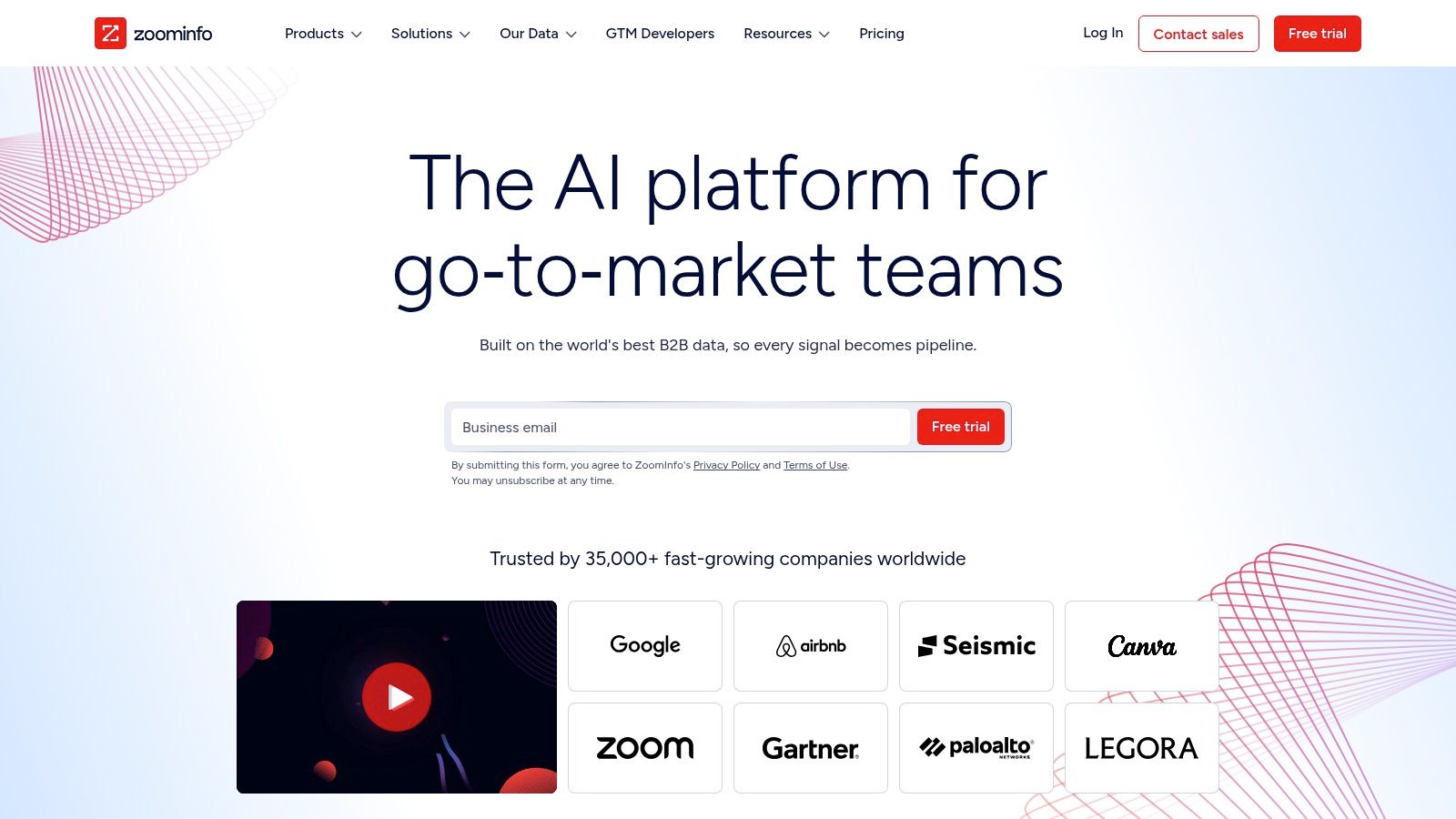
ZoomInfo is often treated as a prospecting database. That undersells what buyers are paying for. Its real value is the path from signal to execution at enterprise scale: detect intent or account changes, verify the right contacts, enrich CRM records, and pass the result into routing, marketing, or rep workflows with controls that larger teams usually require.
That matters because ZoomInfo is strongest in broad coverage rather than narrow trigger speed. If your team needs to work a wide TAM across multiple segments, functions, and regions, depth of company and contact records usually matters more than getting one specialized signal a few hours earlier.
Where ZoomInfo stands out
ZoomInfo performs best when sales intelligence is part of an operating system, not a one-off list-building task. The platform combines company and contact data, org charts, technographics, intent data, enrichment, and workflow automation in one environment. For RevOps teams, the advantage is not only data volume. It is having fewer handoffs between tools when a signal needs to become an assigned lead, an updated account record, or an outbound task.
Viewed through the signal-to-action lens, the workflow is clear. A team identifies accounts based on firmographic fit, technology use, or intent patterns. ZoomInfo then helps verify likely stakeholders, push those records into CRM or MAP systems, and trigger follow-up through the systems reps and marketers already use. That flow is less immediate than a funding-alert product, but it fits organizations that care about repeatability, governance, and broad account coverage.
Data coverage, freshness, and verification
Coverage is the main reason ZoomInfo stays on enterprise shortlists. Teams buying it are usually optimizing for fewer blank fields across a large account universe, stronger buying-committee mapping, and enough supporting data to run segmentation and enrichment centrally.
Freshness and verification are more nuanced. ZoomInfo has a strong reputation for maintaining a large B2B database, but practical performance still depends on your market. A North America focused SaaS team and a team selling into smaller firms or harder-to-reach international segments may see different hit rates. That is why pilot testing against your actual ICP matters more than vendor-level claims about database size.
Integrations, pricing, and workflow fit
Integrations are a major part of the product case. ZoomInfo makes more sense when your stack already includes CRM, automation, lead routing, enrichment, and reporting processes that can absorb a steady stream of account and contact updates. In that setup, the platform functions less like a search tool and more like data infrastructure.
Pricing is the clearest trade-off. It is typically quote-based, which makes evaluation slower and raises the cost of a poor fit. Smaller teams can struggle to justify that model if they mainly need fast access to a smaller set of verified contacts tied to specific triggers. You can review the platform at ZoomInfo.
The practical takeaway is simple. Choose ZoomInfo if your bottleneck is scaled account coverage plus controlled activation across systems. Look elsewhere if your bottleneck is detecting a narrow event quickly and turning it into outreach before the window closes.
3. Apollo
Apollo works best when the gap is not account coverage, but time-to-action. Its advantage is the speed of the full workflow: detect a prospect or account that fits your criteria, verify whether the contact is usable, then move that record straight into outreach without waiting on a separate data team or sequencing tool.
That changes the buying case.
Apollo combines database search, enrichment, email sequencing, and a Chrome extension in one product. For small and mid-sized outbound teams, that means fewer handoffs between tools and fewer delays between identifying a signal and acting on it. If a rep finds a target account after a hiring update, product launch, or market expansion, the next steps can happen inside the same system instead of across three or four vendors.
The trade-off is that Apollo is strongest on workflow compression, not on being the most controlled data layer in a larger revenue stack. Teams that need strict governance, specialized trigger coverage, or heavy cross-system enrichment rules often outgrow that model even if the day-one setup is easier.
Where Apollo stands out
Apollo is popular because it reduces procurement and implementation friction. A team can test coverage against its actual ICP, run prospecting, and evaluate deliverability and reply outcomes before committing to a more expensive enterprise contract.
That matters if your signal-to-action process is rep-led. Apollo helps when the same team is responsible for finding contacts, checking whether the record looks usable, and starting the sequence. In practice, that makes it a better fit for SDR teams, founder-led sales, and lean GTM groups than for companies separating data operations from execution.
If you want a broader view of how trigger-based prospecting differs from general contact search, the sales intelligence articles on the NowFunded blog offer a useful contrast.
Limits to watch
Apollo's pricing model is easier to understand than quote-based enterprise tools, but transparent credits do not always mean low total cost. High-volume enrichment, mobile number pulls, and heavy list-building can raise usage faster than teams expect.
Verification is also a practical rather than theoretical question. The right test is not whether Apollo has a large database. It is whether the specific contacts tied to your target signals are current enough to use immediately. If your team sells into fast-changing org charts, niche international segments, or smaller companies with weaker public data trails, hit rate can vary.
Use Apollo if you want one environment that turns prospect selection into outreach quickly. Look elsewhere if your process depends on deeper data administration, narrower event intelligence, or stricter control over how records move across systems. You can review the platform at Apollo.
4. LinkedIn Sales Navigator
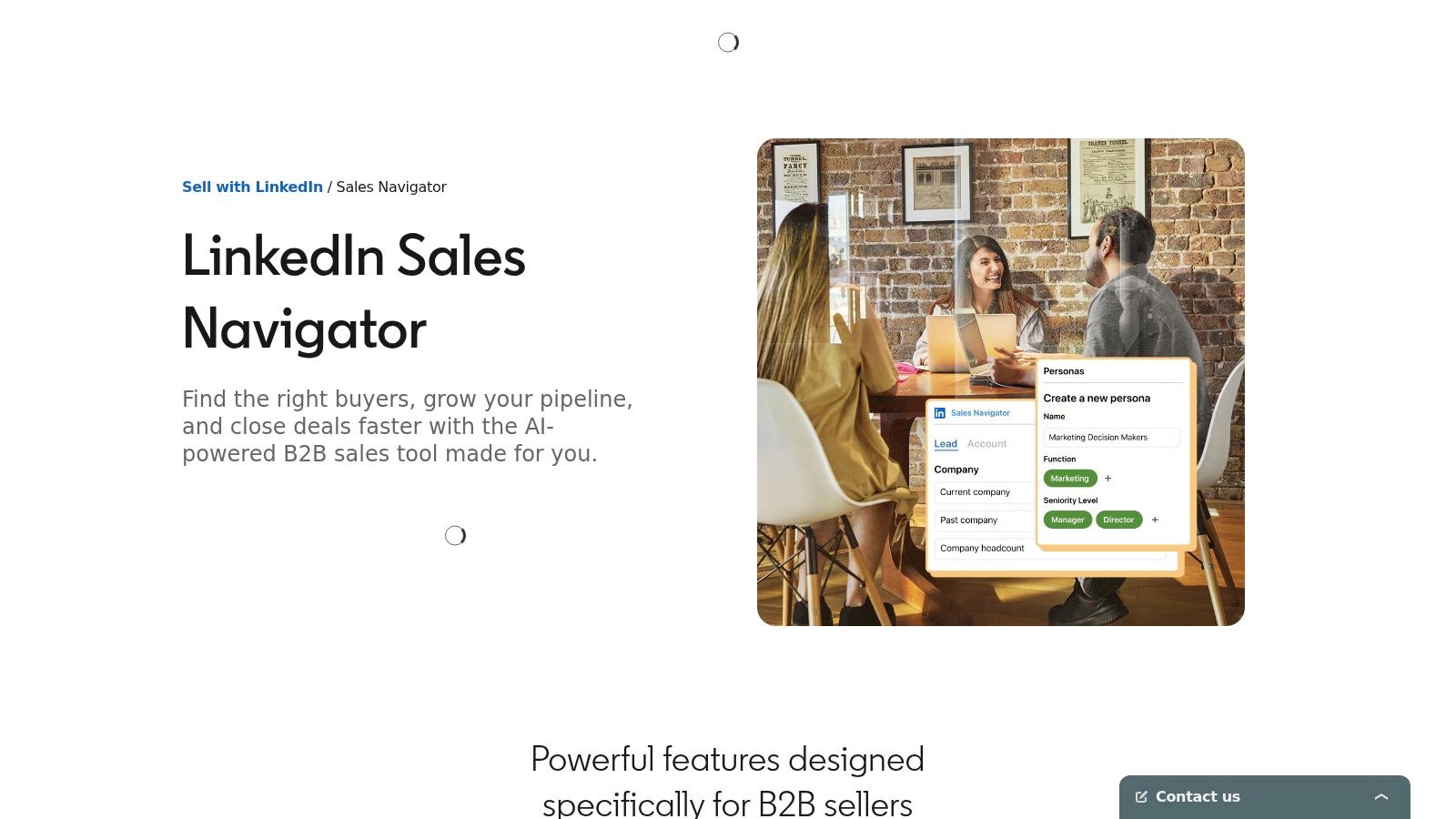
Sales intelligence does not always start with a database. Sometimes the fastest path from signal to action starts with knowing who changed roles, who knows whom, and which account is showing visible people activity. That is the case for LinkedIn Sales Navigator.
Sales Navigator works best as a relationship and org-mapping layer, not as a standalone contact data system. Its advantage is signal freshness around professional identity. Job changes, tenure, team structure, shared connections, and account activity often appear here before a rep would catch them in a static list. For teams that sell through introductions, executive targeting, or multi-threaded account research, that changes the workflow materially.
Best for role-change signals and relationship-led outreach
The key question is not whether Sales Navigator has more records than a data vendor. The better question is what happens after a signal appears.
With Sales Navigator, the signal-to-action chain usually looks like this: a buyer changes roles, joins a target account, engages on LinkedIn, or becomes newly visible through account updates. The rep then verifies relevance by checking current title, mutual connections, prior employers, and likely buying-group fit. Outreach happens through LinkedIn itself or through a connected sales stack that handles email, CRM updates, and task creation.
That sequence is slower than tools built for immediate list export, but often stronger for complex deals. It reduces one common failure point in outbound: contacting the wrong person with technically correct but context-poor data.
This also makes Sales Navigator a useful contrast to funding-trigger prospecting discussed in the NowFunded blog's sales intelligence articles. One model starts with company events. The other starts with people movement and relationship access.
Where it is strongest, and where it depends on the rest of your stack
Data coverage is broad for professional profiles and org visibility, especially in markets where LinkedIn adoption is high. Freshness is often better on titles and employers than third-party databases because users update their own profiles. Verification is narrower. Sales Navigator helps confirm that a person is real, current, and plausibly relevant, but it does not verify contactability in the way email and phone enrichment platforms do.
That trade-off matters operationally. If your team needs to detect a signal and launch outreach in the same session, Sales Navigator usually needs a companion product for email discovery, phone data, sequencing, or enrichment. If your team values precision before speed, that extra step can be worth it.
Integrations and workflow fit are also different from all-in-one prospecting tools. Sales Navigator connects well into CRM-centric workflows and seller research habits. It is less suited to high-volume automation where the goal is to push large batches of verified contacts directly into outbound systems with minimal human review. Pricing follows the same logic. You are paying for visibility into professional relationships and account context, not for bulk data extraction.
Use Sales Navigator when the signal you can act on is a person change, a connection path, or a buying-group map. Pair it with another platform when the next required step is verified contact data and automated execution. You can evaluate plans at LinkedIn Sales Navigator.
5. 6sense
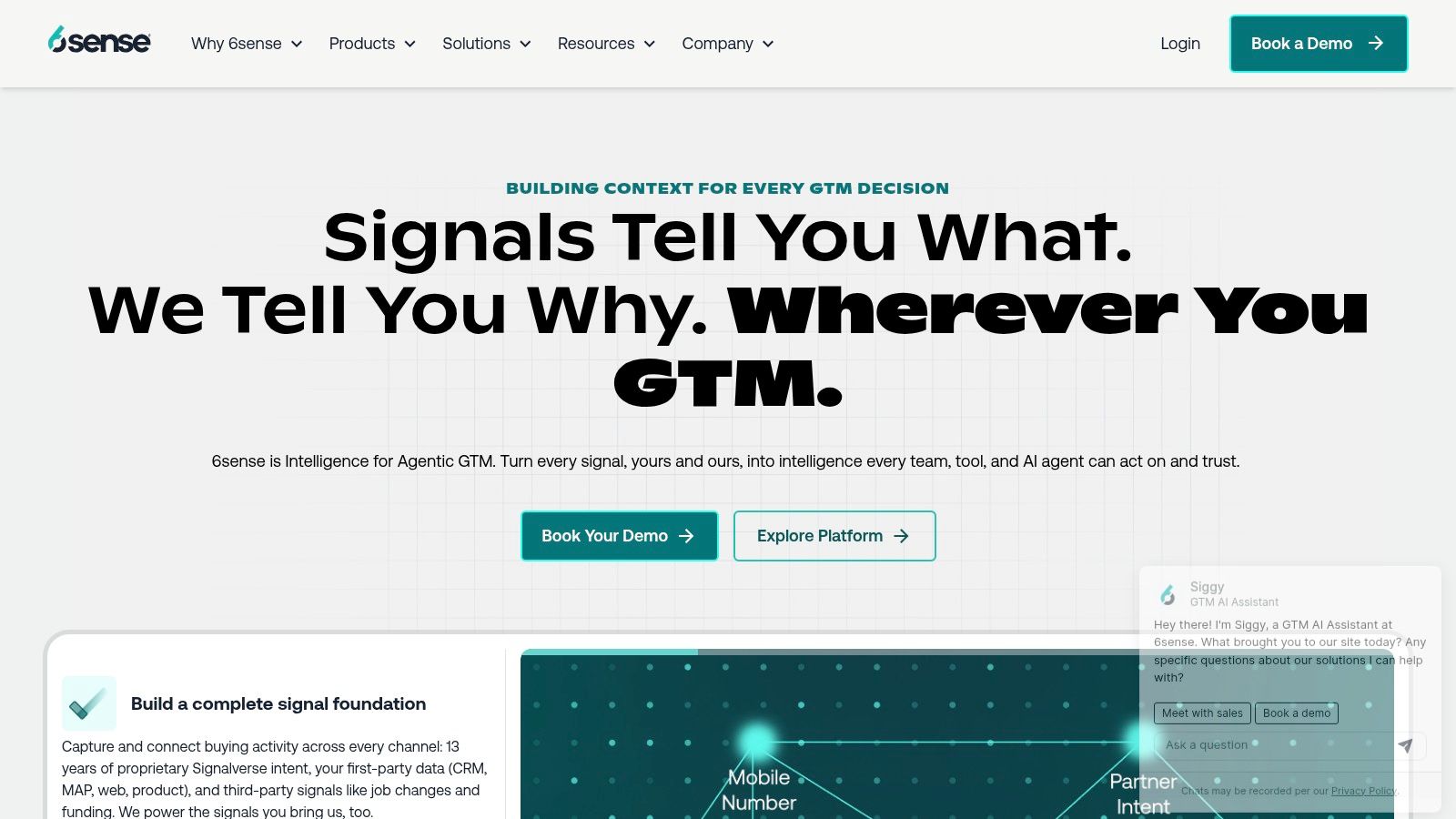
The mistake buyers make with 6sense is evaluating it like a contact database. That misses its actual job. 6sense is strongest earlier in the signal-to-action chain, at detecting account-level buying behavior before a prospect fills out a form, replies to outreach, or appears in a funding feed.
That design changes how you should judge it. Data coverage matters less at the individual record level and more at the account and buying-stage level. Freshness also means something different here. The useful question is not only whether a title or phone number is current, but how quickly the platform detects intent shifts, topic consumption, or anonymous research activity and turns that into a ranked action for sales.
What 6sense does well
6sense is built for enterprise teams that want to prioritize accounts, not just collect names. Its value comes from combining intent data, predictive scoring, account selection, and guidance on who may belong to the buying group. In practice, that can shorten the path from "something is changing at this account" to "this rep should contact these stakeholders with this context."
That is a meaningful distinction from tools optimized for direct contact discovery.
Verification is the trade-off. 6sense can help identify which accounts deserve attention and which personas are likely relevant, but teams still need to assess how well it verifies specific contact details for immediate outreach. If your workflow depends on finding a signal, confirming a reachable person, and launching a sequence in one pass, 6sense often works best alongside enrichment or engagement tools rather than as the only system in the stack.
Where the workflow fits, and where it slows down
6sense fits best when account prioritization is the bottleneck. That is common in larger ABM programs where hundreds or thousands of target accounts show intermittent intent and reps need a system to rank what deserves action now.
Its workflow is less efficient for narrow event-driven selling. A team chasing newly funded startups usually needs faster event detection tied directly to verified founder or revenue-leader contacts. 6sense is better suited to a different signal: diffuse buying activity across an account that would otherwise stay invisible until much later in the cycle.
Integrations matter here because the platform's value depends on operational follow-through. 6sense is most useful when its signals move into CRM, sales engagement, ad audiences, or AI-assisted rep workflows without extra manual triage. Teams with mature RevOps support usually get more from it than teams looking for a lightweight prospecting tool.
Pricing follows the same pattern. 6sense tends to make more sense when the upside comes from better account selection across a large revenue motion, not when the goal is cheaper access to contacts. Review the platform at 6sense.
6. Cognism
Cognism tends to rank lower in US-first comparisons than it should. That usually happens because many buying guides treat raw database size as the main criterion, even though outbound teams selling into the UK and Europe often care more about a different question. Can a rep identify a legitimate trigger, verify a reachable mobile number, and push that record into outreach without creating compliance risk?
That is the lens where Cognism stands out. Its value is less about surfacing novel intent signals and more about shortening the path from a usable account list to verified, compliant contact data for EMEA prospecting. For teams that already know which companies they want to pursue, that can matter more than having the widest possible dataset.
Where Cognism is strongest
Cognism is usually chosen for three reasons: European coverage, mobile data quality in key EMEA markets, and a stronger compliance posture around outbound use cases. Those strengths make it a practical fit for SDR teams calling into the UK and EU, especially when legal, procurement, or RevOps scrutinize vendor data practices before rollout.
Its signal-to-action workflow is relatively direct. The signal often starts outside Cognism, from a funding event, target-account list, territory build, or CRM trigger. Cognism then does the middle part of the job well: finding the right person, verifying contact details, and sending that data into CRM or sales engagement tools so a rep or agent can act quickly. That is a narrower promise than platforms built around intent modeling, but it is often the right one.
Trade-offs to weigh
Cognism is not the best choice for every motion. Teams looking for broad intent coverage, heavy account scoring, or an all-in-one prospecting and sequencing environment will usually find stronger fits elsewhere. Its differentiation is clearer when outreach quality matters more than feature sprawl.
Pricing also needs to be judged against workflow fit, not feature checklists. If your team wins by calling verified contacts in Europe soon after a trigger appears, better mobile coverage can justify a higher spend. If your motion is largely self-serve email sequencing in North America, that premium may be harder to defend.
The practical conclusion is simple. Cognism is a strong operational tool for turning known account signals into compliant outreach in EMEA, but a weaker pick for teams that expect the platform itself to generate most of the signal. Review the platform at Cognism.
7. Crunchbase Pro
Crunchbase Pro earns its place on this list for a narrower reason than many sales teams expect. It is strongest at spotting company-level change early enough to shape account selection, especially around funding, hiring, growth, and category movement. It is weaker at the next two steps in the signal-to-action chain: confirming the right person and pushing that insight into an outbound workflow without extra tooling.
That distinction matters. Many platforms claim to do sales intelligence, but they solve different parts of the job. Crunchbase Pro is primarily a discovery and monitoring product. Analysts, founders, investors, and SDR teams often use it to answer a top-of-funnel question first: which companies look newly worth pursuing?
Best for company discovery, not full execution
Saved searches, list building, and alerts are the core value. If your motion starts with market scanning, such as tracking newly funded startups in a segment or watching companies that are expanding headcount, Crunchbase Pro can surface those changes quickly enough to create a practical prospecting queue.
The trade-off shows up immediately after the signal appears.
Crunchbase Pro does not center its workflow on verified contact data or native outbound execution. Contacts are an add-on rather than the product's main operating model, so teams usually need a second system for email verification, dialing, sequencing, or CRM enrichment. That makes the handoff slower than tools designed to package signal, contact, and workflow in one path.
How it fits the signal-to-action workflow
Crunchbase Pro is useful when the company signal itself is the scarce resource. It helps teams detect likely buying or funding relevance, organize that information into tracked lists, and trigger human research. That is a sound workflow for venture sales, partnerships, recruiting, and category-focused prospecting where account selection matters more than immediate outreach volume.
It is less efficient for teams that need to act within hours with a verified contact already attached. In that use case, platforms built around direct delivery into CRM, sequencing tools, APIs, or agent workflows usually remove more manual work. As noted earlier, some products are built specifically for that faster signal-to-contact handoff.
A separate market review from Amplemarket's analysis of sales intelligence platforms for 2026 also reflects this broader category split between tools that surface targets and tools that operationalize outreach.
Practical fit and trade-offs
Crunchbase Pro is usually easier to adopt than heavier enterprise suites. The interface is familiar, the value proposition is clear, and the pricing model is often easier to justify for teams that need discovery more than deep workflow automation. That makes it a sensible choice for smaller GTM teams, researchers, and founder-led sales motions.
The limitation is workflow depth. If your reps still need another product to verify emails, enrich direct dials, route records into CRM, and launch outreach, then the true cost is not just the Crunchbase subscription. It is the extra time and tooling required to convert a company signal into a live conversation.
The practical conclusion is straightforward. Crunchbase Pro is a strong option for funding-led and growth-led account discovery, but a partial solution for sales teams that measure tools by how fast a signal becomes an actionable contact inside an operating workflow. You can explore it at Crunchbase.
Top 7 Sales Intelligence Tools, Feature Comparison
Product Implementation complexity Resource requirements Expected outcomes Ideal use cases Key advantages NowFunded Low–Moderate, MCP/REST/webhooks provided out‑of‑box Minimal engineering; pay‑per‑contact costs, no subscription Real‑time verified early‑stage funding signals and contacts First‑mover outreach, AI agents, recruiting, SDR workflows Real‑time, machine‑readable feed; verified contacts billed only on success; low barrier to try ZoomInfo Moderate–High, enterprise setup and governance Significant budget and data‑ops resources; integrations with CRM/marketing stacks Broad firmographic/contact coverage and operationalized seller workflows Enterprise ABM, large sales/marketing teams, governed data operations Extensive coverage, integrated sales/marketing portfolio, intent + AI Copilot Apollo Low, self‑serve with APIs and extensions Credits‑based pricing tied to usage; suitable for SMBs/startups End‑to‑end prospecting: search, enrichment and outreach sequences Startups/SMBs seeking unified data + engagement tool Transparent pricing/credit model; all‑in‑one outreach workflow LinkedIn Sales Navigator Low, self‑serve product with CRM connectors Subscription license; typically paired with a contact data provider Relationship‑driven leads, up‑to‑date role and network information Social selling, relationship mapping, account research Direct access to LinkedIn graph, role/relationship insights, published pricing 6sense (Sales Intelligence) High, enterprise deployment with predictive models High cost; enterprise contracts and license tiers; implementation effort Prioritized in‑market accounts and prescriptive actions for sellers Intent‑led ABM and enterprise revenue teams Strong intent and predictive modeling, CRM‑embedded signals and actions Cognism Moderate, integrations plus compliance configuration Quote‑based pricing; compliance/legal oversight for EU/UK outreach GDPR/CCPA‑aligned contact data with strong European mobile coverage EU/UK prospecting, compliance‑sensitive outreach at scale Compliance‑first data collection, strong EU mobile numbers, DNC scrubbing Crunchbase Pro (with optional Contacts) Low–Moderate, self‑serve Pro plus optional add‑on Pro subscription plus separate Contacts add‑on with caps Funding and growth signals to discover high‑momentum companies Targeting newly funded startups, market research, fundraising signals Funding intelligence, saved searches/alerts, transparent Pro subscriptionMatch the Platform to the Signal You Can Act On
The mistake isn't choosing a bad platform. It's buying a platform optimized for the wrong signal. A broad contact database won't help much if your real edge comes from spotting newly funded startups first. A funding tracker won't replace an enterprise intent system if your motion depends on account prioritization across a huge TAM.
That's why the best sales intelligence tools aren't interchangeable. They sit at different points in the signal-to-action chain.
NowFunded is the strongest option here for fresh early-stage funding signals, verified founder and leadership contacts, and machine-ready delivery through MCP, API, webhooks, CSV, or dashboard workflows. It's built for the moment a company becomes newly reachable, and that design choice matters. The second underserved angle in this category is timing around funding stage and company-change events, which many broad roundups still don't handle well, even as one 2025 outlook projects market growth from $4.7 billion to $11 billion by 2034 at a 9.8% CAGR, according to Salesmotion's market discussion of sales AI software in 2026.
ZoomInfo is the right fit when broad enterprise data operations matter more than narrow trigger speed. Apollo works well for self-serve prospecting plus outreach in one system. LinkedIn Sales Navigator remains the best relationship-led layer for social selling and org mapping. 6sense is strongest for enterprise intent prioritization and predictive account selection. Cognism deserves priority for compliance-conscious teams that need stronger European mobile coverage. Crunchbase Pro is a practical choice for funding-led discovery and alerting when you don't need a full execution suite inside the same product.
One more market pattern is worth keeping in mind. The category has moved from static prospect databases toward AI-enabled systems over the last decade, and the U.S. market alone is estimated to grow from USD 833.3 million in 2020 to USD 1,513.4 million by 2027, according to Grand View Research's U.S. market outlook for sales intelligence. That shift changes the buying question from “which tool has data?” to “which tool helps my team or agent act on the right signal with the least friction?”
Use a simple decision sequence before you scale anything:
- Define the trigger: Know whether you care about funding events, account intent, job changes, social activity, or broad territory coverage.
- Verify ICP coverage: Test the platform against your real market, not the vendor's generic examples.
- Check contact quality: Don't assume a visible contact is a reachable contact.
- Map workflow delivery: Decide whether the signal needs to land in CRM, sequencing, Slack, a webhook, or an AI agent.
- Watch the economics: Track credits, per-contact costs, and contract structure before rollout expands.
The best platform is the one your team can act on fast, repeatedly, and without building a fragile workflow around it.
If your team sells to startups, recruits from venture-backed companies, or builds AI agents around business events, NowFunded gives you a live feed of newly funded companies plus verified founder and leadership contacts in formats built for action. It's one of the few tools on this list designed around the exact moment a company becomes newly reachable. You can explore the feed, API, and webhook options at NowFunded.