7 Best Lead Generation Tools for Smarter Outreach

The largest contact database isn't automatically the best lead source. A database can give your team plenty of records while leaving the bottleneck untouched, whether that's stale contact data, weak buying signals, slow routing, poor deliverability, or too much manual work between research and outreach. In B2B SaaS, only 13% of marketing-qualified leads convert to sales-qualified opportunities, while the median cost rises from $198 per MQL to $762 per SQL, according to the 2025 B2B lead-generation benchmark. That makes downstream efficiency more important than list size.
This comparison evaluates seven of the best lead generation tools by the job each performs best: real-time funding triggers, all-in-one outbound execution, enterprise intent intelligence, compliant EMEA contact discovery, HubSpot-native enrichment, transparent credit-based prospecting, and flexible multi-source orchestration.
Table of Contents
- 1. NowFunded
- 2. Apollo.io
- 3. ZoomInfo
- 4. Cognism
- 5. Clearbit by HubSpot
- 6. Lusha
- 7. Clay
- Top 7 Lead Generation Tools Comparison
- Choose the Tool That Matches Your Motion
1. NowFunded
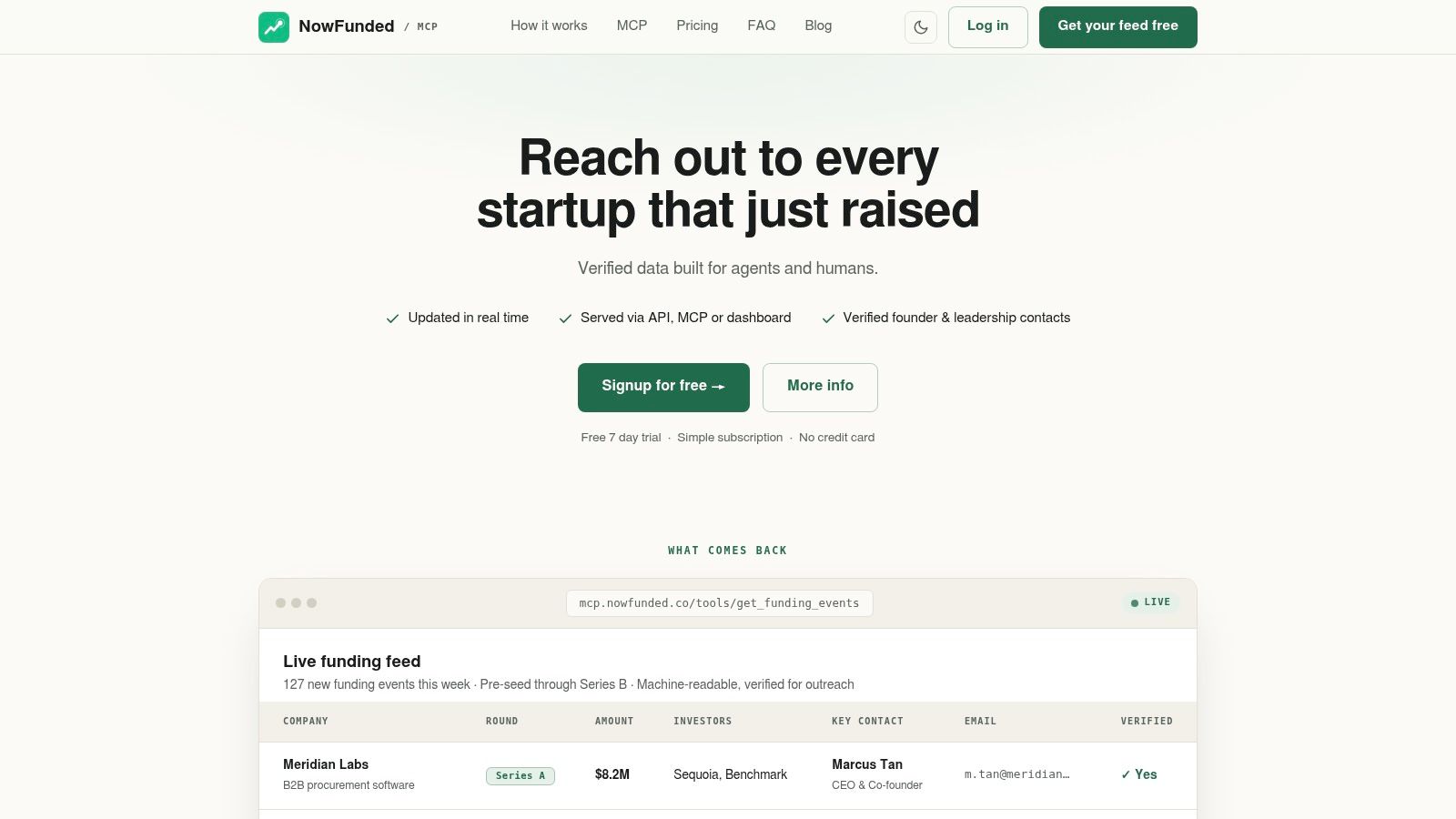
NowFunded targets a narrower problem than a general contact database: identifying newly funded startups while the financing event is still actionable. Its live, machine-readable feed covers companies from pre-seed through Series B, with company name, funding round, amount raised, lead investors, headquarters, headcount, industry, website, and LinkedIn profile. New rounds appear within minutes of verification, giving outbound teams, recruiters, analysts, and AI agents a specific trigger instead of a static account record.
The platform can enrich companies with founder and leadership contacts on demand. Names, roles, work emails, and phone numbers show explicit verification status, and billing applies only when verification succeeds. That billing condition helps separate usable contact discovery from databases that require operators to clean, test, and replace records before outreach.
Where NowFunded fits best
NowFunded is designed for workflows driven by events. Sales teams can trigger outreach after a confirmed raise. Recruiting teams can identify startups that may be expanding, while analysts can monitor investor activity and funding history. AI agents can filter structured records deterministically, without interpreting inconsistent CSV columns or maintaining scraping jobs.
Its delivery options include MCP, REST API, webhooks, CSV export, and a web dashboard. Typed JSON schemas and defined fields make the records easier to pass into agents, routing logic, research systems, and CRM workflows. Webhooks also remove the need for frequent polling when downstream action should begin as soon as a record changes.
Practical rule: Choose NowFunded when the event creates the relevance. A newly verified funding round gives outreach a concrete reason to start, but message quality and human review still determine whether the opportunity converts.
The funding-event feed is free to query and browse. Verified contacts are billed per successful pull at the site-listed rates of $0.10 per email and $0.25 per phone, with no required minimum spend, according to NowFunded's product site. Coverage includes 100+ newly tracked startups weekly and a historic database of 10,000+ funding events from the last 12 months, supporting lookbacks and trend analysis. The trade-off is focused early-stage coverage and potentially higher per-contact costs for large enrichment campaigns. Contact availability also varies by company.
2. Apollo.io
Apollo.io is built for teams whose primary lead-generation job is executing list-driven outbound from one workspace. It combines company and contact search, list building, enrichment, email sequencing, calling, website-visitor identification, deliverability tools, and workflow automation. The practical gain is fewer handoffs between finding a prospect, enrolling that prospect, and recording activity.
For a small or mid-market SDR team, that consolidation can reduce setup work. Reps can filter accounts, choose contacts, create sequences, use the browser extension during research, and connect activity to CRM workflows without assembling each capability from separate vendors. API access also supports programmatic enrichment and exports when the interface is insufficient.
Consolidation improves speed, not automatically data quality
Apollo's breadth creates a clear evaluation trade-off. Credit rules, “unlimited” language, and record-selection limits can make actual usage less transparent than the interface suggests. Accuracy may vary by industry, geography, seniority, and company type, so teams should verify priority contacts before adding them to campaigns.
Usage matters as much as feature count. The B2B lead-generation benchmark reports 58% active seat utilization across a client aggregate of 41 B2B tech accounts. A broad platform produces value only when reps use it consistently and its records transfer cleanly into the next workflow stage.
Apollo fits teams that prioritize outbound execution, speed, and vendor consolidation over real-time trigger intelligence. It is a weaker fit when the central question is why an account is ready now, or when a difficult segment demands highly specialized verification. Compare the complete operating workflow, including credits, verification, sequencing, CRM transfer, and user adoption, rather than judging the database in isolation. For teams evaluating startup-specific trigger data, NowFunded's lead-generation resources offer a signal-first alternative.
3. ZoomInfo
ZoomInfo suits enterprise teams that need account intelligence, governed workflows, and activation across an established go-to-market stack. Its SalesOS suite combines contact and company data with org charts, direct dials, news and operational signals through Scoops, intent products, sequencing through Engage, and AI guidance through Copilot.
Its strongest job is enterprise intent intelligence. ZoomInfo connects account context, buyer roles, intent, and sales execution, helping revenue teams prioritize accounts around relevant events rather than static firmographic filters. That operating model fits organizations with multiple teams, formal ownership rules, and CRM governance. It is less suitable for a lean group that only needs a first prospect list.
Enterprise intelligence has an operating cost
Integrations can move data into CRMs, marketing systems, and engagement platforms with greater control. The benefit appears when managers need shared definitions, permissions, reporting, and auditability across departments. Signal coverage alone does not create pipeline. Teams still need scoring rules, account ownership, and a process that turns alerts into outreach.
Procurement and implementation add friction. Pricing is sales-quoted, and enterprise agreements can require substantial annual commitments. Onboarding also demands more change management than a lightweight prospecting tool. Without clear activation processes, ZoomInfo can become an expensive intelligence layer that reps rarely use.
The enterprise choice is justified by governance, not by the size of the logo database alone.
ZoomInfo is a strong match for mature sales organizations that can administer data and operationalize intent. It is a poor fit for teams whose only requirement is affordable contact discovery. For startups, NowFunded provides a narrower funding-trigger workflow, while ZoomInfo covers broader enterprise intelligence and governance. The trade-off is direct: choose ZoomInfo for coordinated account prioritization, not merely for access to a larger database.
4. Cognism
Cognism is built for compliant EMEA contact discovery, not generic database access. It suits teams prospecting across the UK and Europe when verified phone data, country-specific suppression, and documented processing matter more than the lowest acquisition cost. Its “Diamond Data” contacts are phone-verified, while regional do-not-call and telephone preference service scrubbing, documented data-processing practices, and a data-processing agreement support governance reviews.
The Chrome extension lets reps prospect on LinkedIn, inspect available contact details, and export records into CRM workflows. This fits account-based outreach: the rep identifies a company or person first, then uses Cognism to enrich the record and support compliant calling without switching repeatedly between research tools.
Compliance is part of the data decision
A global database does not automatically meet EMEA requirements. Revenue operations and legal teams may need to review consent handling, suppression, processing documentation, and phone-outreach controls. Cognism's compliance-first positioning therefore gives buyers criteria beyond field coverage and contact volume.
Its clearest use case is EMEA prospecting where verified mobile data and governance reduce operational risk. Buyers should test coverage across target countries, roles, and outreach scenarios before signing. Phone-verified records may consume credits quickly when campaigns rely heavily on direct calling, so credit usage belongs in the workflow design.
Pricing is sales-led rather than openly self-serve, and the premium position can be difficult for early-stage teams testing a narrow motion. Cognism also does not replace targeting, messaging, sequencing, human review, or CRM discipline. It improves contact discovery and confidence, while the sales process determines whether those records become pipeline. Teams seeking a different trigger should consider NowFunded for funding-led prospecting, whereas Cognism is the more focused choice for compliant EMEA contact discovery.
5. Clearbit by HubSpot
Clearbit by HubSpot is designed for teams that already run marketing and sales operations in HubSpot. It enriches company and contact records with firmographic and technographic context, supports Reveal for identifying companies behind website activity, and helps teams build audiences around ICP fit.
Its main advantage is operational alignment. Marketing can segment audiences using enriched fields, while sales and operations use the same CRM records for routing, prioritization, and follow-up. That reduces synchronization work when HubSpot is already the system of record.
Native integration versus data independence
Clearbit is strongest at turning known or inbound interest into an organized HubSpot workflow. The platform answers questions such as which account fits the ICP, how it should be routed, and what context a rep should see before follow-up. It is a weaker fit when the primary job is discovering contacts through external triggers or coordinating several prospecting providers.
The free and legacy free options have been sunsetted, so access is primarily paid through HubSpot. Buyers should test data freshness, field coverage, and taxonomy fit in their target market. Native integration reduces operational friction, but it does not guarantee accurate or current records. Packaging and acquisition changes can also affect cost and availability, making a workflow-level assessment more useful than a feature checklist.
Clearbit's best use case is HubSpot-native enrichment. It can improve segmentation and routing without sending marketers, SDRs, and operations staff to another data destination. Teams that need funding alerts, agent-first delivery, or contact retrieval only after verification succeeds may find a specialized source such as NowFunded's lead-generation platform better aligned with that trigger. The trade-off is clear: Clearbit supports CRM-centered orchestration, while trigger-led prospecting requires a different data workflow.
6. Lusha
Lusha is designed for transparent credit-based prospecting, giving SMB and mid-market teams a direct way to find business emails and phone numbers. Reps can research contacts through its browser extension, enrich records, and send them into existing CRM workflows without an enterprise procurement process.
The credit model also makes acquisition costs easier to inspect than vague unlimited plans. Different contact actions consume credits, while self-serve access, monthly allocations, and rollover policies support controlled testing. A team can estimate list-building costs from its actual contact mix, run a pilot, and expand usage after the workflow proves useful.
A good entry point with a clear ceiling
Lusha's main advantage is speed from research to first list. A sales rep can identify a prospect, retrieve available contact details, and move the record into an existing process with limited setup. Its published compliance materials, including SOC 2 and GDPR/CCPA information, give buyers specific trust documentation to review.
Coverage remains the trade-off. In some segments, Lusha may provide less account depth, organizational context, or specialized intelligence than enterprise databases. Phone-heavy workflows can also consume credits quickly, so buyers should model the cost of their intended email and phone mix instead of treating an email lookup as the complete acquisition cost.
Lusha fits teams whose targeting and outbound execution already work, but whose bottleneck is contact discovery. It is less suitable when the primary requirement is real-time timing, intent intelligence, or multi-source orchestration. The platform can add a practical enrichment layer, yet it does not independently identify which external event should trigger outreach or coordinate that signal across an agent-led workflow.
7. Clay
Clay is most useful when lead generation requires a custom operating model rather than another fixed prospecting database. It functions as a data-orchestration workspace, combining enrichment providers, AI research, waterfall logic, webhooks, APIs, CRM destinations, and outbound tools. Teams decide which source runs first, when a fallback is triggered, how fields are evaluated, and where qualified records go.
That makes Clay a strong fit for flexible multi-source orchestration. SDR operations, growth teams, technical marketers, and agent builders can begin with target accounts, query one provider, use another when coverage is incomplete, research public company context with AI, apply qualification rules, and route approved records to a CRM or sequencer.
Flexibility creates operational responsibility
Clay's differentiation is workflow composition. Integrations with tools such as Outreach, Salesloft, and HubSpot support outbound execution, while tables let operators inspect enrichment results and research outputs before they enter downstream systems. Webhooks and APIs also support event-driven processes, including workflows that need to react to new signals instead of relying on manual exports.
The trade-off is operational ownership. Someone must design the workflow, maintain provider connections, review field mappings, and monitor output quality. Native enrichment can increase usage costs, so teams may supply their own vendor keys to control spending. Results depend on provider coverage, waterfall order, qualification logic, and quality assurance. Clay reduces repetitive research, but it does not replace an operator who understands the process.
Clay is powerful when your process is unusual. It's unnecessary complexity when a standard prospecting workflow already solves the problem.
Choose Clay when the lead-generation job is coordinating several data sources, applying custom rules, or combining human review with agent automation. Choose a packaged platform when the priority is a ready-made database, built-in sequencing, or simpler cost forecasting. Clay offers more control and adaptability, but the team must accept greater responsibility for design, monitoring, data quality, and spend management.
Top 7 Lead Generation Tools Comparison
Product Implementation complexity Resource requirements Expected outcomes Ideal use cases Key advantages NowFunded Low–Medium (API, webhooks, MCP) Low engineering; pay-per-contact enrichment Real-time, verified funding events and deliverable contacts Outbound teams, recruiters, agent-driven automation Live feed, verified contacts, agent-native JSON schemas Apollo.io Low (self-serve UI; optional API) Subscription + credit/record limits; SMB-friendly Broad prospecting, sequencing and outreach capability SMB SDR teams needing integrated outreach tools All-in-one prospecting, sequencing, built-in dialer ZoomInfo (SalesOS) High (enterprise onboarding & governance) High cost; sales-quoted enterprise contracts Enterprise-scale coverage, intent signals, org charts Large GTM teams requiring intent and compliance controls Market-leading coverage, strong intent and admin features Cognism Medium (sales-led setup; compliance config) Moderate–High pricing; credit use for verified records Phone-verified contacts with strong EMEA coverage and compliance EMEA prospecting, regulated teams needing DPA/TPS scrubbing Strong EU/UK mobile accuracy, compliance-first processes Clearbit by HubSpot Medium (native HubSpot integration) Paid via HubSpot subscription; CRM seats Native enrichment, Reveal IP de-anonymization, ICP scoring Teams operating inside HubSpot wanting seamless enrichment Tight HubSpot workflows, detailed firmographics/tech data Lusha Low (self-serve, extensions and CRM plugins) Low cost; transparent credit-based pricing Fast list building and contact discovery SMB and mid-market teams needing quick prospecting Simple credit model, easy trial and fast time-to-list Clay Medium–High (ops to design flows, integrations) Moderate cost; may require vendor keys for scale Custom waterfall enrichments, AI research and automated lists SDR ops and growth teams orchestrating multiple vendors Highly flexible orchestration, table-driven automation and AI stepsChoose the Tool That Matches Your Motion
The right choice starts with the bottleneck, not the category label. Lead-generation software is expanding rapidly, with one market estimate projecting growth from USD 6.32 billion in 2025 to USD 14.85 billion by 2031, a 15.3% CAGR, alongside continued cloud deployment dominance and strong demand for scalable, remote-access platforms in the lead-generation software market forecast. More budget doesn't make every platform interchangeable. It makes workflow fit more important.
Use NowFunded when newly verified funding is the trigger and you need structured startup intelligence, agent-friendly delivery, and verified contacts pulled on demand. Choose Apollo.io when an SMB or mid-market SDR team wants one place for data, sequences, calling, and basic workflow management. Select ZoomInfo when enterprise coverage, intent, governance, and integration administration justify a larger implementation effort.
For EMEA prospecting, Cognism is the stronger fit when compliance processes and phone-verified records matter. Clearbit by HubSpot makes the most sense when enrichment, routing, segmentation, and measurement already live inside HubSpot. Pick Lusha when you need accessible, credit-based contact discovery with a low barrier to testing. Choose Clay when your team needs to combine multiple sources, AI research, custom logic, and downstream activation in one flexible operating layer.
Test the workflow, not the brochure
Run one representative motion before expanding the contract. For NowFunded, test a newly funded startup trigger through a webhook or API and measure how quickly a verified contact reaches the rep. For Apollo or Lusha, compare the effort required to build and verify a campaign-ready list. For ZoomInfo or Cognism, test the exact countries, roles, and signals your team depends on. For Clearbit, inspect how enrichment changes HubSpot routing. For Clay, document the time required to build, QA, and maintain the workflow.
Compare total enrichment cost, verification outcomes, integration effort, and rep adoption. Database size is only an input. The better tool is the one that improves the specific handoff limiting pipeline, whether that's signal quality, contact confidence, execution speed, or operational control.
NowFunded gives sales, recruiting, research, and AI-agent teams a live feed of newly funded startups, structured funding data, and on-demand verified founder and leadership contacts through MCP, REST API, webhooks, CSV, or its dashboard. If fresh funding triggers and usage-based enrichment fit your motion, visit NowFunded and test the workflow without a required minimum spend.