Best Contact Database for 2026: 7 Verified Picks

NowFunded is the best contact database for AI-agent and real-time workflows, while the rest of the list covers established enterprise and SMB tools. Contact data decays fast, with B2B databases losing about 22% to 25% of their accuracy within 12 months without re-verification according to independent 2026 reporting.
Table of Contents
- Why Your Sales Team Is Wasting Hours on Bad Data
- 1. NowFunded
- 2. ZoomInfo
- 3. Apollo.io
- 4. Clearbit by HubSpot
- 5. Lusha
- 6. Cognism
- 7. People Data Labs
- Top 7 Contact Databases Comparison
- Pick the Database That Matches Your Workflow, Not Your Wishlist
Why Your Sales Team Is Wasting Hours on Bad Data
A contact record can look complete and still fail at the moment your SDR sends an email or your recruiter calls a candidate. People change roles, companies change domains, and startup teams turn over quickly. Static lists become operational liabilities because your team spends time researching records that should have been usable from the start.
The financial cost can be material. One industry summary reports that poor data quality costs organizations an average of $12.9 million annually, while inaccurate contact information may cost companies about 15% of revenue as summarized by Landbase. Those figures make database selection a workflow decision, not a simple comparison of record counts.
Every tool below is judged through the same four lenses:
- Verification rates: Can the provider establish that an email, phone number, or company record is usable?
- Per-pull pricing: Do you pay for successful data, credits, seats, or a negotiated contract?
- API and webhook support: Can the database feed your CRM, enrichment pipeline, or AI agent without manual exports?
- Use-case fit: Is it right for startup signals, enterprise prospecting, EMEA calling, HubSpot enrichment, or custom data infrastructure?
The order is intentional. NowFunded leads for real-time startup workflows, followed by ZoomInfo, Apollo.io, Clearbit by HubSpot, Lusha, Cognism, and People Data Labs.
1. NowFunded
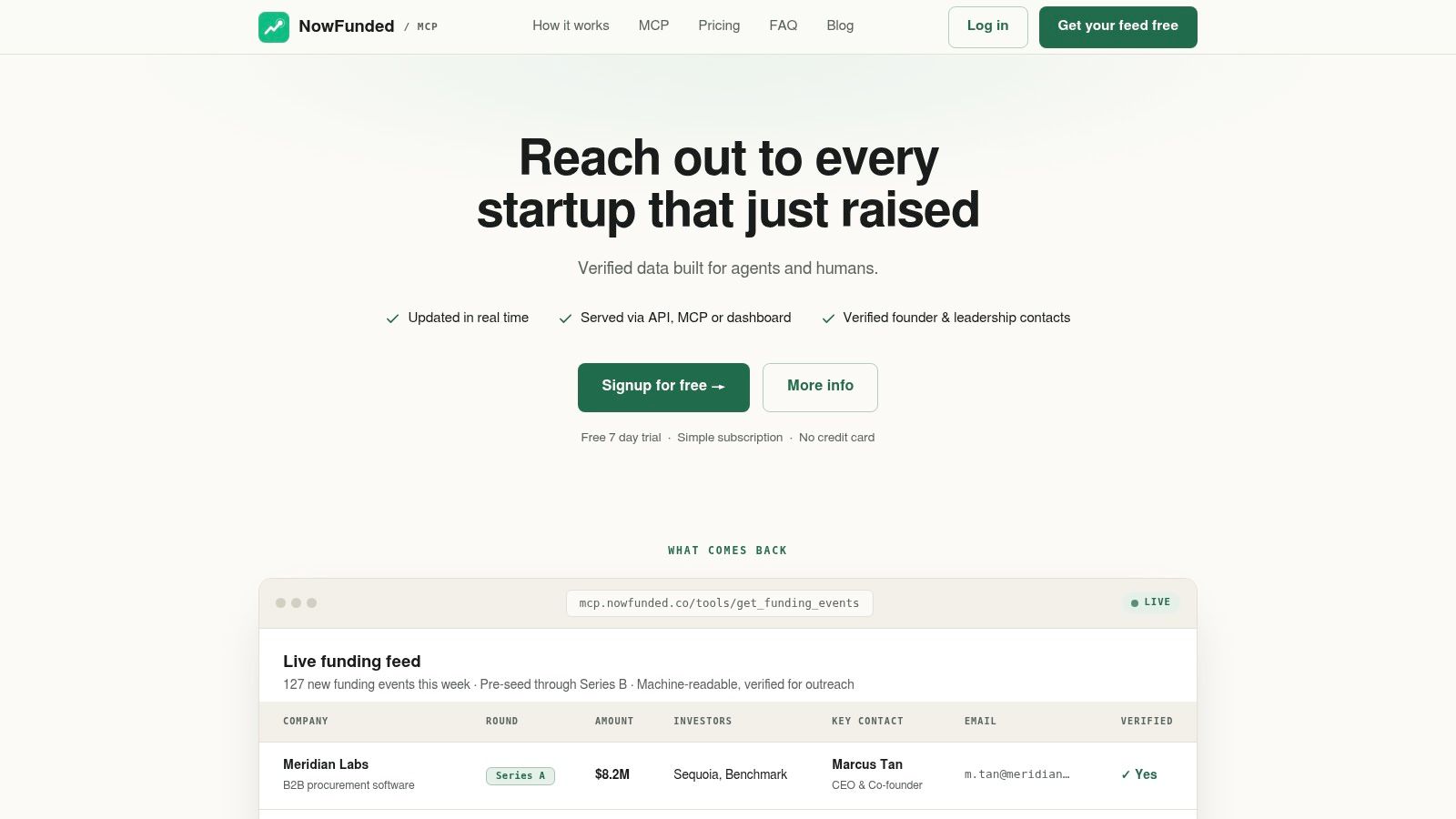
NowFunded is the strongest choice when your workflow depends on newly funded startups, immediate alerts, and agent-ready delivery. It provides a live feed of funding events from pre-seed through Series B, with structured company, round, amount, lead investor, headquarters, headcount, industry, website, and LinkedIn fields.
The contact layer is equally practical. On-demand enrichment returns verified, deliverable founder and leadership emails and phone numbers, with two to five contacts per company where available. You pay $0.10 per verified email and $0.25 per verified phone, and unsuccessful verification isn't billed. Those rates come directly from the product brief, so buyers can model enrichment costs before connecting a campaign.
Verification and delivery
NowFunded's advantage isn't a claim of universal database coverage. It's freshness within a clearly defined segment. The platform tracks 100+ new startups every week and maintains a 10,000+ record historic database from the last 12 months, giving teams both immediate opportunities and lookback context.
Its delivery options are unusually well matched to automation:
- MCP endpoint: Connect AI agents directly to funding and contact workflows.
- REST API: Pull typed JSON records into custom applications.
- Webhooks: Receive HTTP POST notifications when a funding event is verified.
- CSV and dashboard access: Support operators who don't need an engineering integration.
Practical rule: Choose NowFunded when acting within minutes of a verified funding event matters more than searching every public company and late-stage account.
Per-pull billing is transparent, but high-volume enrichment still requires budget discipline. The platform is focused on early-stage companies, so it isn't the right database for late-stage or public-company coverage. For startup-focused outbound, recruiting, market research, and AI-agent development, those boundaries are strengths rather than defects.
Start with the NowFunded live startup funding feed to browse funding events, test the free seven-day trial, and connect the delivery method your stack already uses.
2. ZoomInfo
ZoomInfo suits buyers who need enterprise breadth, organizational mapping, and structured go-to-market operations. It combines company and contact records with intent signals, website visitor identification, CRM enrichment, conversation intelligence, workflow orchestration, and data services.
Verification and delivery
Its main advantage is activation flexibility. Sales, marketing, and talent teams can use separate platform modules, while technical teams can connect through APIs, Data-as-a-Service delivery, developer tools, and agent-oriented capabilities such as MCP support.
Test verification against your actual ICP before signing. Independent testing across multiple tools found submitted-contact coverage ranging from 41.3% to 87.1%, with a median of 58.9% in a 2026 comparison. The result does not measure ZoomInfo specifically, but it shows why geography, industry, seniority, and company size belong in your evaluation.
Per-pull economics are harder to assess because pricing is quote-only. Contract minimums and credit rules may restrict smaller teams, while enterprise buyers can justify the cost when procurement, compliance, and integration requirements carry more weight.
API and webhook support should be confirmed during the sales process, especially if your workflow needs event-based enrichment rather than scheduled exports. For privacy and governance reviews, ZoomInfo publishes GDPR and CCPA positioning and references ISO 27701.
Review ZoomInfo's enterprise data platform information alongside the ZoomInfo platform before requesting a quote. Choose ZoomInfo when broad account coverage and workflow orchestration matter more than transparent self-serve pricing.
3. Apollo.io
Apollo.io is the best practical choice for startups and SMB sales teams that want a database, sequencing, dialing, analytics, and AI assistance in one workspace. It reduces the time between finding a prospect and launching a campaign, which is why it works well for lean teams without separate sales operations support.
Its platform combines contact prospecting, enrichment, sequences, a dialer, conversation intelligence, Salesforce and HubSpot integrations, an AI assistant, API access, and MCP support. That feature density is the main reason to choose Apollo. You don't need to assemble a separate outbound stack before testing your first campaign.
Pricing and verification
Apollo's self-serve approach is easier to evaluate than quote-only enterprise products. However, the credit model needs close attention. Phone reveals and exports can consume credits differently from basic prospecting actions, so the apparent subscription price won't necessarily equal your cost at scale.
Data quality can vary by segment. Test Apollo against the roles, locations, industries, and company stages that define your ICP, then verify records before sending. A broad database isn't automatically the best contact database if the contacts you need are concentrated in a difficult geography or a fast-changing market.
The fastest campaign launch isn't useful if your team measures success only after unverified records have already entered the sequence.
Apollo has API and MCP support for teams that want to connect prospecting with custom workflows, but its strongest fit remains the operator who wants an integrated application rather than a pure data layer. Choose it for speed, self-serve onboarding, and an all-in-one outbound experience. Choose another provider if you need highly specialized regional coverage, strict data-service controls, or a narrowly focused real-time signal feed.
Review Apollo's pricing and plan options before committing to a high-volume workflow.
4. Clearbit by HubSpot
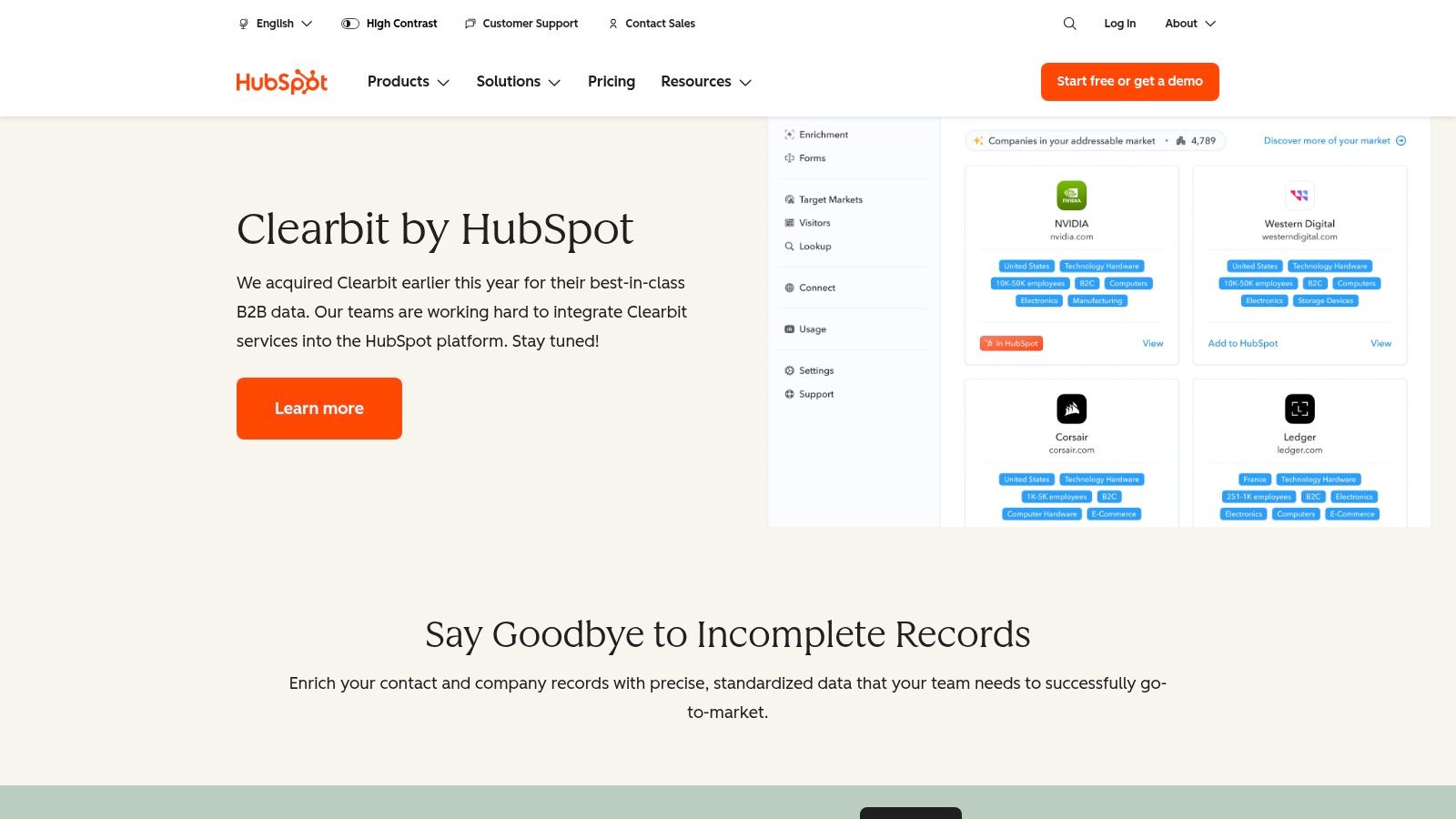
Clearbit by HubSpot is the right choice for teams that already run their revenue process inside HubSpot CRM and want enrichment to feel native. The product supports contact and company enrichment, account-level website identification through Reveal, dynamic form shortening, and targeting workflows.
Clearbit's strength is ecosystem fit rather than an independent, broad outbound application. Following HubSpot's acquisition of Clearbit in December 2023, buyers should evaluate the product as part of the HubSpot environment, including how credits, usage, reporting, and permissions work across their existing subscription.
Pricing and workflow fit
Clearbit provides 100+ enrichment attributes, according to the product plan notes, covering the firmographic and contact context marketers commonly need for segmentation and routing. The integration can shorten forms, identify visiting organizations, and enrich records without forcing a team to move data between unrelated systems.
Public pricing is less transparent than Apollo or Lusha, and buyers may receive pricing through HubSpot rather than a standalone Clearbit checkout. Community feedback has also raised cost concerns, so the correct test is incremental value inside your current HubSpot workflows. Measure whether enrichment improves routing, personalization, qualification, or form completion enough to justify the added usage.
The API and webhook question is different here. HubSpot-native automation may be sufficient for many teams, but technical buyers should confirm the exact delivery and usage model required for their architecture. If you need an independent data service with flexible per-pull enrichment, Clearbit may feel constrained.
Use HubSpot's Clearbit product information to confirm current packaging, then run a controlled pilot on your own inbound and target-account records. Pick Clearbit when HubSpot is the system of record. Don't pick it solely because the brand is familiar.
5. Lusha
Lusha fits small SDR teams that want simple contact reveals, understandable credits, and a low-friction trial. Its browser extension, CRM integrations, enrichment tools, API, buyer intelligence features, and agent-oriented documentation cover the core needs of a focused prospecting team without requiring a large implementation.
Pricing and verification
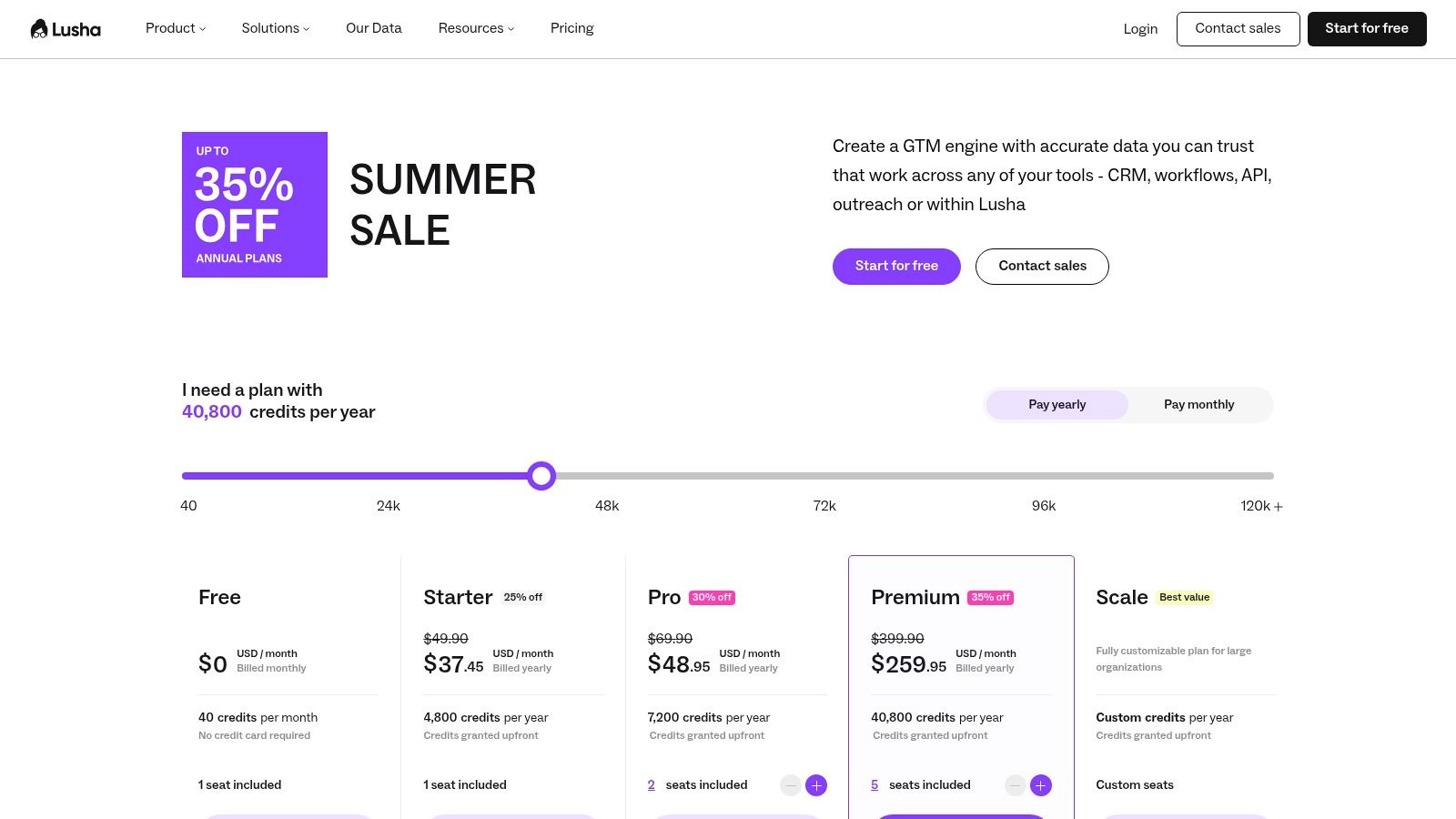
Lusha's credit model is easy to explain: one credit per verified email and 10 credits per phone, based on the supplied pricing notes. That ratio makes phone-heavy workflows materially more expensive than email-first prospecting, so sales managers should estimate their calling mix before selecting a plan.
The advantage is transparency. Teams can pilot the product, see how credits are consumed, and decide whether the revealed records match their target roles and markets. Lusha also offers rollover rules and a free tier, which makes it easier to test before expanding seats or advanced features.
Verification still needs to be measured in context. A verified email is useful only if it belongs to the right person, company, and role. Track successful delivery and connection outcomes rather than treating a reveal as proof that the record will convert.
Budget phone enrichment as a separate decision. Lusha's 10-to-1 email-to-phone credit ratio can change the economics of an otherwise affordable plan.
The API supports teams that need to move records into their own systems, while the extension serves reps who prefer research inside the browser. Advanced features and larger seat requirements may push buyers toward a sales conversation.
Choose Lusha for accessible prospecting and straightforward credit accounting. Select a different tool when you need real-time event feeds, enterprise-wide orchestration, or a custom data platform with bulk licensing.
See Lusha's pricing and credit model before starting a pilot.
6. Cognism
Cognism is the strongest recommendation for EMEA-focused outbound teams that prioritize compliance, mobile coverage, and controlled data delivery. Its positioning centers on GDPR-first sourcing, DNC and TPS screening, continuous updates, confidence scoring, email and mobile verification, and human validation.
That makes Cognism a different purchase from Apollo or Lusha. The buyer isn't just looking for a convenient browser extension. The buyer is reducing regulatory and operational risk while supporting calling workflows across markets where mobile accuracy and consent controls require careful attention.
Verification and delivery
Cognism supports Data-as-a-Service delivery through Snowflake, S3, GCP, Databricks, and SFTP, alongside API and batch options. Those choices suit organizations that need recurring refreshes into a warehouse or CRM rather than one-off prospect reveals.
Regional fit matters. Independent comparisons warn that no single database performs best in every geography, with different providers leading across EMEA, SMB, enterprise, and North American use cases as discussed in a 2026 contact-database comparison. Buyers should therefore test their own country mix, job functions, and phone requirements instead of relying on a global database-size claim.
Cognism's compliance posture includes ISO 27001, ISO 27701, and SOC 2 attestations in the supplied product information. Pricing is quote-based and usually requires a sales-led process, which can be excessive for a small team seeking a quick self-serve experiment.
Pick Cognism when EMEA coverage, compliance controls, and mobile outreach lead the decision. Don't choose it for a lightweight, low-commitment pilot if your team doesn't need those capabilities.
Explore the Cognism data and compliance platform and request a test set built around your priority markets.
7. People Data Labs
People Data Labs, usually called PDL, suits developers building enrichment pipelines, AI agents, research products, or internal data services. It provides person, company, and job-posting datasets through search and enrichment APIs, bulk files, and licensing arrangements.
PDL gives engineering teams a programmable data foundation rather than a ready-made sales engagement application. Your team must define how records are matched, stored, refreshed, scored, routed, and shown to users. That work slows deployment for SDR managers, but it gives product teams control over data behavior and workflow design.
Verification, pricing, and delivery
PDL's API-first model supports custom stacks and agent workflows, with developer resources and multiple delivery modes. Self-serve and enterprise licensing options are available. Higher-volume pricing may require a detailed scope discussion, so confirm the expected per-pull pricing and licensing terms before implementation.
PDL publishes SOC reporting plus privacy and acceptable-use policies for technical and governance review. Buyers should still test field availability, match behavior, geography, refresh expectations, and verification rates against their own records. Published policies do not replace a controlled sample test.
API access is the main advantage. Assess webhook support, integration effort, response formats, and refresh handling before committing to a production dependency. PDL works well when your application needs data delivered inside its own workflow, rather than through a rep-facing search and sequencing interface.
Choose PDL for custom applications, data products, and teams with engineering capacity. Choose Apollo or Lusha when outbound reps need to search, reveal, and sequence contacts immediately. That trade-off matters more than a broad feature checklist.
Use PDL's developer-first data platform to review API documentation, licensing, and integration requirements. Evaluate it with the same four questions as every vendor: how often records verify, what each pull costs, whether API and webhook delivery fit your stack, and whether the use case justifies the build work.
Top 7 Contact Databases Comparison
Product Implementation complexity Resource requirements Expected outcomes Ideal use cases Key advantages NowFunded Low–Medium, easy sign-up, REST/MCP/webhooks, typed JSON schemas Minimal engineering for integration; pay-per-verified-contact costs Real-time, high-quality early-stage funding leads and verified contacts First-mover outreach to newly funded startups; agent workflows Agent-native real-time feed, typed JSON, contact verification billing only on success ZoomInfo Medium–High, enterprise integrations and platform setup Significant budget, contract terms, enterprise IT integration Broad global coverage, deep org charts, intent and CRM enrichment Enterprise GTM, ABM, large-scale sales operations Market-leading breadth, enterprise integrations, visible compliance programs Apollo.io Low, self-serve, quick to launch campaigns and sequences Moderate (credit-based for phones/exports); includes dialer/sequences Fast time-to-first-campaign with prospecting and outreach automation Startups/SMBs running outbound SDR campaigns High feature density for price, clear onboarding and trial Clearbit (HubSpot) Low (within HubSpot) to Medium otherwise, native HubSpot integration Requires HubSpot platform; credits/usage via HubSpot Native CRM enrichment, website reveal and improved form/account targeting Teams standardized on HubSpot seeking native enrichment and web intent Smooth HubSpot-native workflows, website Reveal for intent Lusha Low, browser extension, API, simple credit model Low cost for small teams; credit-based for emails/phones Quick contact reveals and verified emails/phones for outbound SDRs and small teams needing fast direct dials/emails Transparent credit rules, easy trial/free tier Cognism Medium–High, DaaS integrations, compliance workflows, DNC/TPS handling Higher-cost, sales-led purchase; integrations to data lakes/SFTP GDPR-first, verified mobile numbers and compliant outbound lists EMEA-focused teams and regulated industries prioritizing compliance Strong compliance certifications, verified mobiles, DNC/TPS screening People Data Labs (PDL) Medium, developer-first APIs and bulk/license delivery Engineering resources for custom pipelines; volume licensing options Flexible, customizable enrichment powering products or agents Developer/AI teams building custom enrichment or data products API-first flexibility, multiple delivery modes and developer docsPick the Database That Matches Your Workflow, Not Your Wishlist
The best contact database is the one that performs reliably for your market, not the one with the largest headline total. Independent benchmarks show why: database coverage and enrichment outcomes vary substantially across providers, and a 2026 guide recommends treating match rates below 70% in core markets as a warning sign in its buyer guidance. Test the records your team needs.
Use the four evaluation lenses in order:
- Verification rates: Check deliverable email coverage, valid phone coverage, role accuracy, and stale-record exposure.
- Per-pull pricing: Calculate the cost of a delivered lead, not just the subscription or credit price.
- API and webhook support: Confirm whether the tool can push updates, answer agent requests, enrich records, and refresh your CRM without manual work.
- Use-case fit: Match the provider to your geography, company stage, industry, sales motion, and technical capacity.
The decision guide is straightforward. Choose NowFunded for AI agents, real-time funding events, and early-stage startup outreach. Choose ZoomInfo for enterprise breadth and complex go-to-market integration. Choose Apollo.io for SMB speed and an all-in-one outbound workspace. Choose Cognism for EMEA compliance and mobile-focused prospecting. Choose Lusha for small SDR teams that want simple credits and quick reveals. Choose Clearbit by HubSpot when HubSpot is your operating system. Choose People Data Labs when developers are building the workflow themselves.
Run a focused seven-day evaluation:
- Define your ICP, including geography, company stage, roles, and required contact fields.
- Submit representative records or search for a controlled sample.
- Measure verification rate, enrichment coverage, and cost per delivered lead.
- Test API, webhook, CRM, or MCP delivery before involving the full team.
- Review stale records, failed matches, phone usability, and compliance requirements.
- Compare the results against your current workflow.
- Scale only after the provider passes your operational threshold.
Your database needs a refresh process after purchase. B2B data loses about 22% to 25% of usable records annually, while startup and technology contacts can decay at 28% to 38% per year according to 2026 benchmarks. Select the platform that makes verification and refresh practical for your team, then measure it continuously.
NowFunded gives sales, recruiting, research, and AI-agent teams a live feed of newly funded startups, verified founder and leadership contacts, and delivery through MCP, REST API, webhooks, CSV, or a dashboard. Visit NowFunded to browse current funding events, try the seven-day trial without a credit card, and test whether real-time startup data can replace stale prospect lists in your workflow.