Automation Workflow Process That Scales Without Breaking
You've probably seen this happen: a funding alert arrives, your enrichment step runs, and two SDRs receive what appears to be the same prospect. One workflow execution came from the event feed, another came from a retry, and neither checked whether the company had already entered the queue. By the time someone notices, duplicate outreach has gone out, a contact may have been billed twice, and the original trigger is buried in a log nobody watches.
That's the difference between a workflow that works in a demo and an automation workflow process that survives production. Prospecting systems must handle duplicate events, delayed enrichment, incomplete records, API failures, changing ownership, and human decisions without losing track of state. The practical standard is straightforward: deliver timely awareness, use verified data, and make every handoff deterministic enough for an agent, an SDR, or a recruiting operator to act confidently.
Table of Contents
- Why Most Automation Workflows Break in Production
- Core Building Blocks of a Reliable Automation Workflow
- Designing and Operationalizing Your Prospecting Workflow
- Choosing the Right Delivery Mode for Your Stack
- Hardening Your Workflow Against Silent Failures
- Putting Your Automation Workflow Into Action
Why Most Automation Workflows Break in Production
A demo usually follows the happy path. One funding event arrives once, the company matches the target criteria, enrichment returns a contact, and the workflow creates a clean CRM task. Production adds concurrency, retries, partial responses, and records that don't fit the assumptions embedded in the first version.
The most damaging failure often starts with an apparently harmless duplicate. A webhook is delivered, the receiver times out before acknowledging it, and the sender retries. If the workflow treats every delivery as a new event, the same startup can create multiple accounts, multiple tasks, or repeated messages. A poller can produce the same result when its cursor is missing, its time window overlaps, or the API returns records in an unexpected order.
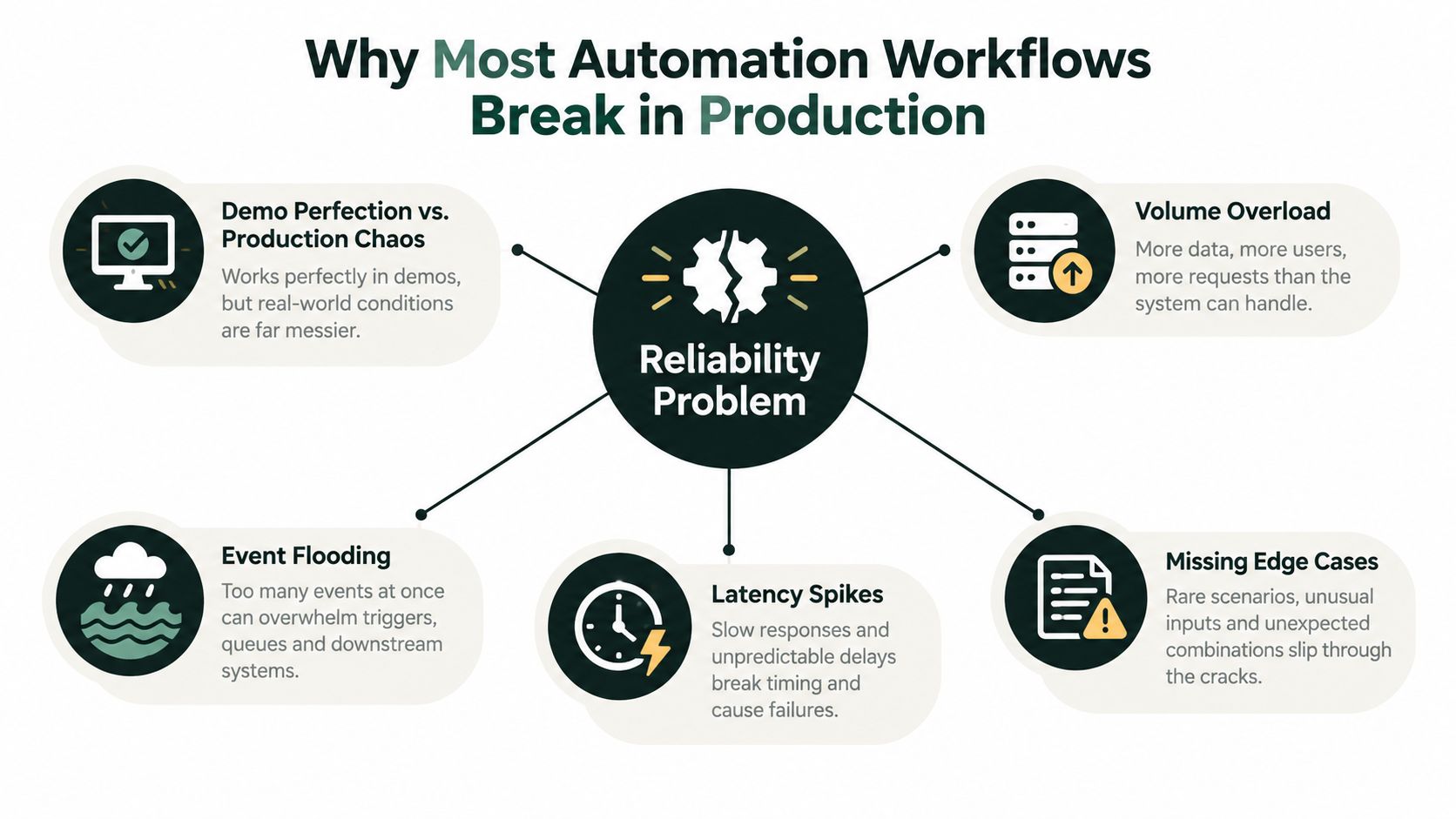
The happy path hides operational risk
Prospecting introduces another layer of risk because the first event isn't always the same thing as a usable lead. A company may have a confirmed raise but no verified founder contact. A contact may exist but fail deliverability checks. A record may match the funding stage while failing an exclusion rule for geography, industry, ownership, or an existing relationship.
Treating enrichment as an unconditional next step creates waste and ambiguity. A dependable process separates event detection, qualification, verification, and delivery. Each stage should produce a state that the next stage can inspect, rather than passing an unstructured blob of data through a chain of tools.
Practical rule: A funding alert should never imply that outreach is ready. It should mean that the workflow has a candidate event to evaluate.
The broader adoption pattern supports this reliability-first view. McKinsey reported that 66% of organizations had adopted automation in at least one business function, up from 57% the year before, a 9 percentage-point year-over-year increase, as summarized in this workflow automation statistics overview. Adoption is mainstream, but mainstream doesn't mean fully autonomous. A 2024 Duke University study found that about 60% of businesses had implemented automation in at least one workflow, while only 4% had fully automated hands-free operations, according to this workflow automation adoption summary.
The right target isn't maximum automation. It's a controlled process where deterministic work runs automatically and judgment-heavy exceptions reach a person with enough context to decide. That model keeps the system useful when inputs are messy, volume rises, or a vendor changes its response format.
Core Building Blocks of a Reliable Automation Workflow
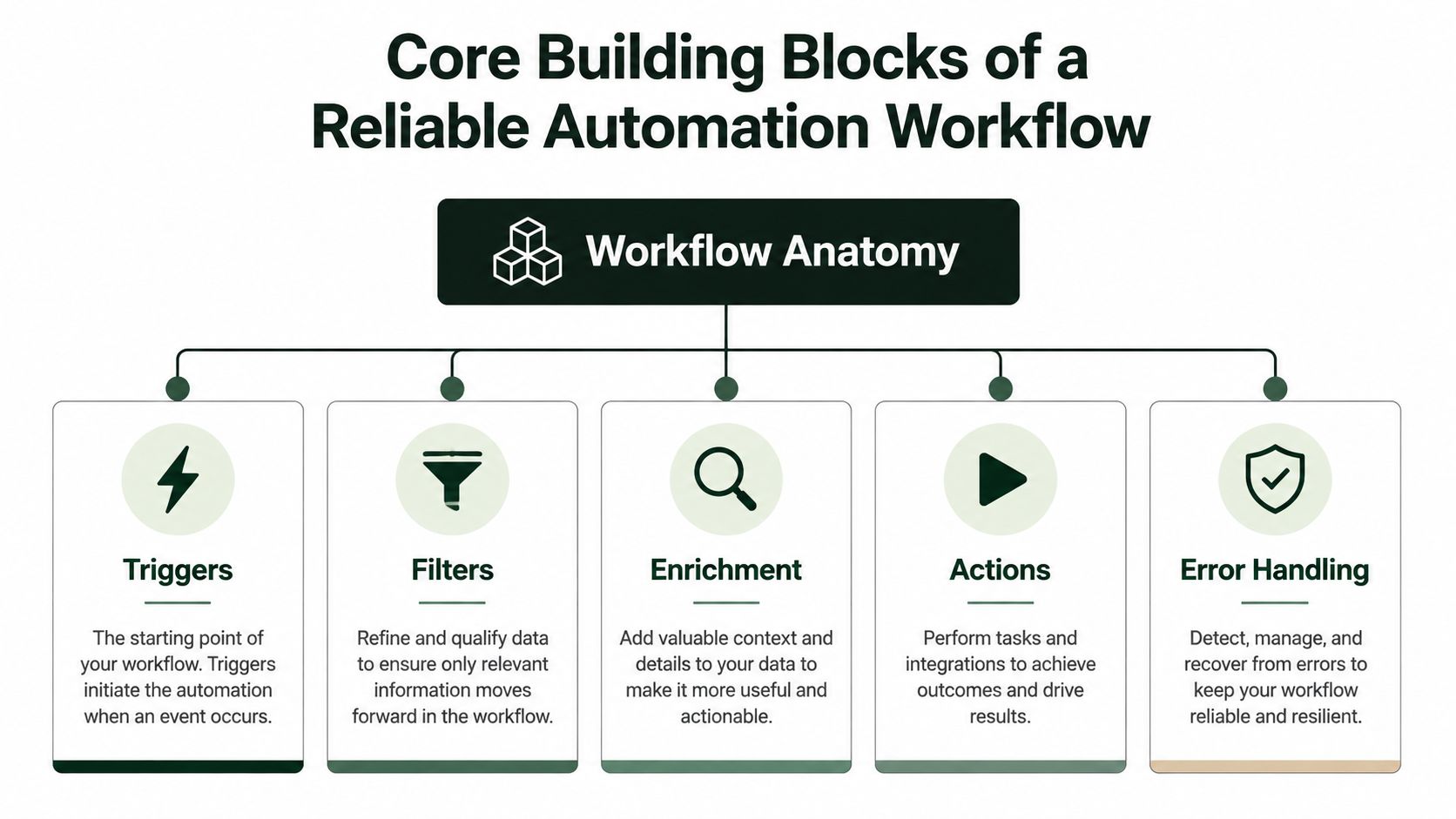
A reliable workflow has a small set of distinct components. Keeping them separate makes failures easier to diagnose and prevents one tool from deciding what the whole process means.
Triggers and filters define the candidate set
The trigger is the event that starts evaluation. For prospecting, it might be a newly verified funding round, an inbound form submission, a CRM status change, or a scheduled request for records. The trigger should carry a stable event identifier, an observed timestamp, and enough metadata to support immediate routing.
Filters then decide whether the event belongs in the target segment. Use explicit fields rather than parsing prose wherever possible. Funding stage, industry tag, headcount range, HQ location, website, investor information, and LinkedIn profile are useful because downstream rules can evaluate them consistently.
A typed schema helps keep that consistency. A record might contain fields such as event_id, company_id, round, verification_status, and contact_status, but the important principle isn't the field names. It's that every field has a defined type, allowed values, and a clear meaning. An agent can then distinguish an unverified contact from a missing contact instead of treating both as empty text.
Enrichment must have an explicit gate
Enrichment should happen only after the company passes the business filters. That order protects both system capacity and contact quality. If the workflow pulls contacts before deciding whether a company fits the campaign, it spends resources on records that will never reach an SDR.
Verification status belongs in the data model, not in a note or a human memory. A verified deliverable work email, an unverified email, and a phone number with an unresolved status should produce different actions. The workflow can send verified records to the sales queue, route unresolved records to review, and leave rejected records out of outreach entirely.
Actions need state, identity, and ownership
Actions include creating or updating a CRM account, assigning a queue, opening an agent task, sending a notification, or writing an audit record. Each action should be associated with the source event and the target object. That relationship lets an operator answer what happened without reconstructing the entire execution from scattered logs.
Idempotency is the protection against repeat execution. Give each logical operation an idempotency key, often derived from the source event, company identity, action type, and campaign or destination. Before creating a task or charging for a contact pull, check whether that key has already completed. If it has, return the prior result instead of performing the side effect again.
The workflow isn't reliable because it never fails. It's reliable because a failure can be retried without creating a second business outcome.
Observability completes the design
Logs should capture event receipt, filter decisions, enrichment status, delivery attempts, response codes, retry counts, and final state. Metrics should distinguish rejected records from technical failures. Those are different operational questions, and combining them makes a healthy filter look like a broken integration.
Designing and Operationalizing Your Prospecting Workflow
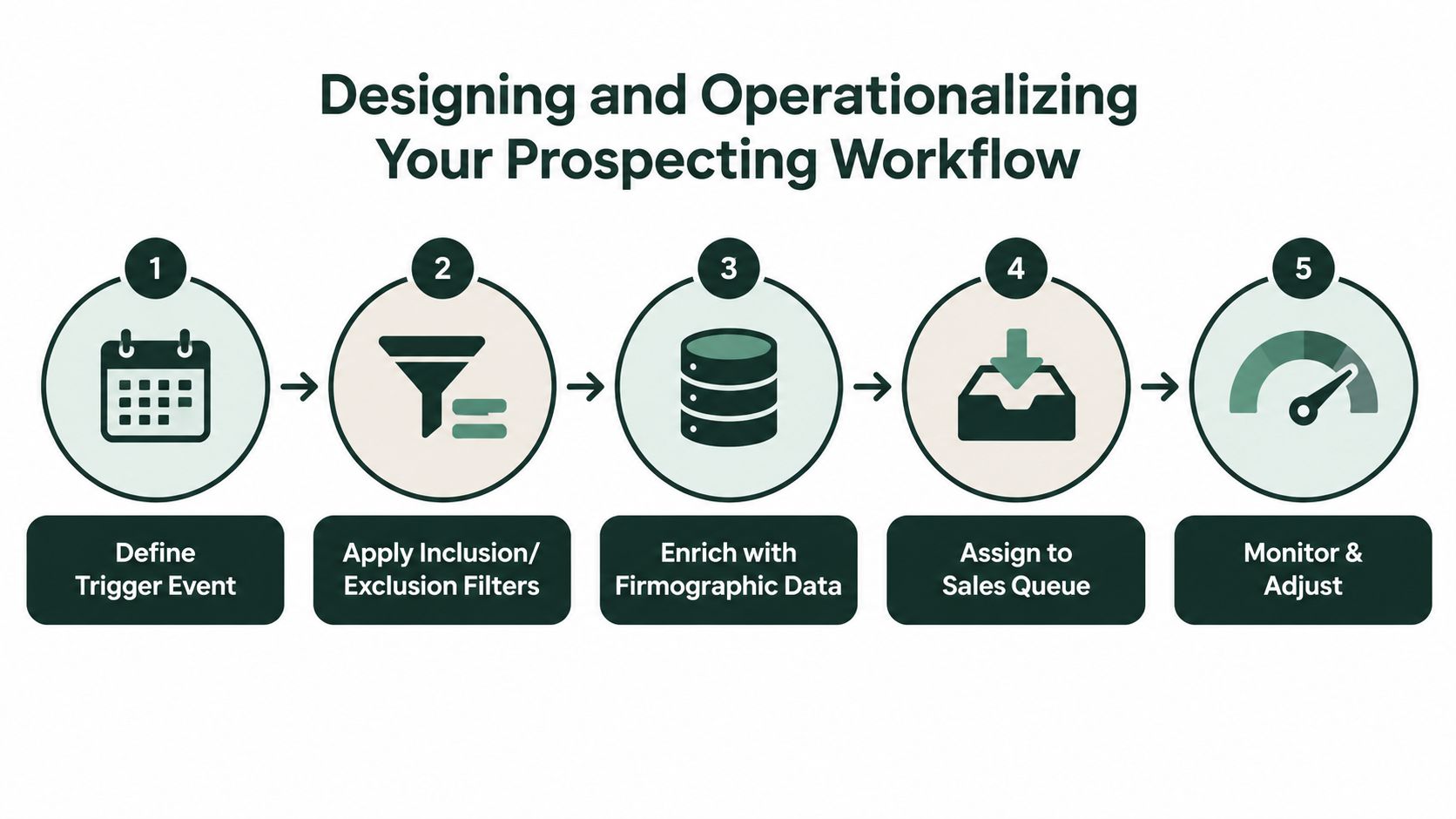
Start with the business event, not the automation platform. Define what qualifies as a new opportunity, what evidence confirms it, and what a receiving SDR or agent must have before acting. For an early-stage prospecting workflow, that could mean a verified funding event from pre-seed through Series B, followed by filters for market, location, industry, headcount, or existing account status.
The next decision is whether the first query should return events or contacts. Keep those operations separate. Funding-event data can be queried before any billable contact pull, which lets the workflow reject irrelevant companies before requesting enrichment. That separation also makes costs auditable because the system can show which event qualified, which contact request followed, and whether verification succeeded.
Apply inclusion and exclusion rules as data operations, not as instructions hidden in an agent prompt. A deterministic filter should be able to say, “include this round and industry, exclude this existing account, continue only when verification status meets the campaign requirement.” AI can help interpret a description or suggest a segment, but the final gate for outreach should remain inspectable.
Choose enrichment boundaries carefully
Enrich only the people the campaign can use. For an SDR motion, that may be a founder, a relevant executive, or a functional leader tied to the offer. For recruiting, the right person may be a hiring leader rather than the founder. Store the role, contact channel, verification result, and source event together so the recipient understands why the record entered the queue.
Do not make enrichment a single opaque step. Model it as a request, a verification result, and a delivery decision. If the provider returns a temporary failure, retry the request. If verification fails, preserve the event and route it to a review state rather than treating the whole workflow as successful.
Select the handoff that matches the operator
A webhook works well when a team wants the workflow to react as soon as a round is verified. The receiver should acknowledge quickly, persist the event, and process it asynchronously. That design keeps the delivery endpoint responsive even when CRM updates or enrichment take longer.
A REST API suits controlled polling, backfills, and systems that need to request data on demand. Polling requires a durable cursor or time boundary, overlap protection, and deduplication. Without those controls, a temporary outage can create gaps, while an overlapping query can create duplicates.
MCP is useful when an AI agent needs structured access to funding records and contact operations through a tool interface. The agent should still operate within deterministic permissions and verification gates. An agent can choose a relevant record or summarize funding context, but it shouldn't bypass the workflow's identity checks or billing safeguards.
CSV has a place in manual review. It works for analysts who want to inspect a batch, correct mappings, or approve a campaign before loading records into a CRM. It isn't a strong primary delivery mechanism for time-sensitive prospecting because exports introduce a human handoff and make state reconciliation harder.
Build for historical context without confusing it with live intake
A historic lookback can support territory research, account history, and trend analysis. Treat it as a separate ingestion mode from live events. The historic database contains 10,000+ records from the last 12 months, according to the publisher's provided product information, so a backfill needs its own checkpoint, rate controls, and idempotency namespace.
The live path should optimize for freshness, while the historic path should optimize for completeness. Combining both into one queue makes it difficult for an SDR to distinguish a newly actionable event from an older research record.
Choosing the Right Delivery Mode for Your Stack
Delivery mode is an architecture decision, not a preference hidden in a setup menu. Choose based on how quickly the team needs a new record, whether an operator or agent initiates the request, and how much state your infrastructure can maintain.
Delivery Mode Latency and Trigger Best For Trade-off to Manage MCP Agent-initiated access when a tool call is made AI agents that need structured funding and contact operations Agents still need permission boundaries, state tracking, and verification gates REST API On-demand requests or scheduled polling Custom applications, backfills, enrichment services, and controlled queries You must manage cursors, overlap windows, retries, and rate behavior Webhook Push delivery through an HTTP POST after an event is verified SDR alerts, real-time queues, and event-driven systems The receiver must acknowledge quickly and deduplicate retries CSV export Batch delivery for manual inspection or controlled import Analysts, researchers, and campaign review Human review slows freshness and complicates reconciliation Dashboard Human-initiated browsing and filtering Operators who need to inspect records before acting It doesn't provide the same unattended execution as an API or webhookPush versus poll
Push delivery removes the need to ask repeatedly whether something changed. It can reduce infrastructure work and gives the receiving system a clear event boundary. That advantage only holds when the receiver stores the event before acknowledging it and can safely replay processing.
Polling remains useful when the consumer controls timing, needs a historical range, or can't expose a reliable inbound endpoint. A production poller needs a cursor, a bounded query window, duplicate suppression, and a recovery procedure for missed intervals. It also needs to distinguish “no new records” from “the request failed.”
Match the mode to the team
An SDR team that wants fresh alerts will usually benefit from webhook delivery into a queue or CRM task service. A research team may prefer CSV or dashboard review because context and selection matter more than immediate routing. An agent platform may combine MCP for interactive research with REST for scheduled ingestion and webhooks for live events.
The mistake is choosing the most advanced interface by default. A webhook doesn't solve poor ownership, an MCP endpoint doesn't make probabilistic decisions safe, and an API doesn't remove the need for observability. The delivery mode should support the operating model you can actually monitor.
Hardening Your Workflow Against Silent Failures
The most serious workflow problems often aren't caused by an unavailable API. They come from choosing the wrong process, losing the person who built it, or allowing silent failures to accumulate. A guide to workflow automation challenges highlights process selection, ownership loss, and unmonitored failures as recurring implementation problems, alongside multi-tool complexity and pricing surprises.
Treat the workflow as a production service with an owner, a runbook, and a defined recovery path. The owner doesn't need to write every integration, but someone must know which system is authoritative, what each state means, and how to replay a failed event without duplicating outreach or billing.
Make side effects safe to repeat
Use idempotent writes for CRM records, task creation, notifications, and contact pulls. Store the idempotency key with the result and make the lookup atomic with the write where possible. If a timeout occurs after the remote system commits the action, a retry should discover the completed result rather than create another object.
Retries also need boundaries. Use exponential backoff for transient failures, cap the number of attempts, and classify permanent errors separately. Invalid credentials, malformed payloads, and rejected business rules shouldn't be retried indefinitely.
Put exceptions somewhere visible
A dead-letter queue gives failed events a durable home. Include the original payload, failure category, attempt history, and the next action required. An operator should be able to correct the cause and replay the event, not copy data into a new workflow by hand.
Verification-gated billing deserves the same discipline. The workflow should request contacts only after the funding event passes its filters, and it should record whether verification succeeded before considering the pull billable or complete. This prevents a failed enrichment result from masquerading as a delivered lead.
Monitor business outcomes, not just uptime
A green integration status can coexist with an empty sales queue. Alert on missing events, unusual rejection patterns, stalled verification, repeated retries, duplicate suppression, and delivery lag. The system should make it obvious whether there are no qualifying companies or whether the trigger stopped arriving.
Process intelligence and AI orchestration make this more important. Emerging automation patterns include process digital twins, privacy-first automation, composable micro-automations, and AI agents, while integration complexity, human-in-the-loop delays, model drift, and vendor lock-in remain practical bottlenecks, as discussed in this analysis of business process automation trends. More automation can increase operational risk when teams can't observe why the system made a decision.
Ownership handoff is a reliability control. Document the schema, state machine, credentials responsibility, alert destination, and replay procedure before the original builder leaves.
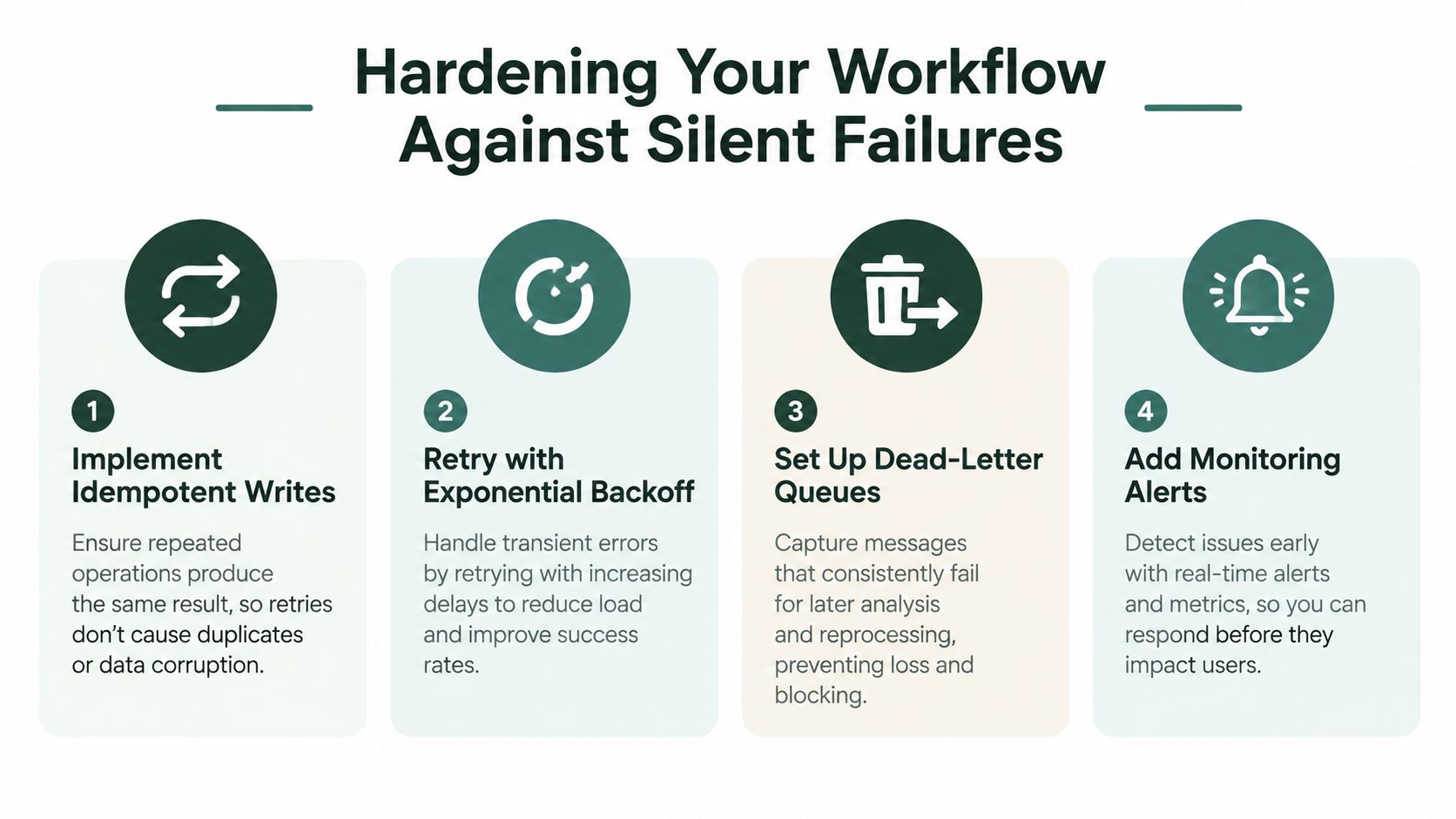
A practical hardening checklist looks like this:
- Implement idempotent writes: Protect every external side effect with a stable key.
- Retry with exponential backoff: Separate temporary transport failures from permanent data errors.
- Set up a dead-letter queue: Preserve failed events for inspection and controlled replay.
- Add monitoring alerts: Watch event flow, verification, delivery, and business-level outcomes.
Putting Your Automation Workflow Into Action
A durable automation workflow process doesn't begin with a large transformation. Start with one funding-event trigger, one clear filter set, and one delivery mode. Prove that the system can receive an event, reject duplicates, preserve state, verify the contact before outreach, and deliver a useful task to the right queue.
Use the first rollout to measure operational behavior rather than chase theoretical perfection. Track exception volume, duplicate suppression, verification outcomes, delivery failures, and the time between a confirmed event and an actionable handoff. Workflow automation effectiveness typically progresses from about 60–75% success in early or experimental stages, to 75–90% during stabilization, and 90–98% in mature implementations with clean human exception routing, according to this workflow automation effectiveness benchmark. The benchmark also cautions that reliability above 98% is generally realistic only for highly deterministic, low-variance tasks with clean inputs.
Once the first slice behaves predictably, add another segment or destination. Don't add multiple agents, enrichment providers, and CRM actions at the same time. A small change surface makes it possible to identify whether a failure came from filtering, identity resolution, verification, delivery, or ownership.
For prospecting teams, the strongest design combines structured funding data, verification-aware contact handling, and a delivery path that fits the team's response model. Agents can use typed records for research and routing, while SDRs receive only the records that meet the campaign's operational requirements.
Visit NowFunded to access a live, verified feed of newly funded startups, structured for AI agents and human operators through MCP, REST API, webhooks, CSV, and a dashboard. Start with one verified funding trigger this week, wire it to an idempotent queue, and use the resulting run history to decide what deserves expansion.