10 AI Sales Prospecting Tools for 2026
The popular advice is to choose the platform with the biggest database or the longest feature list. That approach misses the operating problem. AI sales prospecting tools don't all perform the same job, and a tool that excels at contact discovery may be poorly suited to detecting a fresh buying trigger, enriching a CRM, or handing structured context to an AI agent.
This comparison treats prospecting as a chain of distinct signals and actions. The ten platforms below cover real-time funding alerts, contact enrichment, account prioritization, research, sequencing, enterprise data operations, and agentic outbound execution. The practical questions are more useful than a generic “best overall” ranking: where does each tool fit, what does it connect to, how does its credit or usage model affect operations, and how much human review does an agent-compatible workflow require?
Adoption makes this distinction urgent. Independent coverage tied to Salesforce's State of Sales data reports that 87% of sales organizations use AI in some part of sales, while 54% deploy AI agents across the sales cycle. The same coverage identifies prospecting as the leading AI use case and places the AI SDR market at $4.39 billion in 2025, with a projection of $17.58 billion by 2030 at a 32.3% CAGR. The 2026 AI lead-generation statistics synthesis supports the broader conclusion: AI prospecting is becoming workflow infrastructure, not a side experiment.
Table of Contents
- 1. NowFunded
- 2. Apollo.io
- 3. Clay
- 4. Cognism
- 5. ZoomInfo SalesOS and Copilot
- 6. Clearbit by HubSpot
- 7. Seamless.AI
- 8. 6sense Revenue AI for Sales
- 9. Amplemarket
- 10. Regie.ai RegieGO
- Top 10 AI Sales Prospecting Tools, Feature & Capability Comparison
- Build the Prospecting Stack Around the Signal
1. NowFunded
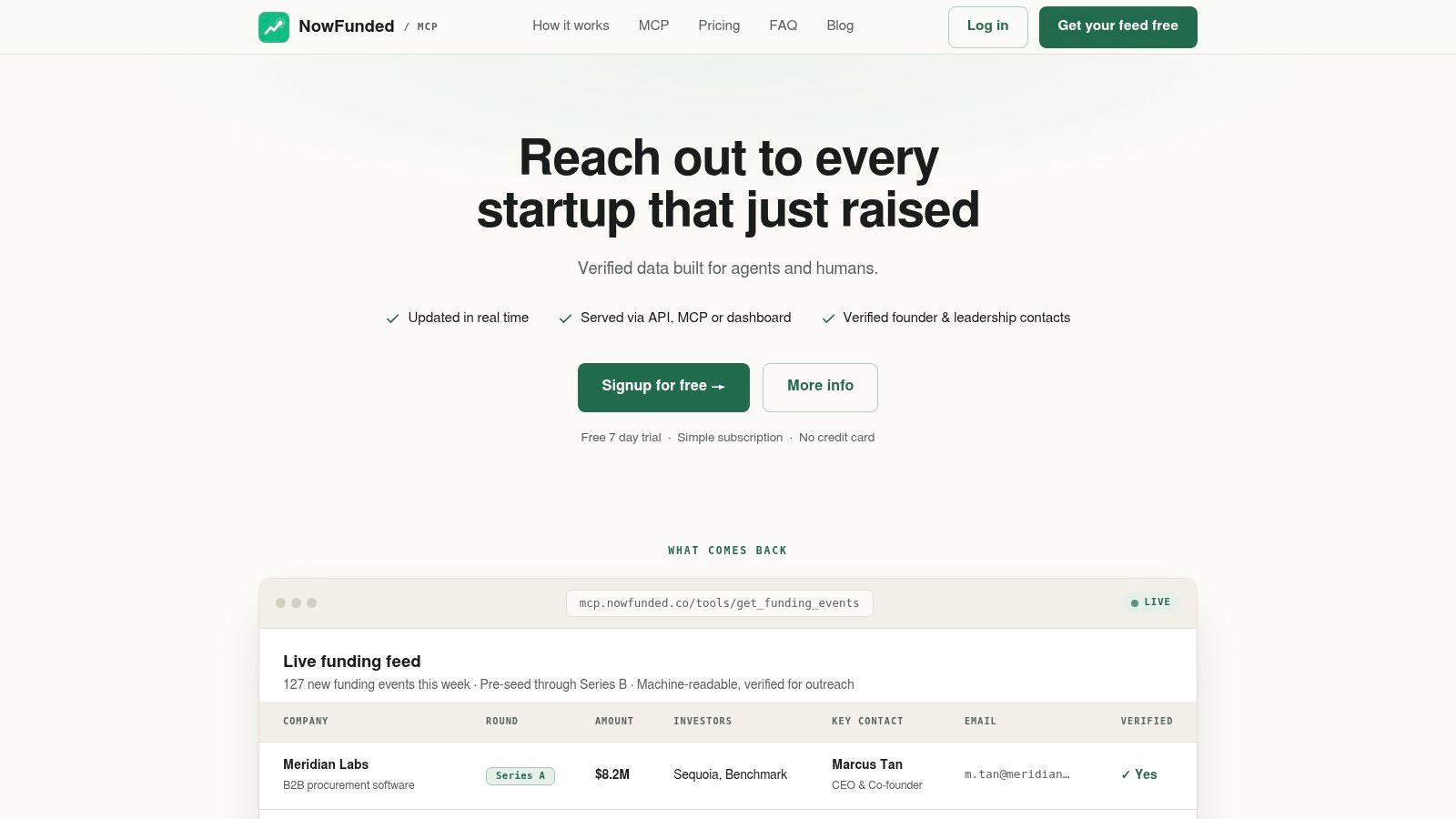
NowFunded is built around a prospecting trigger that broad databases often treat as just another filter: a newly verified startup funding event. Its feed covers companies from pre-seed through Series B and provides structured records containing the company, round, amount, lead investors, headquarters, headcount, sector tags, website, and LinkedIn profile. New rounds are added within minutes, according to the service description, so an outbound team can route a funding event into research, enrichment, and outreach without maintaining a scraping pipeline.
The strongest fit is an agent-compatible workflow. NowFunded provides typed JSON through MCP, REST API, webhooks, CSV export, and a web dashboard. A webhook can push a verified event into an automation layer, while MCP gives an AI agent a direct way to query funding data. The deterministic field definitions matter operationally because an agent can filter by round, sector, location, or company attributes without interpreting inconsistent free text.
Best fit and trade-offs
NowFunded also separates the trigger from contact access. On-demand enrichment returns verified, deliverable founder and leadership emails and phone numbers, with an explicit verification status. Contact pulls are usage-based, currently $0.10 per email and $0.25 per phone, with charges applying when verification succeeds, according to the NowFunded product information. Funding-event data is free to query, and there's no subscription or minimum spend listed.
- Strength: Fresh early-stage funding signals can give reps a concrete reason to contact a company.
- Strength: The MCP, API, webhook, and JSON delivery options reduce engineering work for agent builders.
- Limitation: Coverage focuses on pre-seed through Series B, so it isn't designed for later-stage account intelligence.
- Trade-off: Pay-per-pull contact enrichment can be efficient for targeted workflows, but high-volume contact retrieval requires budget controls.
The service lists 10,000+ historical records from the past 12 months and tracks 100+ new startups weekly. It typically returns 2 to 5 verified contacts per company, making it particularly relevant to SDR teams, recruiters, researchers, and developers who need a fresh trigger before deciding whom to contact.
Practical rule: Treat funding as the event that starts the workflow, not as proof that a company is ready for your offer. Use the round, sector, leadership role, and company context to decide whether the trigger deserves human review.
2. Apollo.io
Apollo.io is the broadest all-in-one option in this list. It combines a B2B contact database, AI-assisted research and writing, multichannel sequences, a dialer, deliverability tools, analytics, and workflow automation. Its database is advertised at 240 million-plus contacts on the Apollo platform, a scale that makes it useful when a team needs to move from an ICP definition to an actionable list inside one environment.
Its workflow fit is strongest for small and midsize SDR teams that don't want to assemble separate data, sequencing, and calling products. Reps can research prospects with an AI assistant, personalize emails, build sequences, and use the Chrome extension while browsing. MCP, API, and automation options also give technical teams a path to connect Apollo with external workflows.
Apollo's breadth is an advantage, but it creates a data-governance question. A team may use the platform for research, contact discovery, sequencing, dialing, and reporting, yet each activity can consume credits or usage capacity differently. New users should map the intended workflow before launching broad enrichment or automated actions.
- Best job: General-purpose contact discovery and outbound execution.
- Strength: One workspace covers list building, research, writing, sequences, and calls.
- Limitation: Credit rules can take time to understand, especially when several workflow actions consume usage.
- Operational trade-off: Consolidation reduces tool sprawl, but teams may accept less specialized signal depth than a dedicated funding or intent product provides.
Apollo is a sensible execution hub when the main problem is fragmented prospecting operations. It's less distinctive when the team's advantage depends on identifying a very specific real-time trigger before competitors do.
For teams that need a funding-event trigger alongside broad outbound infrastructure, NowFunded's live startup funding feed can sit upstream of Apollo rather than forcing Apollo to perform every prospecting job.
3. Clay
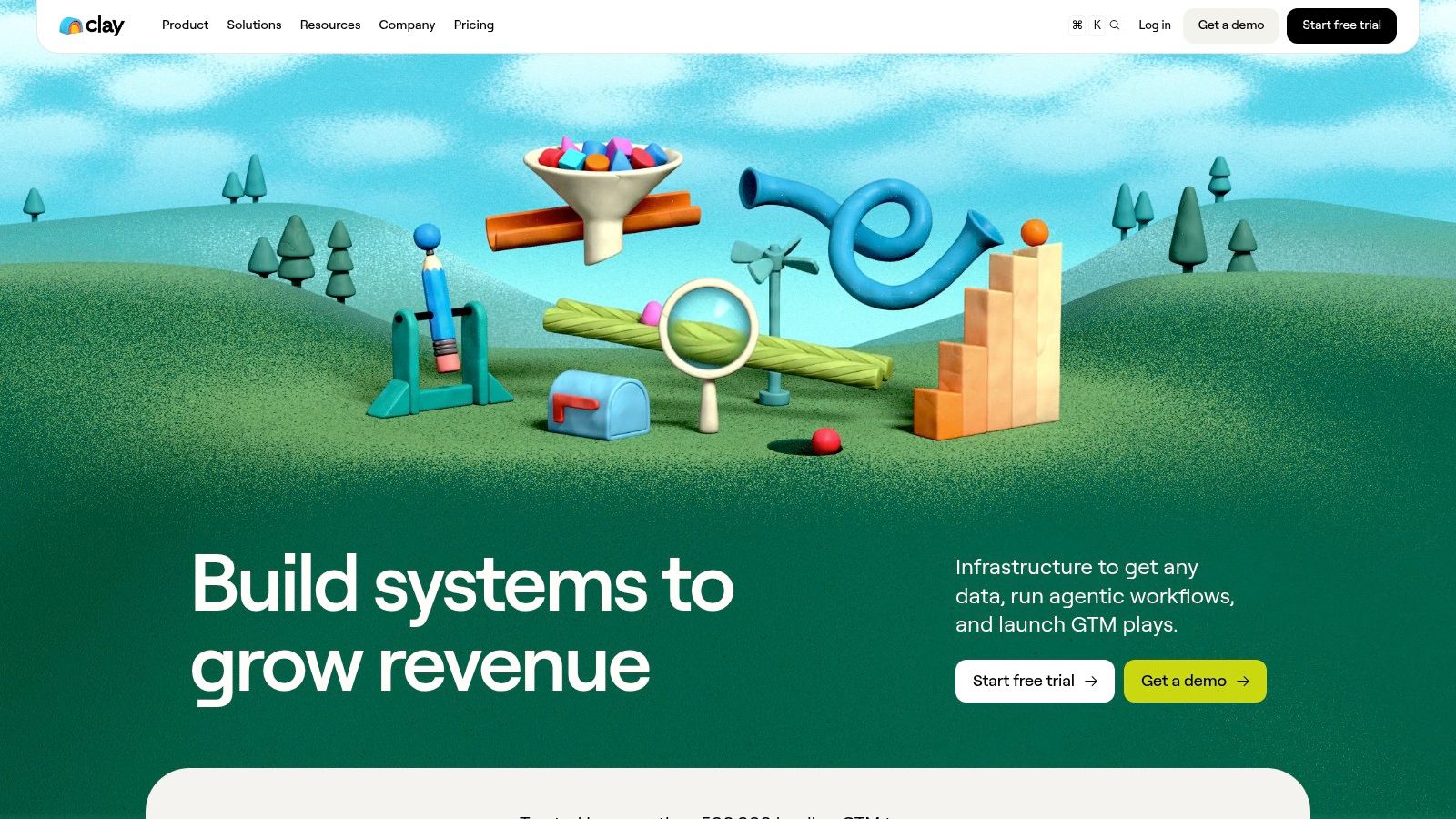
Clay is best understood as a configurable prospecting and enrichment workspace, not a conventional lead database. Teams build “data waterfalls” that combine providers, apply filters, research websites, classify records, and draft messages. That makes Clay valuable when the desired workflow is too specific for a fixed search interface.
Its central advantage is composability. No-code tables can connect more than 100 data and enrichment sources, including technographic providers and services such as 6sense, G2, and Wappalyzer, as described on the Clay website. AI can inspect unstructured web pages, summarize findings, classify accounts, and produce outreach drafts. CRM, Zapier, and other integrations extend the output into existing revenue workflows.
Where flexibility creates work
Clay's flexibility shifts responsibility toward the operator. A RevOps or growth team has to design the waterfall, decide which provider should run first, define fallback logic, and determine when an AI-generated conclusion requires review. The auditability of individual steps helps diagnose errors, but it doesn't remove the need for data governance.
Clay also uses both Actions and data credits in its pricing model. That means a workflow can consume resources through enrichment calls, AI research, transformations, and other steps, even when the final list looks small. Teams should test one narrow workflow and measure its consumption before scaling it across the full ICP.
- Best job: Custom enrichment, research, and signal orchestration.
- Strength: It can combine multiple providers and turn messy web context into structured outputs.
- Limitation: Advanced workflows require technical or operational expertise.
- Trade-off: Bring-your-own-API-key support can provide control, while the multi-layer credit model requires careful planning.
Clay fits agent-compatible operations when the team wants to design the logic itself. It's particularly strong after a trigger has been identified, because the workspace can enrich the company, inspect its website, classify the account, and draft context-aware messaging. It's not the simplest choice for a rep who only wants a ready-made list and sequence.
4. Cognism
Cognism concentrates on the contact layer, especially phone-verified mobile data and compliance-oriented delivery. Its Pro offering adds intent, on-demand mobile verification, AI research, persona building, and AI search. The platform can enrich CRM records, deliver data through its API or bulk options, and support teams that need phone access as part of a multichannel motion.
That focus gives Cognism a different role from NowFunded or Clay. It doesn't primarily identify a funding event or let users construct arbitrary enrichment logic. Instead, it helps a team answer a practical question after an account has been selected: which relevant person can a rep contact, and is the mobile data reliable enough to use?
Cognism's credit model is relatively direct. The company describes one credit as one revealed contact, with no additional charge to revisit that contact, according to the Cognism platform overview. That predictability can make campaign planning easier than models that charge repeatedly for the same record or apply different costs to multiple actions.
- Best job: Verified mobile contact discovery and CRM enrichment.
- Strength: Phone-focused data, compliance capabilities, and support for EU-oriented operations.
- Limitation: Pricing is sales-led, and advanced capabilities can be add-ons.
- Trade-off: Stronger contact confidence may justify a specialized contract, but smaller teams may find the commercial model less flexible.
Cognism is a strong downstream choice after a signal source has identified a priority account. Its AI research and intent features can improve prioritization, but teams should still distinguish between “this person is reachable” and “this company has a timely reason to buy.” Contact accuracy solves the first problem, not the second.
5. ZoomInfo SalesOS and Copilot
ZoomInfo SalesOS with Copilot serves complex account-based selling rather than lightweight list building. The platform combines broad account and contact data with org charts, buying-committee mapping, intent options, CRM integrations, alerts, and AI guidance. Copilot supports account research, next-best actions, email suggestions, and pipeline-risk insights within the wider ZoomInfo environment.
Its value appears when a rep needs to understand an organization rather than identify one contact. Org charts and buying-committee mapping help teams plan multi-stakeholder motions, while alerts can move relevant account changes into Slack, Microsoft Teams, email, or CRM workflows. The ZoomInfo SalesOS and Copilot offering is therefore a better fit for enterprise ABM than for a narrowly targeted early-stage startup campaign.
Enterprise depth and commercial friction
The trade-off is commercial and operational complexity. ZoomInfo is typically contract-led, and add-ons can increase total cost. Annual terms, seat requirements, and credit minimums are common considerations in the buying process. Those conditions may be acceptable to a large revenue organization that needs governance and broad coverage, but they can be disproportionate for a small team testing one trigger-based motion.
- Best job: Enterprise account intelligence and buying-committee coverage.
- Strength: Mature CRM integration, account depth, and workflow alerts.
- Limitation: Pricing and packaging can be difficult for lean teams.
- Trade-off: A large data graph supports scale, but the platform may be more infrastructure than a focused prospecting experiment needs.
ZoomInfo's Copilot can help agents and sellers interpret account context, but agent compatibility should be evaluated through permissions, CRM write rules, alert routing, and human approval. AI assistance is useful only when the resulting action fits the organization's governance model.
6. Clearbit by HubSpot
Clearbit by HubSpot is the natural choice for teams that already run their revenue operations inside HubSpot. Its firmographic and IP intelligence features support contact and company enrichment within HubSpot Smart CRM, while IP reveal can identify companies visiting a website anonymously. The Data Agent and Data Studio actions execute through HubSpot Credits, keeping enrichment and AI actions inside the same administrative environment.
That native position is the main reason to choose it. A HubSpot team can avoid stitching together a separate enrichment layer, CRM sync, and governance process. The Clearbit product page from HubSpot describes a usage-based model in which AI and enrichment actions draw on HubSpot Credits, so administrators can monitor activity through the platform's existing controls.
The integration is the product
Clearbit's weakness is also its source of strength. Teams outside HubSpot won't receive the same workflow benefit, and organizations that need a broad, independent data layer may prefer a dedicated provider. Some users also report variable freshness compared with the period before the acquisition, which means teams should validate records against their own ICP and geography before depending on automated routing.
- Best job: Native firmographic enrichment and website visitor identification in HubSpot.
- Strength: Smooth CRM synchronization and centralized governance.
- Limitation: Its value is much lower if HubSpot isn't the operational center.
- Trade-off: Per-action credits make usage visible, but heavy automation can consume credits quickly.
Clearbit works after a visitor or CRM record provides a starting point. It doesn't replace a real-time funding feed, and it isn't intended to be the primary sequencing platform. Its agent fit depends on how well the Data Agent actions are constrained by HubSpot permissions, field definitions, and review rules.
7. Seamless.AI
The platform targets contact discovery through real-time search, email and mobile lookup, direct dials, and an AI assistant. Its Chrome-centered workflow lets reps build lists while browsing. Job-change filters, pitch intelligence, administrative controls, and paid integrations add structure for teams that need more than basic lookup. API access is available across plans, subject to plan-based usage, according to the Seamless.AI product information.
API access also makes the tool relevant beyond browser-based prospecting. Technical teams can request contact data programmatically and pass it into a CRM, enrichment workflow, or agent process. That supports agent-compatible workflows in which contact discovery is one action inside a larger sequence.
Speed is the main operational advantage. Reps can find contacts and direct dials without constructing a complex enrichment waterfall. This suits SMB-oriented ICPs where list creation and immediate outreach take priority over detailed enterprise account mapping.
- Best job: Fast email and mobile contact discovery.
- Strength: Straightforward onboarding, Chrome workflow, and programmatic access.
- Limitation: Actual per-contact costs and some contract details may require a quote.
- Trade-off: Rapid list building can increase volume, so teams need validation and relevance controls before automated outreach.
The platform should be evaluated against the target segment, geography, and role mix. It may identify the person to contact, but it does not establish why that person merits attention today. A separate trigger source, such as an early-stage funding signal from NowFunded, can supply that missing context. The agent can then combine a timely account event with verified contact discovery, rather than treating every new record as an outreach candidate.
8. 6sense Revenue AI for Sales
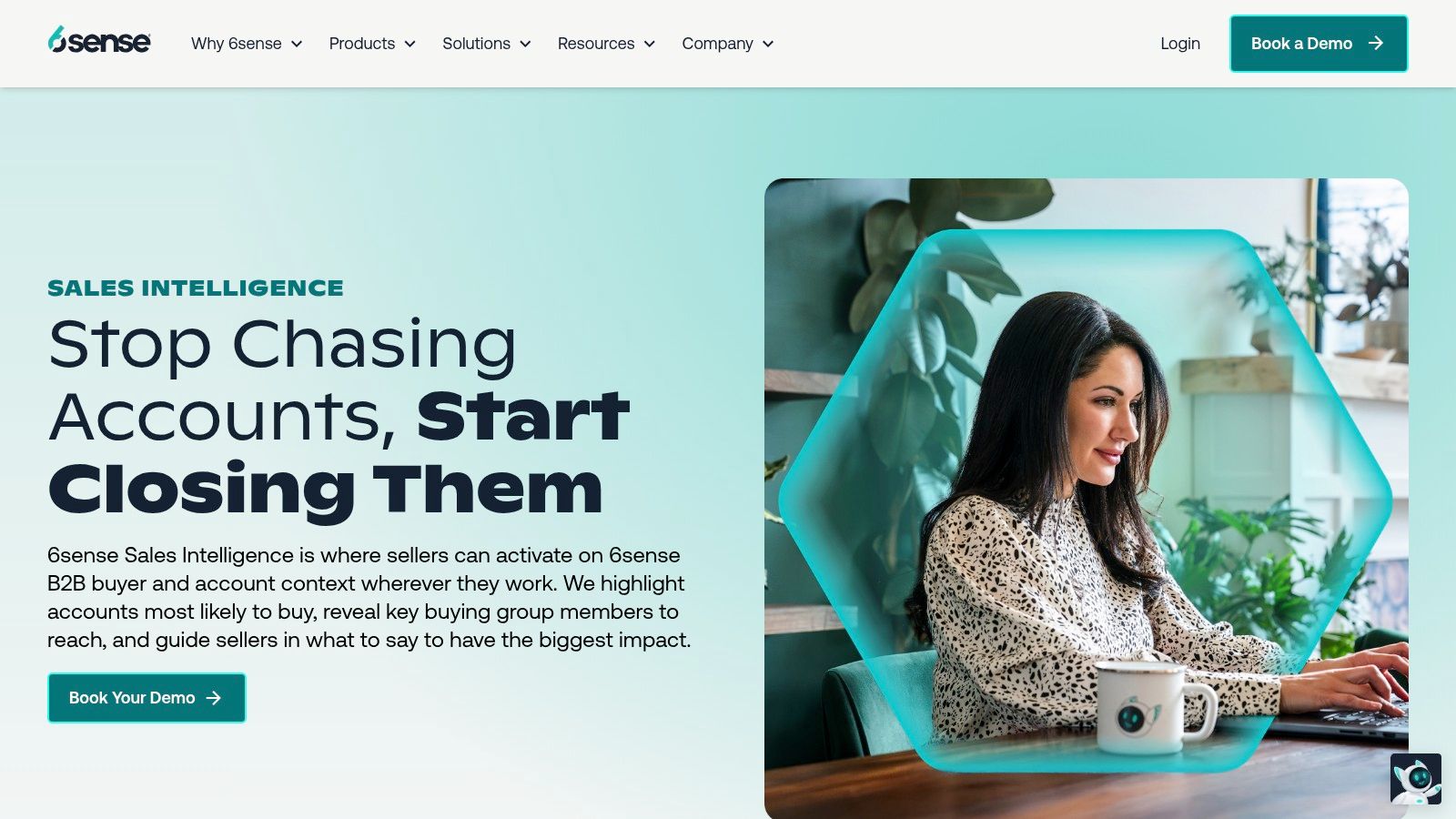
6sense Revenue AI for Sales is designed for account prioritization at scale. Its predictive models assess buying stage and fit, while sales intelligence, data credits, CRM and marketing-automation integrations, and enterprise ABM support help revenue teams coordinate around named accounts. The 6sense Sales Intelligence platform is therefore most useful when a company already has a defined target-account program.
The key distinction is prioritization rather than basic discovery. A list of accounts tells a team who fits an ICP. A predictive model attempts to help the team decide which fitting accounts deserve attention first and where they may sit in a buying process. That can improve territory planning and SDR-to-AE coordination, provided the underlying account and activity data is sufficiently current.
6sense uses a single-license model for Sales Intelligence packaging, but the broader commercial motion remains enterprise-leaning and sales-led. Small teams with limited named-account coverage may not have enough operational complexity to justify it.
- Best job: Predictive account scoring and ABM prioritization.
- Strength: Mature methodology and strong fit for coordinated enterprise motions.
- Limitation: It can be excessive for small teams or loosely defined markets.
- Trade-off: Predictive prioritization is valuable when many accounts compete for attention, but it adds less value when the team needs a fresh event first.
An agent can use 6sense scores to rank work, but the score shouldn't become an unquestioned instruction. Human review remains important when the model lacks a current business event, when the account is strategically sensitive, or when outreach requires a specific interpretation of intent.
9. Amplemarket
Amplemarket combines data, AI research, writing, reply handling, multichannel sequences, and AI voice messaging in one outbound environment. Its agents can research buyers, summarize accounts, request data, and produce personalized outreach. Contact-level intent and job-change alerts add signal context, while email, LinkedIn, and phone sequences provide the execution layer.
This is an agentic outbound platform rather than a data utility. The product is aimed at teams that want an agent to move from research into messaging and follow-up without stitching together multiple applications. The Amplemarket platform is most relevant to modern SDR teams prepared to change their process, not teams looking only for a clean export of contacts.
Automation needs boundaries
Automated reply handling and AI voice messaging create efficiency, but they also increase the importance of escalation rules. A team needs to decide which replies an agent can classify, which messages require a human response, and when a prospect should leave an automated sequence. The platform's value depends on those operating decisions as much as on its AI features.
- Best job: Agentic, multichannel outbound execution.
- Strength: Research, writing, data requests, sequencing, and reply handling in one workflow.
- Limitation: Pricing varies by volume and commonly requires a sales conversation.
- Trade-off: Consolidation reduces integration work, while adoption requires training and process change.
Amplemarket can act on a funding signal, but the signal may need to come from elsewhere. For teams targeting newly funded startups, NowFunded's structured funding data can supply the event before Amplemarket handles research and outreach.
10. Regie.ai RegieGO
Regie.ai's RegieGO is an AI-first outbound workspace that combines account and contact research, enrichment, drafting, dialing, email sending, and configurable agents. It connects with Gmail and Outlook and syncs with HubSpot, giving smaller teams a relatively direct path from prospect selection to campaign launch. The Regie.ai workspace also positions enrichment around a credit model that charges when data is found.
The product's main operational advantage is a short path to a first campaign. A free plan includes research, enrichment, drafting, and a dialer, while the Pro plan offers transparent pricing and a monthly option, according to the product description supplied for this comparison. That lowers the commitment required for a solo SDR or small pod testing an AI-assisted workflow.
RegieGO is better suited to net-new outbound than to complex enterprise governance. Larger organizations may need deeper analytics, controls, and reporting available through Enterprise. Its ecosystem is also smaller than those of legacy incumbents, which can matter when a team depends on specialized integrations.
- Best job: Quick AI-assisted outbound execution for small teams.
- Strength: Configurable agents and a low-friction path from research to campaign.
- Limitation: Enterprise analytics and governance require a higher tier.
- Trade-off: Simplicity accelerates experimentation, but smaller ecosystems can constrain mature operations.
RegieGO can consume a trigger and generate an outreach workflow, but the quality of that workflow still depends on the input signal. The NowFunded research on startup funding triggers can help teams add timely company context before asking an agent to draft or sequence messages.
Top 10 AI Sales Prospecting Tools, Feature & Capability Comparison
Product Core features Contact quality & freshness Integrations & delivery Unique selling point Target audience & pricing/value NowFunded Real-time verified funding feed (pre-seed–Series B), 10k+ historic records, on-demand contact enrichment Deliverability-verified emails & phones; charges only on successful verification; rounds added within minutes MCP, REST API, webhooks (push), CSV, web dashboard; typed JSON for agents Purpose-built for AI agents; low-latency, curated feed with verified founder contacts SDRs/recruiters/AI agents; funding queries free; pay-per-contact ($0.10/email, $0.25/phone); no min Apollo.io Large B2B contact DB, AI research, multichannel sequences, dialer Broad coverage (240M+); deliverability tooling; regional depth varies API, Chrome extension, CRM integrations All‑in‑one prospecting + engagement at SMB-friendly price SMB–mid SDR teams; credit/usage model (value option) Clay No-code enrichment workflows, 100+ data sources, AI scraping & drafting Aggregates many sources; freshness depends on providers; advanced enrichment Integrations with many providers, Zapier, CRMs; BYO API keys Highly customizable data pipelines and “data waterfalls” GTM/automation teams; action + data credit pricing; planning required Cognism Sales intelligence with phone-verified mobile data, intent signals, CRM enrichment High mobile accuracy; on-demand mobile verification; compliance-first API, bulk delivery, CSV, CRM sync Strong mobile verification and EU compliance posture Enterprises/teams needing mobile accuracy; credit model; sales-led pricing ZoomInfo SalesOS + Copilot Enterprise data graph, org charts, intent, AI Copilot for sellers Deep account coverage; mature dataset; enterprise-grade freshness Bi-directional CRM sync, APIs, Slack/Teams alerts Enterprise-grade account intelligence + AI Copilot guidance Large sales orgs/ABM; high cost, contract/seat minimums Clearbit (HubSpot) Firmographic & IP intelligence inside HubSpot; enrichment & IP reveal Good HubSpot-synced freshness; actions billed via HubSpot credits Native HubSpot sync; Data Agent actions via credits Seamless HubSpot-native enrichment and governance Teams standardized on HubSpot; per-action credit pricing Seamless.AI Real-time contact search, email/mobile discovery, AI assistant Plentiful mobile numbers for many SMB ICPs; quality can vary API on all plans, Chrome workflows, CRM integrations Fast list-building and mobile reach for SMBs SMB teams/agent builders; simple onboarding; pricing/contact can be opaque 6sense Revenue AI for Sales Predictive scoring, account fit/stage, intent and sales intelligence Account-level predictive signals; contact augmentation via credits CRM/MAP integrations, platform APIs, data credits Predictive account prioritization for ABM at scale Enterprise ABM and named-account programs; enterprise pricing Amplemarket Native data, AI agents, multichannel sequences, automated reply handling, AI voice Contact-level intent & alerts; quality tied to coverage and volume API, multichannel integrations, dialer, CRM sync Consolidates data, AI agents and voice drops in one platform Modern SDR teams seeking agentic workflows; tiered pricing Regie.ai (RegieGO) AI-first outbound workspace: research, enrichment, drafting, dialer, agents Enrichment charged only when data found; fast time-to-first-campaign Gmail/Outlook dialer, HubSpot sync, API Quick setup for AI-first outbound with configurable agents Solo SDRs / small pods; Pro monthly option and low-friction trialBuild the Prospecting Stack Around the Signal
The right choice depends on where the prospecting process is breaking. NowFunded is the specialist for newly funded early-stage startups, with a live funding feed and verified founder and leadership contacts. Apollo.io, Cognism, and Seamless.AI focus on contact discovery, although they differ in breadth, phone data, usage controls, and enterprise orientation. Clay is the flexible enrichment and research layer for teams willing to design their own workflows.
For teams standardized on HubSpot, Clearbit by HubSpot offers the cleanest native operating model. ZoomInfo SalesOS with Copilot and 6sense Revenue AI for Sales are better suited to enterprise account intelligence, buying committees, predictive scoring, and named-account programs. Amplemarket and Regie.ai concentrate on agentic outbound execution, including research, drafting, sequencing, and reply workflows.
The important conclusion is that these categories aren't interchangeable. A contact database can tell you who works at a company, but it may not tell you that the company just raised a round. An intent platform can prioritize accounts, but it may not provide a verified founder phone number. An outbound agent can draft a message quickly, but it can't compensate for stale or ambiguous source data.
The evidence supports a data-first interpretation of AI performance. One 2026 G2 analysis says AI value is strongest in account prioritization, outreach sequencing, and timing, while data readiness remains the biggest constraint on accuracy and scalability. The same analysis is summarized in G2's guide to AI sales intelligence in prospecting. Salesforce-related coverage also reports that sellers expect only partial time savings from prospect research and email drafting, despite widespread AI adoption. The practical lesson is clear: adding AI branding to a weak data pipeline won't create a reliable prospecting system.
Start with five decisions:
- Trigger: Do you need funding events, intent, job changes, website activity, or a static ICP list?
- System of record: Which CRM should receive the account, contact, signal, and activity data?
- Data standard: Which fields must be current, typed, verified, and auditable?
- Execution channel: Will humans review email drafts, or can agents send through email, phone, or social workflows?
- Credit model: Can you forecast usage under revealed-contact, action-based, seat-based, or data-credit pricing?
Then test one narrow workflow. For example, route a verified early-stage funding event through NowFunded, enrich only relevant leaders, send qualified records into the CRM, and let a human approve the first message. A different team might begin with 6sense account prioritization, Clay enrichment, and Regie.ai execution. The correct test isn't “which platform has more features?” It's whether the complete path from signal to approved action works consistently.
Agent compatibility should be assessed through API access, MCP support, webhook delivery, schema quality, permissions, auditability, and human-review requirements. A tool isn't agent-ready merely because it advertises AI. It's agent-ready when an automated system can retrieve trustworthy context, apply deterministic rules, take a controlled action, and leave a record that a human can inspect.
The strongest stack may therefore use fewer broad tools and more deliberate handoffs. Put the signal first, select the data layer second, and automate outreach only after the system can explain why each prospect entered the queue.
NowFunded provides a live, verified feed of newly funded startups from pre-seed through Series B, with structured funding records, MCP, REST API, webhooks, CSV export, and on-demand verified founder and leadership contacts. If early-stage funding is the trigger your outbound or research workflow is missing, visit NowFunded to query the feed and build a focused, agent-compatible prospecting process.