AI Agent Workflow Automation: Patterns That Ship
The popular advice is to give an AI agent more autonomy, connect more tools, and let the model figure out the rest. That's backwards for production. A funding alert that reaches an SDR workflow late, carries stale investor data, or gets processed twice isn't an intelligent system. It's an unreliable event handler with a persuasive writing layer.
AI agent workflow automation works when orchestration, verification, and side-effect control come before open-ended reasoning. A live funding feed makes the distinction obvious. The workflow must detect a verified round, identify whether the company fits the ICP, enrich the right contact, produce grounded context, and wait for approval before outreach. Each step needs a contract, a trace, and a safe recovery path.
The industry's progression supports this shift. Workflow automation moved from early electronic data interchange through business process management, visual automation tools, and now AI-native systems where agents can act as both triggers and actions, as described in this history of workflow automation. The new capability is meaningful, but production value still depends on whether the surrounding system can prove what happened.
Table of Contents
- Why Most AI Agent Workflow Automation Stalls Before Production
- Core Building Blocks of an Agent Workflow
- Event-Driven Triggers vs Polling for Live Funding Feeds
- Designing a Deterministic SDR Pipeline with NowFunded
- Verification, Schemas, and Why Free-Form Prompting Breaks
- Error Handling and Observability for Long-Running Agents
- Best Practices and Common Failure Modes to Plan Against
- Shipping Reliable Agentic Automation at Scale
Why Most AI Agent Workflow Automation Stalls Before Production
Most pilots fail for a simple reason. Teams treat the model as the hard part and the workflow as plumbing. They test whether an agent can summarize a funding announcement or draft an email, then assume the same prompt will behave reliably inside a daily process. It will not.
A weekly enrichment loop that works on Tuesday is a demonstration, not a production workflow. Prompts drift, APIs return incomplete records, retries repeat side effects, and model outputs change shape without announcing the change. If an SDR agent turns a live funding event into a CRM record, a schema mismatch can contaminate the account, contact, and campaign data in a single run.
Determinism is the bottleneck
The difficult question is whether the system can establish that the opener refers to the correct company, round, amount, and investor before anyone sends it. That requires orchestration around the model, not confidence in the model alone.
Practical rule: Treat every model response as an untrusted proposal until a verifier checks it against structured source data.
The operational risk shows up fast once agents move into production teams. A 2026 survey of enterprise AI agent adoption reports that 72% of enterprises are using or testing AI agents, with deployment already present in customer support and operations. The same source reports that 30% of leaders identify routine workflow automation as the greatest potential. Adoption is no longer confined to experiments, so weak process design now creates operational risk at scale.
Benchmark results point in the same direction. AutomationBench, built from workflow patterns across 47 business tools and six functions, found that even the strongest frontier models scored below 10% on end-to-end workflow execution. The benchmark evaluates the final system state, so an agent must find the right endpoint, apply business rules, and write correct data into the correct system.
The useful framing is direct. Can the system detect, execute, verify, recover, and explain every consequential step? A funding-feed pipeline that answers those questions can ship with a modest planner. A highly autonomous agent without those controls remains a pilot.
Core Building Blocks of an Agent Workflow
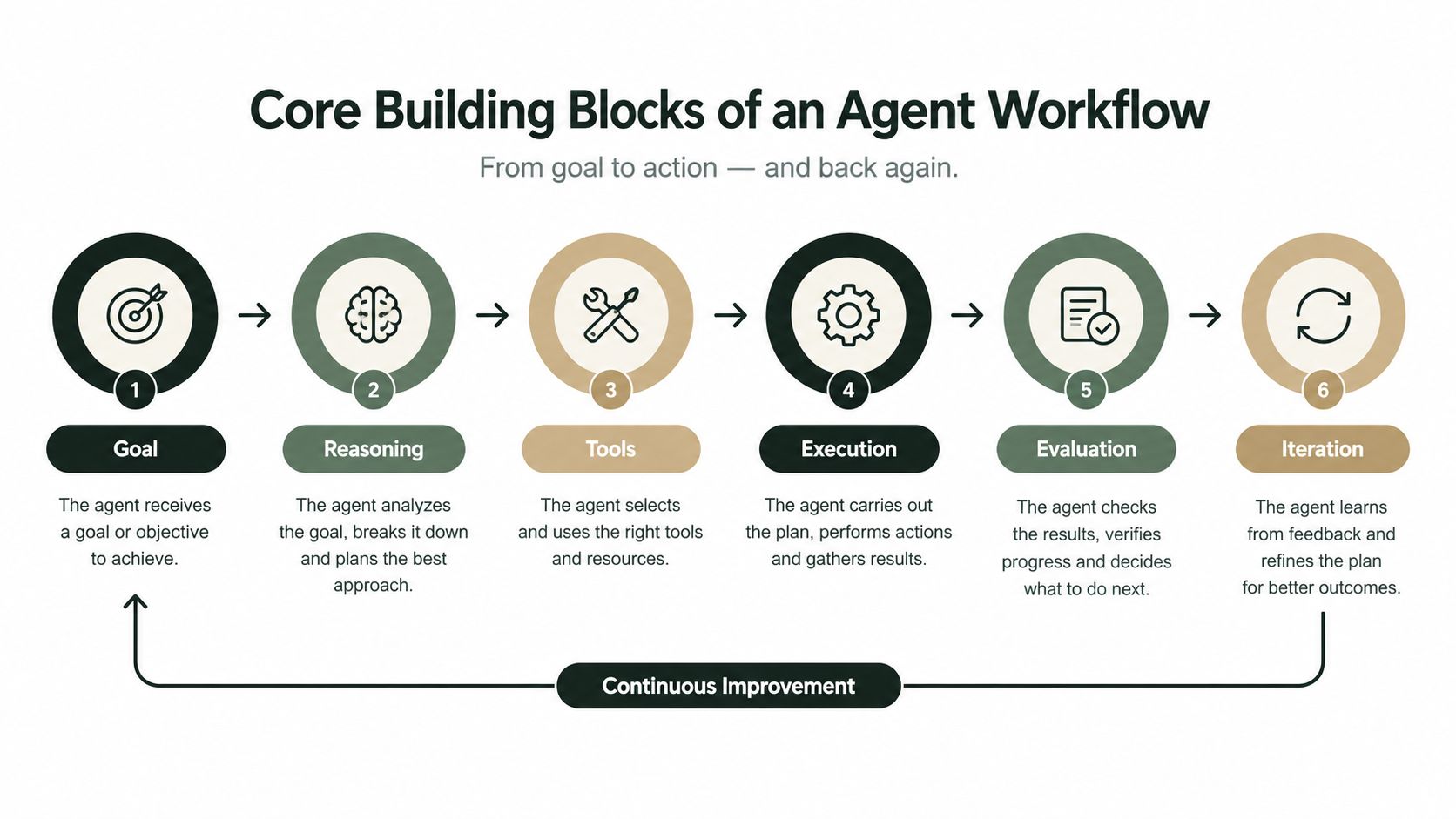
A reliable agent pipeline resembles a directed graph more than a chat session. Each node has one job, a defined input, and a clear handoff. The five core blocks are the trigger, planner, tools, verifier, and sink.
Trigger and planner
The trigger starts a run. It might be a webhook announcing a newly verified funding round, a scheduled polling job, or a manual research request. The trigger should produce an immutable event envelope containing an event identifier, received time, schema version, and source payload.
The planner decides what happens next, but it shouldn't be an unrestricted reasoner by default. In a prospecting pipeline, a deterministic router can first check whether the company matches the ICP. Only then should a bounded agent handle an ambiguous task, such as interpreting an industry description or choosing between approved enrichment paths.
Keep planner output structured. A useful plan might contain:
- Next action: the named tool or workflow step.
- Required inputs: fields copied from the verified event.
- Expected output: a declared schema.
- Stop condition: the condition that ends the run.
- Approval requirement: whether a human must review the result.
Tools, verifier, and sink
The tools layer exposes capabilities such as funding lookup, contact enrichment, CRM search, and Slack queue creation. MCP is useful when an agent needs discoverable, typed tools. REST works well for synchronous lookups with stable request and response contracts. Webhooks fit event ingestion because the provider pushes a change instead of making your system repeatedly ask for it.
Those choices aren't competing ideologies. They're interface decisions. Use the surface that matches the direction, timing, and reliability requirement of the call.
The verifier checks the proposed result before any irreversible action. It can validate required fields, types, enumerated values, source timestamps, and relationships between fields. For a funding event, it should confirm that the company name, round, amount, and lead investor in the generated opener match the source record.
The sink performs the side effect. It may write to a CRM, place a record in an approval queue, update a spreadsheet, or enqueue an outbound message. Keep the sink behind verification and idempotency controls. A model can suggest an email, but it shouldn't send one.
Event-Driven Triggers vs Polling for Live Funding Feeds
Trigger selection determines how quickly the pipeline reacts and how much recovery work the team must build. Polling is easier to understand. A job asks for new records, stores a cursor, and repeats. That simplicity makes polling useful during early development and for reconciliation.
Webhooks reverse the relationship. The provider sends an HTTP event when a funding round is verified, so your system can begin processing without waiting for the next poll. That reduces unnecessary requests and supports time-sensitive prospecting, but the receiving handler must cope with duplicates, delays, malformed payloads, and replay.
A practical comparison
Dimension Webhooks, for example NowFunded Polling Latency Near-event processing when delivery succeeds Depends on the polling interval Cost Efficient because the system receives changes Repeated requests can add load Reliability Requires replay, signature validation, and idempotent handling Easier to backfill and reconcile Complexity Higher at the ingestion boundary Lower to prototype and operate Best fit Hot alerts and time-sensitive workflows Recovery, lookbacks, and scheduled researchA webhook-only design is too optimistic. Providers retry, networks fail, and downstream systems become unavailable. A polling-only design is too slow for teams that want to reach newly funded companies while the event is still commercially relevant.
Use both paths deliberately
A mature design commonly combines them. The webhook handles the hot path, while a daily polling reconciliation job searches for records the event handler missed. Both paths should write to the same canonical event table and derive the same idempotency key from the source event. That way, reconciliation repairs gaps without creating a second outreach record.
Polling also gives the team a controlled way to backfill historical events after a schema change or a temporary outage. Webhooks provide responsiveness, while polling provides repairability. The architecture becomes safer when both feed the same verifier and sink rather than maintaining separate business logic.
Designing a Deterministic SDR Pipeline with NowFunded
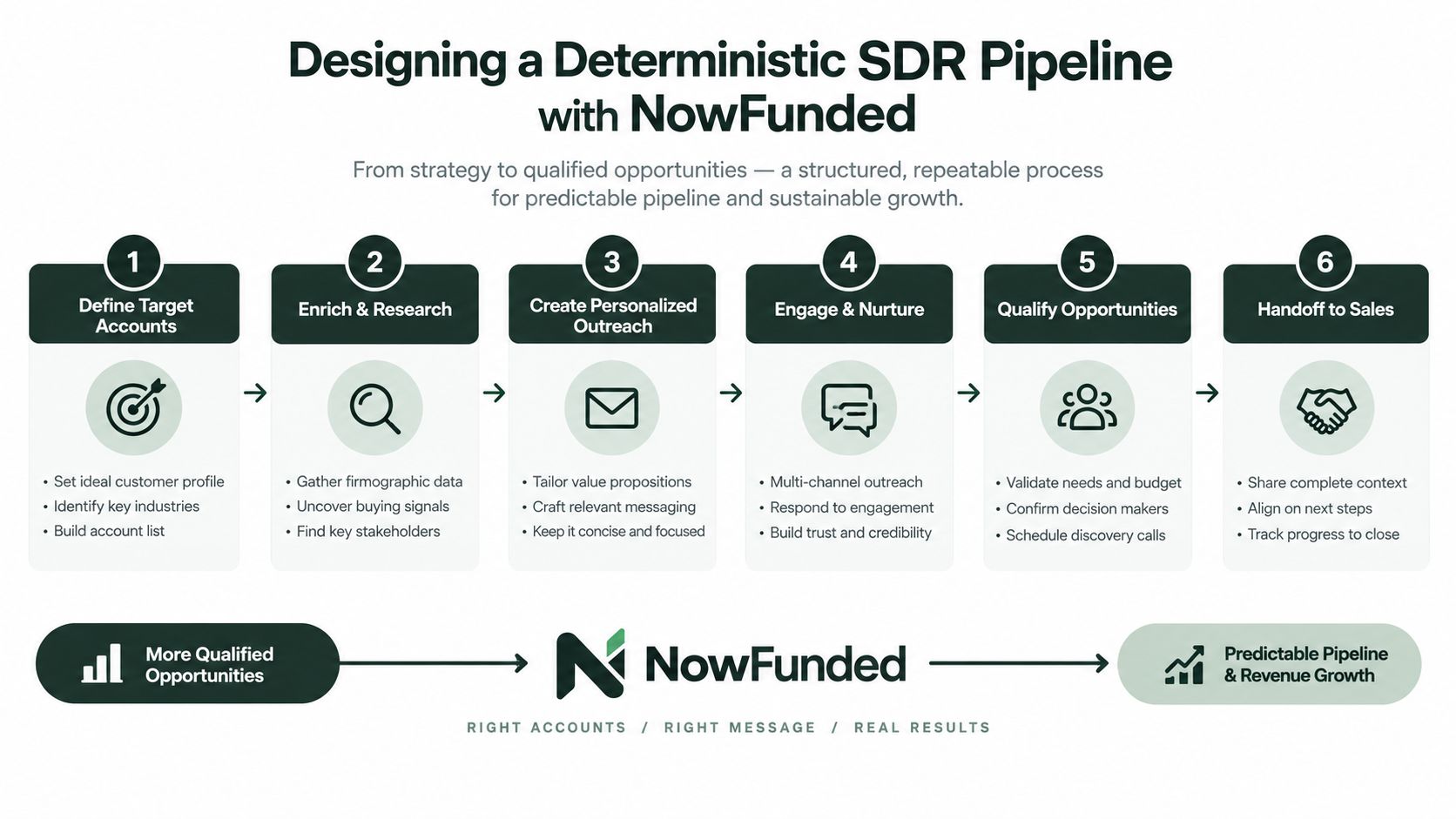
A dependable SDR workflow starts with a narrow outcome: create a verified, reviewable prospecting task from a newly confirmed funding event. It doesn't begin with “let the agent find companies and decide whom to contact.”
The data source can be NowFunded, which provides structured funding events and contact enrichment through MCP, REST, webhooks, CSV export, and a dashboard. The important engineering property is the typed event contract, not the presence of an agent.
Start with the event
The webhook delivers a funding-round event containing the company, amount, investors, and round date. Store the original payload before transformation. This gives later steps a stable source of truth and lets the verifier compare generated content with the exact event that initiated the run.
The first router applies deterministic ICP rules. It can inspect industry, location, company stage, headcount, and other approved fields. If the company fails those rules, the workflow records the decision and stops. There's no reason to spend an enrichment call or generate copy for a company the sales team won't pursue.
Enrich only after qualification
For an ICP match, the workflow calls a People Data tool to find the founder or relevant leader. The request should specify the role, company identifier, and required output fields. The response should distinguish verified deliverable contact details from missing or uncertain data.
A typed MCP request might require:
- Company identifier
- Target role
- Contact name
- Role
- Work email
- Phone number
- Verification status
If the tool returns an invalid shape, the run should fail at the tool boundary. It shouldn't continue with a guessed name or a generic inbox.
Generate context, then pause
The planner can ask a bounded writing step for a one-line opener that references the funding event. The prompt should receive only the necessary verified fields and should return structured output, such as opener, referenced_company, referenced_round, and referenced_investor.
The verifier then compares those fields with the original event. It checks that the company name is exact, the round is supported, the amount hasn't been altered, and the lead investor is present in the source data before the message reaches a human approval queue.
That Slack approval row should include the event identifier, contact verification status, source facts, proposed opener, and links to the relevant records. Only after approval should the sink create an outbound task or send through an approved channel. The pipeline stays agent-assisted, but every consequential transition remains inspectable.
Verification, Schemas, and Why Free-Form Prompting Breaks
Free-form prompting fails because language is permissive while business systems are not. Ask an agent to “summarize this funding event and draft outreach,” and it may produce polished prose while changing an entity name, omitting a field, or inferring an investor that was never in the record. Fluency hides structural failure.
The production fix is to make every boundary explicit. The planner emits parsed data against a schema, each tool declares its inputs and outputs, and an independent verifier compares claims with the source event. The model stays useful for interpretation and drafting, but it no longer decides whether a run is valid.
A funding-event verifier should check fields that are hard to improvise, such as referenced_company, referenced_round, and referenced_investor. If the draft says referenced_company: Acme AI but the source record names Acme Analytics, the run should fail before anything reaches a human queue. If referenced_investor is missing or the round is unsupported, that failure should be recorded as structured output, not hidden inside a sentence that looks confident.
That kind of record is easier to review and easier to debug. A failed validation row might read status: rejected, reason: company mismatch, source_event_id: 18422, proposed_opener: "Acme AI just raised...", expected_company: "Acme Analytics". The point is not prettier formatting. It is making the breakage visible at the exact point where the workflow lost correctness.
ITBench points in the same direction. In multi-step automation, success depends on the system respecting constraints across the chain, not on a model sounding careful. For a funding workflow, that means tighter contracts beat vague instructions.
For a funding workflow, the practical improvement is usually a narrower schema, stricter validation, and a verifier that can veto bad claims. Define the event fields, constrain the planner, validate every generated claim, and make the verifier authoritative. Better wording does not repair an undefined process.
Error Handling and Observability for Long-Running Agents
Long-running agents fail differently from synchronous functions. A webhook can arrive twice, events can be delivered out of order, and a funding record can change after the initial notification. The workflow must preserve correctness without restarting every step or repeating every side effect.
Make retries safe
Derive an idempotency key from the source event identifier and use it on every operation that can create or modify state. A repeated webhook should resolve to the existing run, not create another CRM task or approval row.
Classify failures before choosing a response:
- Transient failures: timeouts, temporary provider errors, and rate limits should retry with bounded backoff.
- Permanent failures: invalid schemas, missing required fields, and rejected authentication should move to a dead-letter queue and alert an owner.
- Business rejections: an ICP mismatch or unverified contact should close cleanly with a recorded reason.
- Amended records: if the upstream round changes, create a new versioned state or re-open the affected verification step instead of overwriting history without notice.
Checkpoint each verified stage. If enrichment succeeds but Slack is unavailable, the restarted run should resume from the saved enrichment result. Re-running the contact lookup can waste usage, introduce a different result, or obscure which data the reviewer originally approved.
Trace the business outcome
Logs should describe the run as data. Include the event identifier, tool name, schema version, attempt number, planner output, verifier result, and sink status. A single trace should connect the inbound funding event to the qualification decision, enrichment response, approval row, and final send event.
Operational standard: If you can't reconstruct why a message entered the queue, the workflow isn't observable enough.
Track outcomes that operators can act on. A token dashboard may show that the agent ran, but it won't show whether the event was duplicated, whether contact enrichment failed, or whether approved outreach reached the CRM. The useful alert says “verification rejected the investor claim” or “reconciliation found an unprocessed event,” not merely “model latency increased.”
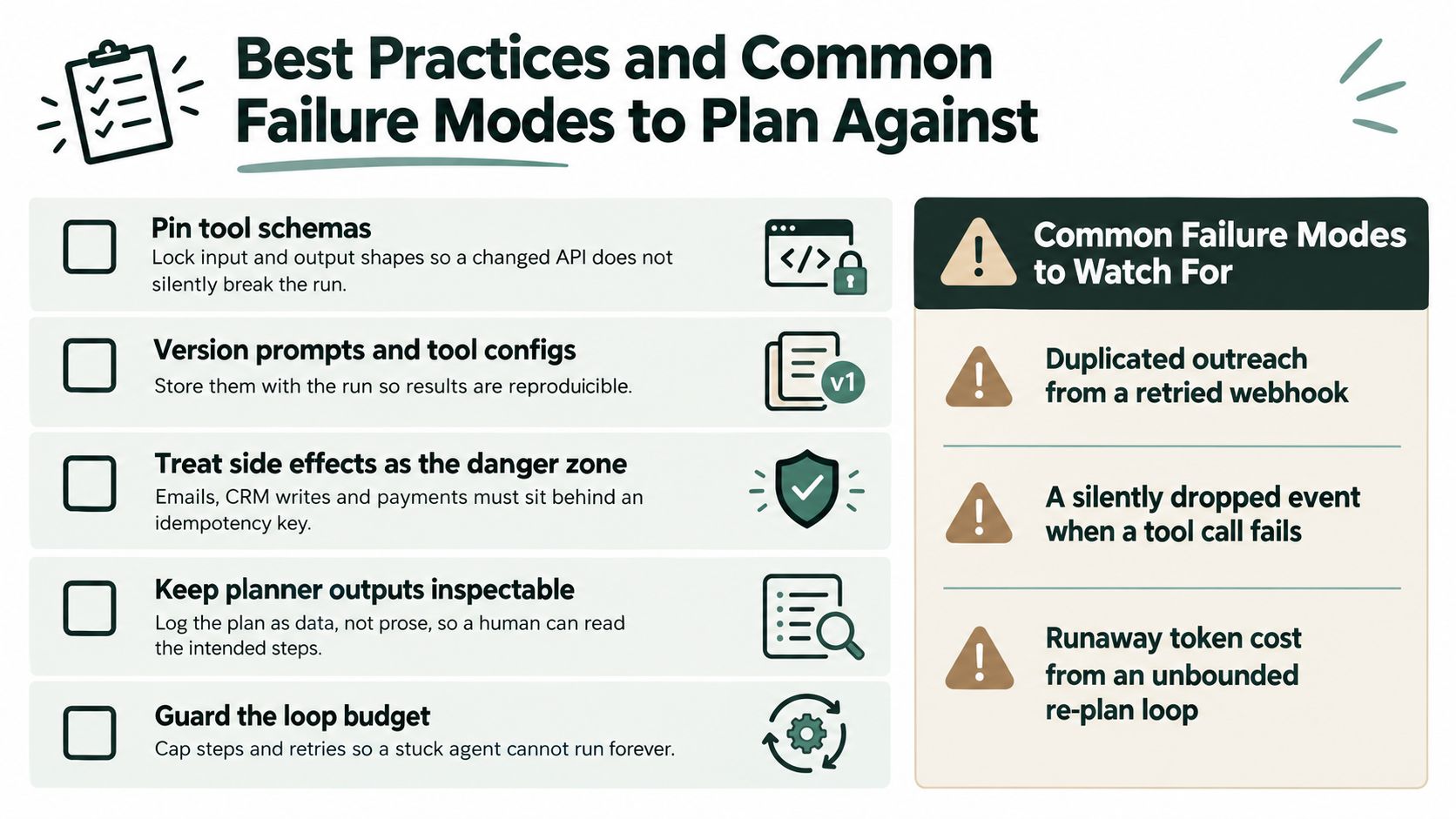
A workflow budget matters too. Cap planner steps, retries, and re-plans. An agent that can call itself indefinitely turns an ambiguous record into an unbounded operational cost and a difficult incident.
Best Practices and Common Failure Modes to Plan Against
Production reliability comes from enforceable rules, not a document titled “AI guidelines.” The funding pipeline should make the safe path the easiest path for every engineer who changes it.
The checklist
- Pin tool schemas: Reject unknown fields and missing required fields. This catches silent changes in a funding provider's payload before they reach enrichment or the CRM.
- Version prompts and configurations: Store the prompt, tool definitions, and schema version with each run. You'll be able to reproduce a message after a regression.
- Protect side effects: Put CRM writes, approval creation, and outbound tasks behind event-derived idempotency keys.
- Keep plans inspectable: Log the intended next step as structured data, not only as a prose explanation.
- Gate every external write: Require a verifier result before any system of record changes.
Failure signals and cheap fixes
Schema drift often appears as a sudden rise in null fields or verifier rejections. Add contract tests against representative event fixtures and fail closed when a required field disappears.
Duplicate outreach usually shows up as repeated approval rows for the same company and event. Persist the idempotency key before processing and enforce uniqueness at the sink.
Prompt caches can mask regressions. If every test uses the same funding example, a changed instruction may appear harmless. Keep a varied fixture set containing amended rounds, missing investor data, and non-ICP companies.
Backfill floods follow missed cron windows. A reconciliation job may discover many unprocessed events at once and overwhelm enrichment or review capacity. Use a bounded queue, preserve event order where it matters, and expose backlog depth to operators.
Token metrics can distract from business failure. A workflow may consume fewer tokens while producing more rejected records. Pair model telemetry with event-to-approval completion, verification rejection reasons, duplicate suppression, and sink success.
The common pattern is visibility at the boundary. Each failure should produce a named state, an owner, and a recovery action. “Agent error” isn't a useful state.
Shipping Reliable Agentic Automation at Scale
Start with a loop that can be described without the word autonomous: receive a funding event, apply ICP rules, call one enrichment tool, validate the result, and write to an approval sink. Instrument it before widening the planner.
The NowFunded blog provides a relevant place to follow product and workflow developments around funding data. But the architecture should remain portable. The same trigger, contract, verifier, and sink pattern can support another provider or another research process.
The strongest systems compose many small, reliable loops. They don't ask one agent to discover tools, invent a plan, write to a CRM, and send outreach without checkpoints. Determinism is a feature, especially when the goal is trustworthy AI agent workflow automation. Add agency only where judgment is required, and keep the verification layer intact as the system grows.
NowFunded offers a live, verified funding feed with structured company and round data, contact enrichment, and delivery through MCP, REST, webhooks, CSV, or a dashboard. If you're building prospecting or research workflows that need fresh events and controlled handoffs, visit NowFunded and design the first narrow loop around a source you can verify.